Digital Badges Vs Physical Rewards For Kids
Why does a 2-cent rock feel more satisfying to a child than a 4K digital trophy? It sounds illogical to an adult mind trained on efficiency. However, for a developing brain, the physical world is the only reality that truly resonates. Digital rewards are synthetic; they provide a spike of dopamine without the weight of accomplishment. During the 7-day reset, we switch to ‘Natural Rewards.’ The physical weight, sound, and texture of a stone hitting a jar provides the sensory feedback the brain needs to feel a true sense of completion.
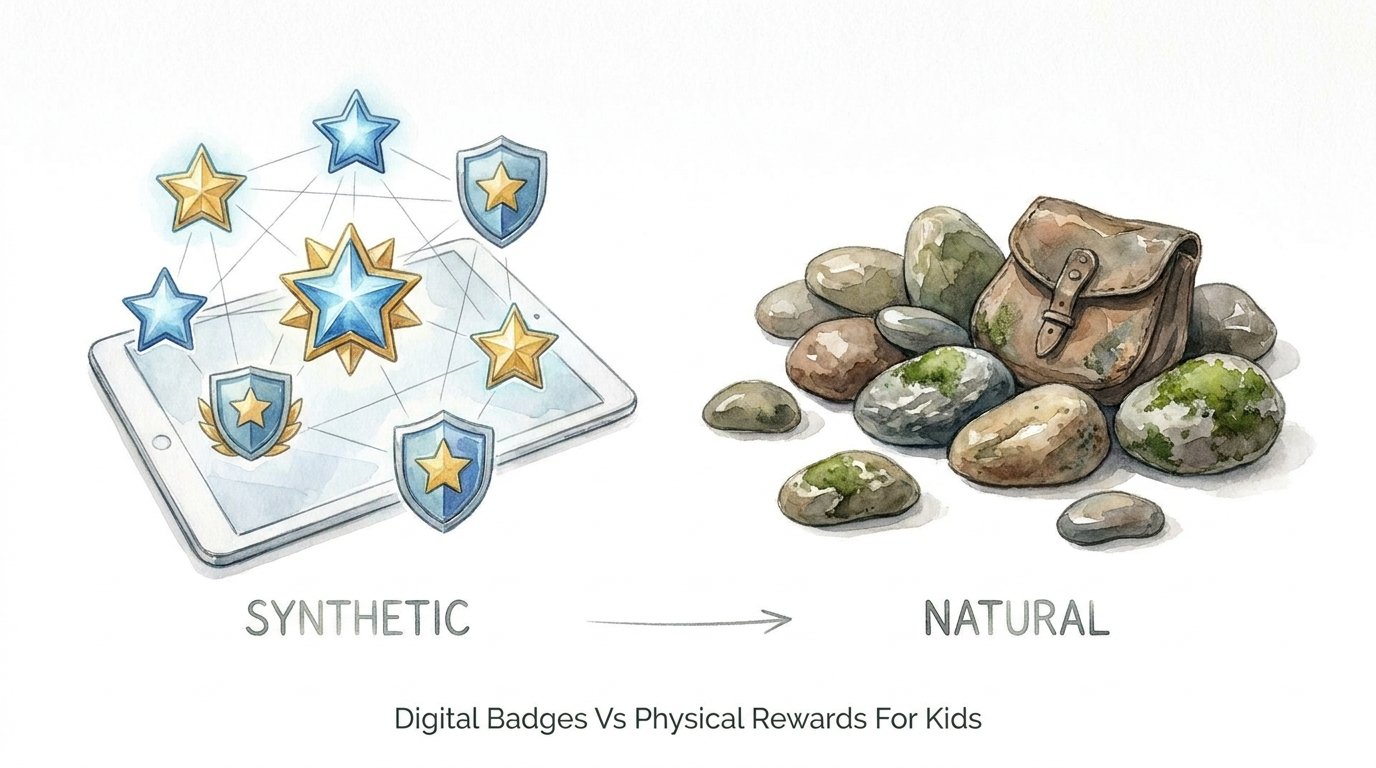
Every “ping” from a smartphone is a hollow promise. It triggers a chemical flash that disappears as quickly as it arrives. In contrast, the “thunk” of a marble hitting glass is a permanent record of effort. This shift from digital to physical isn’t just about parenting. It is about reconnecting with the biological hardware our children are born with. We are moving away from Synthetic Stars and returning to Natural Stones.
Digital Badges Vs Physical Rewards For Kids
Digital badges are virtual icons or graphics awarded to a child for completing a task within an app or software program. They are designed to mimic the feeling of achievement using bright colors, animations, and high-pitched sound effects. You see them everywhere, from educational apps like Duolingo to classroom management tools like ClassDojo. These systems exist because they are cheap, scalable, and provide instant gratification. They keep children “engaged” with the screen, which is often the primary goal of the software developer.
Physical rewards are tangible objects like marbles, stones, stickers, or small wooden tokens. They occupy three-dimensional space and possess weight, texture, and temperature. Unlike a digital badge that exists only when the device is powered on, a physical reward remains visible on a shelf or in a jar. It provides a constant, passive reminder of success. In real-world situations, these are used in “token economies” to shape behavior through positive reinforcement.
The difference lies in the sensory experience. A digital badge is a two-dimensional visual stimulus. A physical stone is a multi-sensory event. When a child holds a stone, their brain processes the smoothness of the surface, the coolness of the mineral, and the resistance of its weight against their palm. This haptic feedback creates a much deeper “encoding” of the achievement in the child’s memory. Research into haptic technology shows that tactile sensations provide a “confirmation of action” that simple visual cues lack.
Setting Up the Natural Reward System
Transitioning to physical rewards requires a clear, tactile setup. You are not just giving out “stuff.” You are building a visual scoreboard for your child’s character. The “Marble Jar” method is the gold standard for this approach. It is simple, effective, and neurologically grounded. You only need two clear glass jars and a bag of marbles or polished river stones.
Place the empty jar in a high-traffic area, like the kitchen counter or the living room mantle. This is the “Success Jar.” The second jar, filled with stones, is the “Resource Jar.” When your child demonstrates a desired behavior—like clearing their plate or speaking kindly to a sibling—move one stone from the Resource Jar to the Success Jar. The goal is to fill the Success Jar to a predetermined line.
The sound is the most important part of this process. Let the child drop the stone themselves. The “clink” or “thonk” against the glass serves as a neurological period at the end of a positive action sentence. It tells the brain, “This task is finished, and it was good.” This auditory confirmation is far more grounding than a digital “ding” because it is a result of a physical law, not a pre-programmed audio file.
Establish clear rules before you start. Focus on broad family values rather than a checklist of chores. If you focus on “being helpful,” the child starts looking for opportunities to help. If you focus on “washing the dishes,” they only do the dishes. General values encourage overall positive behavior and prevent kids from looking for loopholes.
The Benefits of Physical Reinforcement
Physical rewards offer a sense of permanence that digital icons cannot match. A digital badge disappears when the app is closed. A jar of stones sits on the counter all day. It serves as a visual “progress bar” that never times out. Every time your child walks past it, they see a physical representation of their hard work. This constant visibility builds self-esteem through evidence, not just empty praise.
Tactile interaction improves learning and retention. Studies in educational psychology indicate that children retain more information when multiple senses are stimulated simultaneously. When a reward is physical, the child’s tactile system—which is the first sensory system to fully develop—is engaged. This creates a “visceral sense of pride” that is physically felt in the body. It turns an abstract concept like “good behavior” into a concrete reality.
Shared goals become easier to visualize with a physical system. If you have multiple children, they can contribute to the same jar. They begin to encourage each other because they can see the progress growing taller every day. They are not competing for a spot on a digital leaderboard; they are collaborating to fill a real vessel. This fosters a sense of collective responsibility and teamwork.
The 7-day reset relies on “re-sensitizing” the brain. Digital rewards are designed to be high-intensity and high-frequency, leading to a high dopamine threshold. This means children eventually need more “pings” to feel the same level of satisfaction. Physical rewards are “low-frequency” but “high-impact.” They slow down the reward cycle, teaching the brain to appreciate steady, incremental progress rather than instant, hollow spikes.
Challenges and Common Mistakes
The biggest mistake parents make is using the reward jar as a tool for punishment. It is incredibly tempting to take a stone out when a child misbehaves. Resist this urge. Taking stones away shifts the focus from positive reinforcement to the fear of loss. It turns the Success Jar into a source of anxiety. If a child loses a stone they worked hard for, they often feel a sense of “what’s the point?” and give up entirely.
Another pitfall is rewarding “ordinary” behavior. If you give a stone every time a child does something they are already expected to do, the stones lose their value. They become a bribe rather than a reward for effort. Focus on “above and beyond” moments or the “first few times” a new habit is being formed. Once a behavior becomes a routine, stop rewarding it with stones and move on to a more challenging goal.
Inconsistency will kill the system faster than anything else. If you reward a behavior on Monday but forget on Tuesday, the child becomes confused. They stop associating the action with the reward. To avoid this, keep the jars in a place where you cannot miss them. Use a “variable reinforcement” schedule once a habit is starting to stick. This means you don’t reward every single time, which actually makes the behavior more resistant to stopping in the long run.
Avoid “extravagant” final rewards. If the goal for filling the jar is a massive, expensive toy, the child is only focused on the toy. They aren’t focused on the growth. The final reward should be an experience—like a family movie night, a trip to the park, or staying up thirty minutes late. This keeps the focus on “Natural Rewards” and connection rather than material consumption.
Limitations: When Physical Systems May Not Work
Physical reward systems are not a magic bullet for every situation. They require a significant amount of adult presence and observation. If you are not there to “catch them being good,” the system fails. For busy parents or children in multiple care environments, maintaining a consistent physical jar can be difficult. Digital apps are often used in these cases because they can be “automated” or shared across devices, but they lose the tactile benefits.
Older children may find a marble jar “juvenile.” As kids enter middle school and high school, their brains transition toward a need for more abstract and social rewards. A 14-year-old is unlikely to be motivated by a river stone. At this stage, the “physicality” of the reward needs to evolve into things like increased autonomy, trust-based privileges, or more complex long-term goals that they help design.
Children with specific sensory processing disorders may react differently to tactile rewards. While many benefit from the grounding nature of physical objects, some may find certain textures aversive or become overly fixated on the objects themselves. In these cases, the “reward” can become a distraction from the behavior it was meant to encourage. It is essential to tailor the physical medium—whether it is stones, stickers, or tokens—to the child’s specific sensory profile.
The environment itself can be a limitation. In a cluttered or chaotic home, a jar of marbles can become just another piece of “stuff” or a potential safety hazard for toddlers. The system requires a dedicated “sacred space” to be effective. If the jar is buried under mail or knocked over frequently, its symbolic power is diminished.
Synthetic Stars vs Natural Stones
Understanding the difference between these two systems helps you choose the right tool for the right job. Synthetic stars (digital badges) are excellent for short-term engagement and data tracking. Natural stones (physical rewards) are designed for deep habit formation and emotional regulation.
| Feature | Synthetic Stars (Digital) | Natural Stones (Physical) |
|---|---|---|
| Sensory Input | Visual & Auditory only. | Tactile, Auditory, Visual, & Weight. |
| Persistence | Ephemeral; disappears when screen is off. | Permanent; stays visible in the room. |
| Dopamine Type | High-spike, quick crash (Addictive). | Slow-release, steady satisfaction (Grounding). |
| Effort Perception | Low; feels like “gaming” the system. | High; weight reflects the “work” put in. |
| Maintenance | Automated by apps. | Requires active parental presence. |
Practical Tips for a Successful 7-Day Reset
Start by removing all digital reward apps from your child’s devices. If they are used to seeing a “star” pop up on a screen, explain that for the next week, the family is trying something more “real.” Make the setup of the jars a collaborative event. Let them choose the stones or marbles. This gives them a sense of ownership from minute one.
Use the “First-Then” principle to bridge the gap. “First, we put our toys in the bin, then you get to drop a stone in the jar.” This creates a clear causal link between the effort and the sensory reward. Keep the first goal very easy to reach. You want them to “win” within the first 48 hours so they can experience the satisfaction of a full jar and a family reward.
Incorporate descriptive praise alongside the physical reward. Do not just say “good job.” Say, “I noticed you took a deep breath when you were frustrated; that was great self-control. Go put a stone in the jar.” This connects the physical object to a specific internal skill. The stone becomes a “tag” for a positive neural pathway you want to strengthen.
Vary the size or color of the stones for “extra” achievements. A large, shiny river rock could represent a major milestone, while small pebbles are for daily wins. This adds a layer of novelty and excitement to the system without needing digital “unlocks.” It keeps the child’s interest high through visual variety.
Advanced Considerations: Scaling and Intrinsic Growth
The ultimate goal of any reward system is to eventually make the reward unnecessary. You want the “good behavior” to become its own reward. This is known as transitioning from extrinsic motivation to intrinsic motivation. To do this, gradually increase the requirements for a stone. As the child gets better at a skill, the “frequency” of the stones should decrease. This teaches them to persist through longer periods of effort.
Consider the “Credit Assignment Problem.” This is a neurological concept where the brain tries to figure out exactly which action led to a reward. Physical rewards are superior here because the “delay” is minimal. The act of walking to the jar and dropping the stone helps the brain “rewind” the last few minutes and identify the correct behavior. Digital badges often have “lag” or are disconnected from the actual physical movement, making the learning curve steeper.
Talk to your child about how they feel when they drop a stone. Ask them, “Does it feel good to see the jar getting full?” This builds metacognition—the ability to think about their own thoughts and feelings. It helps them recognize the internal “feeling of accomplishment” so that eventually, they can feel that pride without needing the stone at all.
Use “Natural Consequences” alongside the jar. If the child doesn’t brush their teeth, the natural consequence is “no bedtime story” because you ran out of time. The jar is for *growth*, not for *compliance*. Use the jar to celebrate character traits like kindness, grit, and curiosity. Use natural consequences to handle daily routines and boundaries.
Examples and Scenarios
Imagine a 6-year-old named Leo who struggles with emotional meltdowns when it is time to turn off the TV. In a digital system, Leo might earn a “badge” on an app for a week of no meltdowns. But the app is on the tablet he just lost—the irony is not lost on him, and the frustration grows. In the 7-day reset, Leo’s parents use a “Cool Down Jar.” Every time Leo turns off the TV without a scream, he drops a heavy blue marble into a glass jar. The “clink” is a physical “win” that replaces the “loss” of the screen. By day four, Leo can see the pile of blue marbles. He is no longer “a kid who throws fits”; he is “a kid who has four blue marbles.” The physical evidence changes his self-identity.
Consider a 9-year-old named Maya who is working on her reading stamina. Instead of a digital reading log that gives her a virtual trophy, she has a “Page Jar.” For every 20 pages she reads, she adds a decorative glass gem to a tall, thin olive jar. Because the jar is thin, the gems stack up quickly. She can see the “height” of her effort. When she hits the “Level 1” line, the family goes for a hike at her favorite trail. The reward is as natural as the gems. Maya isn’t “gaming” for points; she is watching her knowledge take up physical space in the room.
In a multi-child household, the “Kindness Jar” works wonders. When Sarah helps her younger brother tie his shoes, she gets a stone. When the brother shares his snack with Sarah, he gets a stone. They both watch the jar fill up together. The “competition” is replaced by a “collaboration” to reach the family ice cream night. They aren’t looking at individual digital scores; they are looking at a shared physical vessel of their family’s character.
Final Thoughts
Shifting from digital badges to physical rewards is more than a change in parenting tactics. It is a return to a more human way of learning. Our brains evolved in a world of weight, texture, and immediate physical feedback. When we bypass these senses in favor of pixels and “pings,” we lose the “weight of accomplishment.” The 7-day reset is an opportunity to prove to your child—and yourself—that real effort deserves a real, tangible record.
Physical rewards like the Marble Jar provide a permanent, visual, and tactile anchor for a child’s self-esteem. They slow down the frantic dopamine loop of the digital age and replace it with the steady, satisfying growth of “Natural Rewards.” By focusing on stones instead of stars, you are giving your child’s brain the high-quality sensory data it needs to build lasting habits.
Experiment with this for one week. Put away the apps, clear off a spot on the counter, and find some stones. You will likely find that the simple “thunk” of a rock hitting glass is more motivating than the most sophisticated 4K animation. It is time to stop chasing synthetic stars and start collecting natural stones.
Sources
1 stimul8.app | 2 youtube.com | 3 nhws.us | 4 ariyares.com | 5 psychologytoday.com | 6 bombaytrophies.co.in | 7 illinois.edu | 8 tandcstaff.com | 9 learningliftoff.com | 10 eset.com | 11 modelteaching.com | 12 medium.com | 13 psychologytoday.com | 14 rainbowvt.com | 15 reddit.com | 16 columbia.edu