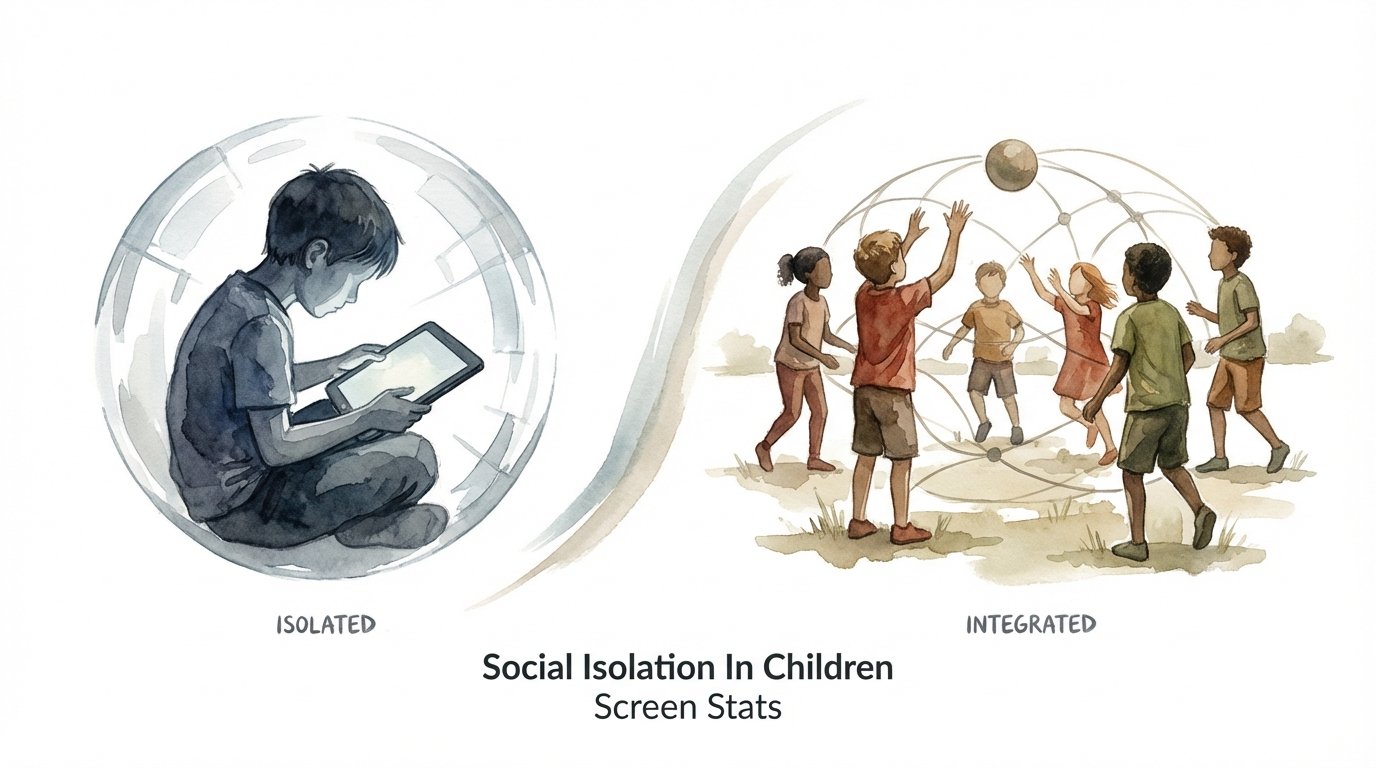
Social Isolation In Children Screen Stats
We’ve used technology to build walls when we should have built bridges. Screen time statistics show a rise in household loneliness despite constant connectivity. By moving from isolated ‘personal’ devices to integrated, shared family tools, we can turn tech into a social adhesive.

Modern households often resemble a collection of private silos. Each member sits in the same room but stares into a different glowing rectangle. This shift from communal television to personal smartphones has changed the fundamental way families interact. Digital tools were promised as a way to connect us to the world, yet they frequently disconnect us from those sitting three feet away. Transitioning toward integrated technology is the key to reclaiming the living room.

Integrated tools are designed for collective engagement. They allow families to experience digital content as a unit rather than a solo venture. This approach transforms a passive, lonely habit into an active, social experience. Understanding the data behind this shift is the first step toward building a healthier digital home.
Social Isolation In Children Screen Stats
Current data provides a sobering look at how children interact with screens today. In 2024, the global average for daily screen time reached approximately 6 hours and 40 minutes. Within the United States, that number climbs even higher to 7 hours and 3 minutes per day. These figures are not just markers of time spent; they are indicators of hours removed from face-to-face social interaction.
Statistics from the CDC highlight a significant mental health correlation. About 27.1% of teenagers who spend 4 or more hours on screens daily report symptoms of anxiety. Similarly, 25.9% of these high-usage teens experience symptoms of depression. This is nearly double the rate of anxiety found in teenagers who keep their screen usage under 4 hours. The isolation factor is real, with nearly half of high-usage teens reporting infrequent social and emotional support.
The phenomenon known as “alone-together” time has increased by roughly 30 minutes per day since the early 2000s. Families might be in the same physical location, but 38% of that time is spent with individuals looking at personal mobile devices. This creates a digital divide where physical proximity does not translate to emotional connection. Research from the World Health Organization also shows that 11% of adolescents now display signs of problematic social media behavior, characterized by a loss of control over their usage.
Socioeconomic factors further complicate these statistics. Teenagers from lower-income households average more than 9 hours of screen time daily. This group often lacks access to shared, high-quality extracurricular activities, making the personal screen the primary window to the world. Without parental intervention and a shift toward integrated tools, these children face the highest risks of long-term social withdrawal.
Bridging the Digital Gap: Transitioning to Integrated Systems
Moving from isolated devices to integrated tools requires a deliberate shift in home architecture and habits. The process begins by identifying which technologies encourage group interaction. You can start by prioritizing “shared screens” like smart TVs, gaming consoles, and communal tablets over individual smartphones.
Centralizing technology in common areas is the most effective first step. This removes the “private silo” aspect of screen use. Instead of each child retreating to their bedroom with a phone, create a “Digital Hearth” in the living room. This could be a large screen used for co-watching documentaries or a gaming console set up for four-player local matches.
Implementing a Family Media Plan helps solidify these changes. This plan shouldn’t just be about restrictions; it should be about opportunities for connection. Designate specific times for “Co-Play” or “Co-Viewing.” For example, Friday nights can be reserved for a shared interactive game where parents and children solve puzzles together on one screen.
Shared digital hubs are another powerful tool. A communal family tablet mounted in the kitchen can serve as a shared calendar, a music station, and a recipe guide. This turns a piece of technology into a collaborative tool for household management. Everyone sees the same information, participates in the same schedule, and contributes to the same goals.
The Ripple Effect: Benefits of Shared Digital Spaces
Integrated technology offers measurable advantages for child development and family cohesion. Studies reviewed in 2024 show that co-viewing and co-playing significantly improve a child’s thinking and reasoning skills. When parents watch content with their children, they can ask questions and draw connections to the real world. This interaction boosts language development and social communication.
Cognitive and Language Growth
Children who engage in co-viewing develop a larger vocabulary and better processing skills. The dialogue that happens during a shared show provides context that passive watching lacks. Parents can explain complex emotions or moral dilemmas as they appear on screen. This transforms a simple cartoon into a lesson in empathy and critical thinking.
Strengthened Emotional Bonds
Shared tech experiences create a common language within the home. When a family plays a game together, they build shared memories and “inside jokes.” These small moments of joy act as a buffer against the stress of daily life. The feeling of being part of a team, even in a digital world, fosters a sense of belonging and security.
Natural Mentorship
Integrated tools allow parents to model healthy digital behavior without being overbearing. Instead of spying on a child’s private phone, parents can guide them through a shared interface. Children learn how to navigate the internet, identify misinformation, and handle digital frustration by watching their parents do it in real-time.
Roadblocks and Resistance: Common Mistakes in Tech Transition
Switching from isolated screens to shared systems is rarely a smooth process. Children often view their personal devices as a source of autonomy and privacy. Attempting to remove these tools too quickly can lead to intense meltdowns or feelings of resentment.
Forcing Constant Interaction
One major mistake is demanding that every digital moment be shared. Tech is a valid tool for individual relaxation and focus. If parents try to make every YouTube video a family discussion, children will likely push back and hide their usage. The goal is a healthy balance, not the total elimination of private digital time.
The Hypocrisy Trap
Parental behavior is the most significant factor in a child’s tech habits. If parents lecture children about screen time while constantly checking their own work emails at the dinner table, the message is lost. Consistency is essential. Parents must be willing to put down their own “isolated” devices to lead the way toward “integrated” family time.
Choosing the Wrong Content
Not all “shared” tech is created equal. Setting the family up to watch a movie that only one person likes isn’t integrated technology; it’s a chore. Choosing interactive content like trivia games, collaborative world-building games, or documentaries about a shared interest is vital. The content must appeal to multiple age groups to be truly effective as a social adhesive.
Boundaries and Balance: When Shared Tech Isn’t Ideal
Integrated technology is a powerful tool, but it has practical limits. Certain activities are inherently solitary and should remain so to support development. Forcing these into a shared format can be counterproductive and stressful for the user.
Academic and Deep Work
Homework, coding, and creative writing are tasks that often require deep concentration. Trying to do schoolwork on a “shared family hub” in the middle of a noisy kitchen can lead to frustration. These tasks deserve a quiet, private space where a child can focus without distraction. Isolation is a tool for productivity when used correctly.
The Need for Adolescent Privacy
Older teenagers require a degree of digital privacy to explore their identities and communicate with peers. While younger children benefit most from 100% integrated tech, teens need a hybrid model. Denying a 16-year-old any private digital space can stunt their social development and damage trust. The key is to maintain open communication rather than total visibility.
Technical Environmental Constraints
A small apartment might not have the space for a massive “Digital Hearth” setup. In these cases, the “integrated” aspect might be more about the *activity* than the hardware. A single smartphone can be an integrated tool if two people are using it to look at a map or listen to a podcast together. The mindset is more important than the size of the screen.
Comparison: Personal Devices vs. Integrated Family Tools
Understanding the fundamental differences between these two approaches helps in making better purchasing and scheduling decisions.
| Feature | Isolated (Personal Devices) | Integrated (Shared Tools) |
|---|---|---|
| Primary User | Single individual | Multiple family members |
| Social Impact | Passive isolation, alone-together | Active engagement, bonding |
| Supervision | Difficult, requires tracking apps | Natural, visible to everyone |
| Mental Health | Higher link to anxiety/loneliness | Associated with better social skills |
| Learning Value | Limited by individual choice | Enhanced through conversation |
Proactive Strategies: Best Practices for Digital Connection
Building a tech-integrated home is an ongoing process of refinement. It’s about creating systems that make shared use the “default” choice for entertainment.
- Establish Screen-Free Zones: Keep bedrooms and dining tables as technology-free sanctuaries. This forces the use of digital tools into common areas where they can be shared.
- Curate a Shared Playlist: Use a smart speaker to create a family music library. Letting each member add songs encourages them to share their tastes and creates a shared auditory environment.
- The 15-Minute Rule: Spend the first 15 minutes of any shared viewing or gaming session actively talking about the content. Ask why characters made certain choices or what everyone expects to happen next.
- Joint Content Creation: Use technology to create rather than just consume. Build a family vlog, edit vacation photos together, or design a world in a sandbox game. Creation is the ultimate integrated activity.
Advanced Considerations: Scaling Family Connectivity
For those who have mastered the basics, advanced tech setups can further enhance the integrated experience. This level involves technical optimization to make the home more responsive to the family’s needs.
Local Media Servers
Setting up a home server like Plex or Jellyfin allows the family to own their digital library. This moves away from the “algorithm-driven” suggestions of streaming services which often target individuals. A shared library encourages the family to pick from a curated list of high-quality films and shows they have chosen together.
Shared Smart Home Dashboards
Installing a central touch-screen hub for the smart home can turn automated tasks into a family effort. Everyone can see the energy usage, control the lighting for “movie mode,” and update the shared grocery list. This fosters a sense of shared responsibility for the home’s environment.
Collaborative Virtual Reality
While VR is often seen as the ultimate isolated experience, newer systems allow for “asymmetric” gaming. One person wears the headset while the rest of the family uses a TV or mobile devices to interact with that player. This turns an isolated VR session into a cooperative party game where everyone is essential to the mission.
Examples: From Bedrooms to the Living Room
Consider the difference between two typical Saturday nights. In Scenario A, the teenage son is in his room playing a battle royale game with strangers. The daughter is on TikTok in the kitchen. The parents are watching a drama in the living room. They are four separate islands in one house.
In Scenario B, the family uses a gaming console in the living room. They are playing a collaborative building game where they are working together to design a digital house. They are laughing at mistakes, discussing the design, and solving problems as a unit. The technology is the bridge.
Another example is the “YouTube Buffet.” Instead of everyone watching their own feed, the family casts one device to the big screen. Each person gets to pick one 5-minute video to show the rest of the family. This leads to sharing interests, explaining hobbies, and a deep understanding of what each person cares about in the digital world.
Final Thoughts
Technology doesn’t have to be a source of isolation. We have the power to decide whether our devices act as barriers or as bonds. By prioritizing integrated tools over isolated ones, we can reduce the loneliness that screen time statistics so clearly warn us about. This shift requires effort and intentionality, but the reward is a household that is more connected and emotionally resilient.
Reclaiming the digital hearth starts with a single choice to share an experience. Experiment with different formats, listen to your children’s digital interests, and lead by example. The goal is to create a home where technology serves the family, rather than the family serving the technology.
Begin today by moving one device into a common area or scheduling one shared gaming session. Small changes in how we use our tools can lead to massive improvements in how we relate to one another. Turning screens into a social adhesive is the best way to ensure that our future is both high-tech and high-connection.
Sources
1 baylor.edu (https://news.web.baylor.edu/news/story/2025/social-medias-double-edged-sword-study-links-both-active-and-passive-use-rising) | 2 illinois.edu (https://publish.illinois.edu/smartfamilies/resources/positive-family-technology-use/) | 3 asu.edu (https://crf.reachinstitute.asu.edu/sites/g/files/litvpz371/files/2024-12/5-Steps-to-support-mindful-family-tech-usage.pdf) | 4 kutestkids.com (https://www.kutestkids.com/blog/average-screen-time-statistics-facts-usage) | 5 magnetaba.com (https://www.magnetaba.com/blog/average-screen-time-statistics) | 6 cdc.gov (https://www.cdc.gov/nchs/products/databriefs/db513.htm) | 7 cdc.gov (https://www.cdc.gov/pcd/issues/2025/24_0537.htm) | 8 ox.ac.uk (https://www.ox.ac.uk/news/2019-03-12-mobile-devices-don%E2%80%99t-reduce-shared-family-time-study-finds) | 9 who.int (https://www.who.int/europe/news/item/25-09-2024-teens–screens-and-mental-health) | 10 schoolhouse-daycare.co.uk (https://schoolhouse-daycare.co.uk/2024/08/10/8-strategies-for-promoting-well-balanced-technology-use-for-families/) | 11 hellopediatrics.com (https://hellopediatrics.com/the-impact-of-screen-time-on-child-development-in-2024/) | 12 skoolofcode.us (https://vertexaisearch.cloud.google.com/grounding-api-redirect/AUZIYQFre_QlOq9_jZlNUMHxBmvl8wssftPTbXzPmg2iQLyj9XLdO8aK5XcluCWlC5nO_Dxu040n9-id5Boyq3t5Kopa2sbKZLf9dXwNN6hFptK-ZFIU7uHwuyGvwmg4jZwvQ4XbTZQKF0QaAyv61DPAwPjNxJ2uaotq7a5Vtwb3MhP8J3UnPZnOkrPSeRbeFD1DEyq3agQdBh5Ps12zGg==) | 13 digitalchild.org.au (https://digitalchild.org.au/four-ways-to-help-your-child-use-screens-well/) | 14 healthychildren.org (https://www.healthychildren.org/English/family-life/Media/Pages/why-co-viewing-is-important-tips-to-share-screen-time-with-your-kids.aspx) | 15 choc.org (https://health.choc.org/the-effects-of-screen-time-on-children-the-latest-research-parents-should-know/)