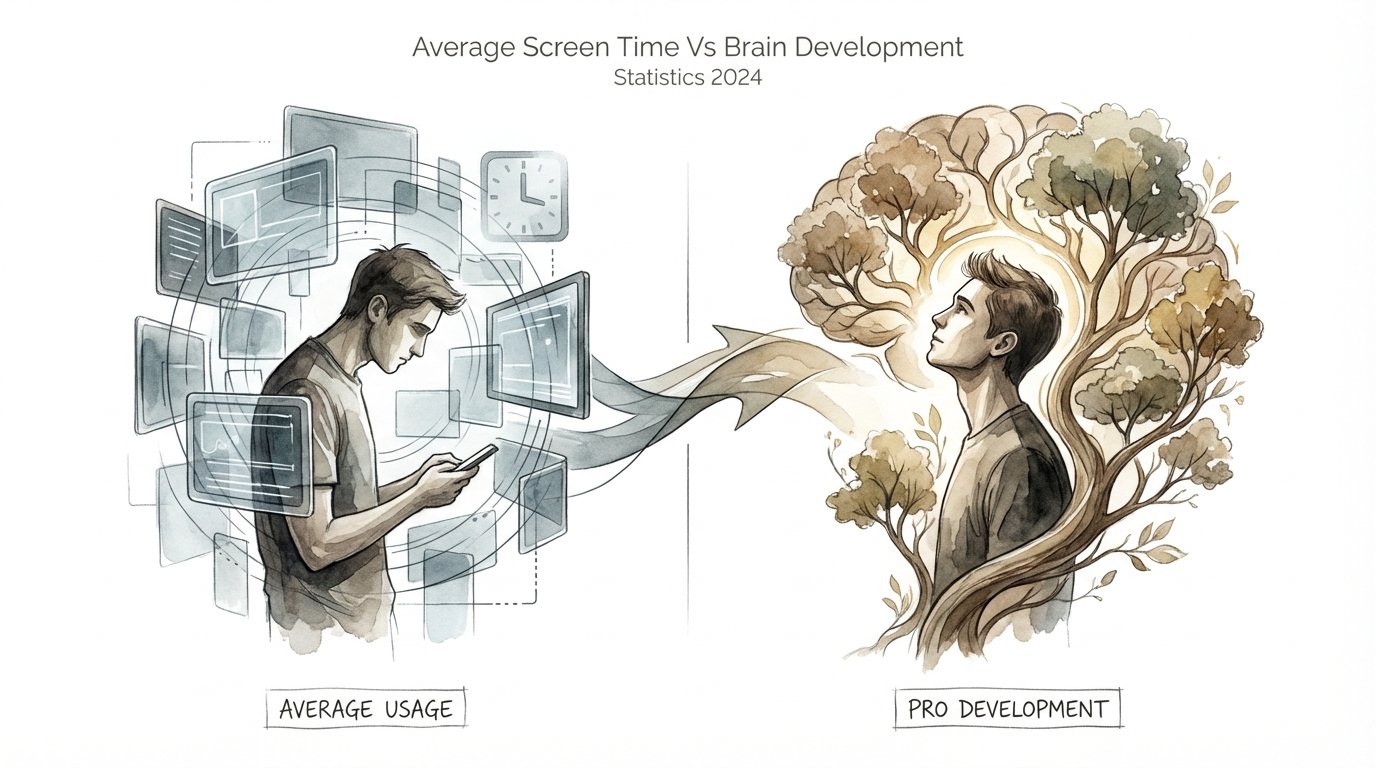
Average Screen Time Vs Brain Development Statistics 2024
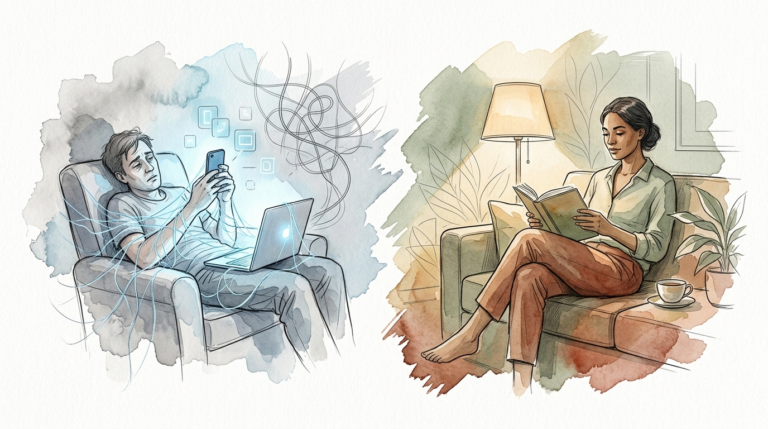
Why do 7 hours of ‘educational’ apps produce fewer neural connections than 30 minutes of physical blocks? The average child now spends over 7 hours a day on screens. While apps claim to be ‘pro-learning,’ the data shows that passive consumption is no match for the ‘pro’ level cognitive engagement of tactile, 3D problem-solving. It’s time to shift from standard scrolling to professional brain building.

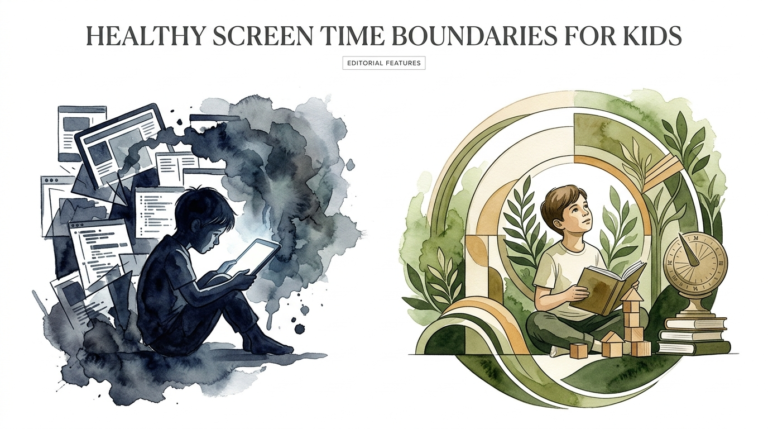
The modern playroom has been hijacked by the digital glow. We were promised that tablets would turn toddlers into tech geniuses, yet the opposite is happening. Every minute spent on a 2D screen is a minute stolen from the 3D world where the brain actually evolves. When a child grips a physical block, their motor cortex, visual system, and prefrontal cortex ignite in a symphony of synaptic growth.

Screens offer a flat, curated experience that demands very little from the developing mind. In contrast, physical play requires constant calculation of gravity, balance, and spatial orientation. This article explores why the shift back to tactile learning is the most “advanced” move a parent or educator can make in 2024. We are looking at the hard data, the neuroscience of play, and the practical steps to reclaim high-level cognitive development.
Average Screen Time Vs Brain Development Statistics 2024
The gap between recommended usage and reality has reached a breaking point. Current data from organizations like Common Sense Media and the National Institutes of Health (NIH) paints a stark picture of the digital landscape for children today. While pediatric guidelines suggest strict limits, the actual consumption is staggering.
Recent 2024 reports indicate that preteens (ages 8-12) are averaging 5.5 to 6 hours of screen time daily. Teens have pushed that number even higher, often exceeding 9 hours per day. Even more concerning is the trend for toddlers aged 2 to 5, who are now clocking in over 3 hours of daily screen use. This is triple the one-hour limit recommended by the American Academy of Pediatrics.
Neuroimaging studies have begun to document the physical consequences of this shift. Large-scale research, such as the Adolescent Brain Cognitive Development (ABCD) study, has found that children with more than seven hours of daily screen use show premature thinning of the brain’s cortex. This area is responsible for critical thinking, reasoning, and processing sensory information.
The impact on white matter—the “cables” that connect different brain regions—is equally notable. High screen use is associated with lower integrity in the white matter pathways that support language and emergent literacy skills. Essentially, the “wiring” of the brain becomes less efficient when it is fed a steady diet of passive digital input instead of active, real-world engagement.
In contrast, 3D tactile play acts as a natural “brain gym.” Physical manipulation of objects stimulates the parietal lobe, the region tasked with spatial awareness and mathematics. Statistics show that 1-year-olds exposed to high levels of screen time face a 49% increased risk of expressive speech delay for every 30 minutes of handheld device use. Meanwhile, children who engage in regular block play score significantly higher on language acquisition tests, proving that the hand-brain connection is the primary driver of early intelligence.
How Tactile Play Builds the Brain: The Mechanics
Tactile play is not just “fun”; it is a complex engineering task for a developing mind. When a child stacks one block on another, they are conducting thousands of micro-experiments in physics. The brain must process the weight of the block, the friction of the surface, and the visual alignment of the edges.
This process activates what neuroscientists call “whole-brain learning.” Unlike a screen, which only stimulates the visual and auditory systems, physical blocks require the integration of the somatosensory system (touch), the motor cortex (movement), and the vestibular system (balance). This multi-sensory input creates “thicker” neural pathways that are much more resilient to pruning.
The Video Transfer Deficit
One of the biggest hurdles for digital learning is the “video transfer deficit.” Research shows that children under the age of three struggle to apply information learned from a 2D screen to the 3D world. If a child watches a video of someone building a tower, they often cannot replicate it with real blocks. Their brains simply do not recognize the 2D representation as a blueprint for 3D reality yet.
Proprioceptive Feedback
Physical objects provide immediate proprioceptive feedback—the sense of where one’s body is in space. Screens lack this entirely. When a child feels the resistance of a block or the “snap” of a connector, they are refining their fine motor control. This precision translates directly into later skills like writing, drawing, and even surgical or engineering tasks in adulthood.
Benefits of Shifting from Digital to Tactile
The advantages of choosing physical blocks over digital apps extend far beyond the toddler years. This foundation sets the stage for advanced academic and social success. By prioritizing 3D problem-solving, you are giving the brain the specific stimuli it evolved to process over millions of years.
- Advanced Spatial Reasoning: Children who build complex structures develop a “mental rotation” ability. This allows them to visualize objects from different angles, a skill that is the single best predictor of success in STEM (Science, Technology, Engineering, and Math) fields.
- Executive Function Mastery: Building a bridge requires planning, working memory, and impulse control. If the tower falls, the child must regulate their frustration and iterate on their design. Apps often “help” too much, preventing the child from developing this crucial resilience.
- Divergent Thinking: Most apps have a “right” way to play. Physical blocks are open-ended. There is no winning or losing, only infinite possibilities. This fosters a type of creativity that allows children to generate multiple solutions to a single problem.
- Natural Language Development: Tactile play is often social. Whether playing with a parent or a peer, children use language to negotiate, describe, and narrate their creations. Research confirms this “serve and return” interaction is the primary way children learn new vocabulary.
The Educational App Trap: Common Pitfalls
Many parents feel a sense of “digital guilt,” leading them to seek out “educational” apps as a compromise. However, the term “educational” is often a marketing label rather than a scientific standard. Understanding these pitfalls is the first step toward a more balanced developmental strategy.
The most common mistake is confusing “engagement” with “learning.” Apps are designed to be addictive. They use bright colors, “ding” sounds, and instant rewards to trigger dopamine releases. A child may look focused, but they are often just trapped in a reflexive feedback loop. This is passive engagement, which does not build the same neural density as active problem-solving.
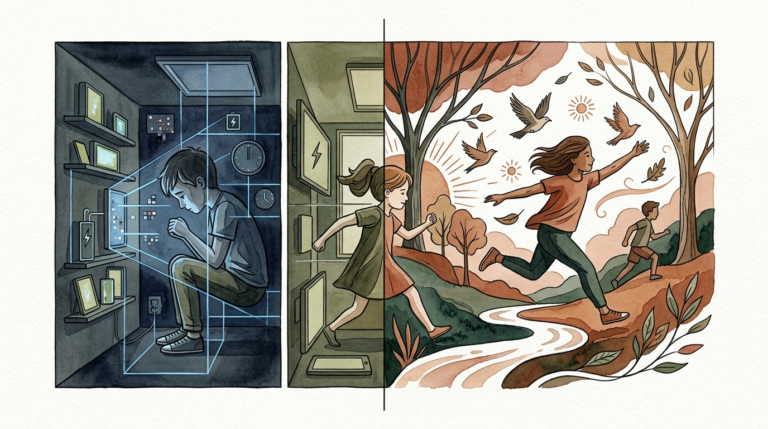
Another frequent error is the “babysitter” approach. While screens are convenient for keeping a child quiet, they deprive the brain of the “boredom” necessary for creative thought. When a child is bored, their brain enters the “default mode network,” where it begins to daydream, plan, and innovate. Screens shut this network down, replacing internal imagination with external stimuli.
Finally, many apps over-simplify the world. In a digital game, blocks never fall over due to a slight breeze or a shaky hand. By removing the “physics” of reality, these apps fail to teach the fundamental laws of the universe. This creates a gap in the child’s understanding of cause and effect that can persist into their school years.
Limitations and Realistic Constraints
It is important to acknowledge that we live in a digital world. A complete ban on screens is often impractical and may even be counterproductive as children grow older. The goal is not “zero tech,” but “tech-life balance.” Understanding when and why screens fail is key to using them correctly.
Screens are excellent for information delivery but poor for skill acquisition. For example, a child can watch a video to learn *about* the solar system, but they should build a model of the solar system to *understand* it. The limitation of the digital world is its lack of depth and tactile resistance. Use screens for “what” and physical play for “how.”
Environmental factors also play a role. Families living in small spaces or urban environments may find it difficult to store large sets of blocks or find space for messy, physical play. In these cases, focus on high-quality, compact building toys or dedicate specific “tactile times” throughout the week. The quality of the interaction matters more than the quantity of the toys.
Comparison: Physical Blocks vs. Digital Building Apps
| Feature | Physical Blocks | Digital Building Apps |
|---|---|---|
| Sensory Input | Full 3D, Tactile, Weight, Texture | 2D Visual, Audio, Flat Touch |
| Brain Activation | Whole-Brain (Motor, Parietal, Frontal) | Limited (Visual, Reward Centers) |
| Problem Solving | Physics-based, Real-world logic | Pre-programmed, Limited variables |
| Social Interaction | Face-to-face, Collaborative | Often solitary or through avatars |
| Resilience | High (Handling real-world failure) | Low (Instant “undo” or “retry”) |
Practical Tips for Professional Brain Building
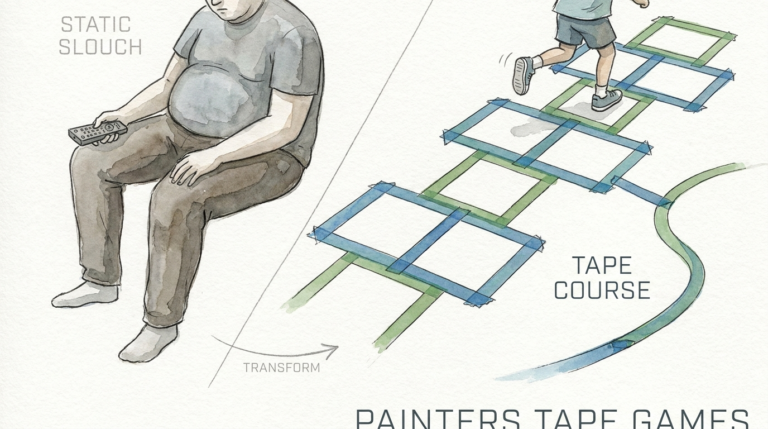
Shifting from screens to blocks doesn’t have to be a battle. It is about making the physical world more interesting than the digital one. Use these strategies to optimize your child’s “play-work” for maximum neural output.
- Create a “Yes” Space: Designate an area where blocks and building materials are always accessible. If a child has to ask permission to play, the friction will drive them toward the easy “click” of a tablet.
- The 10-Minute Spark: Sit down and build for 10 minutes with your child. You don’t need to lead the play; just be present. This “co-play” signals to the child that the activity is valuable and helps bridge the “transfer deficit.”
- Introduce “Complexity Tiers”: Start with large wooden blocks for toddlers, move to interlocking plastic blocks for preschoolers, and introduce technical kits with gears and motors for older kids. Matching the challenge to the skill level prevents boredom.
- Use the “Screen-to-Stone” Method: If your child is obsessed with a digital character or world (like Minecraft), challenge them to build that world in the real room using blocks. This uses their digital interest as a hook for physical development.
- Rotate Your Inventory: Don’t dump all the toys out at once. Keep some sets in the closet and rotate them every few weeks. This keeps the “novelty factor” high, which is essential for maintaining dopamine without a screen.
Advanced Considerations: Neuroplasticity and Critical Windows
The concept of “critical periods” in brain development is vital. Between birth and age five, the brain forms more than one million new neural connections every second. This is the most plastic the brain will ever be. During this window, the environment literally carves the architecture of the mind.
When we prioritize 3D play, we are optimizing the “pruning” process. The brain keeps the connections that are used frequently and eliminates those that aren’t. By providing rich, tactile experiences, we ensure that the brain retains a robust network for spatial logic and motor precision. If these pathways aren’t stimulated during the critical window, they may never reach their full potential.
Furthermore, consider the “Hand-Brain” loop. The hands have more motor neurons than almost any other part of the body. When they are active, they send a massive amount of data to the brain, which in turn grows more complex to handle that data. This is why many of history’s greatest thinkers—from Da Vinci to Einstein—were known for “thinking with their hands.” They understood that physical manipulation is the highest form of cognitive inquiry.
Example Scenario: The Bridge Challenge
Imagine two six-year-olds. Child A spends 30 minutes on a “Building Master” app, dragging virtual blocks into place with a finger. Child B spends 30 minutes with a box of assorted wooden blocks, attempting to build a bridge across two chairs.
Child A completes five levels. They receive “digital stars” and hear celebratory music. However, their brain has only practiced a simple 2D swiping motion. They haven’t learned anything about the actual structural integrity of a bridge. Their spatial reasoning is limited to the constraints of the app’s code.
Child B fails four times. Their bridge collapses because the center is too heavy. They have to figure out that triangles are stronger than squares. They have to adjust for the “wobble” of the chairs. By the time they succeed, they have engaged in deep problem-solving, refined their fine motor skills, and learned the fundamentals of civil engineering. Their brain has formed a dense thicket of new connections that Child A’s brain simply didn’t need to build.
Final Thoughts
The transition from a screen-centric childhood to a tactile-centric one is not about moving backward; it is about moving forward with intention. While digital tools have their place in modern life, they cannot replace the foundational experience of physical interaction. The data from 2024 is clear: the brain thrives on the resistance, gravity, and complexity of the real world.
By swapping just 30 minutes of passive scrolling for 30 minutes of professional brain building with blocks, you are investing in a child’s long-term cognitive health. You are building a prefrontal cortex that can focus, a parietal lobe that can calculate, and a spirit that can persevere through failure. Start today by clearing a space on the floor and letting the real-world engineering begin.
Encourage your children to experiment, to fail, and to build again. The neural connections they form today will be the infrastructure of their success tomorrow. If you found this guide helpful, consider exploring related concepts like sensory-rich outdoor play and the “Tinkering” movement to further deepen your understanding of active development.
Sources
1 psychologytoday.com (https://www.psychologytoday.com/us/blog/the-age-of-overindulgence/202509/screen-times-dangers-from-brain-development-to-heart-health) | 2 choc.org (https://health.choc.org/the-effects-of-screen-time-on-children-the-latest-research-parents-should-know/) | 3 finalsite.net (https://resources.finalsite.net/images/v1742397061/stannsus/equulgzi1guyxi8hwnkm/BeSmartMarch2024-20251.pdf) | 4 fastcompany.com (https://www.fastcompany.com/90984658/screen-time-children-brain-scans-tablets-research-negative-changes) | 5 bluecrossnc.com (https://www.bluecrossnc.com/blog/healthy-living/childrens-health/toddler-screen-time-impact-on-brain-development) | 6 better-blocks.com (https://better-blocks.com/the-neuroscience-behind-the-benefits-of-block-play-for-children/) | 7 nationaleducationsummit.com.au (https://nationaleducationsummit.com.au/nes-blog/why-play-matters/) | 8 psychologytoday.com (https://www.psychologytoday.com/us/blog/pathways-of-progress/202302/sos-for-screens-your-kids-brain-in-the-digital-age) | 9 wonderscounseling.com (https://wonderscounseling.com/children-need-more-3-dimensional-play-and-less-time-on-screens/) | 10 heisaigoncentral.com (https://www.heisaigoncentral.com/en/post/the-science-behind-learning-through-play-how-it-shapes-a-child-s-brain) | 11 kidsusamontessori.org (https://kidsusamontessori.org/playtime-vs-screen-time-impact-on-early-childhood-development/)