Benefits Of Risky Play For Screen Free Kids
We’ve traded the ‘danger’ of a scraped knee for the certainty of a stagnant mind. Digital parenting is safe. It’s clean. It’s controlled. But it also creates a ‘fragile’ child who doesn’t know how to handle a drop in temperature or a difficult physical task. When we let them get cold, wet, and tired in pursuit of a real goal, we aren’t just playing—we’re building a human who can survive anything.

The modern world has become an exercise in risk elimination. We pad every corner. We track every movement. We trade the wild, unpredictable world for the sterilized glow of a tablet. This shift has consequences that go far deeper than a lack of outdoor exercise. We are witnessing a crisis of resilience.
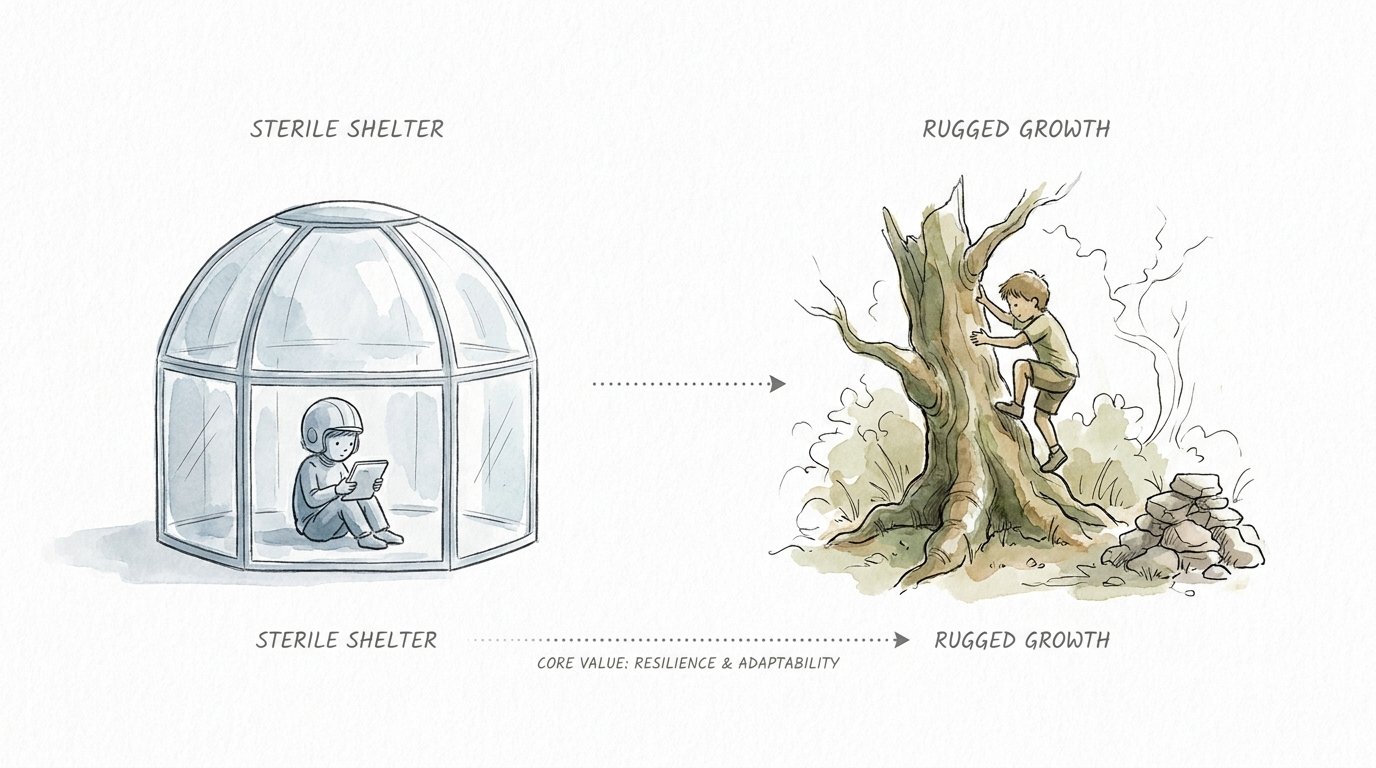
Raising screen-free kids isn’t just about taking away the iPad. It’s about replacing that digital void with something far more potent: real-world experience. This is where risky play comes in. It is the antithesis of the “sterile shelter” environment. It is the intentional pursuit of challenge, uncertainty, and physical thrill.
In this guide, we will explore why letting your child climb a “too tall” tree or handle a real knife is the best thing you can do for their brain. We will break down the science of rugged growth and give you the tools to step back so your child can step up.
Benefits Of Risky Play For Screen Free Kids
Risky play is defined as thrilling and exciting activity that involves a risk of physical injury. It is not about being reckless. It is about managed adventure where the child decides the outcome. For screen-free kids, this is the primary way they build “physical literacy.”
When a child stands at the edge of a climbing structure, their brain is doing more than calculating height. They are learning to manage fear. They are experiencing “physiological arousal”—the racing heart and adrenaline that many kids today only experience through high-speed video games. Real-world risk teaches them that this feeling isn’t a sign of danger, but a sign of engagement.
Research from experts like Dr. Ellen Sandseter shows that kids have an evolutionary need for this. Without it, they don’t learn how to navigate the world safely. They become more prone to anxiety and phobias later in life. Risky play acts as an anti-phobic therapy. It exposes them to the very things they fear in a controlled, self-directed way.
Screen-free children who engage in risky play develop a profound sense of “self-efficacy.” This is the internal belief that they can handle what life throws at them. While a screen offers a fake sense of achievement, a steep hill provides a real one. The victory of reaching the top belongs to the child, not the software developer.
How It Works: The Six Categories of Adventure
Risky play isn’t a vague concept. Researchers have categorized it into six specific types of activities that children naturally seek out. Understanding these helps parents identify opportunities for growth that they might otherwise shut down.
1. Great Heights
This includes climbing trees, ladders, or high structures. The goal is the “bird’s eye view.” It builds spatial awareness and forces the child to plan their descent before they ever reach the top. It is the ultimate lesson in consequence.
2. Rapid Speeds
Think of downhill biking, sledding, or even spinning until they are dizzy. Speed teaches children about momentum and body control. They learn how to react when things move faster than their feet can carry them.
3. Dangerous Tools
Working with real knives, saws, or hammers is a rite of passage. Using adult tools demands intense focus. It transforms a child from a passive consumer into a capable creator. It builds a level of respect for objects that a plastic toy never could.
4. Dangerous Elements
Interacting with fire and water is primal. Learning how to build a campfire or navigate a moving stream teaches environmental awareness. It removes the “sterile” barrier and connects the child to the raw forces of nature.
5. Rough and Tumble Play
Wrestling and play-fighting are essential for social development. It teaches children about their own strength and the boundaries of others. They learn how to negotiate, how to stop when things get too serious, and how to handle physical conflict without aggression.
6. Disappearing or Getting Lost
This is about the thrill of being “away” from the adult gaze. Whether it’s hiding in deep bushes or walking ahead on a trail, it builds independence. It allows the child to feel the weight of their own decisions without a parent narrating every second.
Benefits and Advantages of the Rugged Approach
The advantages of choosing rugged growth over a sterile shelter are measurable and lifelong. Children who engage in risky play show higher levels of physical activity and significantly lower sedentary time. This is a direct combatant to the rising rates of childhood obesity and related metabolic issues.
Psychologically, the benefits are even more profound. Risky play is a “practice arena” for life. It builds a high “distress tolerance.” When a child falls and scrapes a knee, they learn that pain is temporary and manageable. They learn to persevere despite failure. This is the foundation of resilience.
There is also a significant impact on executive function. Planning a route up a rock wall requires organizing, timing, and impulse control. These are the same cognitive skills needed for academic success. Instead of being told what to do by an app, the child is the architect of their own problem-solving strategy.
For children with ADHD, risky play can be a game-changer. These children often seek high-stimulation environments. In a safe, sterile classroom, they might struggle to focus. Put them on a rock-climbing wall, and their focus becomes laser-sharp. The element of “danger” demands the very attention they find hard to give to a worksheet.
Challenges and Common Mistakes
The biggest challenge isn’t the child; it’s the adult’s anxiety. Many parents confuse “risk” with “hazard.” A risk is a challenge that a child can see and choose to take. A hazard is a hidden danger that the child cannot see or manage, like a broken glass in a sandbox or a structurally unsound bridge.
A common mistake is “over-intervention.” We often shout “Be careful!” from the sidelines. This actually distracts the child, potentially causing the very accident we are trying to prevent. It shifts their focus from the task to our voice, breaking their concentration and undermining their confidence.
Another pitfall is “gender bias” in play. Studies show that parents often encourage boys to take risks while protecting girls from the same activities. This limits a girl’s opportunity to build the same resilience and physical literacy. Both boys and girls need the thrill of the “too-fast” slide or the “too-high” branch.
Many parents also fail to provide “loose parts.” A static playground with a plastic slide has a limited shelf life for a child’s imagination. Real risky play thrives on movable objects—planks, tires, crates, and ropes. These allow children to build their own risks, which is far more beneficial than using a pre-determined structure.
Limitations: When to Draw the Line
Risky play does not mean a lack of supervision. The level of “managed risk” must match the child’s developmental stage. A toddler should not be given a wood saw, but they can be given a dull butter knife to cut bananas. The goal is to provide a challenge that is “thrilling but manageable.”
Environmental factors also play a role. In high-risk urban environments, the “disappearing” category of play must be strictly bounded for safety. You have to adapt the principles of risky play to your specific context. If you don’t have a forest, a pile of scrap wood in a backyard can serve as a suitable replacement.
There are also trade-offs in terms of time. Risky play is slow. It doesn’t fit well into a packed schedule of back-to-back extracurriculars. It requires long, uninterrupted blocks of time where a child can get bored enough to start exploring. If your schedule is too tight, the child will never reach the level of deep play where true risk-taking happens.
Sterile Shelter vs. Rugged Growth
Understanding the difference between these two parenting philosophies is crucial for the modern parent. One seeks to minimize discomfort; the other seeks to maximize capability.
| Feature | Sterile Shelter (Digital/Protected) | Rugged Growth (Screen-Free/Risky Play) |
|---|---|---|
| Safety Focus | Eliminating all potential for injury. | Eliminating hazards; managing risks. |
| Skill Development | Fine motor skills (swiping, tapping). | Gross motor, vestibular, and proprioceptive skills. |
| Emotional Regulation | Avoidance of frustration and fear. | Exposure to fear, excitement, and failure. |
| Problem Solving | Linear, guided by software. | Creative, guided by physical constraints. |
| Resilience | Low; prone to “fragility.” | High; builds a “can-do” mindset. |
Practical Tips for Supporting Risky Play
The transition to allowing more risk can be uncomfortable. Start small. Use the “15-second rule.” When you feel the urge to intervene, stop. Count to fifteen. Often, in those fifteen seconds, the child will find their own balance, solve the problem, or decide to come down on their own.
Replace “Be careful!” with curiosity-driven questions. Instead of warning them of danger, ask them to assess it. “What is your plan for getting down?” or “Do you feel stable on that rock?” This forces the child to engage their prefrontal cortex and perform their own risk assessment.
Invest in “loose parts.” Collect old tires, wooden planks, crates, and ropes. These are the building blocks of an adventurous childhood. They are cheap, versatile, and offer infinitely more “play value” than an expensive plastic playhouse. They allow the child to constantly reconfigure their environment to meet their growing need for challenge.
Let them get dirty and uncomfortable. Invest in good outdoor gear—waterproof boots and durable clothes. When a child knows they are allowed to get wet and muddy, they stop worrying about their appearance and start focusing on their goals. This is where the real “rugged growth” happens.
Advanced Considerations for the Serious Practitioner
For those committed to the screen-free, risky play lifestyle, look into the concept of “Physical Literacy.” This is more than just being fit. It is the confidence and competence to move in a wide variety of environments. It is a lifelong gift that prevents the sedentary traps of adulthood.
Consider the “scaffolding” technique. You aren’t just throwing a kid into the woods with a match. You model the safe use of a tool, then you supervise them using it, and finally, you step back and let them work independently. This gradual release of responsibility builds true mastery.
Pay attention to the “vestibular system.” This is the internal sense of balance and spatial orientation. Screens do nothing for this. Spinning, hanging upside down, and balancing on uneven surfaces are the only ways to calibrate this system. A well-calibrated vestibular system is linked to better reading, writing, and emotional regulation.
Scenario: The Fallen Log Bridge
Imagine a seven-year-old coming across a fallen log over a small, shallow creek. In a sterile shelter environment, the parent might say, “Don’t go on that, it’s slippery and you’ll fall in.” The child learns that the world is dangerous and they are incapable of navigating it.
In a rugged growth environment, the parent stands back. The child approaches the log. They test it with one foot. They feel the slip of the moss. They look at the water. They are calculating the risk of a wet foot versus the glory of crossing. They decide to scoot across on their stomach.
The result? The child reaches the other side. They have performed a real-world risk assessment. They have managed their own fear. They have used their core strength and coordination. Even if they had fallen in, they would have learned that being wet is not a catastrophe. That is a human being becoming capable.
Final Thoughts
Risky play is not a luxury; it is a developmental necessity. By removing screens and replacing them with real-world challenges, we are giving our children the chance to build a brain that is wired for competence. We are moving them away from being passive observers and toward being active participants in their own lives.
The goal is to raise a child who is “as safe as necessary,” not “as safe as possible.” The latter leads to a life of avoidance and anxiety. The former leads to a life of adventure and resilience. It starts with a single decision to step back, take a breath, and let them climb that tree.
Experiment with this today. Find a way to say “yes” to a physical challenge you would normally shut down. Watch your child’s face. You will see fear, then focus, then the unmistakable glow of real achievement. That is the sound of a human being growing.
Sources
1 kidsusamontessori.org | 2 medium.com | 3 famly.co | 4 child-encyclopedia.com | 5 wildlingsforestschool.com | 6 outsidethetoybox.com | 7 mypcd.org | 8 psychologytoday.com | 9 rasmussen.edu | 10 happyhandsmessyplayco.com | 11 aoneroomschoolhouse.com | 12 playvolutionhq.com | 13 bu.edu | 14 sickkids.ca | 15 burstingwithpotential.co.uk | 16 citherapies.com | 17 occupationaltherapy.com.au | 18 cdc.gov | 19 cps.ca | 20 nih.gov | 21 psychologytoday.com | 22 nurturingskills.ie | 23 nih.gov | 24 rchsd.org | 25 educationalplayenvironments.com