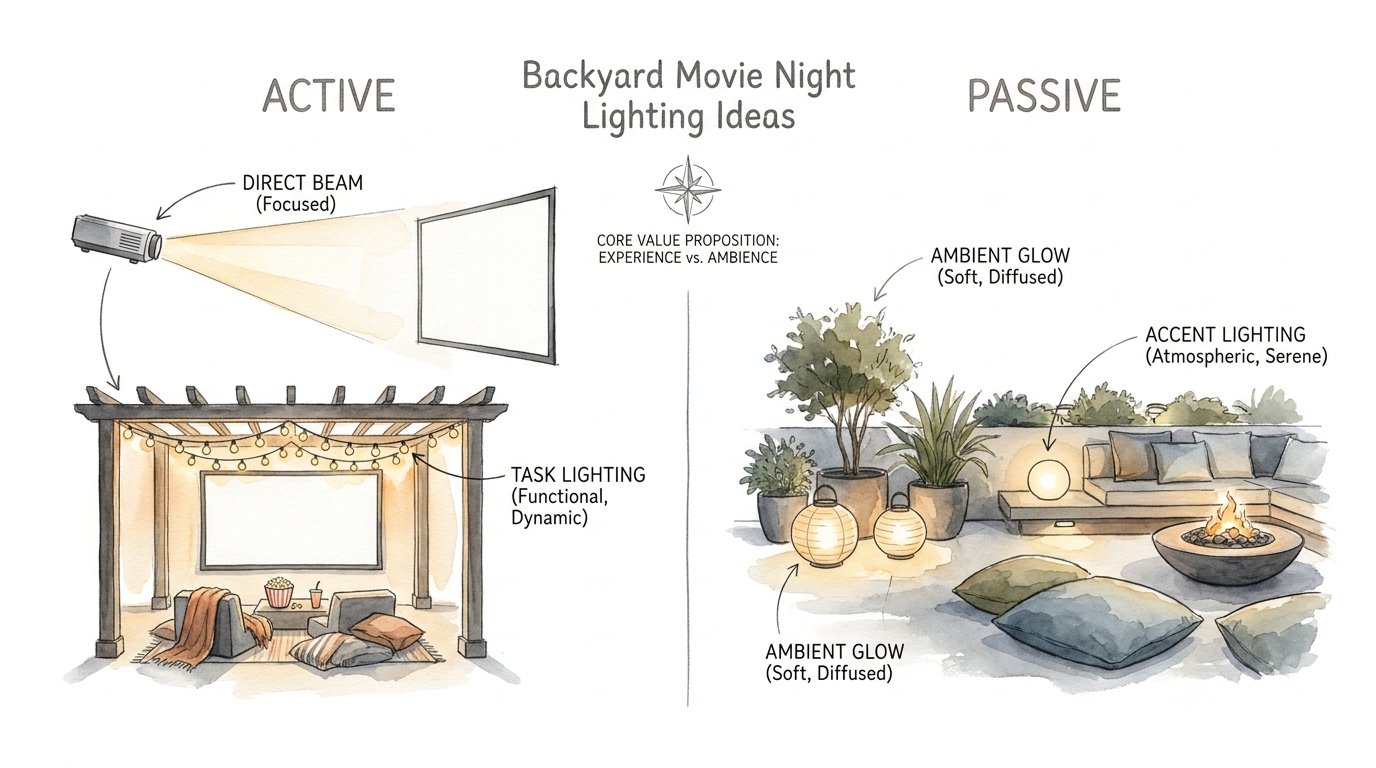
Backyard Movie Night Lighting Ideas
Is your lighting setting the mood or ruining the movie? The biggest mistake in backyard cinema is ‘Active’ lighting. Blasting the yard with floodlights kills your contrast and creates extension-cord trip hazards. Switch to ‘Passive’ solar-powered path lights. They charge during the day and provide just enough glow to find your popcorn without washing out the screen. It’s theater-grade ambiance for zero energy cost.

Setting up a backyard cinema is about more than just a big screen and a loud speaker. It is about creating an environment where the technology disappears and the story takes over. When you use harsh, direct lights, you are fighting against your own projector. Passive lighting works with the darkness to guide your guests safely while keeping the focus exactly where it belongs.
Practical lighting solutions transform a simple lawn into a professional-grade viewing lounge. By thinking like a cinematographer, you can use light to enhance depth and emotion. This guide will show you how to master the balance between visibility and immersion for the ultimate outdoor movie experience.
Backyard Movie Night Lighting Ideas
Backyard movie night lighting ideas focus on providing “task” and “ambient” light without interfering with the “key” light of your projector. In a traditional indoor theater, lighting is controlled to an extreme degree. Outdoors, you have to contend with streetlights, neighbors, and even the moon. This section explores how to reclaim that control.
Passive lighting is the gold standard for outdoor screenings. Think of solar-powered stakes that sit low to the ground. These provide a soft glow on the grass or patio, illuminating the path to the snack table. Because they face downward, none of that light hits your screen directly, preserving those deep blacks in your favorite films.
String lights are another classic choice, but they require careful placement. Instead of hanging them directly over the seating area, try stringing them along a distant fence or around the perimeter of the yard. This creates a “frame” for your theater space. It defines the room without making it feel like you are sitting under a spotlight.
Lanterns and battery-operated candles offer a portable, low-intensity solution. Placing a few small lanterns on side tables gives guests enough light to see their drinks. These small “pockets” of light are much better for the eyes than one giant overhead fixture. They mimic the dim wall sconces found in high-end commercial cinemas.
How the Science of Contrast Dictates Your Lighting
Contrast is the difference between the brightest white and the darkest black on your screen. When ambient light hits a projection surface, it raises the “floor” of those black levels. A screen that should look pitch black ends up looking gray. This ruins the immersion of horror movies or space epics where darkness is essential.
Projectors work by reflecting light off a surface. If your backyard is too bright, the light from your lamp has to compete with the light in the environment. This is why a 3,000-lumen projector can still look washed out if the porch light is left on. Controlling the angle and intensity of your yard lights is the only way to save your image quality.
Passive solar path lights are the secret weapon for maintaining high contrast. Most of these units put out between 5 and 15 lumens. This is a tiny fraction of the 2,000+ lumens coming from your projector. Because the light is directed at the ground, it doesn’t bounce back onto the screen. You get safety and cinematic quality at the same time.
Using “Dark Sky” compliant fixtures is a pro tip for serious enthusiasts. these are lights designed specifically to prevent light pollution. They are shielded on the top and sides, ensuring all the light goes down. This keeps your backyard theater dark while providing enough illumination for your guests to move around.
Passive vs. Active Lighting: The Ultimate Philosophy
Active lighting is what most people use by default. These are the bright floodlights, high-intensity porch lamps, and overhead patio bulbs. While great for a BBQ, they are the enemy of a movie night. They flood the entire space with photons that scatter in every direction, including onto your screen.
Passive lighting, on the other hand, is subtle and intentional. It relies on low-voltage or solar-powered sources that highlight specific areas. Instead of trying to illuminate the whole yard, you only light what is necessary. This creates a much more intimate, cozy atmosphere that feels like a real getaway.
Choosing passive lighting also solves the “extension cord nightmare.” Active lights usually require a constant power source, leading to a web of cables across the lawn. Solar path lights and battery lanterns are completely self-contained. You can place them exactly where they are needed without worrying about where the nearest outlet is.
| Feature | Active Lighting | Passive Lighting |
|---|---|---|
| Brightness | High (500+ Lumens) | Low (5-20 Lumens) |
| Contrast Impact | Negative (Washes out screen) | Minimal (Preserves blacks) |
| Safety | High visibility, high trip risk | Guided paths, zero trip risk |
| Power Source | Hardwired / Extension Cords | Solar / Battery |
| Energy Cost | Standard Electricity | Zero (Solar) |
Benefits of Low-Lumen Ambiance
The primary benefit of low-lumen lighting is eye comfort. When you transition from a bright yard to a bright movie screen, your pupils have to work overtime. Using dim, passive lighting allows your eyes to stay adjusted to the dark. This makes the movie screen pop even more and reduces the “eye fatigue” often felt during long marathons.
Energy efficiency is another massive advantage. High-powered floodlights can draw significant power, especially if left on for hours. Solar-powered path lights use free energy from the sun. They turn on automatically at dusk and off at dawn, making them a truly “set it and forget it” solution for your home theater.
Atmosphere is the final piece of the puzzle. There is something magical about a yard lit only by the flickering light of a screen and the soft glow of path stakes. It creates a sense of seclusion and focus. Your guests will feel like they have entered a private world, away from the distractions of the neighborhood.
Safety doesn’t have to be sacrificed for ambiance. You can line your primary walkways with solar stakes to ensure no one trips on a hidden root or a rogue garden hose. This provides a clear, illuminated path to the house for bathroom breaks without ever needing to turn on the main yard lights.
Challenges and Common Mistakes to Avoid
The most common mistake is placing lights too close to the screen. Even a dim solar light can cause a “hot spot” on the projection surface if it is within a few feet. Always keep your lighting sources at least 10 feet away from the screen, or ensure they are completely shielded from the screen’s line of sight.
Another pitfall is ignoring color temperature. Many cheap LED lights have a very “cool” or blueish tint. This can look clinical and jarring compared to the warm, cinematic colors on your screen. Look for lights labeled “Warm White” or those with a Kelvin rating around 2700K to 3000K for a more natural, inviting look.
Over-lighting the space is a frequent error. It is tempting to put a light every two feet, but “less is more” in a theater setting. You only need enough light to define the space and provide safety. Darker gaps between lights actually help create a sense of depth and keep the focus on the film.
Failing to account for reflective surfaces can also ruin your setup. Light can bounce off windows, glass doors, or even shiny patio furniture and hit your screen. If you have a sliding glass door near your theater, close the curtains or move your lights to an angle where they won’t reflect back toward the audience.
Limitations of Solar and Passive Systems
Solar lighting depends entirely on the weather. If you have a string of cloudy days, your path lights might only last for an hour or two before fading. For a big event where you need guaranteed light, it is a good idea to have a few battery-powered backups ready to go.
Passive lighting is also not ideal for large, crowded events. If you are hosting a neighborhood-wide block party with 50+ people, tiny solar stakes won’t provide enough visibility for safe movement. In those cases, you might need “active” lighting during the intermission and then dim it back down once the movie resumes.
Installation depth can be a constraint for path lights. If your backyard has very rocky soil or a thick deck, you can’t just stake lights into the ground. You may need to look for surface-mount solar “pucks” or weighted lanterns that can sit on flat surfaces without needing to be driven into the earth.
Maintenance is low but not zero. Over time, the plastic lenses on solar lights can become cloudy due to UV exposure. This reduces their light output and makes them look cheap. Occasional cleaning with a microfiber cloth and a mild soap can keep them looking sharp and performing at their peak.
Practical Tips for a Flawless Setup
Start by mapping out your “lighting zones.” You should have a zone for the walkway, a zone for the snack bar, and a zone for the seating area. Each zone should have its own dedicated, low-intensity light source. This keeps the light organized and prevents “spill” into the theater area.
Use “bias lighting” for an advanced theater look. This involves placing a very dim, warm LED strip behind the projector screen. It creates a soft glow on the wall or fence behind the screen, which helps reduce eye strain and makes the screen’s colors look more vibrant. This is a common trick used in professional indoor home theaters.
Angle your screen away from fixed light sources. If you have a streetlight or a neighbor’s porch light that you can’t control, position your screen so that the back of it faces the light. This uses the screen itself as a shield, keeping the projection surface in the darkest possible shadow.
Consider using smart plugs for any “active” lights you do need. If you have decorative string lights, plug them into a smart outlet. You can then dim or turn them off completely using your phone or a voice command the moment the opening credits start. This adds a professional “curtain call” feel to the night.
Advanced Techniques for the Pro Cinema
If you want to go beyond the basics, integrate motion sensors into your lighting plan. You can set up a sensor near the back door that triggers a very dim, red-tinted light when someone walks out. Red light is famous for preserving night vision, allowing guests to see where they are going without “blinding” them for the movie.
Smart home integration allows for automated “scenes.” You can program a “Movie Start” routine that dims your patio lights over a period of 30 seconds. This slow fade mimics the experience of a real commercial theater and helps your guests’ eyes adjust gradually to the screen’s brightness.
For permanent setups, consider low-voltage hardwired landscape lighting. While more complex to install than solar, these systems offer consistent brightness and can be easily dimmed. High-quality brass fixtures look beautiful during the day and provide a lifetime of reliable performance for your outdoor theater.
Syncing your lights with your media player is the ultimate flex. Systems like Philips Hue can sync with the colors on your screen in real-time. Imagine the whole yard turning a subtle blue during an underwater scene or flickering orange during a fire sequence. It is incredibly immersive when done subtly.
Step-by-Step Scenario: The Intimate Date Night
For a cozy night for two, start by clearing a small area on your deck or lawn. Place two comfortable lounge chairs facing your portable screen. Surround the seating area with four to six small, warm-white solar lanterns. This creates a “glow bubble” that feels private and romantic.
Next, place two solar stakes at the entrance to the area to mark the transition from the “rest of the yard” to the “theater.” Ensure no light is pointing directly at the projector lens or the screen. If you are using a portable projector on a tripod, place a small, shielded task light near the controls so you can see to adjust the volume.
Once the movie begins, the only light should be the low-level glow of the lanterns and the screen itself. If you need to pause for more popcorn, the lanterns provide just enough light to find your way back to the kitchen. This setup is simple, effective, and requires zero extension cords.
Step-by-Step Scenario: The Family Block Party
When hosting a larger group, safety becomes the priority. Line your main driveway or side-yard path with high-quality solar stakes every 5 feet. This creates a clear “runway” for guests. Use a few strings of Edison-style bulbs overhead, but keep them on a dimmer switch so you can drop them to 10% brightness during the show.
Set up a dedicated snack station at the back of the seating area. Use a battery-powered LED strip under the edge of the table to light up the food without creating glare. This “under-glow” is functional for guests looking for snacks but remains hidden from the people watching the movie.
During the intermission, use a smart remote to ramp up the overhead string lights to 50%. This signals a break and allows everyone to move around safely. When the second half starts, fade the lights back down. This professional touch keeps the evening organized and makes the movie feel like a special event.
Final Thoughts
Creating a backyard cinema is an art form that balances technology with the natural environment. The right lighting doesn’t just help you see; it shapes the entire emotional experience of the night. By moving away from “active” floodlights and embracing “passive” solar solutions, you protect your contrast and elevate your ambiance.
Experimenting with different placements and intensities will help you find the perfect balance for your specific yard. Every space is unique, and the way light interacts with your trees, fences, and furniture will vary. Take the time to do a “dry run” with your lights before your guests arrive to ensure every seat has a great view.
Ultimately, the best lighting is the kind you don’t even notice once the movie starts. It provides safety, style, and atmosphere while letting the story on the screen take center stage. Grab some solar stakes, dim the porch lights, and enjoy the magic of the movies under the stars.
Sources
1 soundcore.com | 2 usenupitch.com | 3 filmbaker.com | 4 awolvision.com | 5 openaircinema.us | 6 benq.com | 7 perthpopupmovies.com.au | 8 reviewed.com | 9 youtube.com | 10 solarlightingitl.com | 11 totalhomeinteriors.tech | 12 beverlyboy.com | 13 seuslighting.com | 14 videomaker.com | 15 seriouslycinema.co.uk | 16 nofilmschool.com | 17 cinematography.com | 18 theaterone.com | 19 ththeater.com | 20 youtube.com