screen free evening activities
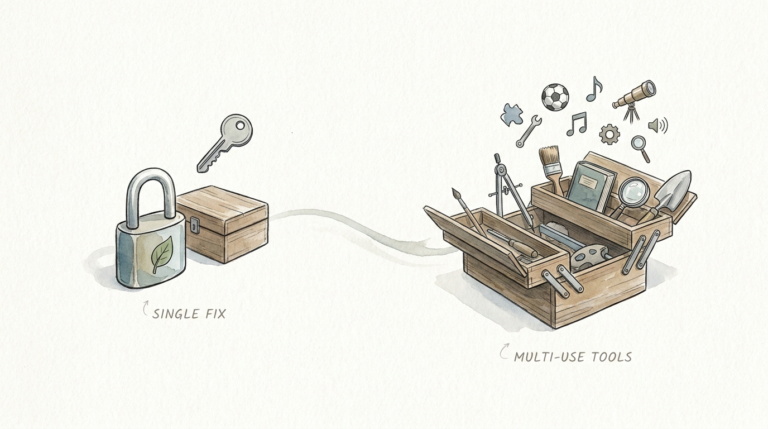
One screen does one thing. One deck of cards does everything. Why limit yourself to a single stream of content? Rediscover the versatile joy of analog entertainment that never needs a software update.
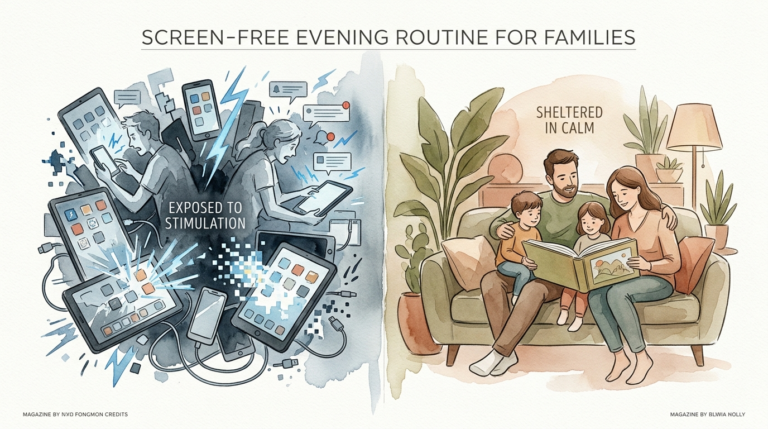
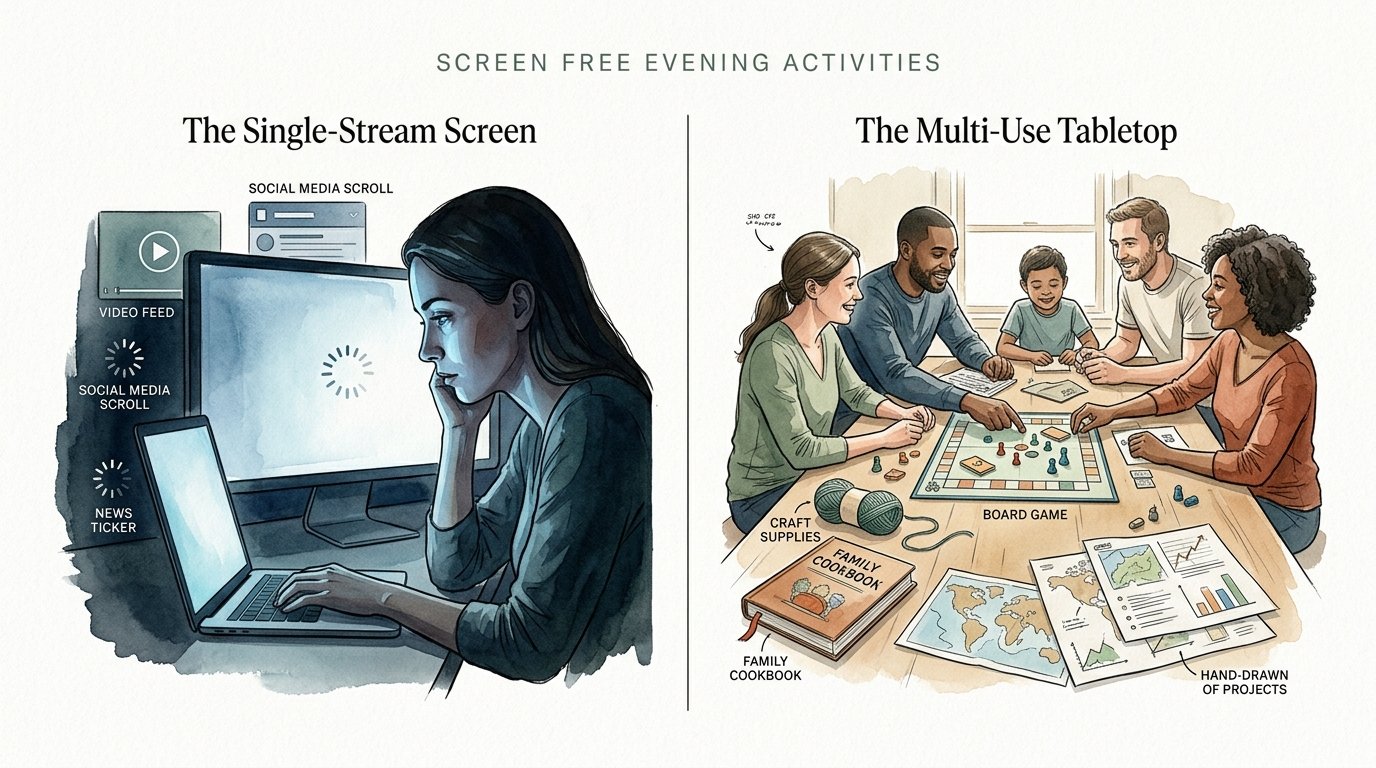
You are likely reading this on a device that is currently fighting for your attention. Notifications pop up. Algorithms suggest the next clip. The “single-stream” screen is a closed loop designed to keep you scrolling. But there is another way to spend your time.
Think about the last time you sat at a table with nothing but a physical deck of cards and a few friends. There was no glare. There were no pop-up ads. Just the tactile snap of cardstock and the sound of laughter. This is the magic of the multi-use tabletop. It is simple, deep, and infinitely adaptable.
Choosing analog play is not about being “old-fashioned.” It is about taking control of your leisure time. It is about choosing an activity that rewards focus instead of fragmenting it. Let us dive into why a simple deck of cards is the ultimate tool for a better evening.
screen free evening activities
Screen-free evening activities are intentional breaks from digital devices. They replace passive scrolling with active engagement. At the center of this movement is the standard deck of playing cards. This small stack of paper has survived for centuries because it is a platform, not just a product.
A deck of cards is a portable engine for hundreds of different experiences. You can use it to test your memory, challenge your friends to a game of strategy, or even practice the fine motor skills of cardistry. It exists to facilitate human connection and mental stimulation. In the real world, you see these decks everywhere from quiet coffee shops to high-stakes poker rooms.
Think of a deck of cards like an offline app store. Every game is a different “app” you can run without an internet connection. Whether you are playing a solitary game of Klondike or a rowdy round of Spoons, you are engaging in a tradition that spans back to 9th-century China. It is a universal language that bridges generations and cultures.
These activities matter because they provide a “cognitive reset.” When you interact with physical objects, your brain processes information differently. You aren’t just clicking; you are feeling, sliding, and stacking. This tactile feedback helps lower stress and improves your sense of presence in the moment.
The Anatomy of Analog Play
To master the art of the card table, you need to understand the tools. A standard deck consists of 52 cards. These are divided into four suits: Hearts, Diamonds, Clubs, and Spades. Each suit has 13 ranks, ranging from the lowly Two to the powerful Ace.
Processes like shuffling and dealing are not just chores. They are part of the ritual. The “Riffle Shuffle” or the “Overhand Shuffle” creates a random state from order. This randomness is what makes every hand feel like a new beginning.
If you are new to this, start with the basics of card handling. Hold the deck in a “Mechanic’s Grip.” Your index finger should be on the top edge, while your other three fingers wrap around the side. This gives you total control over the cards. From here, you can learn to deal smoothly. A good dealer keeps the cards low to the table to prevent anyone from seeing the faces.
Choose a game based on your current goal. If you want to relax alone, Solitaire is your best friend. If you have a partner, Rummy or Gin is a classic choice. For groups, games like Hearts or Spades introduce complex social dynamics and “trick-taking” mechanics.
Benefits of the Physical Deck
The practical benefits of analog play are measurable. Studies have shown that traditional games like cards can help protect against cognitive decline. They force your brain to use different sets of skills simultaneously: strategy, probability, and social intuition.
Socially, the benefits are even more obvious. When you play a game in person, you are reading body language. You are noticing the “tell” in a friend’s smile or the hesitation in their hand. This builds deeper connections than any multiplayer video game can offer. You are sharing a physical space and a shared set of rules.
Another advantage is the lack of “attention theft.” A physical deck does not have a “buy now” button. It does not send you a notification if you haven’t played in three days. You are the one in charge of the start and stop times. This creates a sense of agency that is often missing in the digital world.
Finally, there is the cost-to-value ratio. A high-quality deck of cards costs less than a single month of most streaming services. Yet, that deck will last for years and provide thousands of hours of entertainment. It is a one-time investment in a lifetime of fun.
Challenges and Common Pitfalls
The biggest mistake beginners make is trying to learn too many games at once. Each card game has its own internal logic and “meta-game.” If you jump from Poker to Bridge in one night, you will likely end up frustrated. Focus on mastering one game until the rules become second nature.
Another common pitfall is the “Rule Lawyer” trap. Every family or group has slightly different “house rules.” Arguments over whether an Ace is high or low can ruin the mood. Always clarify the rules before the first card is dealt. If there is a dispute, consult a neutral resource like Pagat.com to settle it quickly.
Poor lighting and cramped spaces are physical challenges. Card games require you to see small details on multiple cards at once. If the room is too dark, you will strain your eyes. Ensure your table is large enough to hold the “stock,” the “waste pile,” and each player’s hand without clutter.
Do not ignore the quality of your cards. Cheap, paper-thin decks will warp and stick together. This makes shuffling difficult and can lead to accidental “marked” cards. Invest in a plastic-coated or 100% plastic deck for a smoother experience.
Limitations of the Tabletop
Analog play does have its boundaries. Unlike a digital game, you cannot play a four-person card game alone if your friends cancel. You are limited by the physical presence of other people. While solo games exist, the social variety of card gaming is its strongest suit.
Physical decks also require a certain level of manual dexterity. Shuffling can be difficult for people with joint pain or limited mobility. In these cases, a mechanical card shuffler can help bridge the gap, but it adds another piece of equipment to the table.
Environment matters too. You cannot easily play a game of cards on a windy beach or a moving bus without specialized “travel” decks or magnetic sets. The wind is the natural enemy of the paper card. You need a stable, flat surface to get the best experience.
Finally, there is the learning curve. Some games, like Bridge, are notoriously complex. They require hours of study and practice to play at a competent level. If you are looking for instant gratification, the deep strategy of high-level card games might feel like too much work.
The Playstyle Spectrum
To choose the right activity, you must understand the different ways people interact with cards. Not every deck is used for gambling or even for games.
| Activity Type | Primary Goal | Player Count | Skill Focus |
|---|---|---|---|
| Traditional Games | Winning/Competition | 2 to 10 | Strategy & Probability |
| Solitaire/Patience | Relaxation/Puzzle | 1 | Pattern Recognition |
| Cardistry | Visual Art/Dexterity | 1 | Fine Motor Control |
| Card Magic | Entertainment/Mystery | 1+ Audience | Misdirection & Sleight |
This comparison shows that a single deck serves multiple personas. A serious practitioner might spend years mastering “The Pass” in card magic, while a casual player just wants to beat their grandmother at Gin Rummy. Both are valid uses of the same 52 pieces of cardstock.
Practical Tips for Hosting
If you want to host a successful card night, preparation is key. Start by sending an RSVP. Card games are often sensitive to player counts. A game of Spades needs exactly four people; five people will leave someone sitting out. Know your numbers before you invite the crowd.
Organize your space. Clear the table of everything except the essentials. Provide small snacks that aren’t “greasy.” Fingerprints from potato chips can ruin a good deck of cards. Stick to pretzels, nuts, or snacks eaten with a fork.
Be the “Teacher.” If you are introducing a new game, learn the rules perfectly yourself first. Explain the goal of the game, then the card values, then the flow of a single turn. Play a “dummy round” where everyone keeps their cards face-up. This helps people learn without the pressure of losing.
Keep the energy high. Music should be background noise, not the focus. Choose a playlist that is instrumental or low-tempo to avoid distracting from the conversation. The goal is to facilitate talking, not to drown it out.
Advanced Considerations
For those who want to go deeper, look into the world of Cardistry. This is the art of shuffling and displaying cards in visually stunning ways. It is often described as “juggling with your fingers.” Moves like the “Charlier Cut” or the “Spring” look like magic but are actually feats of pure dexterity.
Cardistry turns the deck into a fidget tool. It is a great way to keep your hands busy during a meeting or while listening to a podcast. It builds incredible hand strength and coordination. Many magicians use cardistry as “finger exercises” to keep their hands limped for sleight-of-hand work.
If strategy is your focus, start studying “game theory.” In games like Poker or Bridge, the cards you hold are only half the battle. The other half is understanding the probability of what your opponents hold. Serious practitioners use mathematical models to decide when to bet and when to fold.
You might also consider collecting custom decks. The “Bicycle” standard is great for play, but companies like Theory11 or Dan and Dave produce decks with stunning artwork and embossed tuck cases. These “designer” decks turn a simple game into a luxury experience.
Scenario: The “Cheat” Game Night
Let’s look at a real-world example of how a simple game can transform an evening. Imagine you have six people over. You decide to play “Cheat” (also known as I Doubt It or BS).
Everyone is dealt an equal number of cards. The goal is to get rid of your hand by playing cards face-down in a sequence (Aces, then Twos, then Threes, and so on). The catch? You don’t have to tell the truth. If it is your turn to play “Fours” but you only have “Kings,” you place two Kings face-down and say, “Two Fours.”
If someone suspects you are lying, they shout “Cheat!” If you were lying, you must pick up the entire discard pile. If you were telling the truth, the accuser picks it up. This game creates an immediate atmosphere of suspicion, laughter, and high-stakes drama.
It requires no complex board, no batteries, and no expensive setup. Within five minutes, your living room is filled with people shouting and laughing. This is the power of analog entertainment. It scales effortlessly with the energy of the room.
Final Thoughts
A deck of playing cards is more than just a toy. It is a gateway to a more intentional way of living. It offers a way to disconnect from the digital noise and reconnect with the people around you. Whether you are seeking a mental challenge or a social spark, the answers are often found in that small, rectangular box.
Embracing these screen-free evening activities doesn’t require a lifestyle overhaul. It just requires a willingness to put the phone down and pick the cards up. Start with a simple game. Master a new shuffle. Host a small gathering. You will quickly find that the “analog” world has more depth and variety than any high-definition screen.
Take the time to experiment. Try a game you’ve never heard of. Practice a flourish until it feels smooth. The more you use the deck, the more its secrets will be revealed. There is an entire universe of play waiting on your tabletop. All you have to do is deal.
Sources
1 partytrick.com | 2 camillestyles.com | 3 storyofstuff.org | 4 haven-psychology.com | 5 lifegoalsmag.com | 6 baronfig.com | 7 apartmenttherapy.com | 8 professorgame.com | 9 baylorlariat.com | 10 ebsco.com | 11 cbc.ca | 12 sparklestories.com | 13 nih.gov | 14 cardrulesplus.com | 15 youtube.com | 16 coopgestalt.com | 17 lovethynerd.com | 18 pagat.com | 19 youtube.com | 20 reddit.com