Building Emotional Resilience In Screen-dependent Kids
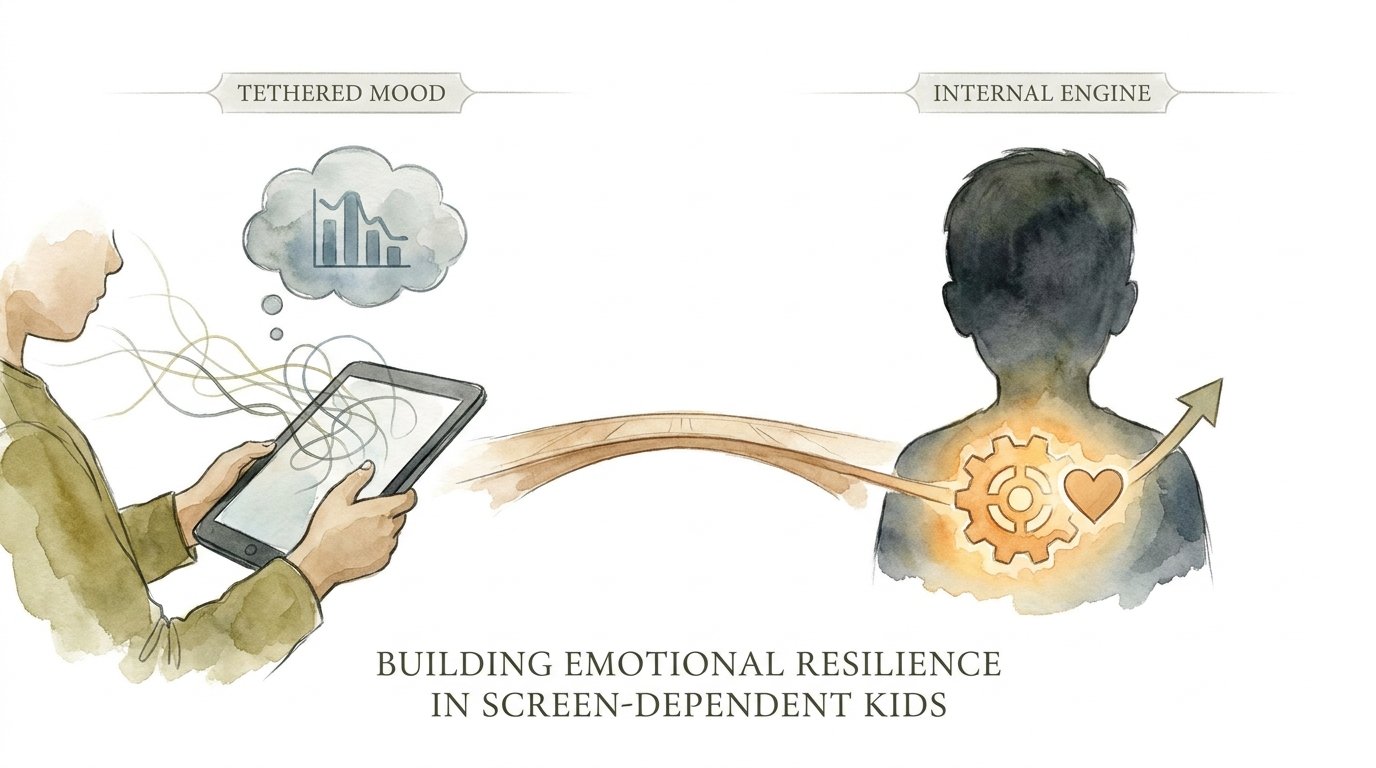
What happens when the battery hits 0%—does their emotional stability vanish with it? We accidentally built a world where our children’s joy is tied to a charging cable. When the Wi-Fi drops, the meltdown begins because their nervous system is tethered to a circuit board. A 7-day reset isn’t just a break from tech; it’s a structural renovation of their resilience. We are moving them from a state of fragile dependency to a self-sustaining ‘internal engine’ of imagination and grit.

Parents today are witnessing a strange phenomenon. A child can be perfectly happy one moment and completely inconsolable the next, simply because a tablet was put away. This isn’t just “kids being kids.” It is a physiological response to the removal of a high-dopamine stimulus. We are seeing the rise of the “Tethered Mood,” where emotional regulation is outsourced to an algorithm.

Breaking this cycle requires more than a weekend without phones. It requires a deliberate, structured approach to reclaim the brain’s natural ability to self-soothe and find interest in the physical world. By following a 7-day reset, you aren’t just taking away a toy; you are handing back your child’s autonomy.
Building Emotional Resilience In Screen-dependent Kids
Emotional resilience is the ability to bounce back from stress, disappointment, and boredom without needing an external “crutch.” In the context of the digital age, screen-dependent kids often lack this because their brains have adapted to instant gratification. When every “level up” or “like” provides an immediate hit of dopamine, the slower, more difficult rewards of real life—like finishing a drawing or building a Lego set—feel frustratingly dull.
This dependency exists because screens act as a digital pacifier. Instead of learning to navigate boredom or frustration, many children use devices to “numb out” or escape uncomfortable feelings. Over time, this weakens the prefrontal cortex—the part of the brain responsible for decision-making and emotional control. When the screen goes away, the child is left with a nervous system that doesn’t know how to downshift, leading to the infamous “digital meltdown.”
Real-world resilience is built in the gaps. It is built when a child is bored and has to find something to do. It is built when they fail at a physical game and have to try again. A digital reset targets these gaps, forcing the brain to reconnect with its own internal resources. We are moving from a state where the “engine” of their happiness is external (the screen) to one where it is internal (their own imagination and grit).
How It Works: The 7-Day Reset Architecture
A successful digital reset isn’t about a sudden, permanent ban. It is about a strategic pause that allows the nervous system to recalibrate. This 7-day plan is designed to transition a child from high-stimulation dependency to low-stimulation engagement.
Day 1: The Habit Assessment
On the first day, do not change anything yet. Instead, observe. Track every minute of screen use and, more importantly, the *why* behind it. Is your child using the screen to socialize, to escape boredom, or to avoid a difficult task like homework? Use a physical log or a digital tracking app to establish a baseline of usage.
Day 2: Setting the New Perimeter
Hold a family meeting. Explain that this reset is a “brain vacation” to help everyone feel more energetic and less cranky. Establish clear tech-free zones (bedrooms and dining tables) and tech-free hours. Inform your extended network—friends and relatives—that you will be less responsive for the week so there is no external pressure to “check-in.”
Day 3: The Digital Declutter
This is the day for “clearing the deck.” Sit with your child and delete unused apps, turn off all non-essential notifications, and organize the home screen to be as boring as possible. The goal is to remove the “visual hooks” that trigger the urge to click. If it’s a gaming console, unplug it and put it in a closet.
Day 4: Introducing High-Value Alternatives
The “withdrawal” usually peaks here. Boredom will set in. You must have high-value, tactile alternatives ready. Think about “analog immersive” activities: complex puzzles, art supplies, a new book series, or outdoor sports equipment. The key is to provide something that requires active participation rather than passive consumption.
Day 5: Strengthening Real-World Connection
Use this day to prioritize face-to-face interaction. Plan a family outing that involves physical movement—a hike, a trip to the park, or a scavenger hunt. Physical activity helps flush out stress hormones and boosts natural endorphins, making the lack of digital dopamine easier to handle.
Day 6: Deepening Engagement and Grit
Encourage a project that takes time. Whether it’s building a garden box, painting a mural, or learning a magic trick, the goal is “delayed gratification.” Celebrate the effort, not just the result. This reinforces the internal engine, showing the child they can achieve satisfaction through persistence.
Day 7: The Reflection and Forward Plan
Look back at the week. Ask the child how they feel—are they sleeping better? Are they less frustrated? Together, decide which “new rules” will stay. The goal isn’t to return to 0% screen time forever, but to integrate technology back in a way that serves the family rather than controlling it.
The Measurable Benefits of Unplugging
The rewards of a digital reset are often visible within 48 to 72 hours. While the initial resistance is loud, the subsequent calm is profound.
- Improved Sleep Quality: Screens emit blue light that suppresses melatonin. Without late-night scrolling, children often fall asleep faster and experience deeper REM cycles, leading to better mood regulation the next day.
- Increased Attention Span: By removing the rapid-fire stimulation of short-form videos and games, the brain begins to “slow down.” Children find it easier to focus on a single task, like reading or listening to a story, without getting restless.
- Enhanced Social Intelligence: Screens often replace the subtle “non-verbal” cues of face-to-face interaction. During a reset, children are forced to look people in the eye, read facial expressions, and practice the give-and-take of real conversation.
- Reduction in Anxiety: High screen use is frequently linked to FOMO (fear of missing out) and social comparison. Stepping back allows a child’s nervous system to exit “high alert” mode, lowering baseline cortisol levels.
Common Challenges and How to Navigate Them
Expect resistance. It is a natural part of the process. If your child is struggling, it’s often because they are experiencing a genuine physiological withdrawal from high-dopamine activities.
The “Boredom” Wall: Your child will likely complain of being bored within the first hour. This isn’t a problem to be solved; it’s a state to be navigated. Boredom is the precursor to creativity. Avoid the urge to immediately provide a new activity. Let them sit with the boredom until their own “internal engine” kicks in and they find something to do.
The Power Struggle: If the reset turns into a battle of wills, you lose the “resilience” aspect. Keep the focus on the “why.” Frame it as a health goal, similar to eating more vegetables or getting enough exercise. If they break a rule, stay calm and re-state the boundary without a lecture. Consistency is more powerful than intensity.
Parental Modeling: This is the hardest part. You cannot expect a child to reset their habits if you are constantly checking your phone in front of them. You must participate in the reset. If you are “tethered” to your email, your child will see the reset as a punishment rather than a lifestyle shift.
When a Digital Reset Isn’t the Only Answer
While a 7-day reset is a powerful tool, it is not a panacea for all behavioral or emotional issues. It is important to recognize the limitations of this approach.
In cases of severe clinical depression, anxiety disorders, or neurodivergent conditions like ADHD or Autism, a digital reset should be done under the guidance of a professional. For some children, technology provides a necessary “social lifeline” or a sensory regulation tool. In these instances, a total “fast” might be counterproductive or even distressing.
Additionally, environmental factors matter. If a child lives in an area with no safe outdoor spaces or has no access to extracurricular activities, taking away screens without providing a viable alternative creates a void that can lead to increased stress. A reset works best when it is part of a larger, supportive ecosystem of physical activity and social connection.
Tethered Mood vs. Internal Engine: The Key Differences
Understanding the shift we are trying to achieve helps in staying motivated during the 7 days.
| Feature | Tethered Mood (Digital Dependency) | Internal Engine (Resilience) |
|---|---|---|
| Source of Joy | External (Apps, Games, Likes) | Internal (Creation, Mastery, Curiosity) |
| Frustration Tolerance | Low; immediate meltdowns when “off” | Moderate to High; can navigate setbacks |
| Social Style | Passive; consumption-based | Active; interactive and empathetic |
| Energy Levels | Cyclical; highs followed by “crashes” | Steady; sustainable and regulated |
| Primary Driver | Dopamine (Seeking Rewards) | Serotonin & Endorphins (Satisfaction) |
Practical Tips for a Stress-Free Reset
Preparation is the difference between a “week of hell” and a “week of growth.” Use these tips to optimize your environment before you start.
- The “Out of Sight” Rule: If a child sees a device, they will want it. Put tablets in a locked drawer. Hide the TV remote. Physically removing the visual cue reduces the “mental load” of resisting the urge.
- Stock the “Boredom Box”: Before Day 1, fill a box with items they haven’t seen in a while—old toys, new art supplies, a deck of cards, or even basic tools for a DIY project.
- Use a Visual Timer: If you are allowing a small amount of “functional” screen time (like for schoolwork), use a physical kitchen timer. It makes the “end” of the session feel like an objective fact rather than a parental whim.
- Create “Rituals of Transition”: Meltdowns often happen during the transition from high-stim to low-stim. Create a 5-minute ritual to bridge the gap—like a quick stretch, a glass of water, or a specific song that signals the move to a new activity.
- Focus on “Add” Not “Subtract”: Instead of saying “We aren’t using the iPad,” say “We are going to the park.” Frame the week around the new things you are *adding* to their life.
Advanced Considerations: The Neuroscience of Resilience
For those who want to understand the “under the hood” mechanics, the 7-day reset is essentially an exercise in neuroplasticity. The brain is remarkably adaptable, especially in childhood. When we remove the constant stream of digital input, we are allowing the “synaptic pruning” process to happen more naturally.
High-stimulation environments can cause “premature specialization” in the brain. The parts of the brain that process rapid visual information become highly developed, but they do so at the expense of the circuits required for complex thinking and emotional regulation. This is why a screen-dependent child might have incredible reflexes in a video game but struggle to follow a three-step instruction in the kitchen.
By slowing down the input, we are encouraging the brain to build more “efficient connections” in the prefrontal cortex. We are also allowing the dopamine receptors to “up-regulate.” When the brain is flooded with dopamine from screens, it protects itself by shutting down some of its receptors—meaning the child needs *more* stimulation just to feel “normal.” A reset allows these receptors to return to a baseline state, making simple pleasures like a walk outside feel rewarding again.
Success Scenario: From Meltdown to Mindful Play
Consider the case of a typical 8-year-old, “Liam.” Before the reset, every time his parents asked him to turn off his gaming console, he would scream, throw objects, or retreat into a sullen silence for hours. His mood was entirely “tethered” to his progress in the game.
During the reset, Day 3 was the hardest. Liam sat on the floor for two hours, insisting he had nothing to do. His parents stayed calm, didn’t offer a screen, and simply sat nearby reading their own books. Eventually, Liam started fidgeting with some old cardboard boxes in the garage.
By Day 5, Liam had constructed a “fort” out of those boxes. He wasn’t just playing; he was problem-solving. He had to figure out how to make the “roof” stay up and how to create a “door.” By Day 7, the meltdowns had vanished. He still wanted to play his game, but when his father said, “Time to eat,” Liam simply stood up and walked to the table. His “internal engine” had taken over, giving him the resilience to handle the transition without a collapse.
Final Thoughts
The 7-day reset is a powerful intervention in a world that is increasingly designed to capture and hold our children’s attention. It is a reminder that resilience is not something kids are born with; it is something they develop through experience, boredom, and the freedom to explore the world without a filter. By moving from a “Tethered Mood” to an “Internal Engine,” you are giving your child a gift that will last far longer than any battery life.
This process isn’t about being “anti-tech.” It’s about being “pro-child.” It’s about ensuring that technology remains a tool for their growth rather than a master of their emotions. Start small, stay consistent, and watch as their natural curiosity and grit begin to resurface.
We encourage you to experiment with this reset. Even a modified version can yield significant results. The goal is progress, not perfection. Every hour your child spends building their internal engine is an hour spent building a more resilient, capable future for themselves.
Sources
1 cirkledin.com | 2 upshurbren.com | 3 allianzcare.com | 4 barodeducation.in | 5 nyp.org | 6 childrenandscreens.org | 7 nurture.is | 8 childtherapycenterla.com | 9 mmguardian.com | 10 familyitguy.com | 11 drdunckley.com | 12 neurosciencenews.com