Dynamic Routine Charts For Toddlers
If your routine chart doesn’t move, your child’s interest won’t either. A flat piece of paper is just a chore list; a rotating wheel is a mission. When children can physically ‘move’ the day forward, their biological urge for autonomy kicks in. We’ve seen engagement triple just by changing the geometry of the schedule.
Parents often struggle with the “morning lag” or the “bedtime battle.” We repeat the same instructions ten times. We feel like a broken record. The problem isn’t the child; it is the delivery system. Most traditional charts are static, boring, and passive.
A dynamic routine chart changes the game. It transforms a list of demands into an interactive experience. It gives a toddler a sense of power. When they turn a wheel or slide a tab, they aren’t just following orders. They are mastering their environment.
This guide explores why dynamic routine charts for toddlers are the ultimate parenting hack. We will dive into the science of executive function and the practical steps to build a system that actually works. Let’s turn those chaotic transitions into a smooth, predictable rhythm.
Dynamic Routine Charts For Toddlers
Dynamic routine charts for toddlers are interactive visual schedules that use moving parts to guide a child through daily tasks. Unlike a standard list taped to a fridge, these charts involve physical manipulation. This might include a rotating wheel, a sliding bar, or flip-tabs that “disappear” once a task is finished.
These tools exist because toddlers are in a critical stage of brain development. They are hardwired to seek independence but lack the executive function to manage complex sequences. A dynamic chart bridges this gap. It acts as an external brain, holding the “mental sticky notes” that a toddler’s working memory can’t quite grasp yet.
Think of it like a GPS for their day. Without it, they are wandering in a fog of adult instructions. With it, they have a clear, visible path. You see these systems used in Montessori classrooms and occupational therapy sessions because they respect the child’s need for concrete, tactile learning.
In the real world, a dynamic chart looks like a colorful wheel on the bedroom door. It might show pictures of a toothbrush, a pajama set, and a storybook. As the child finishes each task, they spin the wheel to the next icon. This physical action signals a completed transition, which is often the hardest part of a toddler’s day.
How the Dynamic System Works
The magic of a dynamic routine chart lies in the feedback loop. When a child interacts with the chart, they receive immediate sensory and visual confirmation of their progress. This satisfies their natural curiosity and desire for sensory input.
To set one up, you start by identifying the “friction points” in your day. These are usually the morning exit and the evening wind-down. You break these routines into four to six simple, visual steps. For a morning routine, this might be: go potty, get dressed, eat breakfast, and put on shoes.
The mechanical design is the next step. A popular choice is the Rotating Wheel. You create two circles of cardboard. The bottom circle has the task images, and the top circle has a “window” cut out. As the child spins the top circle, only one task is visible at a time. This prevents over-stimulation and keeps the focus on the “Now.”
Another effective design is the Velcro Flip-Chart. You use laminated cards with a task on the front and a “Checkmark” or “Done” icon on the back. When the toddler finishes brushing their teeth, they flip the card over. The physical “closing” of the task provides a sense of closure that a verbal “Good job” simply cannot match.
The Benefits of Moving Parts
Autonomy is the primary driver for toddler cooperation. When a child feels they have a choice, or at least a role in the process, resistance drops. Dynamic charts offer a sense of “The Boss” energy that toddlers crave. They aren’t doing it because you said so; they are doing it because the wheel says it’s next.
Executive function skills are the hidden winners here. These skills include planning, organization, and task initiation. By using a dynamic chart, you are literally training your child’s brain to handle multi-step processes. Research shows that children who use visual supports develop higher levels of self-regulation and independence earlier than those who rely solely on verbal prompts.
Anxiety reduction is another major benefit. Many “meltdowns” are actually a result of the child not knowing what comes next. Predictability is safety. A dynamic chart makes the abstract concept of “time” and “schedule” concrete. It removes the mystery of the day, which calms the nervous system.
Dopamine hits are a real factor in these interactive systems. The physical act of sliding a tab or spinning a wheel releases a tiny burst of “feel-good” chemicals in the brain. This creates a positive association with chores. Suddenly, putting on socks isn’t a hurdle; it’s the ticket to the next spin of the wheel.
Challenges and Common Mistakes
One frequent error is over-complicating the chart. Parents often try to include fifteen steps, from “Wake up” to “Say goodbye to the cat.” A toddler’s brain will short-circuit if there are too many choices. Keep the dynamic steps limited to the essentials. Four to six items are the “sweet spot” for children under five.
Inconsistency is the second biggest pitfall. If the chart is used on Monday but ignored on Tuesday, the child loses trust in the system. The chart must be the “North Star” of the routine. If the routine changes, the chart should be updated immediately to reflect reality. A chart that lies to a toddler is a chart that gets ignored.
Neglecting the “Child Buy-In” phase is a recipe for failure. If you present a finished chart as a new set of rules, the toddler may reject it. Instead, involve them in the creation. Let them choose the stickers or take photos of themselves doing the tasks. When they see their own face brushing teeth on the wheel, they own the routine.
Failing to place the chart at the child’s eye level is a simple but common mistake. If they have to ask you to see it or if it’s too high to reach, the autonomy is lost. It becomes your tool, not theirs. It must be physically accessible so they can interact with it without adult assistance.
Limitations of Dynamic Charts
While these tools are powerful, they are not a universal fix for every situation. Environmental factors play a role. If your family is constantly on the move or has an erratic schedule, a physical, wall-mounted wheel might be difficult to maintain. You may need a portable “travel version” using a small binder or a digital app to maintain consistency.
Age transitions can also be a limitation. A 2-year-old might find a rotating wheel magical, but a 6-year-old might start to find it “babyish.” The system must evolve with the child’s development. Eventually, you will transition from a “Moving Wheel” to a “Checklist,” and finally to a “Planner.”
Over-stimulation is a potential risk for neurodivergent children. If the chart is too bright, has too many textures, or makes loud noises, it might become a distraction rather than a tool. For children with sensory processing sensitivities, a minimalist dynamic chart with neutral colors and smooth movements is often more effective.
The “Novelty Effect” is a real constraint. Some children may engage with the chart for two weeks and then lose interest once the “newness” wears off. This requires the parent to refresh the visuals or slightly adjust the mechanism to keep the engagement high. It is a tool that requires occasional maintenance and “tuning” to stay relevant.
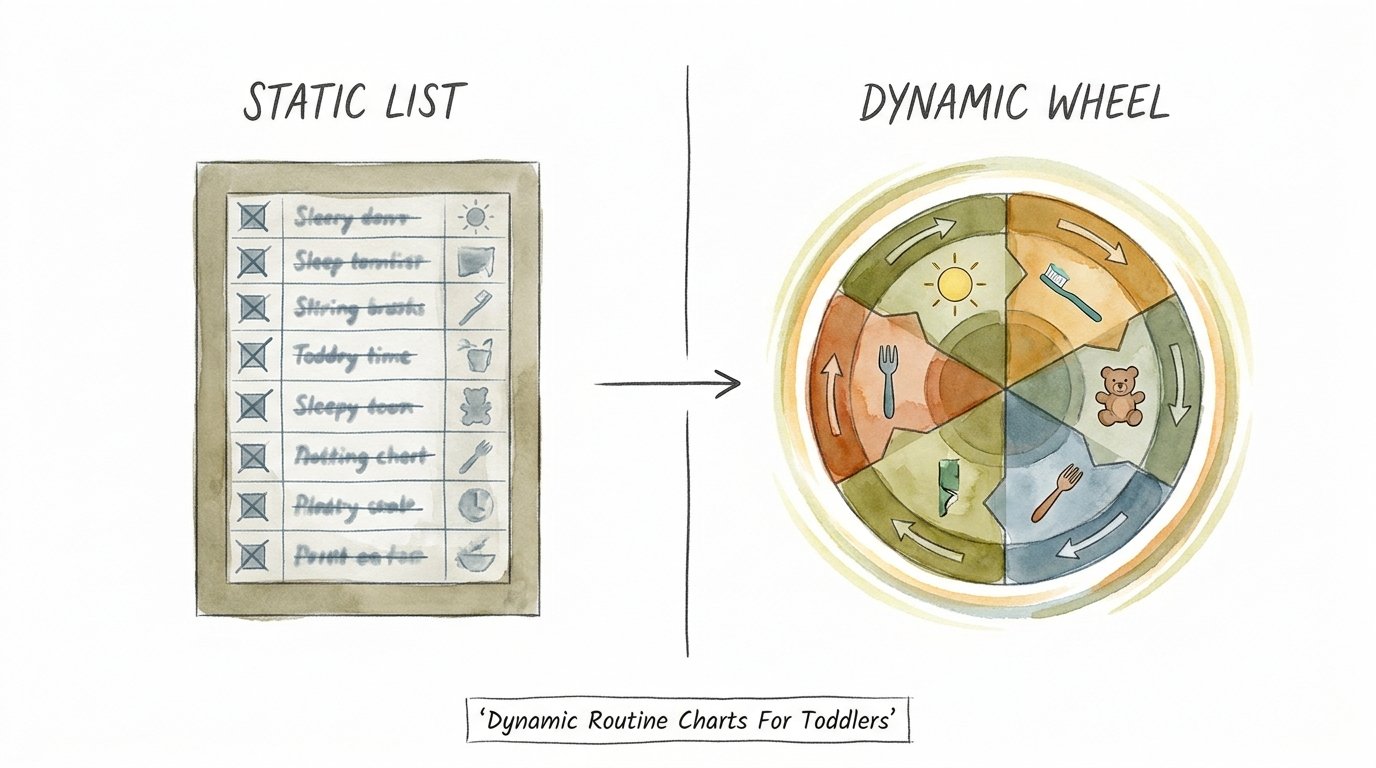
Static List vs. Dynamic Wheel
Understanding why the dynamic approach works better requires a quick look at the competition. Most households use a static list or a simple whiteboard.
| Feature | Static List | Dynamic Wheel |
|---|---|---|
| Interaction | Passive / Visual only | Active / Tactile manipulation |
| Focus | Shows everything at once | Highlights the “Now” |
| Cognitive Load | High (scanning required) | Low (single task focus) |
| Engagement | Quickly becomes “wallpaper” | High due to “toy-like” feel |
Static lists are great for adults who have developed the ability to scan and prioritize. For a toddler, a list is just a wall of noise. The dynamic wheel filters that noise into a single, actionable instruction. This reduces the “choice paralysis” that often leads to tantrums.
Practical Tips for Success
Laminate everything. Toddlers are rough on paper. If your chart isn’t durable, it won’t survive the first week of enthusiastic spinning. Use heavy-duty cardstock and high-quality laminating sheets to ensure the moving parts don’t tear or jam.
Use real photos of your child performing the tasks. While clipart is cute, a photo of your child actually sitting on the potty or holding their toothbrush is much more powerful. It provides a “mirror” for their behavior. They can see themselves being successful, which builds their self-image as a “capable kid.”
Place the chart in the location where the routine happens. Don’t put the “Getting Dressed” wheel in the kitchen. Put it on the closet door. The visual cue needs to be physically linked to the environment where the action takes place. This creates a strong spatial association that helps the brain switch into “task mode.”
Model the usage for at least three days. Don’t just hand it to them and walk away. Spend the first few mornings walking them to the chart, pointing at the picture, and having them spin the wheel. Narrate the process: “The wheel says socks! Let’s get them on so we can spin to shoes!”
Advanced Considerations
Integrating a timer can take a dynamic chart to the next level. For toddlers who struggle with “dawdling,” pairing a visual wheel with a visual countdown timer (like a sand timer or a red-disk clock) adds a layer of time-awareness. This helps them understand that the “spin” needs to happen within a certain window.
Consider a “First/Then” dynamic board for particularly difficult transitions. This is a simplified version of the routine chart that only shows two things: the task they are resisting and the reward that follows. A sliding window that moves from “Put away toys” to “Eat snack” can help neurodivergent children or toddlers in a particularly defiant phase.
Morning and Evening “Modes” are essential as the child grows. You can create a double-sided wheel or a chart with interchangeable discs. This keeps the tool relevant as the day progresses. The “Morning Gear” might be high-energy and bright, while the “Bedtime Gear” uses cooler colors and calming imagery.
Scaling for siblings requires careful thought. If you have two toddlers, they each need their own wheel. Shared charts often lead to “he touched my turn” arguments. Giving each child their own physical tool reinforces their individual autonomy and prevents the routine from becoming a competition.
Example Scenario: The Morning Exit
Imagine a typical Tuesday morning. Usually, you are yelling from the kitchen for your 3-year-old to put on their shoes. They are currently distracted by a dust mote. You feel your blood pressure rising.
Instead, you walk over to their “Morning Mission Wheel” on the bedroom door. You don’t say “Get your shoes.” You say, “Check your mission! What does the wheel say?” The child runs to the wheel. They see the “Shoe” icon in the window. They spin the wheel themselves to reveal the “Backpack” icon, but wait—they realize they haven’t done the shoes yet.
The child sits down, puts on their shoes, and then triumphantly spins the wheel to “Backpack.” They have completed the task without a single direct command from you. You have moved from “Nagger” to “Coach.” The power struggle is bypassed because the child is focused on the mechanical satisfaction of moving the wheel.
This process takes 30 seconds instead of the usual 10-minute battle. By the time you reach the car, the child feels successful and empowered. You haven’t just managed a schedule; you have built their confidence for the day ahead.
Final Thoughts
Dynamic routine charts for toddlers are more than just a craft project. They are a fundamental shift in how we communicate expectations to the developing brain. By moving from a static list to a dynamic, interactive system, we honor the child’s need for movement, autonomy, and clarity.
The transition from “being told” to “doing” is where independence is born. These charts provide the scaffolding necessary for that growth. While they require some initial effort to build and a commitment to consistency, the payoff is a calmer home and a more capable child.
Start small. Choose one routine, build a simple rotating wheel or flip-chart, and watch how your child reacts. You will likely find that when the chart starts moving, the whole family starts moving with it. Embrace the geometry of the routine and turn the daily grind into a daily mission.
Sources
1 lizardcentre.com | 2 positiveparentingconnection.net | 3 metaoh.org | 4 upbility.net | 5 biermanautism.com | 6 sunrayaba.com | 7 moveandplay.com.au | 8 thewolfschool.org | 9 mastermindbehavior.com | 10 discerningparenting.com | 11 gentlecaretherapy.com