Skill Building Routine Charts For Kids
One buys you 15 minutes of quiet today; the other builds a lifetime of competence. A checklist is a disposable tool for a single day. A Mastery System is a legacy tool for a childhood. Why just ‘clean the room’ when you can progress from ‘Clutter Scout’ to ‘Organization Ninja’? Turning a standard routine chart into a multi-use skill tracker shifts the focus from ‘getting it done’ to ‘becoming the person who can do it.’ This transition moves the needle from simple compliance to true capability. Parents often find themselves stuck in a loop of nagging, where the goal is merely to finish a task so the day can proceed.
Instead of chasing a finished task, you can start building a capable human. Every morning routine and every evening cleanup becomes a training ground for executive function and self-reliance. This guide explores the transition from static checklists to dynamic skill-building systems that grow with your child. Readers will learn how to structure routines that provide more than just a clean house—they provide a sense of purpose and a mastery of life skills.
Skill Building Routine Charts For Kids
Skill building routine charts for kids are instructional frameworks designed to teach competence rather than just track completion. Unlike a traditional chore list that simply asks if the bed was made, a skill-building chart tracks the level of proficiency the child has reached. These systems focus on the “how” and “why” of a task, slowly removing the parental “scaffolding” until the child can perform the task independently. These charts exist as a bridge between a parent’s constant reminders and a child’s eventual self-governance.
Real-world application of these charts mirrors professional apprenticeship programs. In a workplace, a junior employee doesn’t just “do work”; they move from “Assistant” to “Lead.” Applying this same logic to home life transforms mundane chores into milestones. A toddler might start as a “Dish Helper” who simply hands plastic cups to an adult. Eventually, that same child progresses to “Dish Specialist,” capable of loading and running the dishwasher without supervision. This method prioritizes the development of the prefrontal cortex, the area of the brain responsible for planning, organization, and focus.
Most standard charts fail because they assume the child already knows how to do the task efficiently. Skill-building charts solve this by breaking complex tasks into manageable micro-skills. For example, “cleaning the room” is not one task; it is a series of decisions regarding sorting, storage, and prioritization. These charts make those hidden steps visible. They provide a roadmap for the child to follow, reducing the cognitive load and preventing the “freeze” response often seen when a child feels overwhelmed by a large request.
The Mechanics of Mastery: How to Build a Skill-Based System
Developing a mastery-based system requires a shift in how parents view household contributions. You must stop seeing chores as labor and start seeing them as curriculum. The process usually involves three distinct phases: Observation, Collaboration, and Independence.
The Scaffolding Method: I Do, We Do, You Do
The “I Do, We Do, You Do” framework is the backbone of skill acquisition. Parents begin by modeling the behavior (I Do) while explaining the logic behind each step. Watching an adult sort laundry while hearing them explain why “lights and darks” stay separate provides the first layer of understanding. Next, the child joins in (We Do). This collaborative phase allows the child to practice the physical movements while the adult provides immediate, corrective feedback in a low-pressure environment. Finally, the child takes over (You Do). The routine chart at this stage acts as a safety net, reminding them of the steps they have already practiced.
Defining Levels of Proficiency
Assigning “ranks” or “levels” to routines keeps the engagement high and the progress measurable. You can use any theme that resonates with your child, such as Video Game Levels, Martial Arts Belts, or Scout Ranks.
- Level 1: Novice / Scout – The child requires 100% supervision and performs small parts of the task.
- Level 2: Apprentice / Hero – The child performs the majority of the task with verbal prompts from an adult.
- Level 3: Specialist / Warrior – The child completes the task independently but needs an adult for final inspection.
- Level 4: Master / Ninja – The child initiates and completes the task perfectly without any reminders.
- Level 5: Mentor / Sensei – The child is capable of teaching a younger sibling or peer how to do the task.
The Visual Structure of the Chart
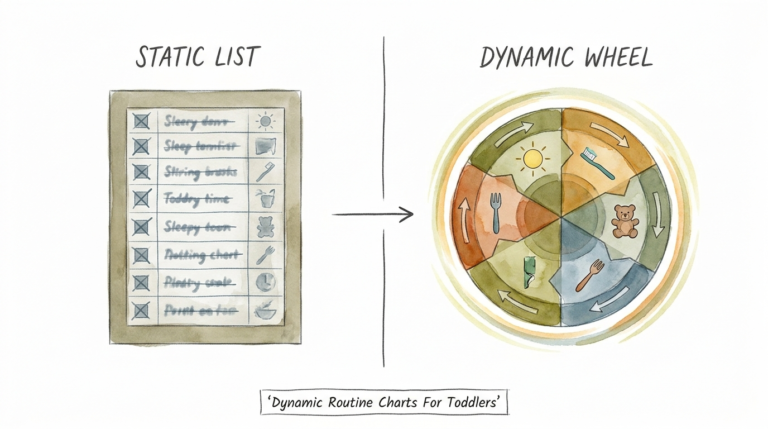
Visual aids are non-negotiable for younger children and highly beneficial for older ones. For toddlers and preschoolers, high-contrast photos of the child actually doing the task are more effective than icons or drawings. Seeing a picture of themselves putting shoes in the bin provides a clear “done state” to aim for. As children grow, the chart can transition to a more detailed “Skill Wheel” or a digital app that tracks experience points (XP). The key is to ensure the chart is located exactly where the task happens. The morning routine chart belongs on the bathroom mirror or bedroom door, not hidden away in a kitchen binder.
Benefits of the Mastery Approach
Choosing a mastery-based approach over a standard checklist offers measurable improvements in both child behavior and household harmony. The primary benefit is the development of Executive Function. These skills—working memory, cognitive flexibility, and inhibitory control—are stronger predictors of adult success than IQ scores.
Increased Self-Efficacy and Confidence
Children who master household skills develop a deep sense of self-efficacy. They don’t just feel good because they were praised; they feel capable because they have tangible proof of their own competence. This internal validation is far more powerful than the external “good job” a parent might provide. When a child knows they can cook a simple meal or manage their own laundry, they carry that confidence into the classroom and social circles.
Reduction in Power Struggles
Nags and arguments often stem from a mismatch in expectations. A parent says “clean your room,” but the child doesn’t actually know where to start, leading to defiance as a defense mechanism. Skill-building charts remove the ambiguity. The chart becomes the “boss,” not the parent. If the chart says “Level 3 Cleaning” includes clearing the floor and making the bed, there is no room for debate. This shifts the parent’s role from “Enforcer” to “Coach.”
Long-Term Time Efficiency
Investing time in teaching a skill today saves hundreds of hours of labor in the future. Parents often think, “It’s faster if I just do it myself.” While true in the short term, this mindset creates a “Competence Gap” that only grows wider as the child ages. A child taught to manage their own morning routine at age seven is a child who doesn’t need to be woken up and nagged every five minutes at age fifteen. The mastery system builds a foundation that eventually removes the burden of “mental load” from the parents.
Challenges and Common Pitfalls
Moving to a skill-based system isn’t without its hurdles. Many parents start with high energy but find the system stalling after a few weeks. Understanding these pitfalls helps in creating a more resilient routine.
The Complexity Trap
Over-engineering the chart is the most frequent mistake. A system that requires stickers, color-coding, points, and a complex spreadsheet is a system that will fail the moment life gets busy. The most effective routine charts are simple enough to be understood in five seconds. If the child finds the chart itself confusing, they will never use it to master the actual skills. Focus on one or two key skills at a time rather than trying to overhaul every habit at once.
Prioritizing Compliance Over Competence
Parents sometimes fall back into the habit of rewarding a “quick job” rather than a “right job.” If a child gets a point for a messy bed, they learn that the goal is the point, not the mastery. You must be willing to hold the line on the “Mastery Standard.” This doesn’t mean being a drill sergeant; it means calmly pointing out the missing steps and encouraging the child to try again. Learning that “good enough” isn’t the same as “mastered” is a vital life lesson.
Inconsistency in Feedback
Skill building relies on a tight feedback loop. If a child works hard to reach “Level 3” in a task, but the parent doesn’t notice or update the chart for a week, the motivation will plummet. Positive reinforcement should be immediate and specific. Instead of “You’re so helpful,” try “I noticed you remembered to clear the table without me asking—that’s a huge step toward your next rank!”
Limitations and When This May Not Work
While mastery systems are powerful, they are not a universal cure for every household issue. Certain environmental and biological factors can limit their effectiveness.
Neurodivergence and Executive Dysfunction
Children with ADHD or Autism may struggle with the “initiation” part of a routine, regardless of how well they know the skill. For these children, a chart that tracks mastery is still useful, but they may require more frequent “body doubling” (working alongside them) or visual timers to help them bridge the gap between knowing what to do and actually doing it. A mastery system for a neurodivergent child should focus heavily on environmental supports, like bin systems and color-coded zones, to reduce the cognitive load.
High-Stress Seasons
During times of family crisis, moving, or significant schedule changes, the “training” aspect of these charts should take a backseat. Maintaining basic habits is more important than leveling up when the family is under pressure. It is okay to revert to a “Level 1” (high parent involvement) status temporarily to keep the household running. The system should serve the family, not the other way around.
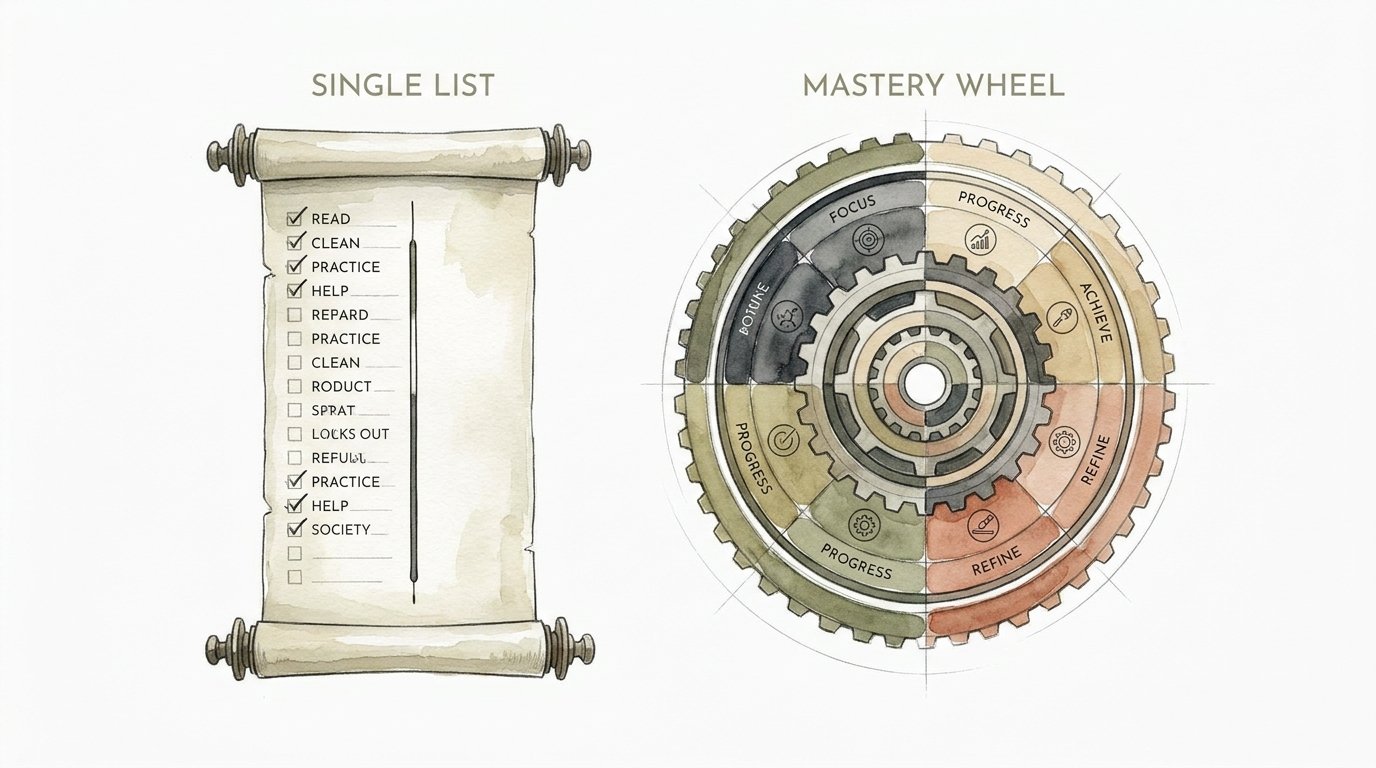
Comparison: Single List vs. Mastery Wheel
Understanding the difference between these two tools helps you choose the right one for your child’s current developmental stage.
| Feature | Standard Checklist (Single List) | Skill Building Chart (Mastery Wheel) |
|---|---|---|
| Primary Goal | Task completion (Daily “Done”) | Skill acquisition (Long-term growth) |
| Longevity | Short-term; needs constant updates | Long-term; grows with the child |
| Feedback Style | Binary (Yes/No) | Progressive (Levels 1-5) |
| Motivation | Extrinsic (Stickers/Rewards) | Intrinsic (Competence/Identity) |
| Parental Role | Inspector / Nagger | Mentor / Coach |
Practical Tips for Implementation
Success with skill-building charts often comes down to the small details of how they are introduced and maintained. These best practices ensure the system remains a helpful tool rather than a chore for the parent.
- Involve the child in the design. Letting a child choose their “Hero Name” or the theme of their ranks increases their buy-in immediately. Ownership is the first step toward responsibility.
- Focus on “Habit Stacking.” Attach new skills to existing habits. If they already brush their teeth, add “putting away the laundry” to the immediate aftermath of that habit.
- Use “Low-Stakes” times for training. Do not try to teach a new morning routine on a Monday morning when you are running late. Practice the routine on a relaxed Saturday afternoon when the pressure is off.
- Normalize the “Reset.” Things will go off the rails. When a routine fails for a few days, simply call a “Family Huddle,” adjust the chart if needed, and start again without guilt.
- Rotate the “Master” roles. If you have multiple children, let the one who has mastered a skill be the “Inspector” for a younger sibling. This reinforces their knowledge and provides a status-based reward.
Advanced Considerations: The Psychology of Self-Determination
Serious practitioners of this method should look into **Self-Determination Theory (SDT)**, which posits that humans have three basic psychological needs: Autonomy, Competence, and Relatedness. A skill-building routine chart addresses all three when implemented correctly.
Competence is addressed through the “Ranking” system, showing the child exactly how they are improving. Autonomy is supported by giving children choices within the routine. Instead of “Clean your room now,” try “Do you want to achieve your Level 2 in laundry or Level 3 in toy sorting first?” This gives the child a sense of agency. Relatedness is built because the chores are framed as “contributions to the family team” rather than isolated tasks.
Advanced systems can also incorporate **Natural Consequences** rather than arbitrary punishments. In a mastery-based house, the “reward” for being a “Laundry Ninja” might be the privilege of choosing a new outfit or staying up 15 minutes later to read because they saved the family time. If a child fails to perform their mastered task, the consequence is the loss of that time—perhaps a shorter playtime because the task still needs to be finished. This teaches the child that their actions (or inactions) have a direct impact on their own life and the lives of those around them.
Examples and Scenarios
Looking at how this works in real-time can help clarify the difference between a checklist and a mastery system.
Scenario: The “Morning Launch” Routine
Standard Checklist approach: A list on the fridge says: Get dressed, eat breakfast, pack bag. The parent follows the child around saying, “Did you do it? Check the list!”
Mastery System approach: The chart defines three ranks for the “Morning Launch.”
- Rank 1 (Cadet): Parent helps pick out clothes and prepares breakfast. Child puts on shoes.
- Rank 2 (Pilot): Child gets dressed and packs their own bag using a visual guide. Parent provides a “Pre-flight Check” at the door.
- Rank 3 (Commander): Child wakes up to their own alarm, completes all tasks, and meets the parent at the car at a specific time.
The child is motivated to reach “Commander” because it comes with the “status” of being a self-governing member of the house.
Scenario: The Kitchen “Dish Duty”
In this scenario, a 10-year-old might be a “Dish Apprentice.” They know how to rinse plates and put them in the bottom rack. To reach “Specialist,” they must learn how to load the top rack efficiently and handle delicate glassware safely. The parent spends 10 minutes teaching the “Top Rack Strategy.” Once the child demonstrates this five times, they “Level Up” on the chart. This small ceremony makes the child feel like they are gaining ground, turning a boring chore into a skill achievement.
Final Thoughts
Building a skill-based routine system is an investment in your child’s future self. These tools do much more than keep a house tidy; they provide a structured environment where a child can fail safely and succeed visibly. Moving from a “getting it done” mindset to a “becoming capable” mindset changes the energy of the home. It replaces the friction of nagging with the momentum of growth.
Start by choosing one area of the house where the current routine is failing. Apply the “I Do, We Do, You Do” framework and create a simple rank-based chart. Watch as your child’s perspective shifts from “What do I have to do?” to “What can I master next?” The quiet you buy today through a checklist is temporary, but the competence you build through a mastery system lasts forever.
Encourage your children to see themselves as contributors, not just consumers, of the household’s peace and order. This mindset, once established, will serve them far beyond the walls of your home, helping them navigate college, careers, and their own future families with confidence. Experiment with different themes, keep the feedback positive, and remember that the goal is progress, not perfection. Every small step toward independence is a victory for both the parent and the child.
Sources
1 jobcannon.io | 2 helpmegrowutah.org | 3 strong4life.com | 4 ladderofsuccessaba.com | 5 leaderboarded.com | 6 societyofcare.org | 7 handspringhealth.com | 8 kidsfirstservices.com | 9 imagineelc.com.au | 10 idratherbewriting.com | 11 sais.edu.hk | 12 firstthings.org