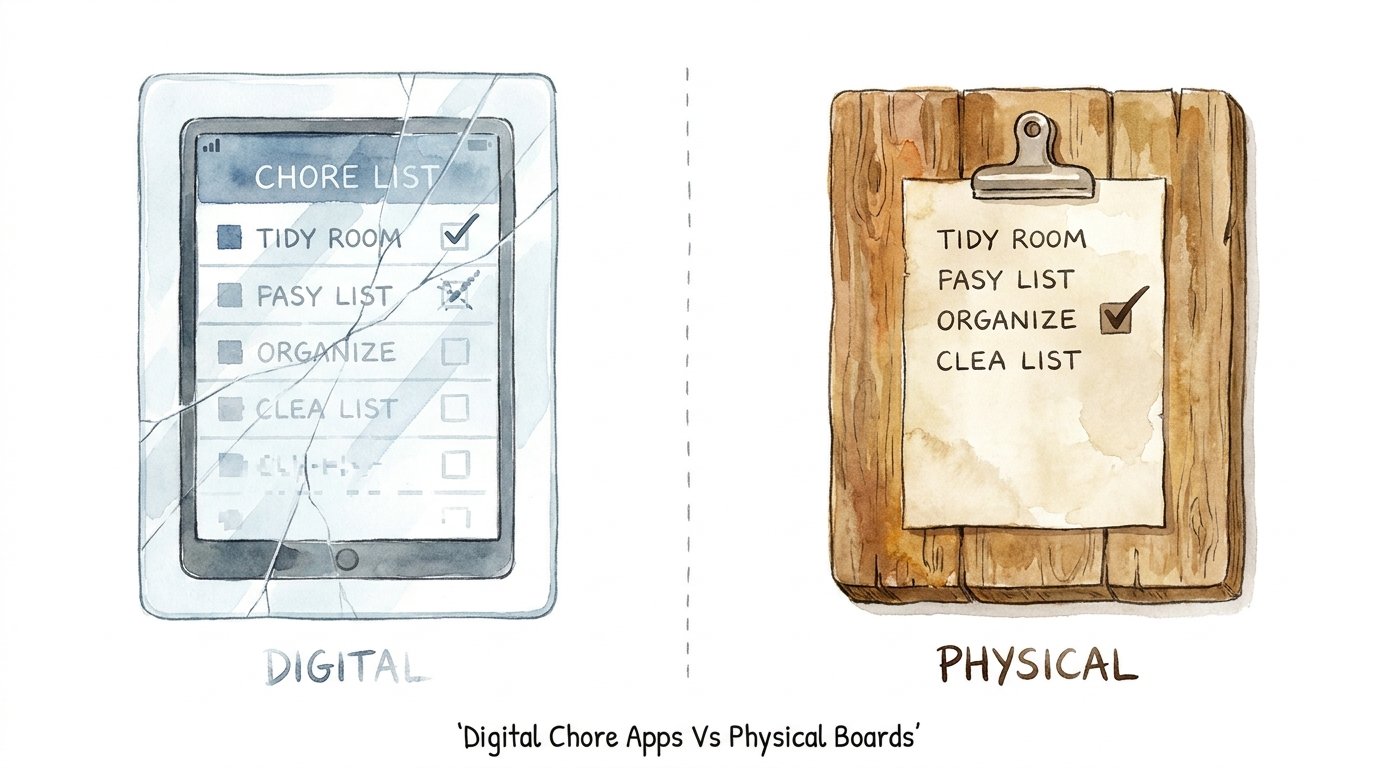
Digital Chore Apps Vs Physical Boards
When the Wi-Fi drops, does your child’s morning routine crash with it? We’ve traded physical reliability for digital ‘convenience,’ but a routine that requires a charger is a routine with a single point of failure. Physical boards offer a sensory ‘click’ and a visual permanence that a pixels simply cannot match. Build a system that doesn’t need a firmware update to help your child brush their teeth.
Introducing a resilient routine into your home starts with recognizing where the friction lives. Digital systems often hide behind lock screens and notification badges that compete with endless distractions. Physical boards stand as silent, unmovable sentinels in your hallway or kitchen. They provide a constant environmental prompt that anchors a child’s day in reality rather than in a glow.
Every parent wants to raise a self-sufficient human. The journey from “did you do your homework?” to a child who manages their own time is built on clear, consistent visual feedback. Moving away from the fragility of digital trackers toward a tactile system creates a foundation that works even when the power is out.
Digital Chore Apps Vs Physical Boards
Digital chore apps are software programs designed to gamify household responsibilities. They exist to bring convenience to parents by providing automated reminders, syncing across multiple devices, and offering virtual rewards like coins or badges. In a world where parents are often in different locations, these apps help keep everyone on the same page regarding task completion and allowance.
Physical boards are tangible tools like wooden sliders, magnetic charts, or simple chalkboards. They live in the physical environment, usually mounted at eye level for the child. Unlike an app that requires a parent to hand over a smartphone, a physical board is always “on.” It serves as a visual anchor in the home, providing a persistent reminder of what needs to happen next.
Think of a digital app like a GPS on your phone; it tells you where to go, but you might stop paying attention to the road. A physical board is like a physical map and a compass; it requires you to engage with your surroundings and understand the terrain. While apps offer high-tech features, they often introduce “digital friction”—the steps of finding a device, unlocking it, and navigating past social media notifications just to see if the cat has been fed.
Real-world situations often expose the fragility of digital systems. A dead battery or a lost iPad can derail a bedtime routine in seconds. Conversely, a wooden chore board is a “low-tech, high-utility” solution. It doesn’t suffer from notification fatigue and it won’t distract your child with a YouTube recommendation while they are trying to log their progress.
How the Physical Routine System Works
Building a resilient routine requires understanding the “Feedback Loop.” Every habit consists of a cue, an action, and a reward. Physical boards excel at the “cue” phase because they are a permanent fixture in the child’s visual field. When a child walks past a wooden board with their name on it, the visual presence of an un-flipped slider serves as an immediate environmental prompt.
Tactile interaction is the secret sauce of physical systems. Research into “The Enactment Effect” suggests that physically moving an object helps the brain encode information more deeply. When a child moves a wooden token from “To Do” to “Done,” they receive a sensory “click” or a satisfying magnetic snap. This physical movement provides a dopaminergic hit that is more grounding than a simple tap on a glass screen.
Step-by-step implementation involves selecting a central location, like the kitchen or the mudroom. You define 3–5 core “anchor tasks” for each part of the day, such as making the bed, brushing teeth, and putting away shoes. The child interacts with the board independently, checking off items as they go. This removes the parent from the role of “The Nagger” and places the child in the role of “The Manager.”
Visual persistence is a key underlying principle here. In psychology, “Visual Persistence” refers to the ability of an object to stay in the peripheral vision and maintain its influence on behavior. A digital notification disappears once it is swiped away. A physical board remains visible until the task is complete, creating a gentle, non-verbal pressure to finish the job.
Benefits of a Resilient Physical System
Tactile engagement leads to better memory retention. Maria Montessori famously said, “What the hand does, the mind remembers.” Physical boards require children to use their fine motor skills to manipulate sliders, magnets, or pegs. This hands-on interaction strengthens neural pathways related to habit formation and responsibility.
Zero screen time is perhaps the most immediate health benefit. Modern parents are increasingly concerned about “digital fatigue” and the impact of blue light on a child’s circadian rhythm, especially during morning and evening routines. Using a wooden board ensures that the first and last things your child interacts with during the day are natural materials rather than a high-stimulation device.
Autonomy grows when a child can see their own progress without asking for a phone. Physical boards empower children to take ownership of their schedule. They don’t have to wait for a parent to unlock a device to see what’s next. This independence builds self-confidence and reduces the power struggles that often occur when parents are forced to act as constant reminders.
Cost-effectiveness is a major advantage for the long-term household budget. Most high-quality digital chore apps require a monthly subscription, which can cost between $60 and $120 per year. A well-made wooden or magnetic board is a one-time investment that can last for a decade. It never requires a software update, and it will never go obsolete when an operating system changes.
Challenges and Common Mistakes
Losing physical components is the most common pitfall. Magnets can fall behind the fridge, and wooden pegs can vanish into toy boxes. To avoid this, choose systems with integrated sliders or “captive” pieces that cannot be removed from the board. If you use a system with loose parts, establish a “home base” container nearby to prevent the system from becoming incomplete and unusable.
Setting up too many tasks at once often leads to burnout. Parents frequently get excited and list 15 different chores, overwhelming the child. This mistake happens because parents view the board as a “to-do list” rather than a “habit builder.” Start with three essential tasks and only add more once the first three have become automatic.
Failure to update the tasks can make the board “invisible” over time. When a child has mastered a routine, the board can become part of the background noise of the house. To prevent this “static fade,” periodically refresh the tasks or change the location of the board. Keeping the system dynamic ensures that the child remains engaged with the process.
Ignoring the “reset” phase is another frequent error. For a routine to be resilient, the board must be reset every evening or morning. If a child wakes up and sees yesterday’s tasks already marked as “Done,” the system loses its credibility. Incorporate the “Reset” as a final step in the evening routine to ensure a fresh start every day.
Limitations of Physical Boards
Portability is a primary constraint for physical systems. While an app travels in your pocket, a wooden board is usually anchored to a wall. This makes it difficult to maintain the routine during vacations or trips to a grandparent’s house. For families who travel frequently, a physical board may need to be supplemented by a simplified travel version or a temporary printable checklist.
Scaling for very large families can lead to cluttered walls. If you have five children, five separate wooden boards can take up significant real estate in a small kitchen. In these scenarios, a single large “Command Center” board or a modular system might be necessary. Physical space is a finite resource, and large families must be strategic about where they place their visual aids.
Data tracking is non-existent with most physical boards. If you want to see a pie chart of your child’s completion rate over the last six months, a wooden board cannot provide that. Parents who value analytical insights or need to track complex allowance structures over long periods may find physical boards too simplistic for their record-keeping needs.
Physical boards are not easily modified once they are “set.” If you buy a pre-printed wooden board and your routine changes, you cannot simply “swipe and delete” a task. This trade-off means you must be more intentional about the tasks you choose. It forces a level of stability that apps lack, but it can be frustrating if your family’s schedule is in a constant state of flux.
System Comparison: Digital vs. Physical
| Factor | Digital Chore Apps | Physical (Wooden) Boards |
|---|---|---|
| Annual Cost | $60 – $120 (Subscriptions) | $0 – $45 (One-time) |
| Battery Life | Requires frequent charging | Infinite (No power needed) |
| Distraction Risk | High (Notifications, games) | Zero |
| Sensory Feedback | Digital “ding” or haptic tap | Tactile “click,” magnet snap |
| Visibility | Hidden behind lock screen | Always on (Environmental) |
| Maintenance | Firmware & app updates | Occasional dusting / Resetting |
Practical Tips for a Resilient Setup
Placement is the most critical factor for success. Mount the board at the child’s eye level, not the adult’s. A board that is too high to reach or too low to see will quickly be ignored. The “Path of Least Resistance” rule applies here: place the board exactly where the action happens. A teeth-brushing reminder belongs in the bathroom, not the living room.
Use “Chore Bundling” to improve efficiency. Instead of listing every tiny step, group related actions under a single heading. “Morning Grooming” could include brushing hair, washing face, and applying sunscreen. This prevents the board from looking cluttered while still guiding the child through the necessary sequence of events.
Implement a “Tiered Reward” system to maintain interest. While the physical act of moving a slider is rewarding for a 4-year-old, a 10-year-old may need more motivation. Connect the completion of the board to “Unlocking” privileges. For example, the Wi-Fi password is only provided once the physical board shows all tasks as “Done.” This bridges the gap between the physical world and digital rewards.
Color-coding helps with “At-a-Glance” processing. If you have multiple children, assign each child a specific color for their board or magnets. This allows everyone to see the status of the household’s productivity from across the room. It fosters a sense of healthy competition and collective responsibility without requiring anyone to “log in” to a dashboard.
Advanced Considerations for Executive Function
Physical boards are essential tools for children with ADHD or other executive function challenges. These children often struggle with “Time Blindness” and working memory. A digital notification is an “interrupter” that can lead to frustration, but a physical board acts as an “External Brain.” It holds the information so the child’s working memory doesn’t have to, reducing the cognitive load and preventing meltdowns.
The neurobiology of the “Done” state is powerful. When we finish a task, the brain releases a small amount of dopamine. Physical boards maximize this by adding a motor component to the completion. The larger the physical movement (like flipping a large wooden tile), the more significant the internal sense of accomplishment. This is why “low-tech” solutions often result in “high-stick” habits.
Consider the “Zeigarnik Effect,” which states that the brain experiences tension when a task is left unfinished. A physical board with an open slider creates a visual “unclosed loop” that the brain naturally wants to close. Digital apps try to replicate this with red notification circles, but those circles are often associated with stress. A physical gap on a wooden board feels more like a puzzle piece waiting to be placed.
Environmental design is a form of passive parenting. By choosing “Resilient Wood” over “Fragile Digital,” you are designing an environment that promotes calm and focus. The aesthetic of natural materials has been shown to reduce stress levels compared to plastic or high-tech interfaces. A beautiful wooden board is not just a tool; it is a piece of your home’s architecture that signals “This is a place of order and rhythm.”
Real-World Scenarios
Imagine a Tuesday morning where the power has gone out due to a storm. In a digital-first home, the tablet is dead, the smart speaker won’t play the “getting ready” music, and the parent is frantically trying to remember the school’s updated lunch schedule. The children are aimless because their “prompts” have disappeared.
In a resilient-wood home, the morning continues as planned. The children walk to the hallway, see their wooden sliders, and move through their routine: Dress, Eat, Pack Bag, Brush Teeth. The lack of Wi-Fi is an inconvenience for the adults, but for the children, the “operating system” of their morning is untouched. They remain calm because their visual support is independent of the grid.
Consider another scenario: a child who is easily overstimulated by screens. Every time they are handed a phone to check their “chore app,” they end up begging to play a game or watch a video. This creates a 20-minute battle that defeats the purpose of the chore itself. By switching to a magnetic board on the fridge, the “Screen-to-Tantrum” pipeline is severed. The child does the chore, moves the magnet, and moves on to play with their actual toys.
Final Thoughts
Building a routine that doesn’t rely on a firmware update is one of the most practical gifts you can give your family. Physical boards provide a level of reliability and sensory feedback that digital apps simply cannot duplicate. They transform the home from a place of digital nagging into a space of visual clarity and child-led autonomy.
Moving toward a “Resilient Wood” system is not about being anti-technology. It is about choosing the right tool for the job. For daily habit formation and the development of executive function, the physical world offers a permanence and a “weight” that helps children ground themselves in their responsibilities.
Experiment with a simple physical board this week. Start small, stay consistent, and watch how the sensory “click” of a completed task does more for your child’s independence than a thousand push notifications ever could. By simplifying the system, you amplify the results.
Sources
1 mychoreboard.com | 2 printablechorechart.com | 3 everblog.com | 4 family-checklist.com | 5 coldplayedeffect.com | 6 kokoroapp.online | 7 occolondon.co.uk | 8 funderstanding.com | 9 structural-learning.com | 10 thenurts.com | 11 futureself-ai.com | 12 visionboard2026.com | 13 affinitypsych.com