Screen Time And Emotional Regulation In Toddlers
If the battery dies, does their ability to stay calm die with it? When we use screens to ‘fix’ a child’s mood, we create a fragile system. Statistics suggest that children who rely on digital distraction for emotional regulation struggle more with frustration later in life. Resilience isn’t built in an app; it’s built in the quiet moments of waiting and self-soothing.

Parenting in the digital age feels like a high-wire act without a net. You are exhausted. The toddler is screaming in the middle of a crowded restaurant. The easiest, fastest solution is sitting right in your pocket. You hand over the phone, and like magic, the screaming stops. Peace returns.

But that peace comes with a hidden price tag. Research from institutions like Michigan Medicine and JAMA Pediatrics suggests that this “digital pacifier” might be short-circuiting your child’s brain. Instead of learning how to navigate big feelings, they are learning how to escape them. This isn’t just about “too much TV.” It is about how the human brain develops the hardware for self-control.
Understanding the link between screens and emotional development is the first step toward building a resilient kid. This guide explores why digital distraction often backfires and how you can help your toddler build the internal tools they need to stay calm—even when the battery is at zero.
Screen Time And Emotional Regulation In Toddlers
Screen time and emotional regulation in toddlers refers to the relationship between digital device use and a child’s ability to manage their feelings, impulses, and behaviors. In the first few years of life, a child’s brain is under construction. They are building the prefrontal cortex, which is the command center for executive function. This center handles everything from waiting your turn to not hitting a friend when you’re angry.
When a toddler is upset, they are experiencing a “neurological storm.” Their nervous system is overwhelmed. In a traditional setting, a caregiver helps them “co-regulate.” You hold them, label the feeling, and help them breathe. Over time, the child internalizes these patterns. They learn that feelings are temporary and manageable. This is the foundation of emotional resilience.
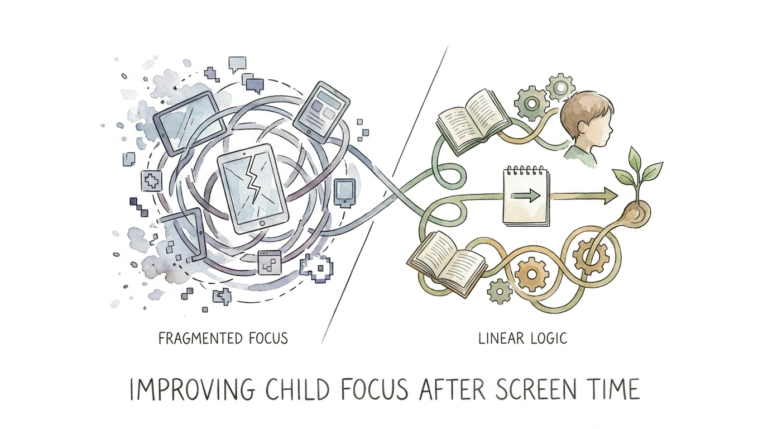
Digital escapism changes the math. When a child is handed a tablet during a meltdown, the brain receives a massive hit of dopamine from the bright lights and fast-paced content. The “bad” feeling isn’t processed; it is simply paved over by a digital high. This is used in real-world situations like grocery lines, doctor’s offices, and long car rides to maintain order. However, because the child never practices the hard work of calming down naturally, their “emotional muscles” remain weak.
The statistics are sobering. Recent studies involving over 400 children aged 3 to 5 found that frequent use of mobile devices to calm upset children was associated with increased emotional dysregulation just six months later. This effect was even more pronounced in boys and children who already had high-spirited temperaments. We are trading long-term stability for short-term quiet.
How the “Digital Pacifier” Works (And Why It Fails)
To understand why screens are such a powerful—yet dangerous—tool, we have to look at the underlying principles of brain development. Toddlers are sensory learners. They need to interact with the physical world to understand cause and effect. They need to feel the weight of a block, the coldness of water, and the warmth of a hug.
The process of learning to self-soothe involves three main steps:
- Arousal: The child feels a strong emotion (anger, fear, frustration).
- Processing: The child notices the sensation and looks for a way to handle it.
- Resolution: The child uses a strategy (deep breathing, seeking a hug) to return to a baseline state.
Screens skip the processing and resolution steps entirely. The device acts as a powerful external regulator. It highjacks the child’s attention so completely that the original emotion is forgotten, but not resolved. Imagine trying to learn how to ride a bike, but every time you start to wobble, someone catches you and puts you in a car. You never learn to balance. You only learn to rely on the car.
Common pitfalls in this process include “displacement.” This happens when screen time replaces the face-to-face interactions children need to read non-verbal cues. If a child spends their “bored” time staring at a screen, they miss the chance to observe human faces, practice eye contact, and learn empathy. These are the building blocks of social-emotional intelligence.
The Benefits of Building Emotional Resilience
Choosing the harder path—venturing into the world without a digital safety net—offers measurable advantages for a child’s future. When you prioritize resilience over distraction, you are giving your toddler a “mental toolkit” that lasts a lifetime. This isn’t just about behavior; it’s about brain architecture.
Children who develop strong self-regulation skills often show:
- Better Academic Performance: Executive function is a better predictor of school success than IQ. Kids who can focus and ignore distractions learn more efficiently.
- Stronger Social Bonds: A child who can manage their frustration is less likely to have peer conflicts and more likely to develop deep, lasting friendships.
- Lower Risk of Addiction: Early reliance on “quick fixes” for emotional pain can set a template for later life. Building resilience now protects them from the “escape” mentality.
- Higher Creativity: Boredom is the mother of invention. When a kid doesn’t have a screen to fill every gap, they are forced to use their imagination.
Practical benefits also extend to the parents. While the “unplugged” path is harder at first, it eventually leads to a child who can sit through a meal or wait in line without a meltdown. You are investing in a future where you don’t have to carry a charger everywhere you go just to keep the peace.
Challenges And Common Mistakes
Transitioning away from screens as an emotional tool is notoriously difficult. Many parents find themselves stuck in a “vicious circle.” The child has a meltdown, the parent gives them a screen to stop the noise, the child’s regulation skills weaken, and the next meltdown is even worse. This leads to the parent feeling even more desperate for the screen.
One of the biggest mistakes is the “Cold Turkey” Trap. Suddenly removing all devices without providing a replacement strategy often leads to chaos. Children don’t know how to handle the sudden “quiet” and will escalate their behavior to get the stimulation they are used to. You have to teach them the new skill before you take away the old crutch.
Another frequent error is ignoring parental screen use. Children are mimics. If they see you reaching for your phone every time you have a spare second or a stressful moment, they will assume that is how humans handle life. You cannot teach resilience while you are practicing digital escapism yourself. Modeling is the most powerful teaching tool you have.
Social pressure also plays a role. We live in a world where parents feel judged for a crying child. This shame often drives the reach for the “digital pacifier.” Acknowledging that “it’s okay for my child to be loud while they learn” is a radical and necessary shift in mindset.
Limitations: When Screens Aren’t the Only Factor
It is important to maintain a balanced perspective. Screens are a significant factor, but they are not the only factor in a child’s emotional health. This section is vital for parents who feel overwhelmed by guilt. Sometimes, a child’s struggle with regulation is tied to things beyond a tablet.
Realistic constraints include:
- Neurodiversity: Children with ADHD, Autism, or sensory processing disorders may have different neurological “baselines” for regulation. For these children, screens can sometimes be a legitimate therapeutic tool if used intentionally.
- Environmental Stress: If a household is under high stress (financial, emotional, or transitional), a child’s ability to regulate will naturally decrease. The screen use in these cases is often a symptom of the stress, not just the cause.
- Developmental Leaps: Toddlers go through “sensitive periods” where their brains are re-wiring. During these times (like the “terrible twos” or “threenage” years), even the most resilient kid will have meltdowns.
A balanced understanding means recognizing that a 20-minute video while you cook dinner is not the same as using a phone to stop every tantrum. The goal is intentionality, not total elimination. Screens are a tool; they should not be the architect of your child’s emotional state.
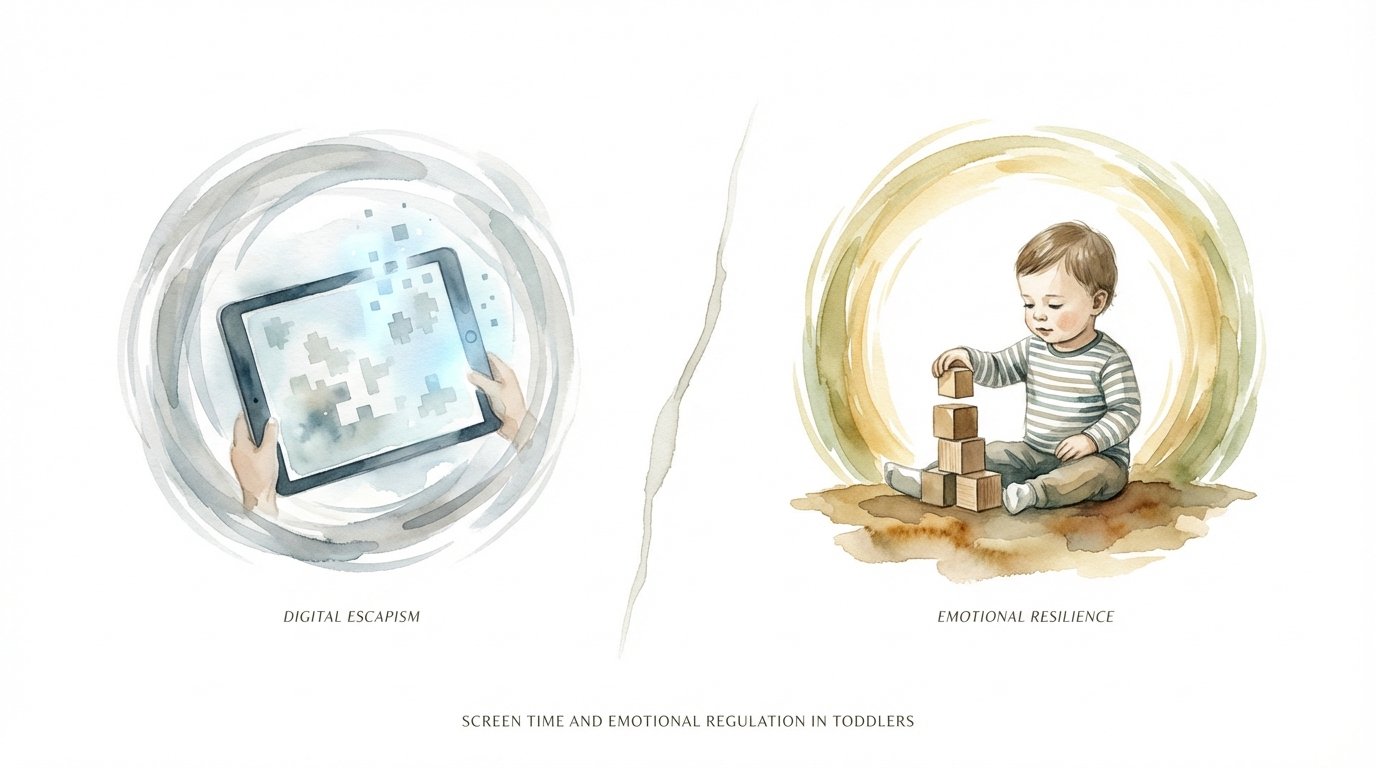
Digital Escapism vs. Emotional Resilience
To see the difference clearly, we can compare the outcomes of these two approaches. While digital escapism focuses on extinguishing the behavior, emotional resilience focuses on educating the child. The table below breaks down the core differences.
| Feature | Digital Escapism | Emotional Resilience |
|---|---|---|
| Immediate Goal | Silence and distraction. | Understanding and soothing. |
| Child’s Role | Passive consumer. | Active participant. |
| Brain Impact | Dopamine spikes; suppresses EF. | Strengthens prefrontal cortex. |
| Long-term Effect | Increased impulsivity. | Higher frustration tolerance. |
| Parental Effort | Low (initially). | High (initially). |
The complexity of building resilience is higher, but the maintenance cost is much lower. A child who can regulate themselves doesn’t need constant external management. They become more independent and capable of navigating the “real world” with confidence.
Practical Tips For Building Resilience
If you want to move away from screens and toward resilience, you need actionable strategies. You are essentially coaching an athlete; it takes practice, repetition, and a good game plan. Here is how to start today.
1. Name the Feeling to Tame the Feeling
When your child is upset, help them put a label on the emotion. Say, “You are feeling frustrated because that block fell down.” This moves the experience from the emotional part of the brain to the logical part. Even if they can’t speak yet, hearing you name the feeling provides a sense of order.
2. Create a “Calm-Down Corner”
Designate a small space in your home filled with sensory, non-digital tools. Think soft pillows, a weighted blanket, fidget toys, or “calm down jars” (glitter in water). Encourage your child to go there when they feel “big feelings.” This teaches them that they have a place to go to find peace that doesn’t involve a power button.
3. Practice “Wait Time”
Build the “waiting muscle” in low-stakes situations. Start with just 30 seconds of waiting for a snack. Don’t provide a distraction. Let them experience the slight discomfort of waiting. Gradually increase the time. This builds inhibitory control, a key component of executive function.
4. Use Sensory Resets
Sometimes a physical change can break an emotional loop. A splash of cool water on the face, a “bear hug,” or jumping up and down for ten seconds can reset the nervous system. These are “manual overrides” that work much better than digital ones because they keep the child present in their body.
5. The “Boredom” Challenge
Allow your child to be bored. Don’t rush to fill every silence with an activity. Boredom is the space where creativity is born. Watch what they do when they have nothing to do—usually, they will eventually find a toy, a leaf, or a game of pretend. This is them building their own internal world.
Advanced Considerations: Moving Toward “Digital Resilience”
For those ready to go beyond the basics, we must discuss Digital Resilience. This is the idea that we don’t just protect kids from screens; we teach them how to use technology without being used by it. As they get older, they will need to know how to navigate the digital world.
Serious practitioners suggest focusing on Active vs. Passive use. Passive use is “zoning out” to a stream of random videos. Active use is using a device to create something—like taking photos of bugs in the backyard or video chatting with Grandma. Active use requires more cognitive effort and is less likely to lead to the “digital pacifier” effect.
Consider the “Three C’s” framework: Content, Context, and the Child.
- Content: Is the show slow-paced and educational (like Mister Rogers) or high-arousal and frantic?
- Context: Are they watching alone in a dark room, or are you watching with them and talking about what’s happening?
- The Child: How does your specific child react? If they “glaze over” or become aggressive when the screen turns off, that content is likely too stimulating for their current regulation level.
Optimization in the digital age means using screens as a planned “vitamin” rather than an emergency “painkiller.” When screen time is a predictable, scheduled part of the day, it loses its power as a tool for emotional escape.
Example Scenario: The Grocery Store Meltdown
Let’s look at a realistic example of how to apply these theories. You are at the grocery store. Your 3-year-old wants a sugary cereal. You say no. They begin to scream. In the past, you’ve reached for your phone to stop the scene.
The Resilience Approach:
Instead of the phone, you stop the cart. You get down on their level. You say, “I see you are really mad. You wanted that cereal and I said no. It’s okay to be mad, but we are not screaming.” You offer a “job” instead. “I need your help. Can you help me find five red apples?”
The Reasoning:
By acknowledging the emotion, you validated their experience. By giving them a “job,” you used cognitive redirection. You didn’t distract them with a digital high; you redirected their energy into a real-world task. They might still whimper, but they are learning that they can feel a “no” and still function. This is a massive win for their developing brain.
The Long-term Result:
The next time you say no, the meltdown will likely be shorter. Why? Because they’ve survived a “no” before without needing a screen to save them. They are learning that they are strong enough to handle their own disappointment.
Final Thoughts
Building emotional resilience in a world of instant digital gratification is one of the hardest tasks of modern parenting. It requires us to sit with our children’s discomfort—and our own. It means choosing the long, messy conversation over the quick, quiet fix. But the rewards are beyond measure.
When you prioritize internal regulation over digital distraction, you are building a child who is “future-proof.” You are giving them the ability to focus, to empathize, and to stay calm in the face of life’s inevitable storms. You are ensuring that their peace of mind doesn’t depend on a Wi-Fi signal or a full battery.
Start small. Choose one transition today where you would usually reach for a screen and try a “sensory reset” or a “feeling label” instead. Experiment with the quiet moments. You might find that in teaching your child to be still, you find a little more peace for yourself as well. The journey to resilience is a marathon, not a sprint, but every step away from the screen is a step toward a stronger, healthier future.
Sources
1 medium.com (https://medium.com/@eloisaamae/the-digital-pacifier-why-screens-fail-young-minds-d6aa600d62c2) | 2 michiganmedicine.org (https://www.michiganmedicine.org/health-lab/frequently-using-digital-devices-soothe-young-children-may-backfire) | 3 apa.org (https://www.apa.org/news/press/releases/2025/06/screen-time-problems-children) | 4 zerotothree.org (https://www.zerotothree.org/resource/how-to-foster-resilience-in-infants-and-toddlers-a-guide-for-educators-and-caregivers/) | 5 subscriptionboxkids.com (https://subscriptionboxkids.com/blogs/news/calming-strategies-for-kids-without-screens) | 6 copakids.com (https://copakids.com/child-healthcare-news/how-to-build-emotional-resilience-in-kids/) | 7 psychiatrist.com (https://www.psychiatrist.com/news/digital-pacifiers-for-cranky-kids-only-make-matters-worse-in-the-long-run/) | 8 theguardian.com (https://www.theguardian.com/society/2026/jan/22/how-screen-time-affects-toddlers-were-losing-a-big-part-of-being-human) | 9 illinois.edu (https://medicine.illinois.edu/news/more-physical-activity-less-screen-time-linked-to-better-executive-function-in-toddlers-study-finds) | 10 researchgate.net (https://www.researchgate.net/publication/403118478_Digital_Resilience_A_New_Blueprint_for_Protecting_Children%27s_Mental_Health)