Setting Up Dramatic Play Areas At Home
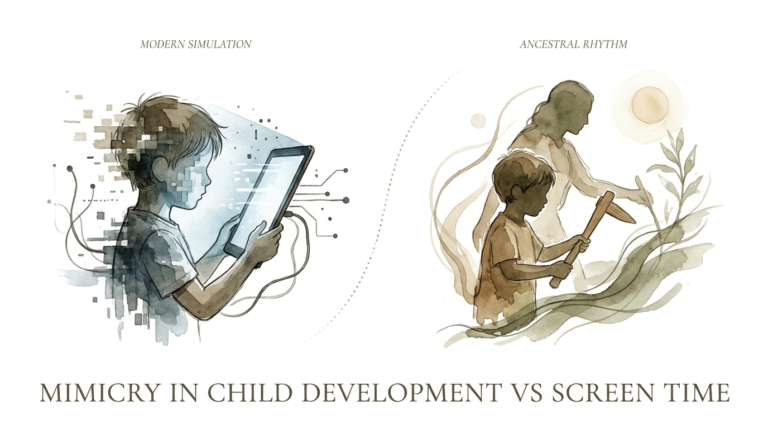
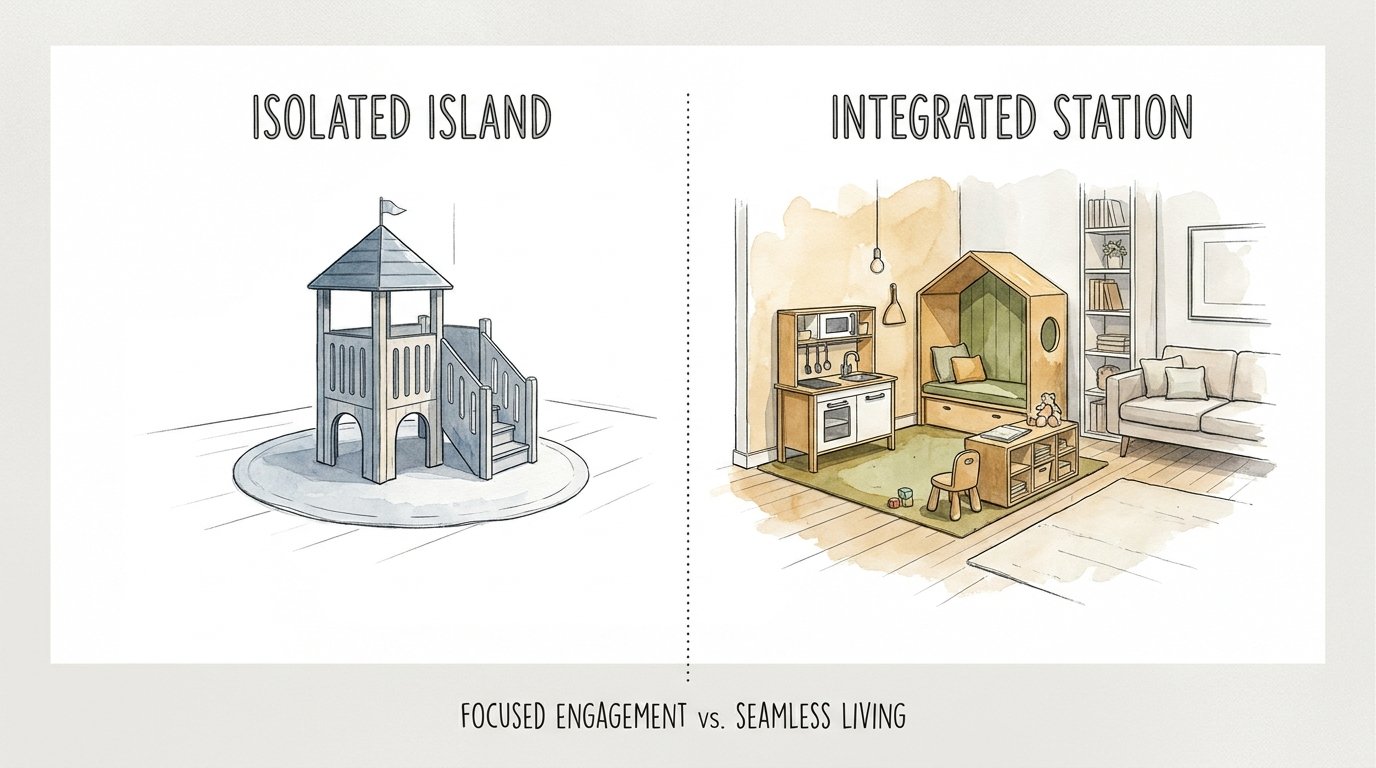
Play isn’t a separate activity; it’s an apprenticeship for life. We spend thousands on isolated playrooms only to find our kids underfoot in the kitchen anyway. Humans are social learners. When we integrate ‘dramatic play stations’ into our actual workspaces, we transition the child from ‘being kept busy’ to ‘being part of the tribe.’ See how much more complex their roleplay becomes when they are mimicking the rhythm of the home.
Most modern homes treat play as a mess to be contained. We build beautiful, toy-filled “islands” in basements or back rooms, then wonder why our children drag every plastic block back into the living room. The reason is simple: kids want to be where the action is. They don’t just want to play; they want to practice being you.
By shifting our perspective from “keeping them occupied” to “integrating their development,” we unlock a powerful educational tool. Dramatic play stations are more than just toy corners. They are high-fidelity simulators where children process social cues, master language, and develop executive function while staying within the family’s social orbit.
Setting Up Dramatic Play Areas At Home
Setting up a dramatic play area means creating a designated “zone” that mirrors the adult functions of the home. Unlike a standard toy box, these areas are thematic and structured to mimic real-world environments. You aren’t just giving them toys; you are giving them a “job” that runs parallel to your own.
Think about your kitchen. If you place a small play kitchen or a low shelf with real pots and pans right next to your prep area, you have created an integrated station. The child isn’t playing “in their room”; they are “cooking dinner” alongside you. This proximity allows them to observe your movements, hear your vocabulary, and mirror the social rhythm of a household.
In the real world, dramatic play is used by educators to teach “symbolic representation.” This is the cognitive leap where a child understands that one thing can stand for another—a wooden block becomes a phone, or a cardboard box becomes a spaceship. At home, this translates into “occupational play,” where children mimic doctors, grocers, or office workers to make sense of the complex systems they see every day.
A successful home station doesn’t need to be expensive. It needs to be accessible and relevant. If you spend your day on a laptop, a small “office” station with a defunct keyboard and old notebooks will be far more engaging than a random pile of stuffed animals. They want the tools of the tribe.
How to Build Your First Integrated Station
Building a station starts with observation. Watch where your child naturally gravitates when you are working. If they are always at your feet while you fold laundry, that is where the “laundry station” belongs. You don’t need a massive footprint; a single basket and a few small towels are enough to start the “apprenticeship.”
Select props that have high “realism value.” Research shows that children are more engaged when using objects that feel authentic. Skip the neon-pink plastic hammers if you can find a small, sturdy wooden one. Use real, empty cereal boxes, cleaned-out spice jars, and expired credit cards. These “real-world” artifacts bridge the gap between fantasy and reality.
Define the boundaries of the station clearly. This helps with the “mess” factor and gives the child a sense of ownership. A small rug, a low shelf, or even a line of painter’s tape on the floor can signify where the “clinic” or “cafe” begins. This structure encourages them to keep their “tools” in their “workspace,” just as you do.
Rotate the theme every few weeks to keep the cognitive load high. When a child has mastered the “grocery store,” they aren’t learning as much as they were on day one. Swap the cash register for a doctor’s kit or a post office setup. This “thematic rotation” ensures they are constantly exposed to new vocabulary and social scenarios.
The “Prop Box” Strategy
Manage the variety by using the “Prop Box” method. Instead of having every toy out at once, organize them into bins labeled “Restaurant,” “Construction,” or “Doctor.” When it’s time for a change, you simply pull out one bin and put the other away. This prevents “toy fatigue” and makes cleanup a five-minute task.
Involve your child in the setup process. Let them help you find “props” around the house. An old silk scarf becomes a cape; a cardboard tube becomes a telescope. When children help build the world, they are more likely to respect the rules of that world and stay engaged for longer periods.
The Benefits of Integrated Dramatic Play
Dramatic play is often called a “metaphoric multivitamin” for child development. It touches every major developmental milestone simultaneously. When a child pretends to be a waiter taking an order, they are practicing memory, fine motor skills, social negotiation, and oral language—all in the span of thirty seconds.
Executive function is perhaps the biggest winner. To stay in character, a child must practice “inhibitory control.” They have to stop being themselves and start being the “chef.” This requires them to follow a set of internal rules and resist the urge to break character. This is the foundation of self-regulation and focus later in life.
Language skills explode during dramatic play. Children adopt the “register” of the character they are playing. They use words like “appointment,” “prescription,” or “ingredients” that they might not use in everyday conversation. Because they are mimicking you, they are effectively “downloading” your vocabulary and testing it out in a safe environment.
Social-emotional intelligence is the heart of roleplay. By pretending to be a “sad patient” or a “busy boss,” children practice empathy. They are literally stepping into someone else’s shoes. They learn to read non-verbal cues and negotiate with “customers” or “coworkers,” which reduces social anxiety and builds confidence.
Common Mistakes and Pitfalls
The most frequent error is “over-management.” It is tempting to step in and tell the child how to play “properly.” If they want to use the frying pan as a hat, let them. The goal isn’t perfect realism; it’s cognitive flexibility. Your role is to be a “facilitator,” not a “director.” Step in to offer a new word or a prop, then step back.
Another pitfall is the “plastic trap.” Many parents buy massive, all-in-one plastic play centers that leave no room for imagination. A pre-formed plastic “grocery store” that only does one thing limits a child’s ability to innovate. Opt for open-ended furniture—like a simple wooden bench—that can be a store counter today and a vet clinic tomorrow.
Don’t ignore the “cleanup” phase as part of the play. If you treat cleaning up as a chore that ends the fun, the child will resist it. Instead, make “closing the shop” part of the dramatic scenario. The “chef” has to clean the kitchen before the “restaurant” opens tomorrow. This builds responsibility without the power struggle.
Finally, avoid the “isolated island” syndrome. Placing the play area in a part of the house where you never go ensures the child will eventually abandon it. If you want them to play independently for longer stretches, you must be the “anchor.” Your presence nearby provides the emotional security they need to dive deep into their fantasy world.
Limitations and Environmental Constraints
Not every home has room for a dedicated “station” in every room. If you live in a small apartment, “integrated” play might mean a single “activity tray” that comes out on the coffee table while you work. The concept of the station is about the *presence* of the adult-child connection, not the square footage.
Safety is a non-negotiable boundary. While we want to include children in our workspaces, some areas (like a garage with power tools or a kitchen with hot surfaces) require strict physical barriers. In these cases, the “station” should be a safe mimicry zone located just outside the danger area, allowing for observation without risk.
Child temperament also plays a role. Some children are “onlookers” who prefer to watch you for a long time before they try the play themselves. Don’t force engagement. Others are “solitary players” who might want their station tucked into a quiet corner rather than in the middle of a high-traffic zone. Adapt the station to the child, not the Pinterest photo.
Integrated Station vs. Isolated Island
| Feature | Isolated Island (Playroom) | Integrated Station (Living/Kitchen) |
|---|---|---|
| Proximity | Far from adult activity. | Directly adjacent to adult work. |
| Engagement | High intensity, short duration. | Lower intensity, longer duration. |
| Vocabulary | Limited to child-child peers. | High-level mimicry of adult speech. |
| Maintenance | Massive cleanups required. | Frequent, small “resets” as part of day. |
| Independence | Lower (seeks adult attention). | Higher (feels “part of” the activity). |
Practical Tips for Prop Sourcing
You are surrounded by free, high-quality props. Your recycling bin is a treasure trove. Egg cartons are perfect for “sorting labs,” and yogurt containers are the best “mixing bowls.” A clean pizza box is the ultimate prop for a “delivery driver” scenario. These items have a “used” feel that kids find incredibly satisfying.
Visit thrift stores for the “jewelry and textiles” box. Old necklaces, waistcoats, silk scarves, and hats provide endless “character hooks.” Avoid full-body costumes that are itchy or hard to put on. Simple accessories—like a “doctor’s coat” made from an old white t-shirt—allow the child to transition into character quickly and independently.
Use “open-ended” props like playsilks or large cardboard blocks. A blue silk can be “water” for a boat one minute and “medicine” for a sick teddy bear the next. The more “vague” the prop, the harder the brain has to work to assign it a meaning. This is pure cognitive weightlifting for a three-year-old.
Introduce “literacy tools” into every station. Put a notepad and a pencil in the “restaurant” to encourage order-taking. Put old envelopes and stamps in the “post office.” This introduces the idea that writing has a real-world purpose, long before they start formal schooling.
Advanced Considerations: Social Systems
As children get older (ages 5–7), their dramatic play can shift from simple mimicry to complex social systems. This is the perfect time to introduce “play money” and basic economic concepts. A “cafe” station can now include a menu with prices and a budget for “ingredients.” This adds a layer of math and logic to the creative play.
Introduce “time” and “scheduling.” Give the “office worker” a calendar and a toy clock. Ask them when your “meeting” is. This helps children grasp the abstract concept of time and sequence, which are critical for school readiness. They aren’t just playing; they are learning how to navigate a structured world.
Consider “community roles” that go beyond the home. Use your stations to explore diverse careers and cultures. A “travel agency” station with maps and brochures from different countries can spark curiosity about the wider world. This is “global citizenship” in its most organic, playful form.
Focus on “collaborative problem solving.” If the “car” breaks down in their play, don’t fix it for them. Ask, “Who should we call?” or “What tool do we need?” This encourages the child to think through a sequence of events and find solutions, building the “grit” necessary for real-world challenges.
A Realistic Scenario: The Tuesday Morning Cafe
Imagine it’s Tuesday morning. You are at the kitchen counter answering emails. Instead of having your toddler pull on your leg, they are at their “Cafe Station”—a small stool and a tray located at the end of your counter. You’ve given them a small pitcher of water, two cups, and a “menu” (a piece of paper with drawings of coffee and muffins).
While you type, the “barista” is busy pouring water (fine motor skills) and counting the cups (early math). They “take your order,” asking if you want milk or sugar (social negotiation and vocabulary). You engage for 20 seconds, saying, “I’d like a large latte, please,” then return to your work.
Because the child is in your “tribe,” they feel seen and significant. They aren’t “being kept busy”; they have a job to do. They stay at the station for 40 minutes—a lifetime in toddler years—because the play is fueled by the proximity to your real-world rhythm. You finish your emails, they practice their “apprenticeship,” and the morning is a success.
Final Thoughts
Integrating dramatic play into your home isn’t about adding more “stuff.” It is about changing the “geography” of your interaction. By moving the play from the isolated playroom to the heart of the home, you validate the child’s desire to learn, mimic, and grow. You transform your living space into a collaborative workshop for life.
Start small. You don’t need a custom-built miniature house. You need a dedicated corner, a few “real” props, and your own willingness to let the child work alongside you. The “mess” of a station is temporary, but the cognitive and social architecture you are building will last a lifetime.
Experiment with different themes and watch which ones stick. Your child is a unique learner with specific interests. Whether they are running a “space station” in the corner of the living room or a “laundry service” in the hallway, they are practicing the most important skill of all: how to be a competent, creative human being.
Sources
1 playtolearnpreschool.us | 2 gryphonhouse.com | 3 autismcareplus.com | 4 kindergartencafe.org | 5 playtolearnpreschool.us | 6 abcschoolsupplies.com.au | 7 kaplanco.com | 8 earlylearningideas.com | 9 naeyc.org | 10 wgu.edu | 11 lillio.com | 12 playtolearnpreschool.us | 13 primarydelightteaching.com | 14 difflearn.com | 15 pbs.org | 16 gryphonhouse.com | 17 inspired-motherhood.com