How To Keep Dramatic Play Fresh
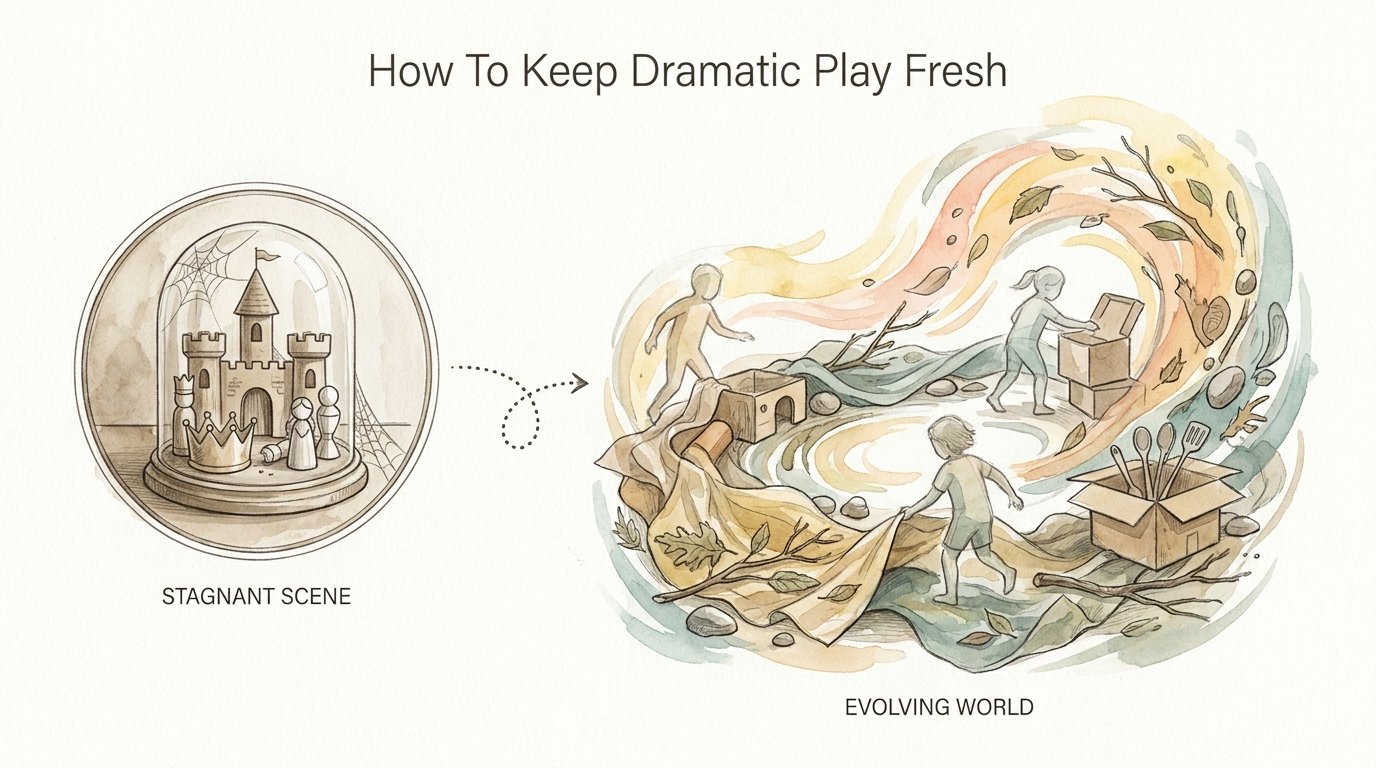
If the scene never changes, the story eventually dies. The problem with highly detailed, static play sets is that they tell the child exactly what to be. A police station set can only ever be a police station. Using dynamic props that shift with the day’s ‘mission’ forces the brain to re-contextualize reality. This is the difference between a child who follows a script and a child who writes the story.
Static environments create passive observers. Dynamic worlds create active architects. When we hand a child a pre-molded plastic kitchen, we hand them a role that is already finished. But when we hand them a wooden crate, a piece of blue silk, and a handful of smooth stones, we hand them the entire universe. This approach matters because it builds the mental muscles required for innovation, problem-solving, and emotional resilience.
How To Keep Dramatic Play Fresh
Keeping dramatic play fresh means moving away from “fixed” environments and toward “fluid” ones. This concept relies on the principle of open-endedness. It is the practice of providing materials that do not have a single, predetermined purpose. In the real world, this is how engineers look at raw materials or how entrepreneurs look at a market gap. They see potential rather than a finished product.
Dynamic play exists in classrooms, therapeutic settings, and homes where the goal is child-led discovery. It is used to help children process the world around them. For example, a child who visited the dentist might need to play “dentist” to process their anxiety. If the play area is stuck as a “grocery store,” that child loses the opportunity to work through their experience. Freshness comes from the ability to pivot.
Think of it like a theater stage. A static set is built for one specific play. A dynamic set uses “black box” theater principles. Every prop can be re-purposed. A chair is a throne today and a rocket ship tomorrow. This constant shifting keeps the dopamine levels high and the engagement deep. It prevents the “I’m bored” syndrome that often occurs two weeks after a child receives a highly specific, expensive toy set.
The Mechanics of an Evolving World
Creating an evolving play world requires a strategy of rotation and suggestion. You don’t need a thousand toys. You need twenty versatile ones. The process starts with a base layer of neutral “anchor” items. These are large, stable pieces like low shelving, a simple wooden table, or sturdy cardboard boxes. These items define the physical space without defining the narrative.
Next, you introduce “themed invitations.” These are small clusters of more specific props that suggest a direction without enforcing it. If you want to encourage medical play, you might place a few bandages, a clipboard, and a stethoscope on the table. You do not need the full plastic doctor’s office. The child’s imagination fills the gaps.
Step-by-step implementation looks like this:
- Observe the current interest. Watch what the child is talking about or acting out.
- Clear the clutter. Remove items that are no longer being used to make room for new ideas.
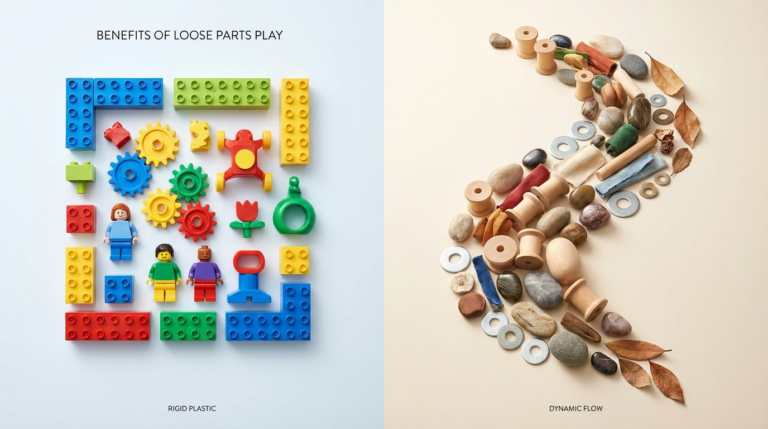
- Introduce “Loose Parts.” Add materials like pebbles, fabric scraps, or PVC pipes.
- Wait and watch. Do not tell the child what the items are. Let them decide.
- Document the story. Take photos or write down their narratives to show the value of their work.
Underlying this technique is the Theory of Loose Parts. Developed by architect Simon Nicholson, this theory suggests that the more “variables” an environment has, the more creative the interaction will be. Static sets have zero variables. A box of fabric has infinite variables.
Benefits of the Dynamic Approach
Practical benefits of dynamic play are measurable in a child’s cognitive development. One of the most significant advantages is the boost in executive function. Children must plan their play, negotiate roles with peers, and remember the “rules” of their imagined world. These are the same skills used in adulthood for project management and social navigation.
Symbolic thinking is another massive win. When a child uses a block as a phone, they are practicing abstract representation. This is the foundational skill for both literacy and mathematics. Letters and numbers are symbols for sounds and quantities. A child who can master symbolic play is better prepared for the abstract concepts found in higher education.
Social-emotional growth happens faster in fluid environments. In a static kitchen, there is usually only room for one “cook.” In a dynamic space made of blocks and blankets, children must decide together what the space is. This leads to intense negotiation, conflict resolution, and the development of empathy. They are not just playing; they are practicing how to live in a community.
Common Mistakes and Pitfalls
The biggest mistake adults make is over-specificity. We often think that “more detail” equals “better play.” It is actually the opposite. High-detail toys leave no room for the imagination to do its job. If a toy does everything—makes noise, flashes lights, and has a specific name—the child is reduced to an operator. They are pressing buttons instead of creating worlds.
Over-cluttering is another frequent error. Too many choices lead to “choice paralysis.” When a play area is overflowing with props, children often spend more time dumping bins than actually playing. A clean, sparse environment with five well-chosen items is infinitely more effective than a room filled with five hundred random toys.
Mistaking “facilitation” for “direction” can also kill the story. Adults often jump in to “help” by suggesting what should happen next. This shifts the power dynamic. The child stops writing the story and starts performing for the adult. Avoid the urge to lead. Your job is to be the stage manager, not the director.
Limitations of Dynamic Environments
Dynamic play is not without its challenges. One primary limitation is the “mess factor.” Because the materials are loose and versatile, they tend to spread. A static play set stays in its corner. A dynamic world might take over the entire living room floor. This requires a mindset shift for the caregiver and a solid system for “resetting” the space.
Safety is another boundary. Loose parts often include small items or recycled materials. You must be vigilant about choking hazards for younger children and ensure that recycled items are clean and free of sharp edges. This approach requires more active supervision and environmental auditing than a single, safety-tested plastic toy.
Finally, there is a learning curve for the child. Children who are used to being “entertained” by screens or specific toys may struggle with open-ended materials at first. They might stand in the middle of a room full of boxes and say they don’t know what to do. This “boredom” is actually the brain transitioning into a creative state, but it requires patience from the adult to let it happen.
Static Playsets vs. Evolving Worlds
Understanding the differences between these two approaches helps in choosing the right tools for the environment. Cost, complexity, and longevity are the key factors here.
| Feature | Static Playsets | Evolving Worlds (Dynamic) |
|---|---|---|
| Initial Cost | High (branded, pre-made) | Low (recycled, loose parts) |
| Versatility | Low (one-use scenario) | Infinite (re-purposable) |
| Storage Needs | Bulky, hard to hide | Compact bins and containers |
| Longevity | Short (outgrown quickly) | High (grows with the child) |
| Cognitive Load | Low (following a script) | High (problem-solving) |
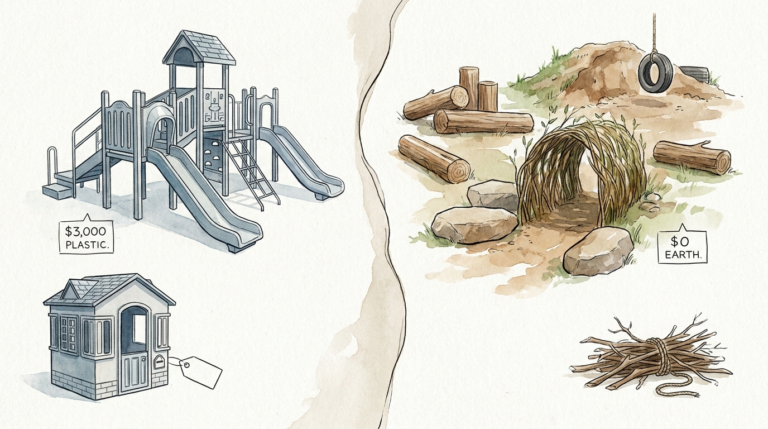
While a static set might offer an immediate “wow” factor, the dynamic world offers sustained engagement. Parents often find that the expensive plastic castle is ignored after a week, while the large box it came in remains a favorite for a month.
Practical Tips for Implementation
Start small to avoid overwhelm. You don’t need to transform your entire home or classroom overnight. Focus on one corner and commit to a “rotation schedule.” Changing the props every two weeks keeps the interest high without requiring daily labor from the adult.
Use “Prop Boxes” to organize your themes. Instead of having everything out at once, keep themed kits in labeled bins. A “Vet Clinic” box might have stuffed animals and old towels. A “Space Station” box might have silver foil and cardboard tubes. Swapping these boxes takes five minutes but resets the entire play experience for the child.
Encourage “Object Substitution” through modeling. If a child is looking for a “sword,” don’t go buy one. Pick up a cardboard tube and say, “I found this long, strong tool.” This gives the child permission to use the object symbolically. Once they see you do it, they will start doing it themselves.
- Include “Functional Print.” Add menus, signs, and “open/closed” tags to the play area.
- Use Natural Materials. Stones, pinecones, and sticks provide sensory input that plastic cannot.
- Rotate the furniture. Sometimes just moving the shelf to the other side of the room sparks a new idea.
- Focus on “Neutral Colors.” Natural wood and earth tones reduce overstimulation.
Advanced Considerations for Serious Practitioners
Serious practitioners look at the “Layering Method” of play. This involves moving from simple object substitution to complex narrative building. In the beginning, a block is just a block. Then, the block becomes a phone. Later, the block is part of a complex “network” where the child is a business owner communicating with “clients.”
Scaling this for groups requires a deep understanding of social dynamics. You must provide enough materials so that “resource guarding” doesn’t stop the play, but not so many that the space becomes chaotic. The goal is to create “bottlenecks” where children must communicate to proceed. If there is only one “steering wheel” (a wooden ring), they must negotiate who drives the ship.
Performance and “flow” are also critical. In psychology, “flow” is the state of being completely immersed in an activity. Static toys often break flow because they have limited possibilities. Dynamic props support flow because they allow the story to evolve as fast as the child’s mind. Recognizing when a child is in a flow state and avoiding interruption is the hallmark of a master facilitator.
Example Scenarios: The Evolution of a Box
Consider the lifecycle of a large appliance box in a dynamic play environment. This demonstrates how a single, zero-cost prop can outperform a $200 playset over the course of a week.
Day 1: The New House. The child crawls inside. They use markers to draw “windows” and a “door.” They bring in a pillow and a flashlight. This is the stage of seeking security and defining boundaries.
Day 2: The Delivery Truck. The child decides the house is now a vehicle. They find a round plastic lid and tape it to the front as a steering wheel. Smaller boxes are gathered and put inside as “packages.” They are now exploring community roles and movement.
Day 3: The Animal Shelter. The box is turned on its side. Stuffed animals are placed in “cages” made of yarn. The child uses a clipboard to “check in” the pets. This stage focuses on empathy and caretaking.
Day 4: The Space Station. The box is covered in aluminum foil. Empty paper towel rolls are taped to the side as “oxygen tanks.” The child is now exploring the boundaries of science and the unknown.
In four days, the child has been an architect, a driver, a veterinarian, and an astronaut. A static “Police Station” set would have kept them trapped in one role for all four days. The cost of the box was zero. The value of the learning was immeasurable.
Final Thoughts
Dramatic play is the laboratory of childhood. It is where children test the laws of physics, the rules of society, and the boundaries of their own identities. Providing a static environment is like giving a scientist a lab where all the results are already written on the wall. It removes the need for inquiry.
Using dynamic props ensures that the “mission” always stays fresh. It forces the brain to stay agile and creative. This method prepares children for a world that is constantly changing—a world where the ability to re-contextualize reality is the ultimate survival skill.
Encourage yourself to experiment with less. Remove the batteries, hide the plastic sets, and see what happens when you offer a blank canvas. You will likely find that when the scene finally changes, the story truly comes to life. Focus on the process, respect the silence of the imagination, and watch as your children become the authors of their own magnificent worlds.
Sources
1 united4children.org | 2 wonderseekerssensoryplay.com.au | 3 inspiremyplay.com | 4 xiairworld.com | 5 thecuriosityapproach.com | 6 thepillarsclc.com | 7 lillio.com | 8 habausa.com | 9 gryphonhouse.com | 10 wgu.edu | 11 psu.edu | 12 play.wales | 13 healthline.com | 14 theottoolbox.com | 15 tcu.edu | 16 theharvardbrain.com | 17 childmind.org | 18 nih.gov | 19 aepsinteractive.com | 20 mdpi.com | 21 brookespublishing.com