Backyard Water Physics For Kids
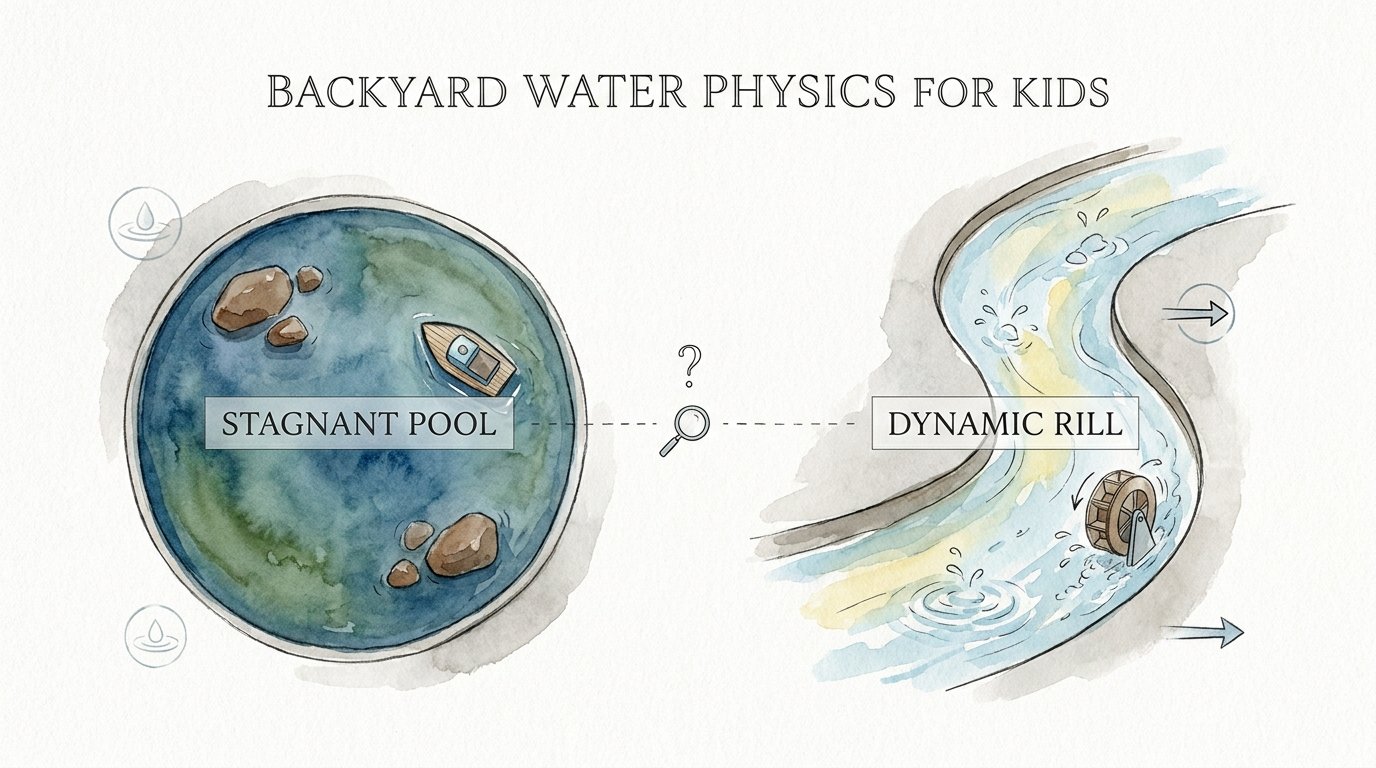
One breeds mosquitoes; the other breeds future engineers. Still water is a containment zone; moving water is a laboratory. When children interact with the physics of flow, gravity, and resistance, they aren’t just ‘playing’—they are mastering fluid dynamics. Trade the stagnant plastic tub for a backyard rill and watch their problem-solving skills ignite.

Forget the days of watching a plastic bucket collect scum and larvae. Water is a living tool that behaves according to strict physical laws. When you introduce a dynamic element—motion—you turn your backyard into a high-stakes engineering environment. Children naturally want to touch, block, and redirect. By giving them a system that responds to these interventions, you are handing them the keys to mechanical comprehension.

This guide explores how to transform a simple outdoor space into a masterclass in physics. We will dive into the mechanics of moving water, how to build your own fluid systems, and why the “dynamic rill” is the ultimate STEM (Science, Technology, Engineering, and Math) upgrade for any home.
Backyard Water Physics For Kids
Backyard water physics is the study of fluid mechanics within a controlled, outdoor environment. It is the real-world application of how liquids behave when subjected to external forces like gravity, pressure, and friction. In a classroom, these concepts are abstract diagrams in a textbook. In your backyard, they are tangible, wet, and immediate.
Fluid dynamics—the sub-discipline of physics dealing with the flow of liquids—is the core of this experience. It exists everywhere, from the plumbing in your walls to the way massive hydroelectric dams generate power for entire cities. When a child builds a small dam out of pebbles or uses a PVC pipe to create a siphon, they are essentially modeling the same systems used by civil and mechanical engineers.
The topic matters because it bridges the gap between observation and intervention. In a stagnant pool, a child observes. In a moving rill or stream, a child experiments. They learn that water doesn’t just “go down”; it follows the path of least resistance. They discover that velocity increases as a channel narrows. These aren’t just “fun facts”—they are the foundations of spatial reasoning and scientific inquiry.
How It Works: The Mechanics of Flow
To build a functioning water laboratory, you need to understand the three primary drivers of fluid movement: gravity, pressure, and siphoning. Each provides a different set of lessons and construction challenges.
Gravity-Fed Systems (The Rill)
Gravity is the most reliable engine in the world. A backyard rill—a small, shallow channel designed for water to flow through—relies entirely on a subtle incline. Even a 1-2% grade is enough to keep water moving. As water travels from a higher elevation to a lower one, stored potential energy converts into kinetic energy.
To build one, you don’t need a massive hill. A simple raised planter box or a slight slope in the lawn will suffice. Dig a narrow trench, line it with a pond liner or heavy-duty plastic, and cover the bottom with smooth river rocks. When you pour water at the top, it follows the grade, creating a mini-ecosystem of flow.
The Power of Siphons
A siphon is a “magic” trick of physics that allows water to move uphill before flowing down. It works through a combination of gravity and atmospheric pressure. Once a tube is filled with water (primed) and placed between two containers at different heights, the weight of the water falling down the longer leg creates a partial vacuum at the top. This vacuum “pulls” water up the shorter leg, maintaining a continuous flow without a pump.
Setting this up requires only a flexible clear tube and two buckets. Children can experiment with height differences to see how it affects the flow rate. If the discharge end is only slightly lower than the source, the flow is slow. If they drop the discharge end a few feet lower, the velocity increases dramatically.
Manual and Electric Pumps
While gravity is great, a closed-loop system often requires moving water back to the start. An electric pond pump can automate this, but a manual hand pump is where the real learning happens. Manual pumps require physical work to create pressure, teaching children about the relationship between energy input and fluid output. It turns the water cycle into a tangible, mechanical process.
Benefits of Dynamic Water Play
Moving water is a multi-sensory experience that builds cognitive and physical skills far beyond what a stationary toy can offer.
Cognitive Problem Solving
When a child builds a rill, they inevitably face “leaks” or “stagnation.” To fix it, they must analyze the system. Is the angle too shallow? Is there an obstruction? This is the Engineering Design Process in action: Identify the problem, brainstorm a solution, build it, and test it. They learn that failure is just data.
Fine and Gross Motor Development
Moving rocks to change a stream’s path builds gross motor strength. Using small pipettes to move droplets or connecting narrow PVC joints develops fine motor control and hand-eye coordination. Unlike many sedentary activities, water physics requires the whole body to participate in the learning process.
Intuitive Physics Mastery
Through play, children internalize complex concepts like buoyancy and viscosity. They see that a heavy wood block might float (buoyancy) while a tiny pebble sinks, or that “thick” liquids like mud flow differently than clear water (viscosity). These intuitive “gut feelings” about how the world works are what make future physics classes much easier to navigate.
Challenges and Common Mistakes
Building a backyard water system isn’t without its hurdles. Knowing the pitfalls can save you hours of frustration.
The Leveling Trap
The most common mistake in building a rill is underestimating the power of “true level.” Water will not flow uphill, even if the ground looks like it’s sloping down. Using a string level or a laser level is essential. If the channel isn’t graded correctly, you end up with a series of disconnected puddles—the exact stagnant environment you were trying to avoid.
Pump Burnout
If you use an electric pump to create a waterfall or return flow, it must never run dry. Pumps rely on the water they move to cool their motors. Children often get distracted and let the reservoir empty, or they block the intake with sand and pebbles. This can fry an expensive pump in minutes. Always use a pre-filter or a mesh bag around the pump intake.
Algae and Slime
Even moving water can develop algae if it isn’t properly maintained. Sunlight and nutrients (like grass clippings or soil) are fuel for green growth. While some algae is fine for a “natural” look, it can make rocks slippery and clog fine siphons. Regular flushing and keeping the water clear of organic debris are necessary.
Limitations and Environmental Constraints
Before you dig up the yard, consider the realistic boundaries of your project.
Water Conservation
In many regions, “running the hose” for hours is environmentally irresponsible or even illegal during droughts. A dynamic water system should ideally be a closed loop. This means the water that flows down the rill collects in a basin at the bottom and is pumped back to the top. This minimizes waste and allows you to use the same 10-15 gallons of water for weeks.
Space and Permanent Impact
A high-quality rill requires a permanent or semi-permanent footprint in your landscape. If you are renting or have a very small yard, a large-scale engineering project might not be feasible. In these cases, portable “water walls” made of PVC pipe and zip ties on a wooden frame offer the same physics lessons without the landscaping commitment.
Stagnant Pool vs. Dynamic Rill
To understand why the shift to moving water is so critical, let’s look at the measurable differences between the two environments.
| Feature | Stagnant Tub/Pool | Dynamic Rill/Stream |
|---|---|---|
| Primary Interaction | Splashing and pouring | Daming, diverting, and siphoning |
| Physics Concepts | Volume, surface tension | Velocity, pressure, gravity, friction |
| Biological Risk | High (Mosquitoes, bacteria) | Low (Aerated, moving water) |
| Engineering Level | Beginner/Sensory | Advanced/Problem-solving |
| Complexity | Low (One container) | High (System-wide dependencies) |
Practical Tips for Success
Ready to get started? Follow these best practices to ensure your water lab is both functional and educational.
- Use Food Coloring: To help kids visualize flow and mixing, add a few drops of food coloring at the top of the system. They can watch how the “dye front” moves faster in the center of the stream than at the edges due to friction against the banks.
- Incorporate Clear Tubing: Whenever possible, use transparent vinyl tubing for siphons. It allows children to see the water moving and identify air bubbles that might be breaking the vacuum.
- Standardize PVC Sizes: If you use PVC pipes for channels, stick to 1/2-inch or 3/4-inch fittings. This makes it easy for kids to mix and match parts, encouraging creative “plumbing” solutions.
- Vary the “Cargo”: Provide different objects for the water to carry—corks, plastic boats, leaves, and stones. This teaches lessons about density and the force of moving water.
Advanced Considerations: Going Deeper
For the older child or the truly dedicated parent-engineer, you can introduce advanced concepts that take the backyard lab to a professional level.
Laminar vs. Turbulent Flow
Explain the Reynolds Number without the math. Show them that when water moves slowly and smoothly in a straight line, it is laminar (orderly layers). When it hits a rock or speeds up around a curve, it becomes turbulent (chaotic and swirling). This distinction is vital in everything from airplane wing design to circulatory health.
Bernoulli’s Principle
Introduce the idea that as the speed of a fluid increases, its pressure decreases. You can demonstrate this by narrowing a portion of your rill. As the water squeezes through the gap, it speeds up. This “venturi effect” is the same principle that allows carburetors to work and planes to fly.
Hydroelectric Power
If your rill has a decent “head” (the vertical distance the water falls), you can install a small DIY water wheel. Attach a small motor to the wheel, and you can actually generate a tiny amount of electricity—enough to light an LED. This connects the physics of water directly to the global challenge of renewable energy.
Scenario: The Cargo Challenge
A great way to test a child’s engineering skills is the “Cargo Challenge.” Give them a small floating object (like a rubber duck or a cork) and a starting point at the top of the rill.
The goal is to move the cargo to the bottom basin in under 30 seconds without touching it. The catch? The rill has obstacles—a “dam” that must be bypassed or a “whirlpool” that traps the object. The child must use their knowledge of flow to adjust the rocks, increase the water volume, or create a bypass channel to successfully navigate the cargo to its destination. This scenario requires iterative testing and a deep understanding of how current works.
Final Thoughts
The transition from a stagnant pool to a dynamic water system is a transition from passive play to active engineering. By introducing motion, you introduce the laws of the universe in a way that no screen or classroom can replicate. You aren’t just giving your children something to do; you are giving them a system to master.
Water is the ultimate teacher because it is honest. It doesn’t care about your plan; it only cares about the physics of the channel you’ve built. If the water stops, the engineering has failed, and the “future engineer” in your backyard has a new problem to solve.
Encourage your kids to get messy, to fail often, and to watch the water closely. Whether they grow up to build bridges or just want to understand how their home’s plumbing works, the lessons learned in a backyard rill will stick with them for a lifetime. Trade the mosquitoes for the mechanics—it’s the best investment you’ll make all summer.
Sources
1 imthecheftoo.com | 2 montessorigeneration.com | 3 youtube.com | 4 imthecheftoo.com | 5 libretexts.org | 6 instructables.com | 7 jdaniel4smom.com | 8 edgeearlylearning.com.au | 9 vortex-intl.com | 10 scribd.com | 11 youtube.com | 12 sciencebuddies.org | 13 siliconvalleyinternational.org | 14 wikipedia.org | 15 frugalfun4boys.com | 16 alloprof.qc.ca