Best Bushcraft Tools For Children
Will their tools end up in a landfill by Christmas, or in their grandchildren’s hands? Plastic toys teach children that things are meant to be broken and replaced. Real, heirloom-quality tools teach them respect, maintenance, and mastery. When a child feels the weight of forged steel and the grain of a wooden handle, their relationship with work changes from ‘distraction’ to ‘legacy.’
Handing a child a sharp blade or a forged axe often feels counterintuitive to modern parenting. We are conditioned to protect, to cushion, and to remove risk. However, true safety does not come from the absence of danger; it comes from the presence of skill. High-quality bushcraft tools offer a bridge between childhood play and adult responsibility. They provide a tangible way for young people to interact with the physical world, moving away from screens and into the dirt and wood of the forest.
Choosing the right gear involves balancing safety features with the utility of professional-grade materials. Cheap “adventure kits” made of thin plastic and dull metal are arguably more dangerous than sharp, well-made tools. Dull blades require more force, leading to slips and frustration. Forged steel and seasoned hickory allow a child to succeed in their tasks, building a reservoir of confidence that translates into every other area of their life. This guide explores the best bushcraft tools for children, focusing on longevity, safety, and the development of lifelong skills.
Best Bushcraft Tools For Children
Bushcraft tools for children are specialized implements designed to bridge the gap between toy safety and professional utility. These tools often feature ergonomic designs tailored for smaller hands while maintaining the high-quality steel and wood components found in adult versions. They exist to allow children to participate in woodcraft, fire-making, and shelter building without the unwieldy weight of full-sized equipment.
In the real world, these tools are used in scouting, forest schools, and family camping trips. They are not merely “smaller versions” of tools but are often redesigned with specific safety contingencies. For example, many children’s knives feature a blunted tip to prevent puncture wounds during a slip, yet they retain a razor-sharp edge for efficient carving. This design acknowledges that most injuries occur when a blade is too dull to bite into the wood, causing it to skip off the surface toward the user’s hands.
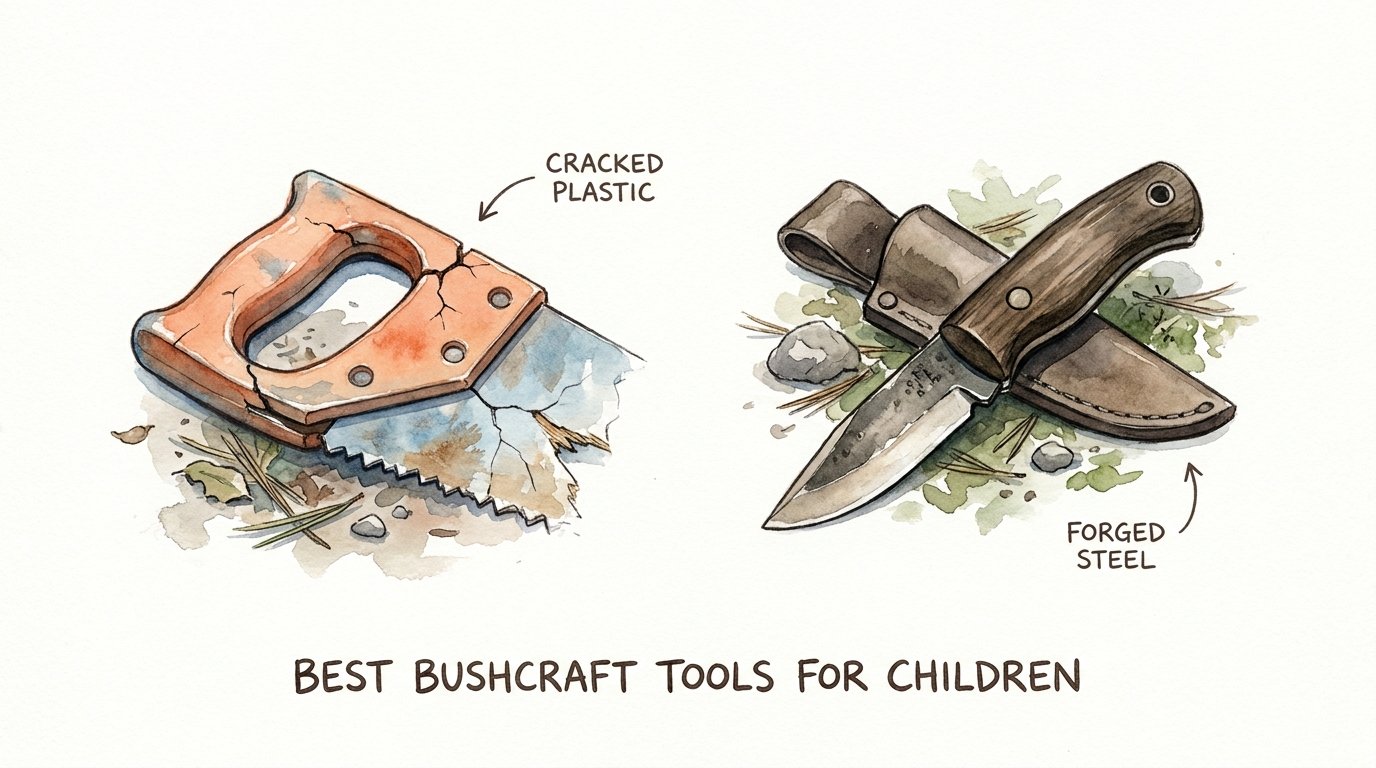
Common examples include the Morakniv Rookie or the Opinel No. 7 My First Knife. These brands understand that a child’s first tool is a rite of passage. Using real forged steel instead of cracked plastic transforms the experience from a temporary game into a serious apprenticeship. These tools are used for tasks like carving marshmallow sticks, processing kindling for a campfire, or crafting basic camp furniture. They teach a child that their actions have physical consequences and that tools, when respected, are extensions of their own capability.
How to Introduce Children to Bushcraft Tools
Introducing a child to sharp tools requires a structured approach that prioritizes safety protocols over the task itself. The goal is to build a “safety-first” mindset that becomes automatic. Start by explaining the anatomy of the tool, whether it is a knife, saw, or hatchet. Understanding how the tool functions helps the child respect its power.
The “Blood Circle” is the most fundamental safety concept to teach. Instruct the child to stand with their tool sheathed and extend their arm fully, rotating in a 360-degree circle. This imaginary bubble is their safe zone. If anyone enters this circle, the child must immediately stop working and sheath the tool. This teaches situational awareness and places the responsibility for safety squarely on the tool user.
The “Triangle of Death” is another critical safety lesson. This refers to the area between the knees and the groin, where the femoral arteries are located. Children must be taught never to cut or carve toward this area. Instead, they should work to the outside of their legs or use a “chest lever” technique where the knife moves away from the body. Using a log as a “chopping block” or “carving bench” provides a stable surface that keeps the blade’s path away from the child’s limbs.
Batoning is often a safer alternative to swinging a hatchet for young beginners. To baton, the child places the blade of a fixed-knife or small hatchet on a piece of wood and strikes the back of the tool with a heavy stick. This method allows for precise splitting of kindling without the high-velocity risk of a swinging axe. It provides the satisfying results of wood processing while keeping both hands in controlled positions.
Benefits of Real Bushcraft Tools for Kids
Confidence is the primary benefit when a child masters a real tool. Successfully splitting wood or carving a useful peg provides a sense of agency that digital achievements cannot match. This self-reliance fosters a “can-do” attitude, teaching children that they can solve physical problems with their own hands and mind. This resilience is a transferable skill that helps them navigate academic and social challenges with greater composure.
Fine motor development is significantly enhanced through whittling and carving. These activities require precise coordination between the hands, eyes, and brain. The resistance of the wood provides immediate feedback, forcing the child to adjust their pressure, angle, and grip. This physical intelligence is often neglected in modern childhood but is essential for overall cognitive development.
Environmental stewardship naturally follows tool use. When a child uses a saw to process a dead branch or a knife to carve a spoon from birch, they develop a deep, tactile connection to nature. They begin to see the forest not as a backdrop, but as a source of material and a space to be respected. This intimacy leads to a genuine desire to protect and maintain the natural world.
Tools also facilitate multi-generational bonding. Teaching a child how to sharpen a blade or build a fire creates a shared experience that transcends the usual parent-child dynamic. It becomes a mentorship. These moments of quiet focus in the woods often lead to deeper conversations and a lasting legacy of shared knowledge and respect.
Challenges and Common Mistakes
Parental anxiety is the most common challenge in children’s bushcraft. Fear of injury can lead to “helicoptering,” where the adult takes over the task, depriving the child of the learning experience. The mistake here is focusing on the hazard rather than the risk management. To overcome this, set clear boundaries and allow the child to make small, non-catastrophic mistakes, like a tiny nick or a broken stick, which are part of the learning curve.
Using improper grips is a frequent error. Children often want to put their thumb on the spine of the knife for more pressure, but this can lead to the thumb slipping onto the edge if the knife gets stuck. Teaching the “hammer grip” or “fist grip” ensures the hand stays behind the finger guard. Consistent correction is necessary until the proper grip becomes a habit.
Neglecting tool maintenance is another pitfall. A dull tool is a dangerous tool. Parents often assume children don’t need sharp tools because they are “safer,” but a dull blade requires more force and is prone to slipping. Make sharpening a part of the activity. Show the child how to use a whetstone or a strop to keep the edge keen, teaching them that a tool’s performance is a reflection of how it is cared for.
Forgetting to sheath the tool is a high-risk mistake. Children often get excited about their progress and set a naked blade on the ground or walk toward a friend with an open saw. Instill the “sheath or hand-off” rule: the tool is either in the hand being used or in its sheath. There is no middle ground. This habit prevents the majority of accidental injuries in a camp setting.
Limitations and Age Appropriateness
Strength and hand size are the primary physical limitations. A tool that is too heavy will cause the child to fatigue quickly, leading to poor form and potential accidents. For example, a full-sized felling axe is inappropriate for a ten-year-old because they cannot control the momentum of the swing. Start with lightweight folding saws and small fixed-blade knives before progressing to heavier implements.
Attention span is a developmental constraint. Younger children may be able to focus on a carving project for only ten to fifteen minutes before their mind wanders. When focus drops, the risk of injury rises. It is better to have several short, successful sessions than one long session that ends in a mishap. Adults must monitor for signs of fatigue and call for a break before mistakes happen.
Legal restrictions can also be a limitation depending on your location. Some public lands or parks have strict rules about the use of knives or the gathering of wood. Always check local regulations before heading into the woods. In urban settings, carrying these tools can be restricted by law, making it essential to transport them in a secure pack and only use them in designated areas.
Environmental conditions can impact tool safety. Wet wood is harder to carve and more likely to cause a blade to skip. Cold hands lose dexterity and feeling, making it difficult to maintain a safe grip. In sub-freezing temperatures or heavy rain, it may be better to postpone tool-heavy activities in favor of shelter-based skills or simple fire-starting drills.
Comparison: Kids’ Safety Knives vs. Standard Knives
When selecting a first knife, parents often choose between a dedicated “safety” model and a standard small utility knife. The following table highlights the key differences based on construction, safety features, and longevity.
| Feature | Kids’ Safety Knife (e.g., Mora Rookie) | Standard Utility Knife (e.g., Mora Companion) |
|---|---|---|
| Blade Tip | Blunted/Rounded to prevent punctures. | Pointed for piercing and detail work. |
| Finger Guard | Pronounced guard to prevent hand slips. | Moderate guard, varies by model. |
| Handle Size | Specifically contoured for smaller hands. | Standard ergonomic size for adults. |
| Edge Geometry | Typically Scandi grind for easy sharpening. | Various grinds (Scandi, flat, hollow). |
| Sheath Design | High-visibility colors; simple retention. | Various colors; friction or clip retention. |
| Maintenance | Requires regular oiling and sharpening. | Requires regular oiling and sharpening. |
Choosing a safety knife is ideal for children under the age of nine or ten who are just beginning their journey. The rounded tip significantly reduces the risk of accidental stabs during a slip. However, for older children who have demonstrated responsibility, a standard utility knife allows for more advanced techniques like “boring” holes or fine detail work. Both options are superior to cheap toy versions because they use high-quality steel that holds a reliable edge.
Practical Tips for Tool Care
Maintenance is a core part of the bushcraft philosophy. Teach children to clean their tools after every use. Sap from pine or moisture from green wood can cause carbon steel to rust overnight. A simple wipe-down with a dry cloth followed by a light application of food-safe mineral oil is all that is needed to protect the blade. This ritual reinforces the idea that tools are valuable and deserve care.
Wooden handles require occasional attention to prevent cracking and splintering. Rubbing a small amount of boiled linseed oil into a hickory handle keeps the wood supple and weather-resistant. This task is safe for children of almost any age and provides a great opportunity to discuss how natural materials interact with the elements. Over time, the handle will develop a patina that marks it as a personal, well-loved tool.
Sharpening should be introduced as a slow, meditative process. A simple “puck” style sharpener or a basic whetstone allows a child to see the results of their labor. Focus on maintaining a consistent angle. It is helpful to color the edge of the blade with a permanent marker; as the child sharpens, they can see exactly where the metal is being removed. This visual aid makes the abstract concept of an “edge angle” tangible and easy to understand.
Storing tools properly is just as important as how they are used. Create a “tool board” or a dedicated gear box where each item has a specific place. Tools should never be stored damp or left in the dirt. Encouraging a child to “put their tools to bed” at the end of the day builds organizational skills and ensures the gear is ready for the next adventure.
Advanced Considerations for Maturing Bushcrafters
Transitioning from “safety” tools to standard equipment should be based on demonstrated skill rather than age alone. Look for indicators such as consistent use of the Blood Circle, proper hand placement, and a high level of situational awareness. When a child can explain the “why” behind their safety choices, they are likely ready for a pointed tip or a larger saw. This transition is a major milestone and should be celebrated as a step toward adult competency.
Introduce specialized tools like the palm drill or crooked knife for more complex projects. A palm drill allows for safe, controlled hole-boring in wood, opening up possibilities for building stools or more advanced camp furniture. The crooked knife (or spoon knife) is essential for carving bowls and utensils. These tools require different muscle groups and more refined control, challenging the child’s growing skills.
Scaling the environment is another advanced step. Move from the backyard or a local park to more remote wilderness areas where the stakes are higher. In these settings, the tools become more than just carving implements; they are essential for warmth and shelter. This shift helps the child understand the “survival” aspect of bushcraft, where tool efficiency can have a direct impact on the group’s comfort and safety.
Mentorship and teaching are the ultimate advanced stages. Encourage older children to teach safety protocols to younger siblings or friends. Explaining a concept to someone else forces the child to solidify their own understanding. This role as a “junior instructor” builds leadership and communication skills, turning the young bushcrafter from a student into a steward of the craft.
Examples and Training Scenarios
Carving a marshmallow stick is the classic entry-level project. It teaches the basic “push cut” and the importance of finding the right wood. Instruct the child to find a green hazel or willow branch about the thickness of their pinky finger. They must peel the bark back about three inches from the tip and then whittle the end to a point. This simple task provides immediate gratification and a useful tool for the evening fire.
Building a pot hanger for the campfire is a slightly more advanced scenario. This requires making two “notches” in wood: a “7-notch” to hold the pot handle and a “V-notch” to secure the hanger to a tripod. This project introduces the concept of structural integrity and precise carving. The child must consider the weight of the water-filled pot and ensure their notches are deep enough to be secure. It is a lesson in engineering using nothing but wood and a blade.
Processing a “tinder bundle” with a ferrocerium rod is a high-energy fire-starting exercise. Instead of using matches, the child uses the back of their knife to strike a ferro rod, showering sparks into a nest of dry grass or cedar bark. This requires coordination and speed. The success of seeing a flame erupt from a pile of “trash” wood is a powerful moment that reinforces the value of their tools and their ability to provide for their own needs.
Final Thoughts
Equipping a child with high-quality bushcraft tools is an investment in their character. It moves them away from a world of disposable plastic and into a realm where quality, maintenance, and skill are the primary currencies. These tools are the physical manifestation of trust between a parent and a child, providing a platform for growth that is both challenging and deeply rewarding.
Mastery of forged steel teaches lessons that go far beyond the forest edge. It instills a sense of patience, a respect for physical limits, and the understanding that anything worth doing requires effort and care. Whether they are carving a simple spoon or processing wood for a winter fire, the child is building a legacy of self-reliance that will serve them for a lifetime.
Encourage your children to get outside and get their hands dirty. Start with the basics, prioritize safety, and watch as their confidence grows alongside their skills. The woods are a patient teacher, and with the right tools in hand, your child is ready to begin a journey of discovery that may well span generations.
Sources
1 bpsknives.com | 2 wildlingsforestschool.com | 3 pgl.co.uk | 4 youroutdoorfriend.com | 5 reddit.com | 6 naturalleaders.com | 7 wyp.org | 8 silvrback.com | 9 bushcraftdays.com | 10 survivalfrog.com | 11 youtube.com | 12 youtube.com | 13 youtube.com | 14 knivesandtools.com | 15 hikeforpurpose.com | 16 reddit.com | 17 bushcraftusa.com | 18 bladeforums.com | 19 trueprepper.com | 20 selfrelianceoutfitters.com | 21 owncorp.ca | 22 outdoorlife.com | 23 youtube.com | 24 youtube.com