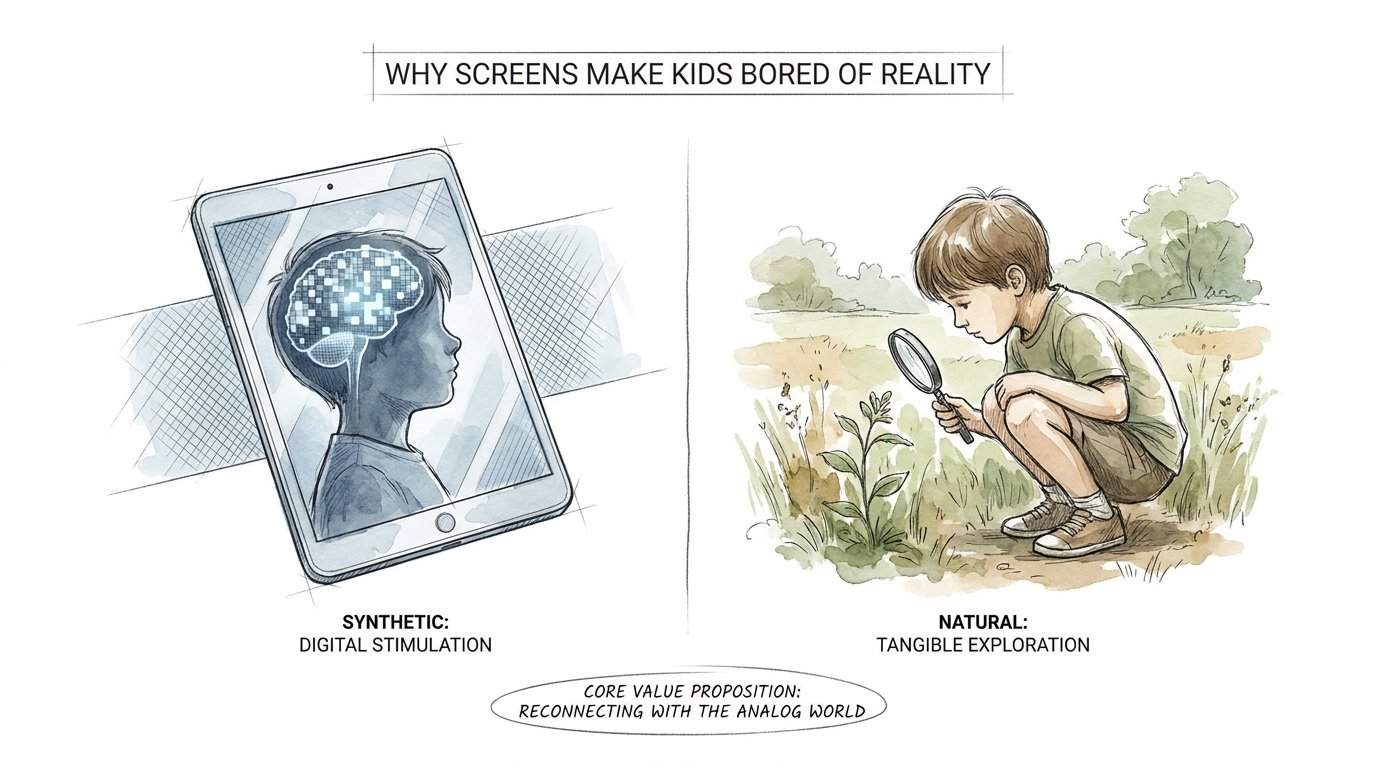
Why Screens Make Kids Bored Of Reality
When real life feels ‘boring,’ it’s because the synthetic has set the bar too high. Digital worlds are engineered to be louder, brighter, and faster than reality. If your child finds a ladybug ‘boring’ compared to a tablet, their sensory threshold has been hijacked. It’s time to recalibrate their brain to the subtle beauty of the real world.
The modern childhood landscape has shifted from the dirt of the backyard to the glow of the high-definition screen. This transition is not merely a change in scenery; it is a fundamental shift in how the human brain processes reward, attention, and satisfaction. Parents today often find themselves competing with algorithms designed by the world’s most brilliant engineers to capture and hold a child’s gaze.
Understanding this dynamic is the first step toward reclaiming your child’s attention. It is not about hating technology, but about respecting the power of the natural world to heal and develop a young mind. We are witnessing a generation where the threshold for ‘excitement’ has been pushed so far that the slow, rhythmic pace of real life no longer registers as stimulating.
Why Screens Make Kids Bored Of Reality
The disconnect between a screen and a ladybug comes down to a concept called supernormal stimuli. In nature, a child might find a brightly colored flower or a fast-moving insect. These provide a healthy dose of dopamine—the chemical responsible for reward and motivation. However, a video game or a short-form video app provides thousands of these ‘hits’ every minute.
Digital worlds are essentially concentrated versions of reality with all the ‘boring’ parts removed. When a child spends hours in an environment that offers instant gratification and constant novelty, their brain’s dopamine baseline begins to climb. This means it takes more stimulation to feel the same level of interest. Reality, which moves at a human pace, simply cannot keep up with an algorithm that refreshes every few seconds.
Recent research highlights that the pace of short-form content—videos ranging from 15 to 90 seconds—is particularly problematic for developing brains. These bursts are emotionally intense and algorithmically personalized, reinforcing circuits linked to instant gratification. The result is a child who is ‘wired and tired,’ struggling to sustain attention on homework or find joy in unstructured play.
How the Digital Hijack Works
To understand how to fix the problem, we must understand the mechanics of the digital world. Most modern apps use a ‘variable reward schedule.’ This is the same logic used in slot machines. A child doesn’t know what the next video or game level will bring, so they keep scrolling or playing to find out. This unpredictability keeps the brain in a state of high arousal.
The brain’s prefrontal cortex, which handles impulse control and long-term thinking, is under construction until a person reaches their mid-twenties. When a child is exposed to high-intensity digital stimulation, the emotional centers of the brain (the amygdala and striatum) are over-activated. This creates an imbalance where the ‘gas pedal’ of desire is fully pressed, but the ‘brakes’ of self-control are not yet fully functional.
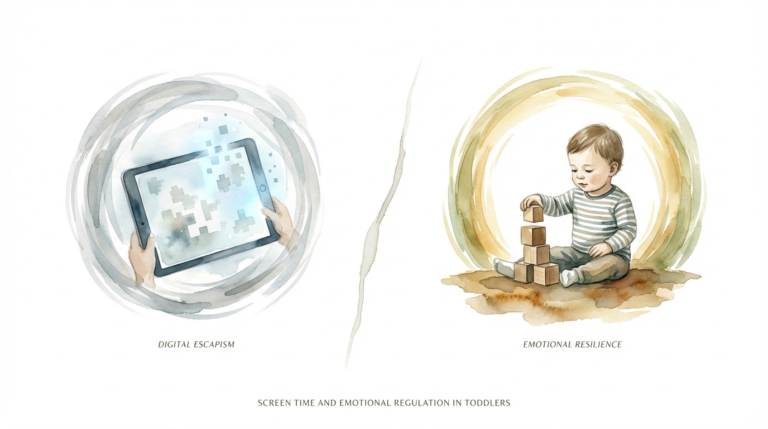
Passive consumption—watching a video without interacting—is very different from active play. In active play, a child must exert effort to get a reward. They must build the block tower to see it stand. Screens often deliver the reward without the work, which can atrophy the neural pathways required for deep focus and problem-solving.
How to Recalibrate the Brain Through a Digital Fast
Recalibrating a child’s brain requires a strategic reduction in artificial stimulation to allow their sensory thresholds to reset. Experts often recommend a ‘screen fast’ or a ‘digital detox’ period. This is not meant as a punishment, but as a physiological reset for the nervous system.
A successful reset usually lasts between two to four weeks. During this time, interactive and high-stimulation screens are removed entirely. This allows stress hormones like cortisol to drop and rebalances the reward pathways. You might notice increased irritability in the first few days as the brain ‘withdraws’ from the high dopamine levels, but this is a sign that the recalibration is working.
Physical activity and nature exposure are the best tools for this transition. Movement triggers the release of BDNF (Brain-Derived Neurotrophic Factor), which helps repair and grow new neural connections. Nature provides a ‘soft fascination’—a type of attention that is restorative rather than draining. Looking at trees or water allows the brain’s executive functions to rest while still providing gentle sensory input.
Benefits of Real-World Engagement
The primary benefit of a recalibrated brain is the return of creativity. When a child is no longer being fed a constant stream of pre-made imagery, their brain’s Default Mode Network (DMN) becomes active. This is the system responsible for daydreaming, imagination, and self-reflection. Boredom is often the doorway to the most creative moments of childhood.
Emotional regulation also improves significantly when the digital noise is silenced. Without the constant spikes and crashes of dopamine, children often become less prone to meltdowns and more capable of handling minor frustrations. They begin to develop ‘frustration tolerance,’ which is the ability to stick with a difficult task—like a puzzle or a math problem—without giving up immediately.
Physical health is another measurable advantage. Real-world play involves fine and gross motor skills that screens simply cannot replicate. Handling small objects in the dirt, climbing trees, or drawing with physical crayons strengthens the tactile systems that underpin learning and coordination.
Challenges and Common Mistakes
The most common mistake parents make is the ‘cold turkey’ approach without providing alternatives. If you take away the tablet but offer no new way to engage, the child will simply sit in a state of distress. You must fill the void with high-quality ‘natural’ stimulation. This could be art supplies, building sets, or simply more time spent outdoors.
Another pitfall is using screens as a ‘digital pacifier’ during difficult moments, such as in a restaurant or a car. While this provides short-term peace, it prevents the child from learning how to regulate their own boredom or anxiety. Over time, this creates a dependency where the child cannot function without a screen in ‘low-stim’ environments.
Parental ‘technoference’ is a major hurdle. If a parent is constantly checking their phone while trying to engage with their child, the child perceives the device as a competitor for attention. Children often mirror their parents’ digital habits. If you want your child to find a ladybug interesting, you must be willing to put down your phone and look at the ladybug with them.
Limitations: When the Method Needs Adjustment
It is unrealistic to expect a 100% screen-free life in a digital world. Schools often require tablets for homework, and social connection for teenagers often happens online. The goal should be ‘digital hygiene’ rather than total digital abstinence for older children. The key is to distinguish between high-stimulation ‘junk’ content and low-stimulation ‘nutritious’ content.
Some children with neurodevelopmental conditions, such as Autism Spectrum Disorder (ASD), may find digital tools highly beneficial for communication or learning. In these cases, the ‘synthetic’ world can be a bridge to the ‘natural’ world. The focus should be on how the technology is used—is it a tool for growth or a tool for numbing?
Environmental constraints also play a role. Not every family has access to a safe backyard or a nearby park. In these situations, parents must get creative with ‘analog’ indoor play. Building forts, indoor scavenger hunts, and sensory bins (filled with rice or beans) can provide the tactile stimulation a brain needs to stay grounded in reality.
Natural Play vs. Synthetic Worlds
| Factor | Natural Play (The Ladybug) | Synthetic Worlds (The Tablet) |
|---|---|---|
| Reward Speed | Slow, earned, and meaningful. | Instant, frequent, and hollow. |
| Attention Type | Sustained and reflective focus. | Fragmented and reactive focus. |
| Sensory Input | Multi-sensory (touch, smell, depth). | 2D visual and auditory only. |
| Brain State | Active, creative, and calm. | Passive, overstimulated, and alert. |
Practical Tips for Recalibrating Daily Life
Creating a ‘low-stim’ environment doesn’t have to be a monumental task. Start by designating ‘Sacred Screen-Free Windows’ in your daily schedule. The first hour of the morning and the hour before bed are the most critical times for brain regulation. Avoiding screens during these times helps the brain wake up naturally and wind down effectively.
Transition spaces are another powerful tool. Moving directly from a high-stimulation video game to the dinner table is a recipe for a meltdown. Use ‘brain breaks’ to bridge the gap. A few minutes of stretching, dimming the lights, or playing quiet music can help the nervous system downshift before social interaction or sleep.
Encourage ‘Brain-On’ time. This is when the child is a creator rather than a consumer. If they want to use a screen, encourage them to learn coding, digital art, or video editing. This shifts the experience from passive scrolling to active problem-solving. Always prioritize ‘intentional’ use over ‘compulsive’ use.
Advanced Considerations for Long-Term Success
Serious practitioners of digital wellness look closely at the role of light. Blue light from screens suppresses melatonin more aggressively in children than in adults. This doesn’t just make them stay up later; it reduces the quality of their deep sleep, which is when the brain processes the day’s learning. Investing in warm, dim lighting for the evening can significantly improve a child’s mood the following day.
Understand the ‘Sensory Registration’ profile of your child. Some children are ‘sensory seekers’—they naturally crave high input. These children are most vulnerable to the lure of high-speed digital worlds. For them, recalibration must include ‘heavy work’—physical activities like carrying groceries, jumping on a trampoline, or swimming—that provide intense but healthy sensory feedback.
Watch for ‘Brain Rot’ slang in older children. This term is often used to describe the mental fog and fatigue that follows a ‘doomscrolling’ session. Acknowledging this feeling with your child can help them build self-awareness. When they feel ‘rotted,’ it is a signal from their brain that they need to step away from the synthetic and return to the natural.
Scenario: The Weekend Reset in Practice
Imagine a Saturday where the usual routine is three hours of morning cartoons followed by gaming. In a recalibrated weekend, the family begins with a ‘no-tech’ morning. Instead of the TV, the living room floor is covered in blankets and pillows for a ‘living room campout.’
The child might initially complain of boredom. This is the critical moment. Instead of providing a device, the parent suggests a simple, open-ended task: ‘Can you find three different types of leaves in the yard?’ or ‘Let’s see if we can build a bridge for your cars using only cardboard and tape.’
By the afternoon, the child’s brain has downshifted. They are no longer seeking the ‘ping’ of a notification. They are engrossed in the physical sensation of the tape or the texture of the leaves. At dinner, they are more present, able to hold a conversation without glancing at a screen. The ‘ladybug’ has become interesting again because the noise of the digital world has been turned down.
Final Thoughts
The battle for a child’s attention is won in the small, quiet moments of daily life. When we choose the ladybug over the tablet, we are not just choosing an activity; we are choosing to protect the delicate architecture of a developing brain. Recalibrating to the real world is a gift that allows children to experience the full spectrum of human emotion and creativity.
While the synthetic world will always be louder and faster, the natural world offers a depth of experience that no algorithm can replicate. By setting healthy boundaries and prioritizing real-world exploration, you empower your child to find beauty in the subtle and satisfaction in the slow.
Start small. Turn off the background TV. Put your phone in a drawer for an hour. Go outside and see what you can find. The brain is remarkably resilient—it only takes a little bit of quiet for the natural world to start looking ‘exciting’ again. Encouraging this balance today builds a foundation for a lifetime of focus, resilience, and genuine joy.
Sources
1 buildingbrains.ca | 2 reverehealth.com | 3 sciencealert.com | 4 instituteofchildpsychology.com | 5 fuzzigram.com | 6 pendium.ai | 7 11alive.com | 8 societyofcare.org | 9 braintasticscience.com | 10 instituteofchildpsychology.com | 11 nih.gov | 12 turkishjournals.org | 13 wfaa.com