Screen Time And Child Attention Span Stats
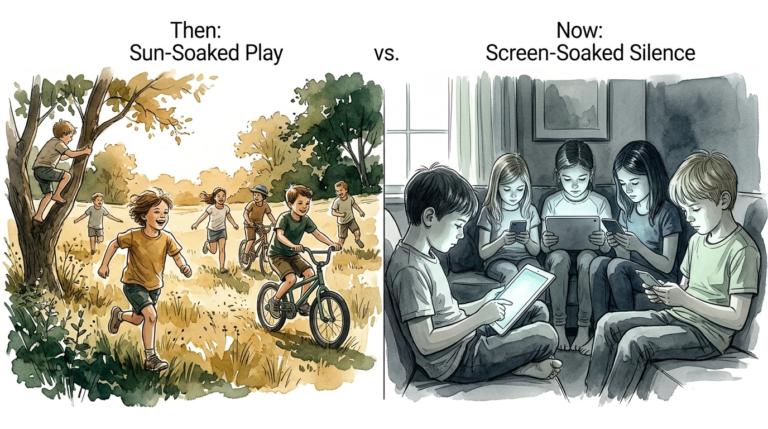
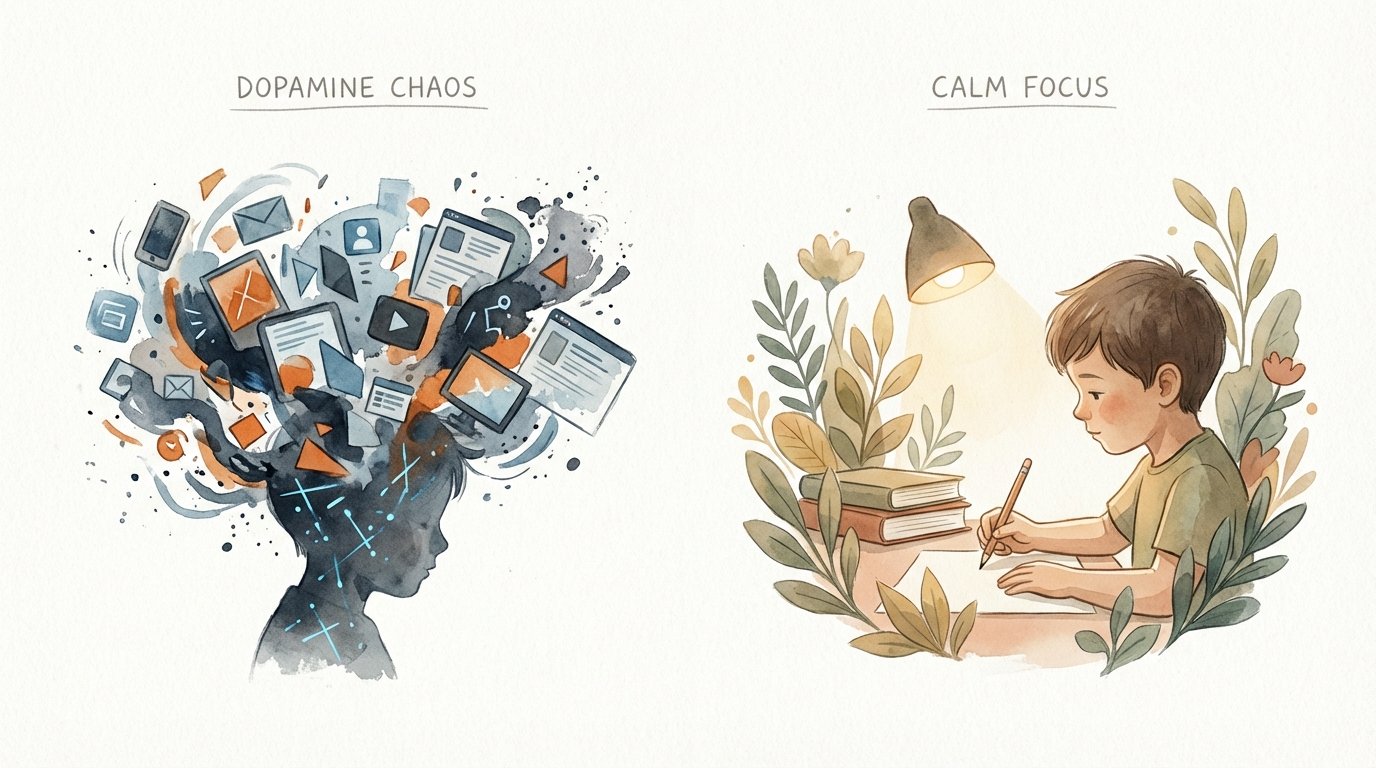
Their brain is wired for deep focus, so why are we training it for constant distraction? Modern apps are designed to create ‘Dopamine Chaos,’ fragmenting a child’s attention span into 15-second intervals. This makes the ‘Order’ of deep focus—like reading a book or finishing a task—feel impossible. Understanding these stats is the first step in reclaiming your child’s ability to concentrate.

The digital world is not just a tool; it is an environment. For a developing brain, this environment can either be a sanctuary for growth or a chaotic storm of stimulation. When kids spend hours scrolling, they aren’t just “watching videos.” They are undergoing a high-speed neurological workout that rewards impulsivity over patience.

In this guide, we will look at the hard data behind Screen Time And Child Attention Span Stats. We will explore how “Dopamine Chaos” disrupts the natural rhythm of “Calm Focus.” Most importantly, we will provide you with the roadmap to help your child find their way back to deep concentration.
Screen Time And Child Attention Span Stats
Screen time is no longer a luxury; it is a baseline of modern childhood. However, the sheer volume of digital consumption has reached levels that experts call “alarming.” To understand the impact on attention, we must first look at the raw numbers.
Recent data from 2024 and 2025 reveals that children are spending more time on screens than ever before. On average, children aged 8 to 18 spend approximately 7.5 hours a day in front of screens for entertainment alone. This equals about 114 days a year—or nearly one-third of their entire life spent in a digital loop.
The breakdown by age shows a steady climb in usage as children grow. For the youngest members of our society, the numbers are particularly surprising:
- Infants (0–2 years): Average 1 hour and 3 minutes per day. Remarkably, 40% of children consistently use a tablet by age 2.
- Early Childhood (2–4 years): Average 2 hours and 8 minutes per day.
- Children (5–8 years): Average 3 hours and 38 minutes per day.
- Tweens (8–12 years): Average 5 hours and 33 minutes per day.
- Teens (13–18 years): Average 8 hours and 39 minutes per day.
These statistics reflect a 17% increase in media use since 2019. The shift isn’t just about time; it is about content. Children are moving away from traditional “slow” television toward high-velocity “short-form” video content like TikTok and YouTube Shorts. For example, daily time spent on short-form video for kids aged 0–8 jumped from just 1 minute in 2020 to 14 minutes in 2024—a 14x increase.
This matters because attention is a finite resource. When a child’s brain is bombarded with 15-second “hits” of novelty, the prefrontal cortex—the part of the brain responsible for impulse control—is essentially being put on the sidelines. Studies show that heavy short-form video use is moderately linked to reduced inhibitory control and shorter attention spans.
How the Dopamine Loop Rewires Focus
The human brain operates on a reward system powered by dopamine. This chemical is released whenever we encounter something new, exciting, or rewarding. Digital platforms are designed to exploit this system through what psychologists call “Variable Reward Schedules.”
Imagine a slot machine. You pull the lever, and you don’t know if you’ll win. The anticipation is what creates the rush. Short-form videos work exactly the same way. Every swipe is a “pull of the lever.” The next video might be a funny prank, a scary clip, or a boring ad. The brain stays locked in because it is chasing the next hit of novelty.
This creates a state of “Dopamine Chaos.” Because the feedback is instant and requires zero effort, the brain begins to habituate to this high-speed pace. When that child is later asked to read a book or do homework—activities that move slowly and require “Calm Focus”—the brain feels under-stimulated. It starts to feel “bored” or “foggy,” a sensation some call “brain rot.”
Research using EEG data has shown a significant negative relationship between short-video addiction and executive control in the prefrontal region. Essentially, the “brakes” of the brain get weaker, while the “gas pedal” of craving gets stronger. This is why many parents notice increased irritability or restlessness when screens are turned off; the brain is literally experiencing a minor withdrawal from the dopamine loop.
The Benefits of Reclaiming Calm Focus
Shifting from a high-stimulation environment to one that fosters “Calm Focus” provides immediate and long-term benefits for a child’s development. Focus is a muscle, and when it is trained through slow activities, the entire neurological system stabilizes.
One of the primary benefits is improved emotional regulation. When a child isn’t constantly riding the emotional rollercoaster of viral videos—flipping from laughter to outrage in seconds—their nervous system has time to reset. They become more resilient to frustration because they have practiced the “Order” of staying with a single task.
Other measurable advantages include:
- Academic Performance: Students who can sustain attention perform better on tasks requiring deep reasoning and reading comprehension.
- Better Sleep Quality: Reducing high-dopamine activities, especially before bed, allows the brain to transition into the “Melatonin Window” naturally.
- Enhanced Social Skills: Real-world conversations don’t have an “edit” button or a “skip” feature. “Calm Focus” allows kids to be present and empathetic with peers.
- Language Development: Studies indicate that 2-year-olds with lower screen use can identify 65% of test words, compared to only 53% for high-use toddlers.
Choosing “Calm Focus” isn’t about banning technology. It is about prioritizing the brain’s natural need for depth and reflection over the superficial speed of the algorithm.
Common Challenges and Parenting Mistakes
Most parents do not intend to create “Dopamine Chaos.” In fact, nearly 60% of parents report feeling guilty about their child’s screen time. However, modern life presents several traps that make high screen use the path of least resistance.
A frequent mistake is using screens as a “digital pacifier” to manage behavior in public or during high-stress moments. Roughly 71% of parents admit to using screens to manage their child’s behavior in public. While this provides short-term peace, it prevents the child from learning how to self-soothe or handle boredom.
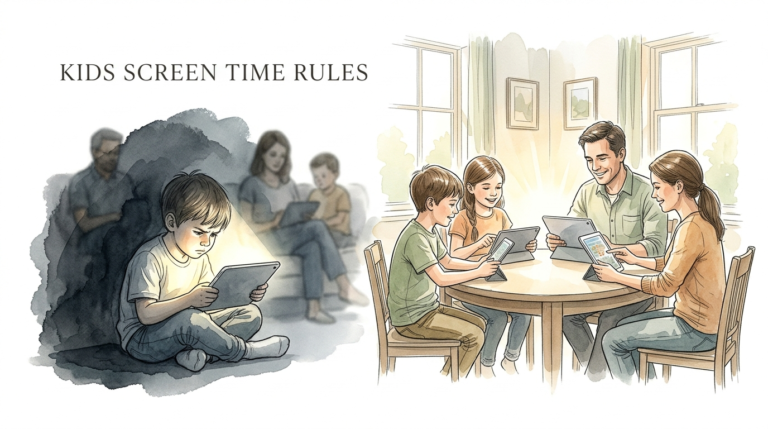
Another challenge is the “fragmented home.” When every family member is on a separate device, the collective attention of the household is shattered. This makes it harder to enforce boundaries because the “digital environment” is everywhere.
Finally, many parents underestimate the power of the algorithm. They assume that if a video is “educational,” it is fine. However, if that educational content is delivered in 30-second rapid-fire clips with bright flashing lights and loud music, it is still contributing to Dopamine Chaos. The *format* of the delivery often matters as much as the *content* itself.
When Screens Are Not the Enemy: Understanding Limitations
It is important to acknowledge that not all screen time is detrimental. The goal isn’t to live in a pre-digital cave, but to understand when technology serves a purpose and when it becomes a parasite.
Interactive screen time—such as video calls with grandparents or using creative software like digital art tools—can actually support development. The American Academy of Pediatrics (AAP) notes that high-quality, prosocial content can have positive effects if used in moderation.
The limitations of “no-screen” rules often come down to the reality of modern education. Many schools require tablets for homework or research. In these cases, the screen is a tool for “Calm Focus.” The problem arises when the child finishes their homework and immediately transitions to a scrolling app on the same device. The brain struggles to switch from the “Productive Order” of schoolwork to the “Chaotic Novelty” of social media.
Dopamine Chaos vs. Calm Focus: A Comparison
Understanding the differences between these two states helps parents make better decisions about which activities to encourage.
| Feature | Dopamine Chaos | Calm Focus |
|---|---|---|
| Pace | 15–60 second intervals | Sustained (20+ minutes) |
| Reward | Instant and effortless | Delayed and earned |
| Brain Region | Reward Center (Striatum) | Prefrontal Cortex |
| Emotional State | High-arousal, volatile | Low-arousal, stable |
| Effort Level | Passive consumption | Active engagement |
As the table shows, Dopamine Chaos is optimized for consumption, while Calm Focus is optimized for creation and learning. One exhausts the brain; the other builds it.
Practical Tips for Reclaiming Attention
You can begin shifting the environment in your home today. These small, tactical adjustments are designed to break the dopamine loop and reintroduce the brain to slower rhythms.
1. Use the “Gray Scale” Hack
Most apps use bright, saturated colors to trigger a psychological response. By turning your child’s device to “Gray Scale” (found in accessibility settings), you strip the “candy-coating” off the screen. It becomes significantly less addictive instantly.
2. Establish “No-Tech Zones”
Create physical boundaries. The dinner table and bedrooms should be strictly tech-free. Data shows that 28% of children use screens during meals, which directly interferes with family connection and mindful eating.
3. Implement the “1-to-1 Rule”
For every 30 minutes of high-stimulation screen time, require 30 minutes of a “slow” activity like reading, drawing, or playing outside. This forces the brain to practice the transition from Chaos back to Order.
4. Focus on the “5 C’s”
The AAP suggests parents look at: Child, Content, Context, Computational thinking, and Community. Instead of just counting minutes, ask: *Who* is watching? *What* are they watching? *Where* are they watching? Is it helping them *solve problems*? Are they doing it *with others*?
Advanced Considerations: Neuroplasticity and Pruning
For parents who want to understand the long-term stakes, we must talk about “Pruning.” The brain undergoes a massive “great rewiring” during early childhood and again in adolescence. During these windows, the brain is highly plastic.
Connections that are used frequently become stronger, while those that are neglected are “pruned” away. If a child spends their entire adolescence in a state of Dopamine Chaos, they are essentially strengthening the neural pathways for distraction. They are telling their brain that deep focus is not a necessary skill for survival.
This doesn’t mean the damage is permanent, but it does mean that “un-learning” these habits becomes harder the older a child gets. Acting now, while the brain is still under construction, is the most effective way to ensure they develop the cognitive “muscles” needed for a successful adult life.
Real-World Scenarios
How does this look in daily life? Let’s consider two different approaches to a rainy Saturday afternoon.
Scenario A: The Dopamine Loop
The child is given a tablet and allowed to browse YouTube Shorts. Over the next two hours, they watch 150 different clips. Each clip is 45 seconds long. By the end of the two hours, the child is irritable, “bored” with their toys, and has a “meltdown” when told it’s time for dinner. Their brain has been in a high-arousal state for 120 minutes and cannot handle the “slow” reality of the real world.
Scenario B: The Calm Focus Build
The parent sets a timer for 30 minutes of a favorite video game (which has a clear beginning and end). Afterward, they spend 60 minutes building a Lego set together. The Lego activity requires following instructions, finding specific pieces, and dealing with the frustration of a piece not fitting. The child’s brain is practiced in “Order” and “Patience.” When dinner is called, the transition is smoother because the brain was never in a state of hyper-arousal.
Final Thoughts
The rise in screen time and the subsequent shift in child attention span stats is a modern challenge that requires a deliberate response. We are essentially the first generation of parents raising “digital natives” in an era of algorithmic optimization. The data shows that the “Dopamine Chaos” created by short-form content is real, but it is not inevitable.
Reclaiming your child’s focus is not about becoming “anti-tech.” It is about becoming “pro-brain.” By establishing clear boundaries, choosing high-quality content, and prioritizing slow, deep activities, you give your child the greatest gift possible in the 21st century: the ability to pay attention.
Start small. Turn off the auto-play feature on YouTube. Put the phones away during dinner. Encourage that first 20 minutes of “boredom” that eventually leads to creative play. Every moment of Calm Focus you protect today is a brick in the foundation of your child’s future mental clarity.
Sources
1 impactparents.com (https://impactparents.com/screen-time-safety-and-smart-tech-use-with-common-sense-media/) | 2 instituteofchildpsychology.com (https://instituteofchildpsychology.com/how-short-form-video-is-impacting-our-kids-brains-ctv-news-february-2026/) | 3 monstermath.app (https://www.monstermath.app/blog/how-much-screen-time-are-kids-getting-in-the-us-in-2025) | 4 sciencealert.com (https://www.sciencealert.com/short-videos-could-have-an-insidious-effect-on-childrens-brains) | 5 luriechildrens.org (https://www.luriechildrens.org/en/blog/screen-time-2025/) | 6 aap.org (https://www.aap.org/en/patient-care/media-and-children/center-of-excellence-on-social-media-and-youth-mental-health/qa-portal/qa-portal-library/qa-portal-library-questions/average-amounts-of-screen-time/) | 7 kutestkids.com (https://www.kutestkids.com/blog/average-screen-time-statistics-facts-usage) | 8 slicktext.com (https://www.slicktext.com/blog/2023/01/30-key-screen-time-statistics-for-2022-2023/) | 9 magnetaba.com (https://www.magnetaba.com/blog/average-screen-time-statistics) | 10 raisingarizonakids.com (https://www.raisingarizonakids.com/2022/04/using-common-sense-media-use-by-tweens-and-teens-on-the-rise/) | 11 reverehealth.com (https://reverehealth.com/live-better/short-form-videos-brain-rot/) | 12 frontiersin.org (https://www.frontiersin.org/journals/human-neuroscience/articles/10.3389/fnhum.2024.1383913/full) | 13 hsa.net (https://tutoring.hsa.net/blogs/students-published-works/lwl-the-impact-of-screen-time-on-attention-spans-exploring-duration-content-and-context-across-various-age-groups)