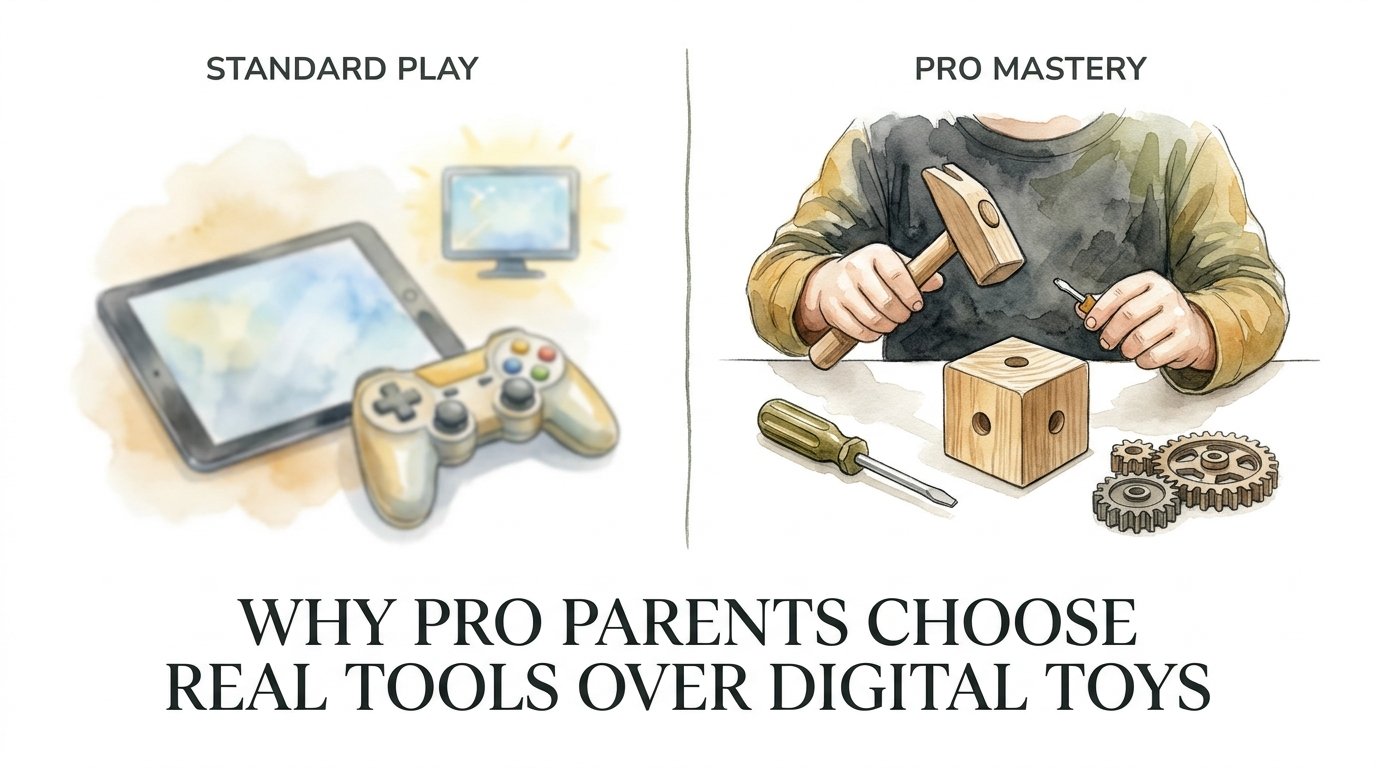
Why Pro Parents Choose Real Tools Over Digital Toys
We’ve traded the thrill of real-world mastery for the hollow pings of digital achievement. Standard play is about being entertained by a machine. Pro-level play is about learning to control the world around you. One builds a dependence on batteries; the other builds a lifelong sense of self-reliance.

Every time a child picks up a tablet, they enter a world of predefined boundaries. They follow a path designed by someone else. They solve puzzles with no physical weight and no real-world consequences. This is the comfort of standard play.
Real-world mastery is different. It starts with the weight of a hammer or the resistance of a screw. It requires focus, coordination, and a willingness to make mistakes. When a child learns to use real tools, they stop being a consumer and start being a creator.
This shift matters because the world is built by hands, not just screens. Mastering tools builds more than just birdhouses or shelves. It builds a mindset of competence that stays with a person forever. It transforms “I can’t” into “I can learn how.”
Why Pro Parents Choose Real Tools Over Digital Toys
Pro parents understand that toys are temporary, but skills are permanent. Real tools are functional instruments designed to perform specific tasks. They use metal, wood, and mechanics to interact with the physical environment.
Digital toys often prioritize immediate gratification. They use flashing lights and loud sounds to trigger dopamine hits. Real tools prioritize process and results. A nail is either flush with the wood or it isn’t, and no digital reward sound can replace the satisfaction of a job well done.
Research into child development shows that manual tool use is a fundamental part of human evolution. Using tools expands the body schema in the brain. The brain begins to treat the tool as an extension of the limb itself. This deep connection fosters spatial reasoning and problem-solving skills that digital apps simply cannot replicate.
Real-world tools also introduce the concept of “risky play.” This isn’t about being dangerous; it’s about manageable risk. Learning to respect a sharp edge or a heavy weight teaches responsibility. It forces a child to be mindful of their surroundings and their own movements.
In a home repair or DIY situation, real tools allow a child to participate in the actual upkeep of their environment. They see how things work—and how to fix them when they don’t. This transparency is missing from sealed electronic devices that offer no insight into their inner workings.
The Progression: Introducing Real Tools by Age
Mastery is a ladder. You don’t hand a circular saw to a toddler. You start with tools that match their physical strength and motor control. Success in early stages builds the confidence needed for advanced techniques later.
The Foundation (Ages 3–4)
Focus on measurement and observation. A tape measure is the perfect first tool. It teaches numbers, fractions, and the concept of scale. It has virtually zero risk of injury but offers high engagement.
Leveling is another great entry point. A spirit level shows the invisible force of gravity in action. Let them check if the table is flat or the picture frame is straight. These tasks build a “builder’s eye” before they ever strike a nail.
The Builders (Ages 5–7)
This is the age of the hammer and the screwdriver. Use a lightweight finish hammer (7-8 ounces) with a real metal head. Plastic hammers bounce and frustrate children; real metal drives the nail home. Pair this with roofing nails because they have large heads that are easy to hit.
Introduce screwdrivers with thick, ergonomic handles. Phillips and flat-head screws require different types of torque and pressure. “Lefty-loosey, righty-tighty” becomes a mantra. Starting screws in pre-drilled holes helps prevent frustration as they develop hand-eye coordination.
The Craftspeople (Ages 8–12)
Older children are ready for saws and wrenches. A pull saw is better for beginners than a standard push saw. It cuts on the pull stroke, which prevents the blade from buckling and sticking in the wood. It offers more control and requires less brute strength.
Adjustable wrenches and pliers introduce the mechanics of leverage. Show them how a longer handle makes a tight bolt easier to turn. At this stage, they can move from “tinkering” to actual projects like birdhouses, toolboxes, or simple furniture repairs.
The Practical Benefits of Real Tool Mastery
The advantages of tool use go far beyond the workshop. They impact the way a child’s brain processes information and handles challenges. Physical labor and manual precision are high-level cognitive tasks.
Fine Motor Skill Development: Turning a small screw or holding a nail in place requires incredible precision. These movements strengthen the small muscles in the hands. This directly translates to better handwriting and improved performance in STEM-related tasks.
Executive Function and Focus: You cannot rush a woodworking project. If you don’t measure twice, you will cut once and fail. Tools demand a sustained attention span that digital media often erodes. A child must plan, execute, and troubleshoot in a logical sequence.
Self-Efficacy and Grit: When a child builds something real, they have tangible proof of their own capability. They see that through effort and persistence, they can change their physical world. This builds “grit”—the ability to push through difficulty to reach a goal.
Spatial and Mathematical Thinking: Measurements, angles, and geometry are no longer abstract concepts in a textbook. They are the requirements for making the legs of a stool the same length. Tool use makes math useful and intuitive.
Common Mistakes and How to Avoid Them
The most frequent error is providing low-quality “toy” tools. Many plastic sets are designed to look like tools but fail to function. A hammer that doesn’t drive a nail is a source of frustration, not learning. Always choose tools that actually work but are scaled for smaller hands.
Skipping safety gear is another common pitfall. Safety glasses are non-negotiable from day one. Even for simple tasks, wearing protective gear builds the habit of safety. It teaches the child that pro-level play requires pro-level preparation.
Hovering too closely can stifle the learning process. While supervision is essential, constant interference prevents the child from experiencing the “aha!” moments of problem-solving. Give them space to struggle slightly. Let them figure out why the screw is crooked before you step in to help.
Expecting perfection is a recipe for failure. The goal is not a professional-grade cabinet; the goal is the child’s development. Celebrate the effort and the process. A wobbly birdhouse is a badge of honor because a child built it themselves.
Limitations: When Real Tools Aren’t the Answer
Physical tools have environmental and physical constraints. They require a dedicated workspace where sawdust and scraps won’t cause issues. If you live in a small apartment without a balcony or garage, a full woodworking setup might be difficult to manage.
Physical maturity matters. A child with significant motor delays may find certain heavy tools dangerous. In these cases, focus on softer materials like balsa wood or foam before graduating to hardwoods. Always match the tool to the child’s current strength and grip capacity.
Time is another constraint. Tool use is slow. If you are in a rush to finish a home repair, it might not be the best time for a lesson. Learning requires a relaxed environment where the child doesn’t feel pressured. Save the teaching moments for when you have the bandwidth to be patient.
Standard Play vs. Pro Mastery
Standard play is often characterized by consumption. The child is a spectator to the toy’s features. Pro mastery is characterized by production. The child is the operator of the tool’s capabilities.
| Feature | Standard Digital Play | Pro Tool Mastery |
|---|---|---|
| Input Type | Taps and swipes | Grip, torque, and strike |
| Feedback | Visual/Audio pings | Physical resistance and results |
| Risk Profile | Zero (Safety through isolation) | Low/Managed (Safety through skill) |
| Skill Longevity | Short (App-specific) | Lifelong (Universal mechanics) |
| Output | Digital data/Points | Physical objects/Repairs |
The difference is the transferability of the skill. Knowing how to play a building game on a tablet doesn’t help you hang a shelf. Knowing how to use a drill and a level gives you the power to renovate a home.
Practical Best Practices for the Home Workshop
Setting up a space for pro-level play doesn’t require a massive budget. It requires organization and clear boundaries. A simple corner of a garage or a sturdy low table can become a dedicated “Maker Station.”
- Organize by Function: Use pegboards or clear bins so tools are easy to find and put away. This teaches the child that professional work begins with a professional environment.
- Work at the Right Height: A standard workbench is too high for a child. Use a stool or build a shorter table. If the child is reaching too high, they lose leverage and control.
- Start with Soft Materials: Pine and balsa are much easier to work with than oak or maple. Use soft wood for early projects to ensure the tools can actually bite into the material.
- Establish the “Safety Zone”: Define where the tools stay and where the “active work” happens. Tools should never be left on the floor or in walkways.
Teach the “Two-Hand Rule” for sharp tools. If both hands are on the saw handle, neither hand is in the path of the blade. This simple habit prevents the most common workshop injuries.
Advanced Considerations for Serious Practitioners
Once the basics are mastered, you can introduce more complex systems. This is where “tinkering” becomes “engineering.” Move beyond simple assembly and into mechanical understanding.
Deconstruction Projects: Give a child a broken toaster or a non-functioning mechanical fan. Let them take it apart entirely. Removing screws, clips, and wires reveals how complex machines are designed. This “reverse engineering” is an incredible way to learn about circuits and mechanics without the danger of live electricity.
Introduction to Power Tools: A small, low-voltage cordless screwdriver is a great first power tool. It provides the thrill of a motor but is slow enough to control easily. Teach them how to hold it with two hands and how to apply even pressure to prevent the bit from slipping.
Material Science: Start discussing why we use different tools for different materials. Why do we use a different saw for metal than for wood? Why do we use wood glue for joints but nails for framing? Understanding the properties of materials is what separates a handyman from a pro.
Example: Building the First Birdhouse
Building a birdhouse is the classic tool-use milestone. It incorporates every major skill: measuring, sawing, hammering, and finishing. It also provides a clear “real-world” result—a home for a living creature.
1. The Plan: Sit down with the child and sketch the house. This introduces blueprint reading. Use simple measurements like 6 inches or 10 inches to make the math easy.
2. The Cut: Clamp the wood securely to the workbench. The child uses a pull saw to cut the pieces. Clamping is vital; it lets the child focus on the saw rather than holding the wood still.
3. The Assembly: Use wood glue to “tack” the pieces together first. This holds them in place while the child focuses on driving the nails. This reduces the frustration of pieces slipping during the hammering phase.
4. The Finish: Sanding the edges smooth teaches the importance of detail. A quick coat of paint or sealer introduces the concept of protection and maintenance.
When the birdhouse is finished and hung in a tree, the child sees a permanent change they made to their world. They didn’t just play; they practiced pro-level mastery. They have a physical object that proves their competence.
Final Thoughts
The move from digital toys to real tools is a move from dependence to independence. We live in an age where the ability to actually “do” things is becoming a rare and valuable commodity. By giving a child a real tool, you are giving them the keys to the physical world.
Mastery takes time, and it involves a few bruised thumbs and crooked nails. These are not failures; they are the price of admission to a higher level of play. The pride on a child’s face when they tighten a real bolt or finish a real project is something no screen can ever match.
Start small. Be patient. Let them lead. You aren’t just teaching them how to use a hammer; you are teaching them that they have the power to fix, build, and improve the world around them. That is the true heart of pro-level play.
Sources
1 familyhandyman.com | 2 handyfamm.com | 3 nih.gov | 4 klium.com | 5 billionartstoys.com | 6 ndna.org.uk | 7 mamateaches.com | 8 storiesofourboys.com | 9 sandpal.com.au | 10 sandpal.com | 11 hi-spec.com | 12 forresttalley.com | 13 montessorifamilycenter.com | 14 hi-spec.com | 15 hi-spec.com | 16 skyrockettherapy.org | 17 clapstoretoys.com | 18 toolkid.com | 19 researchgate.net | 20 heav.org | 21 happyhandsworld.com | 22 forsmallhands.com