Visual Routine Charts For Kids Vs Paper Lists
A piece of paper tells your child what to do; a dynamic system lets them feel the progress of doing it. We treat our children’s days like a factory shift with rigid, static lists. But a child’s brain thrives on momentum and tactile feedback. When we switch from a boring paper checklist to a dynamic, interactive rhythm, we stop being the ‘enforcer’ and start becoming the ‘coach.’ Watch how a physical slider transforms a morning meltdown into a mission.
Many parents wonder why a simple to-do list doesn’t work for a five-year-old. The answer lies in the architecture of the developing brain. Children do not process abstract information the same way adults do. A list of words on a fridge is a static hurdle. An interactive chart with moving parts is an engine for autonomy.
In this guide, you will discover the science behind visual routines. We will explore why tactile feedback changes behavior faster than verbal commands. You will learn how to build a system that grows with your child, rather than one they grow tired of.
Visual Routine Charts For Kids Vs Paper Lists
A paper list is a flat, one-dimensional instruction manual. It relies entirely on a child’s working memory and their ability to decode symbols into actions. For a young child, a written list is often just “noise” on a page. Visual routine charts, however, use images and physical movement to represent time and tasks.
Visual routine charts exist because the human brain is wired for visual and spatial recognition. Roughly 80% of all information our brains process is visual. When a child sees a picture of a toothbrush, their brain immediately retrieves the motor plan for brushing. When they see a word, they must first translate the letters, then the word, then the concept, and finally the action. This creates a massive cognitive load that leads to frustration.
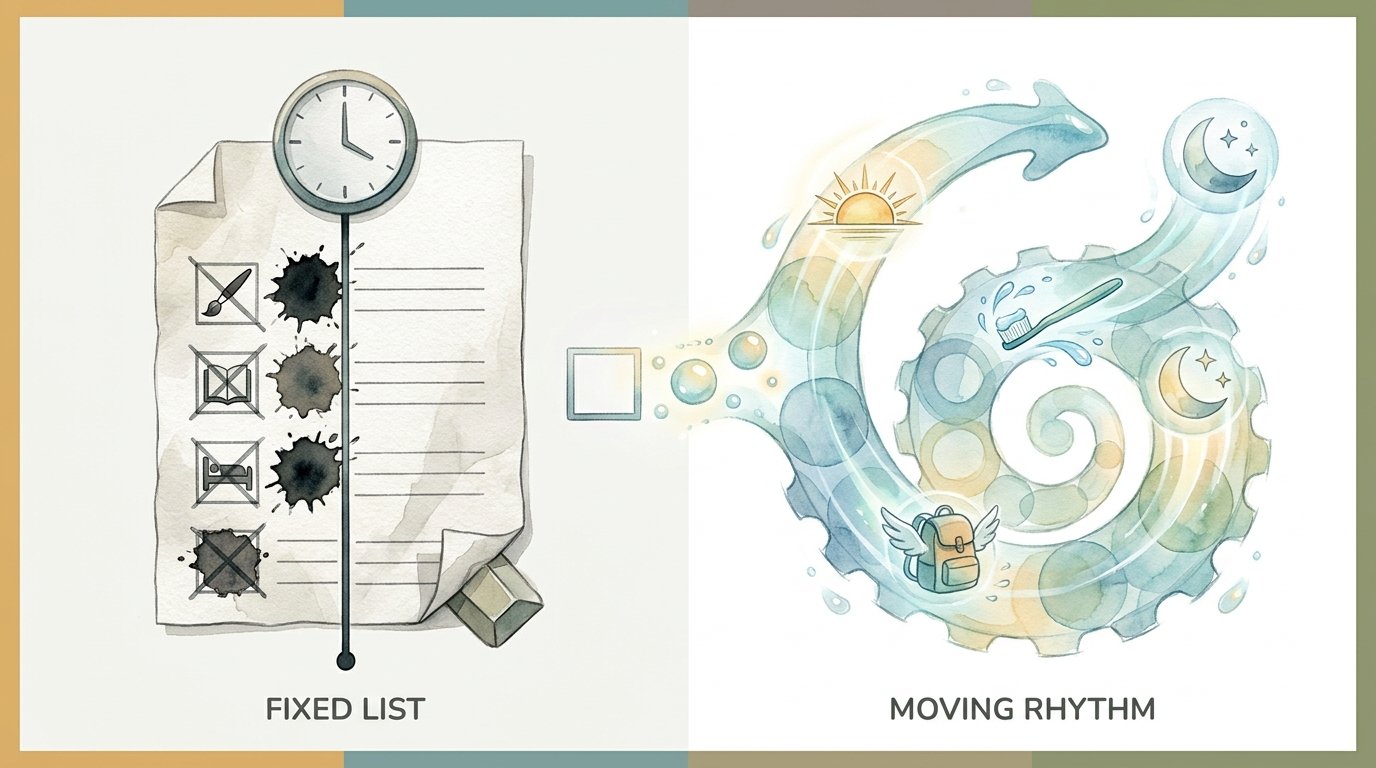
Paper lists are “Fixed.” They are unchanging and often ignored once the novelty wears off. Dynamic charts represent a “Moving Rhythm.” They allow a child to physically move a slider, flip a tab, or move a magnet from “To Do” to “Done.” This physical act provides immediate feedback to the nervous system, signaling that a mission is accomplished.
Real-world usage of these charts spans from general household organization to specialized therapeutic environments. Occupational therapists and educators have used visual schedules for decades to help children with ADHD and Autism navigate transitions. However, neurotypical children benefit just as much from this reduction in “instructional friction.”
How Dynamic Routine Systems Work
Interactive systems work by externalizing the brain’s executive functions. Executive function acts like an air traffic controller in the mind, managing focus, timing, and task switching. Children have an underdeveloped “controller.” A physical chart takes that invisible mental work and puts it on the wall where they can see and touch it.
The process usually follows a three-step sensory loop. First, the child receives a visual cue from a picture or icon. Second, they perform the task. Third, they return to the board to physically change the status of the task. This final step is the most critical because it triggers a physiological response.
Physical interaction with a chart involves proprioception—the sense of self-movement and body position. When a child slides a wooden toggle or pulls a Velcro tab, they are engaging their motor cortex. This physical “click” or “rip” provides a sense of closure that a checkmark on a piece of paper cannot match.
These systems also leverage operant conditioning. The “reward” isn’t necessarily a sticker or a treat; the reward is the feeling of momentum. Each completed task builds a “win streak” in the child’s mind. This momentum makes the next task easier to start because the brain is already primed for success.
Benefits of Visual Routine Systems
Moving to an interactive system offers measurable improvements in daily life. Most parents notice an immediate drop in “verbal prompting.” This is a polite way of saying you stop nagging. When the chart holds the plan, the parent is no longer the source of the “bad news” that it is time to get dressed.
Visual routines significantly reduce anxiety. Uncertainty is a major trigger for meltdowns. When a child knows exactly what comes next—and can see it on their board—their nervous system remains regulated. This predictability creates a “safe” environment where they can focus on learning skills rather than wondering what happens next.
Independence is the ultimate goal of parenting, and these tools are the bridge. A child who can follow a chart without being told what to do is building self-efficacy. They begin to see themselves as someone who is capable and organized. This confidence transfers to school, sports, and social interactions.
Time management becomes concrete rather than abstract. Children do not naturally understand that “five minutes” is a specific duration. Pairing a visual routine with a countdown timer or a progress bar helps them “see” time moving. This turns an invisible concept into a tangible reality they can navigate.
Challenges and Common Mistakes
The biggest pitfall is making the system too complex. A chart with twenty steps will overwhelm a child within forty-eight hours. Most parents start with too much enthusiasm and create a “master schedule” that includes everything from waking up to specialized chores. This leads to burnout for both the child and the parent.
Consistency is another major hurdle. If the chart is only used on “good days,” it loses its power as an anchor. The system must be part of the environment, like a door or a window. Forgetting to reset the board at night is a common error that ruins the momentum the following morning.
Neglecting child input is a recipe for resistance. If a parent designs the entire board in secret, the child views it as another set of rules imposed upon them. Lack of ownership leads to a lack of engagement. The child needs to feel that this is *their* tool, not your weapon of control.
Finally, placing the chart in a low-traffic area is a common mistake. If the morning routine chart is hidden in a hallway, the child won’t use it in the bedroom or bathroom where the actions actually happen. “Point of performance” is everything in behavioral design.
When Visual Charts May Not Be Ideal
Physical routine charts have realistic boundaries. One major limitation is portability. A large wooden slider board is perfect for the kitchen, but it doesn’t help during a busy weekend of travel or errands. When the environment changes rapidly, a static physical board can’t always keep up.
Age also plays a role in the effectiveness of specific formats. A toddler needs simple icons and high tactile feedback (Velcro). A teenager might find a physical “brush teeth” slider patronizing. As children grow, their needs shift toward digital calendars or bullet journals that offer more complexity.
Environmental constraints can also limit these systems. In very small living spaces or highly cluttered homes, adding more “visual noise” to the walls can actually increase overstimulation. If a child is already sensitive to visual clutter, a busy chart might contribute to their overwhelm rather than solve it.
High-conflict situations may also require a different approach. If the relationship between parent and child is currently characterized by intense power struggles, any new system might be viewed as a “trap.” In these cases, the relationship needs repair before the routine can be restructured.
Static Lists vs. Moving Rhythms
Choosing the right format depends on your child’s age and developmental stage. The following table highlights the core differences between a standard paper list and a dynamic, interactive system.
| Feature | Fixed Paper List | Moving Rhythm Chart |
|---|---|---|
| Cognitive Load | High (Requires decoding) | Low (Visual recognition) |
| Feedback Loop | Passive (Checkmark) | Active (Tactile/Physical) |
| Brain Engagement | Abstract/Sequential | Spatial/Motor-Driven |
| Motivation Factor | Static (Done/Not Done) | Dynamic (Momentum Building) |
| Durability | Low (Easily lost/torn) | High (Usually wood/plastic) |
Practical Tips for Implementation
Start with a single “pain point” in your day. Most families find that mornings or bedtimes are the most chaotic. Do not try to automate the entire day at once. Focus on the three to five steps that cause the most friction, such as getting dressed, eating, and packing a bag.
Involve your child in the “unboxing” or creation of the system. Let them choose where the magnets go or which icon represents “snack time.” This small act of agency creates a psychological “buy-in.” When they participate in the setup, they are more likely to defend the system later.
Place the board at the child’s eye level, not yours. This seems obvious, but many parents hang charts where *they* can see them. The chart is for the child. It should be easily reachable so they can manipulate the sliders or tabs without needing your help.
Create a “Reset Ritual.” Every evening, walk to the board with your child and move everything back to the “Start” position. This prepares their mind for the next day. It also serves as a quiet moment of connection where you can talk about what went well.
Advanced Considerations for Long-Term Success
Serious practitioners of routine systems understand the importance of “scaffolding.” This means providing high support initially and slowly fading it out as the child masters the skill. Eventually, the child might stop looking at the board because the routine is “burned” into their long-term memory.
Neurodivergent children often require specific adaptations. For children with ADHD, the novelty of a new chart might wear off in two weeks. To combat this, rotate the icons or change the “reward” at the end of the slider. For children with Autism, ensure the icons are literal and realistic photos rather than stylized cartoons to avoid confusion.
Scaling the system for multiple children requires clear boundaries. Each child should have their own distinct board or a clearly color-coded section. Combining everyone onto one large chart often leads to “bystander apathy,” where no one takes responsibility for their individual tasks.
Think about the transition to digital tools. Around age nine or ten, many children begin to mimic adult behaviors. Transitioning from a physical slider to a simple digital app can be a powerful “rite of passage.” However, ensure the digital tool still offers a satisfying “haptic” or visual feedback when a task is completed.
The “Morning Mission” Scenario
Imagine a Tuesday morning. Usually, you are yelling from the kitchen about shoes. Your child is staring at a toy, completely disconnected from the passing time. You feel your blood pressure rising as the clock ticks toward 8:00 AM.
Now, imagine the same morning with a “Moving Rhythm” chart. Your child walks to the board in the hallway. They see the “Pajamas to Clothes” slider is still on the red side. They move to their room, change, and return to push the slider to the green side. They feel a small “click” in their hand.
Instead of your voice being the trigger, the board is the guide. They see the next icon: “Breakfast.” They move to the table. You are drinking coffee, not checking your watch. When they finish, they return to the board for the next “win.” The power struggle has been replaced by a sequence of small, physical victories.
This isn’t a fantasy; it is the result of using a system that aligns with how a child’s brain actually functions. By removing the abstract “parental demand” and replacing it with a concrete “physical mission,” you change the entire emotional climate of the home.
Final Thoughts
Transforming your home from a place of constant reminders to a hub of independent action doesn’t happen by accident. It requires a shift in how we view our children’s capabilities. A static piece of paper assumes they have the adult-level focus to stay on track. A dynamic system acknowledges that they need a physical partner to help them navigate their day.
When you invest in a visual, tactile routine, you are doing more than just getting them to brush their teeth. You are training their prefrontal cortex. You are teaching them how to plan, how to focus, and how to experience the satisfaction of a job well done. These are the executive functioning skills that will serve them for the rest of their lives.
Start small, stay consistent, and let the board do the talking. You might find that your most important role isn’t the “enforcer” who manages the list, but the “coach” who celebrates the progress. Switch from a list to a rhythm today and watch the meltdowns disappear.
Sources
1 flourishinglivesmi.com | 2 busybudgeter.com | 3 metaoh.org | 4 hearthdisplay.com | 5 lifestance.com | 6 biermanautism.com | 7 lifeskillsadvocate.com | 8 upbility.net | 9 childrensdiscoverycenters.com | 10 crazyfitnessguy.com | 11 nih.gov | 12 occupationaltherapy.com.au | 13 raisingchildren.net.au