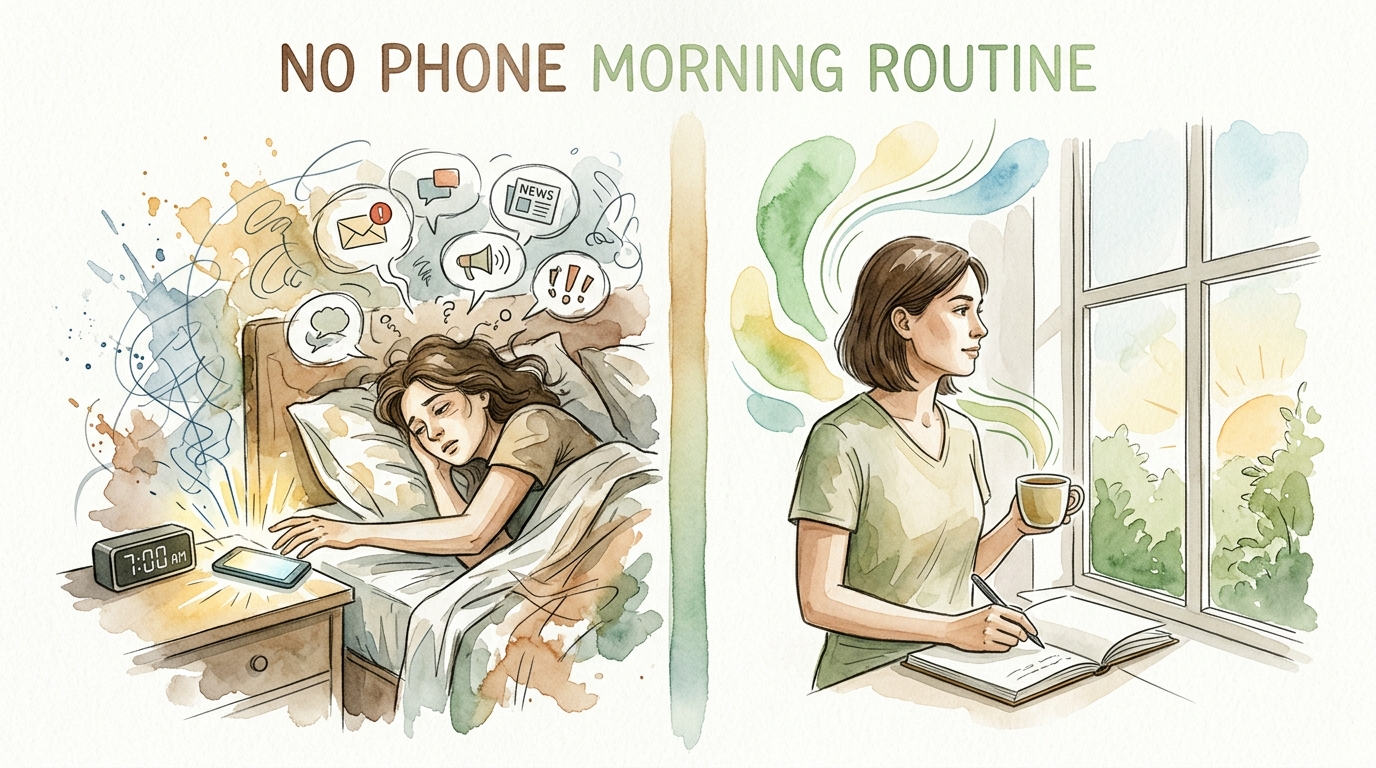
no phone morning routine
Do you start your day on your terms or the world’s? When the first thing you touch is your phone, you start your day in a reactive state. Reclaim your morning with an active routine that puts your goals first.
Most of us are guilty of the “morning scroll.” We reach for the glowing rectangle before our eyes are even fully open. We check emails, headlines, and social feeds before we even say good morning to ourselves. This habit is more than just a time-waster. It is a neurological hijack.
Transitioning from sleep to wakefulness is a delicate process. Your brain is moving through specific frequency states that govern your mood and focus. When you introduce a smartphone into this window, you short-circuit your natural chemistry. You trade long-term clarity for a short-term dopamine hit.
Breaking this cycle is the most effective way to improve your mental health. It requires moving from a state of Passive Reaction to Active Intention. This guide will show you how to protect your morning window and why your brain will thank you for it.
no phone morning routine
A no phone morning routine is the practice of avoiding all digital screens for a set period after waking up. Usually, this buffer lasts between 30 to 90 minutes. It creates a physical and mental “clean zone” where you focus on your own thoughts before consuming anyone else’s.
Think of your morning brain like a fresh snowfall. It is pristine and full of potential. Checking your phone is like walking all over that snow before you have even decided where the path should go. You are letting the outside world—bosses, news cycles, and influencers—set your priorities for the day.
This routine is not about being “anti-tech.” It is about being “pro-brain.” In the real world, high-performing athletes and executives use this strategy to maintain their competitive edge. They understand that focus is a finite resource. If you spend your best mental energy on notifications, you have less left for your actual work.
Common real-world uses include using the time for deep reflection, physical movement, or creative hobbies. It is a defensive strategy against the “doomscrolling” culture that often leads to morning anxiety. By keeping the phone out of reach, you ensure that you are the pilot of your day, not a passenger.
How to Build Your Screen-Free Morning
Success starts the night before. You cannot rely on willpower alone when you are groggy at 6:00 AM. You need a system that removes the choice entirely. Follow these steps to build a bulletproof morning environment.
Step 1: The Analog Swap
Ditch the phone as your alarm clock. This is the single biggest point of failure for most people. If your phone is your alarm, it is already in your hand the second you wake up. Buy a dedicated analog alarm clock or a sunrise lamp. Place it where you can hear it, but keep the phone in a different room entirely.
Step 2: Create a Dedicated Charging Station
Establish a “phone jail” outside of your bedroom. The kitchen or the home office are great spots. Plug your phone in at least 30 minutes before bed and do not touch it again until your morning window is over. Physical distance is the strongest barrier against habitual checking.
Step 3: Define Your Window
Start with a manageable goal. Commit to 30 minutes of no-phone time. Use this time for three specific actions: hydration, movement, and reflection. Once this feels natural, you can extend the window to an hour or more. Consistency is more important than duration in the beginning.
Step 4: Prepare Your Replacement Activities
Nature hates a vacuum. If you don’t have a plan, you will instinctively look for your phone. Lay out a book, a journal, or your gym clothes the night before. Make the “good” habit easier to start than the “bad” one. If your journal is sitting on your bedside table, you are much more likely to pick it up.
The Biological Benefits of Staying Offline
The advantages of a phone-free morning are grounded in neurobiology. Research shows that your brain transitions through different waves as you wake up. You move from Delta (deep sleep) to Theta (dreamy state) and then to Alpha (relaxed wakefulness).
Theta waves are the gateway to creativity and intuition. When you check your phone immediately, you skip these beneficial states and jump straight into High Beta. This is the state associated with stress, anxiety, and the “fight or flight” response. Staying offline preserves your Alpha and Theta states, allowing for more creative problem-solving throughout the day.
Mental clarity is the most immediate benefit. Without the noise of social media, your brain can process the previous day’s information and prepare for the new one. You will find that your attention span increases. You are no longer training your brain to seek 15-second dopamine hits every few minutes.
Emotional resilience also takes a leap forward. Morning phone use often exposes us to negative news or social comparison. By avoiding this “mental junk food,” you start your day with a neutral or positive mindset. You become less reactive to stressors that happen later in the afternoon.
Challenges and Common Pitfalls
The hardest part of this routine is the initial “itch.” You will likely feel a sense of FOMO (Fear Of Missing Out) during the first few days. Your brain is addicted to the dopamine loops created by notifications. This discomfort is actually a sign that your brain is recalibrating.
A common mistake is replacing the phone with another screen. Checking your laptop or turning on the TV defeats the purpose. The goal is a total digital detox. Any screen exposure triggers the same blue light and high-stimulation response that interrupts your natural waking process.
Another error is being too rigid. If you miss a day, don’t throw away the whole week. Habit formation is a long game. Many people quit because they “failed” once. Simply acknowledge the slip and put the phone back in its charging station for the next morning.
Watch out for “utility creeping.” This is when you justify checking the phone for a “useful” reason, like checking the weather or your calendar. These small tasks quickly turn into 20 minutes of scrolling. Check your schedule and the weather the night before so you have no excuse to look at the device in the morning.
Limitations and Realistic Constraints
This routine is powerful, but it isn’t always practical for everyone. Parents with young children or those caring for elderly relatives may need to be reachable at all times. In these cases, total disconnection might cause more stress than it relieves.
Professionals in emergency roles, such as doctors or first responders, often have no choice but to be on call. For these individuals, the “no phone” rule must be modified. You might use “Do Not Disturb” settings that only allow calls from specific contacts while blocking all other apps and notifications.
Living in a small studio apartment can also make physical distance difficult. If you can’t charge your phone in another room, consider using a timed lockbox. These devices keep your phone physically inaccessible until a pre-set time. It removes the element of willpower from the equation.
Travel can also disrupt this habit. When you are in a new city, your phone is your map and your concierge. During these times, focus on “Intentional Use” rather than “No Use.” Use the phone for the specific task you need, then immediately put it away.
Passive Reaction vs. Active Intention
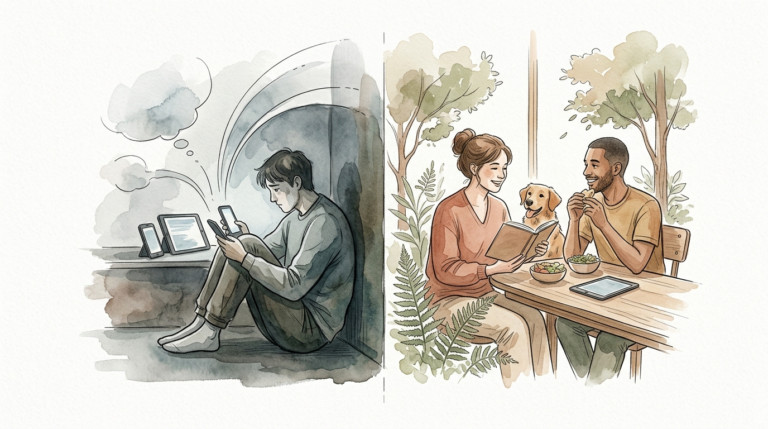
To understand why this routine works, we must compare the two primary mindsets of the modern morning. Most people live in a state of reaction. They let external stimuli dictate their internal state.
| Factor | Passive Reaction (Phone First) | Active Intention (No Phone) |
|---|---|---|
| Brain State | Immediate High Beta (Stress) | Extended Theta/Alpha (Creativity) |
| Dopamine | Unpredictable spikes and crashes | Steady, natural release |
| Focus | Scattered and easily distracted | Sustained and deep |
| Mood | Reactive and anxious | Proactive and calm |
| Decision Power | Depleted by early trivial choices | Conserved for high-impact tasks |
Choosing Active Intention means you decide what matters before the world can tell you. You are building a fortress around your focus. This simple shift in the morning pays dividends in your productivity for the remaining 16 hours of your day.
Practical Tips for Instant Success
Ready to start? Use these tactical adjustments to make the transition easier. These tips focus on environment design rather than willpower.
- The 10-10-10 Rule: Spend the first 10 minutes hydrating, the next 10 moving, and the final 10 reflecting. This gives you a structured 30-minute block that requires zero technology.
- Visual Cues: Place a book or your journal directly on top of your phone if you must keep it in the room. The physical barrier serves as a reminder of your commitment.
- Use “Gray Scale” Mode: If you find yourself reaching for the phone out of habit, turn the screen to grayscale. This makes the apps far less stimulating and easier to put down.
- Morning Playlist: If you use your phone for music or podcasts, set up a “No-Look” system. Use voice commands or a dedicated smart speaker so you never have to actually touch or see the screen.
- Sunlight Exposure: Get outside or look out a window within 20 minutes of waking. Natural light helps reset your circadian rhythm and boosts alertness naturally, replacing the artificial “boost” of blue light.
Advanced Considerations for Practitioners
Once you have mastered the basic 30-minute window, you can take your routine to a deeper level. Advanced practitioners often extend their “digital fast” until they have completed their first block of Deep Work. This means not checking messages until 10:00 AM or 11:00 AM.
Consider the impact of Information Foraging. Our brains are evolved to seek out information, which is why social media is so addictive. By delaying your phone use, you are essentially training your brain to “forage” for information within your own mind first. This leads to higher-quality insights and better long-term memory consolidation.
Optimization techniques include combining the phone-free morning with a “dopamine fast” on weekends. This prevents the “rebound effect” where you spend the rest of the day over-using your phone to make up for the morning restriction. Balance is the key to making this a lifestyle rather than a temporary challenge.
Scaling this habit to your team or family can also amplify the benefits. Creating “Device-Free Zones” in common areas during the morning ensures that everyone starts the day with presence. It fosters better communication and reduces the collective anxiety levels of the household or office.
Example Scenarios
How does this look in practice? Here are two realistic ways to implement a no phone morning routine depending on your goals.
The Creative Professional
Maya is a graphic designer who struggled with morning brain fog. She used to scroll Instagram for “inspiration” as soon as she woke up. Now, she leaves her phone in the kitchen. She wakes up at 7:00 AM, drinks 20 ounces of water, and spends 40 minutes sketching in a physical notebook. She doesn’t touch her phone until she has finished her first cup of coffee and drafted her top three goals for the day. Her creativity has increased because she is drawing from her own imagination rather than reacting to other artists’ work.
The High-Stakes Executive
James is a CEO who felt constantly overwhelmed by “firefighting” emails. He moved his phone charger to his home office. He wakes up at 6:00 AM and immediately goes for a 20-minute walk outside without headphones. He uses this time to mentally simulate his day. After returning, he eats a high-protein breakfast with his family, completely present. He only enters his office and opens his phone at 8:00 AM. By then, he is fully awake and ready to handle crises with a level head rather than a reactive pulse.
Final Thoughts
Reclaiming your morning is the ultimate act of self-care in a hyper-connected world. It is a small change that yields massive psychological and professional results. By protecting the first hour of your day, you ensure that your energy is spent on the things that actually move the needle in your life.
Remember that your phone is a tool, not a master. You are not missing anything vital in those first 60 minutes that cannot wait. The world will still be there when you choose to log back in. The clarity and peace you gain from a phone-free morning are far more valuable than any notification you might miss.
Start tomorrow. Charge your phone in another room tonight. Buy a basic alarm clock. Give your brain the space it needs to wake up naturally. You will be amazed at how much more productive and calm your life becomes when you start it on your own terms. Explore related concepts like Digital Minimalism or Monastic Work Blocks to further deepen your focus and master your time.
Sources
1 unplugged.rest | 2 unplugged.rest | 3 bannerhealth.com | 4 digitalwellnessinstitute.com | 5 unplugged.rest | 6 thriveglobal.com | 7 vanillapapers.net | 8 healthshots.com | 9 camillestyles.com | 10 reddit.com | 11 mymeadowreport.com | 12 mymeadowreport.com | 13 reddit.com | 14 medium.com | 15 rebalancehealth.com | 16 upskillist.com | 17 lonestarneurology.net | 18 scribd.com | 19 medium.com | 20 whowhatwear.com | 21 medium.com | 22 thriveglobal.com | 23 hmn24.com | 24 silvermagazine.co.uk | 25 psychologytoday.com | 26 pamelarutledge.com | 27 hannahsaundersyoga.com | 28 nhahealth.com