Tactile Routine Charts For Kids Vs Verbal Reminders
Why are you working harder than the piece of wood on your wall?

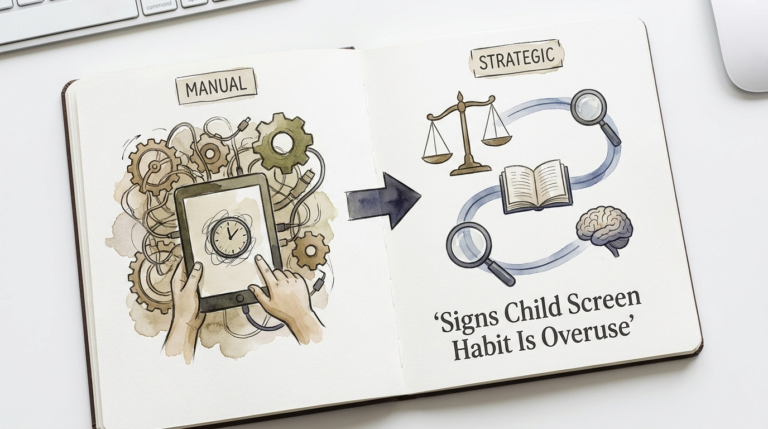
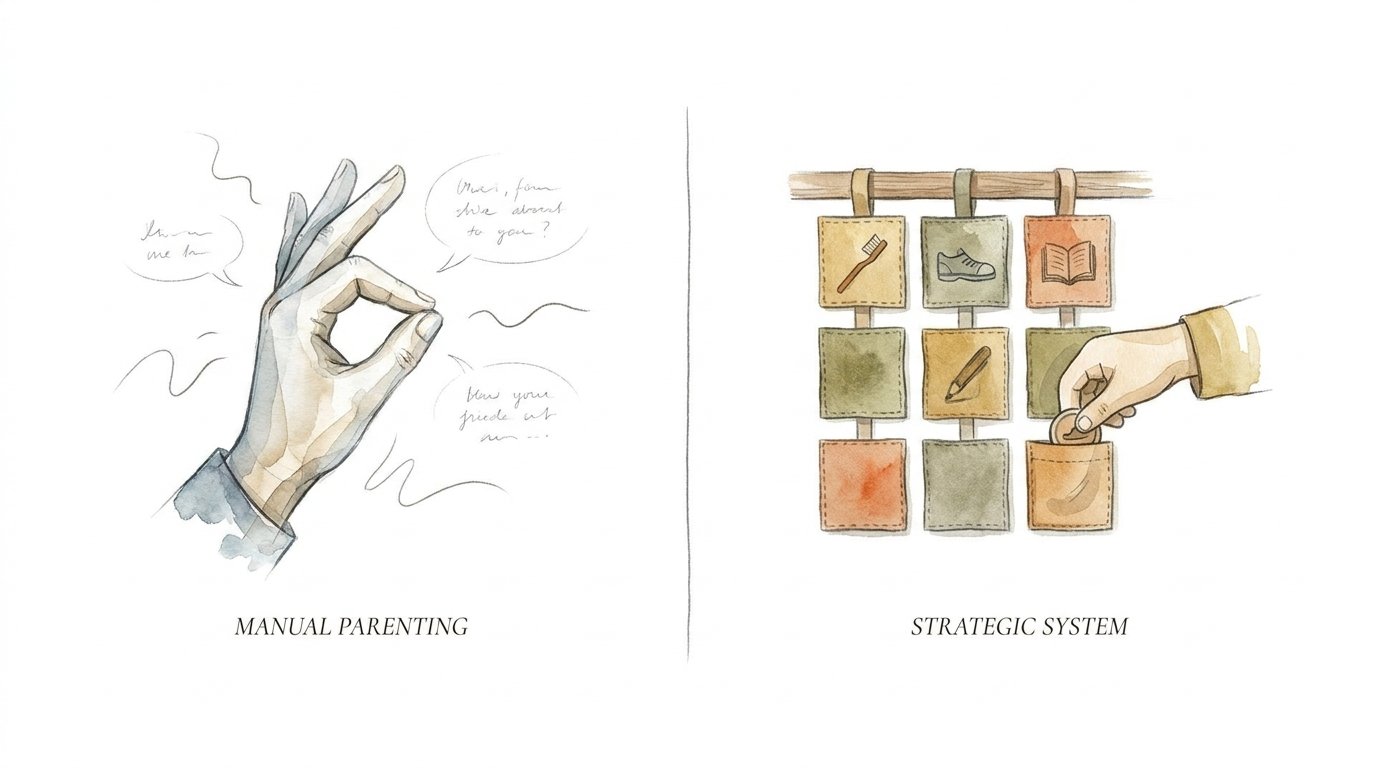
We spend 4 hours a day repeating the same three sentences: “Brush your teeth,” “Put on your shoes,” and “Get in the car.” That’s manual parenting, and it’s exhausting. A strategic routine chart isn’t just a list; it’s an employee that manages your child’s morning so you don’t have to.
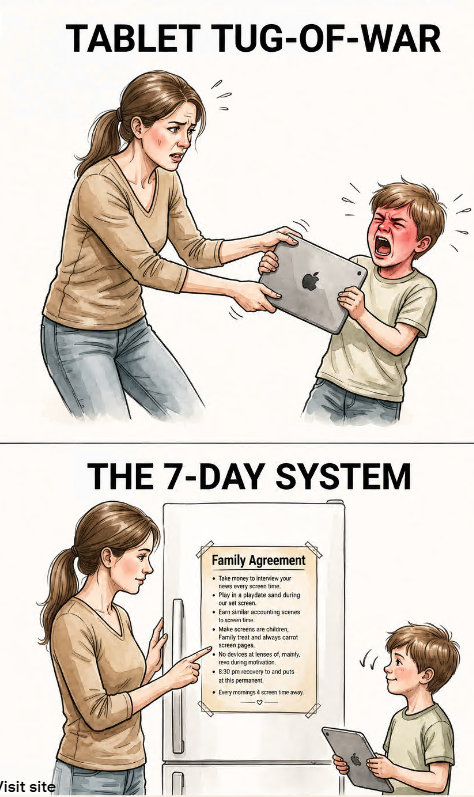
Think of your current morning routine. You are likely acting as a human alarm clock, a project manager, and a frustrated drill sergeant all at once. This manual approach drains your battery before you even finish your first cup of coffee. It turns your home into a courtroom where you are constantly prosecuting “The Case of the Missing Socks.”
Transitioning to a strategic system shifts the burden of responsibility. Instead of your voice being the trigger for action, a physical object becomes the guide. This small shift changes the dynamic of your entire household. You stop being the “bad guy” who nags and start being the coach who cheers.
Tactile Routine Charts For Kids Vs Verbal Reminders
Tactile routine charts are physical tools that allow children to interact with their daily schedule using their hands. Unlike a simple poster, these charts involve moving parts like magnets, Velcro tabs, or sliding windows. They exist to bridge the gap between an abstract instruction and a completed task.
Verbal reminders rely entirely on a child’s working memory. Research shows that young children, especially those under seven, have a limited “buffer” for holding multiple instructions at once. When you say, “Go upstairs, put on your pajamas, and bring down your laundry,” their brain often drops the last two items before they hit the first step.
Tactile charts serve as an external brain. They provide a permanent visual and physical anchor for what needs to happen next. In the real world, we use these systems everywhere without realizing it. Pilots use physical checklists, and surgeons use tactile boards to track instruments. We don’t expect experts to rely on memory alone, yet we often expect toddlers to do exactly that.
A tactile chart transforms a “demand” into a “discovery.” When a child flips a tab from “To Do” to “Done,” they receive an immediate hit of dopamine. This physical feedback loop reinforces the behavior far better than a parent’s voice ever could. Verbal reminders often lead to “nagging fatigue,” where the child eventually tunes out your voice like background static.
How The Strategic System Works Step-By-Step
Building a strategic system requires more than just a piece of paper and some markers. You are designing a workflow for a tiny human. Success depends on how you structure the sequence and the physical interaction.
First, you must break down complex tasks into “atomic” steps. “Get ready for school” is too big. It’s a mountain, not a step. Break it into: Underwear, Socks, Pants, Shirt. Use clear, high-contrast photos or icons for each.
Second, choose your tactile mechanism. Magnets are great for the fridge. Velcro is perfect for wall-mounted boards. Some parents use “flip-up” charts made from poster board and clothespins. The key is that the child must physically move something to signify completion.
Third, place the chart at the child’s eye level in the exact location where the tasks happen. A bathroom routine chart belongs on the bathroom wall, not in the kitchen. This reduces the distance between the instruction and the execution.
Finally, introduce the system during a “neutral” time. Never try to launch a new routine chart in the middle of a Monday morning meltdown. Sit down on a Sunday afternoon. Let the child touch the pieces and practice moving them. This creates a sense of ownership before the pressure is on.
The Practical Benefits Of Going Tactile
Tactile charts provide measurable improvements in household efficiency. The most immediate benefit is the reduction in parental vocal strain. You will find yourself saying “What does the chart say?” instead of “Put your shoes on for the tenth time.”
Independence is the ultimate goal of parenting. A tactile system allows a child to self-navigate. When they look at the board and see a picture of a toothbrush, they don’t need you to tell them what to do. They are learning to manage their own time and energy, which are essential executive function skills.
Predictability reduces anxiety. Many “behavioral issues” in children are actually stress responses to transitions. When a child can see exactly what is coming next, they feel in control of their environment. This safety allows their brain to stay in a learning state rather than a “fight or flight” state.
You also gain a cleaner emotional environment. When the chart is the boss, you get to be the assistant. If a task isn’t done, the “chart” says so. This removes the personal conflict between parent and child. You can stand next to them and say, “Oh man, the chart says we still have to find shoes, let’s go get ’em!”
Challenges And Common Pitfalls To Avoid
The most common mistake is overcomplicating the board. If you put 15 steps on a morning routine for a three-year-old, they will shut down. Start small. Three to five essential steps are plenty for a beginner.
Consistency is another major hurdle. A strategic system only works if the parent respects it as much as the child. If you skip using the chart for three days, the child learns that the system is optional. You have to be the guardian of the process until it becomes a habit.
Many parents forget to update the chart as the child grows. A chart with a “diaper change” icon is no longer relevant to a potty-trained preschooler. If the chart becomes stale, the child will stop looking at it. Review the system every few months to ensure it still matches their current skill level.
Avoid using the chart as a punishment tool. If you say, “Because you didn’t do your chart, you lose your toys,” you attach negative emotions to the system. The chart should be a helpful guide, not a threat. Focus on the satisfaction of completion rather than the fear of failure.
Limitations Of The Routine Chart Method
Routine charts are powerful, but they are not magic. They cannot fix deep-seated sleep issues, nutritional deficiencies, or underlying medical conditions. If a child is physically exhausted or unwell, no amount of tactile feedback will make them move faster.
Environmental factors can also limit success. In a chaotic, high-stress home, a chart might just become another piece of clutter on the wall. The system requires a relatively stable environment to take root. If the morning routine changes every single day, the chart loses its predictive power.
Some children with specific sensory processing needs may find certain tactile materials aversive. For example, a child who hates the sound of Velcro might avoid the chart entirely. You must tailor the materials to the child’s specific sensory profile.
Finally, charts have a “shelf life” for some kids. Some children master a routine so thoroughly that they no longer need the visual aid. Forcing an older child to use a “babyish” chart can lead to resentment. At that point, it’s time to graduate to a digital system or a simple written checklist.
Comparing Tactics: Tactile vs. Verbal
| Feature | Tactile Routine Charts | Verbal Reminders |
|---|---|---|
| Cognitive Load | Low; information is stored externally. | High; requires active working memory. |
| Engagement | High; physical interaction is rewarding. | Low; often perceived as “nagging.” |
| Independence | Encourages self-navigation and autonomy. | Reinforces dependence on adult prompts. |
| Emotional Tone | Neutral; the chart is the “boss.” | Can become tense or confrontational. |
| Consistency | Visible 24/7; stays the same. | Changes based on parent’s mood/energy. |
Practical Tips For Immediate Success
Start with “The Big Three.” Focus only on the three things that cause the most stress in your morning. For most families, this is getting dressed, eating breakfast, and brushing teeth. Master these before adding more.
Use real photos of your child doing the tasks. Seeing a picture of themselves brushing their teeth is far more powerful for a toddler than a generic cartoon icon. It creates a “mirror effect” where they want to match the image they see.
Incorporate a “Done” bucket. If you use magnets or Velcro pieces, let the child drop the completed task into a physical container. The “clink” of a magnet hitting the bottom of a tin is a satisfying auditory cue that the job is finished.
Keep the chart accessible. If your child has to climb on a stool to reach their chart, the friction is too high. It should be at their height in a high-traffic area. The less effort it takes to use the system, the more likely they are to stick with it.
Advanced Considerations For Long-Term Success
For neurodivergent children, tactile charts are often a lifeline rather than a luxury. Children with ADHD or Autism frequently struggle with “internalizing” time. A tactile chart with a visual timer (like a red disappearing disk) can help them “see” time passing.
You can eventually transition to “conditional” steps. For older children, you might include “If it’s a PE day, pack sneakers.” This introduces logic and decision-making into the strategic system. It prepares them for the complex scheduling they will face in middle school and beyond.
Consider the “fade-out” strategy. Once a routine is 100% automated, you can remove that specific icon from the board. This prevents the chart from becoming overwhelming. It also gives the child a sense of “leveling up” their responsibilities.
Think about scaling the system for the whole family. A master board in the kitchen can show everyone’s primary tasks. This models the behavior for your children. When they see Mom and Dad checking their own tactile boards, they realize that systems are a tool for successful adults, not just a “kid thing.”
Realistic Scenarios In Action
Imagine it’s 7:15 AM. In a “manual parenting” house, the parent is yelling from the kitchen for the child to put on their shoes. The child is distracted by a toy. The parent gets louder. The child starts crying. Everyone leaves the house late and angry.
In a “strategic system” house, the 7:15 AM scene looks different. The child finishes breakfast and walks to the fridge. They see the “Shoes” magnet. They move it to the “Done” column and hear the “click.” They go to the door and put on their shoes. The parent is finishing their coffee, looks over, and says, “I see you’ve already checked off three things, great job!”
The difference isn’t the child; it’s the system. In the second scenario, the parent didn’t have to use any “voice juice.” The child didn’t feel attacked. The physical magnet acted as the prompt, and the physical movement acted as the reward.
Another scenario involves the dreaded bedtime routine. Instead of the “one more story” battle, the chart shows exactly three book icons. As each book is read, the child removes an icon. When the icons are gone, the “boss” (the chart) says it’s time for lights out. The parent is just following the chart’s rules.
Final Thoughts
Shifting from manual parenting to a strategic system is the best gift you can give your future self. It requires an upfront investment of time and a few bucks for materials, but the ROI is measured in years of peace. You are not just getting your kid to put on their socks; you are teaching them how to build their own systems for life.
Stop working harder than the wood on your wall. Your voice should be used for singing, laughing, and reading stories, not for acting as a repetitive task manager. Build a tactile routine chart this weekend and watch how the energy in your home shifts from friction to flow.
The transition won’t be perfect on day one. You might have to point at the chart fifty times before they start looking at it on their own. But every time you point instead of yelling, you are winning. You are moving away from the exhaustion of manual parenting and toward the freedom of a strategic system.
Sources
1 sensorypoodle.com.au | 2 rayzkidz.com | 3 linksaba.com | 4 simplyspecialed.com | 5 occupationaltherapy.com.au | 6 pathstoliteracy.org | 7 educatly.com | 8 upbility.net | 9 biermanautism.com | 10 omegapediatrics.com | 11 nwciowa.edu | 12 abilitypath.org | 13 childrenscolorado.org | 14 cookcounselingandconsulting.com | 15 nih.gov | 16 mentalhealthcenterkids.com