Signs Your Child Has Screen Time Brain Fog
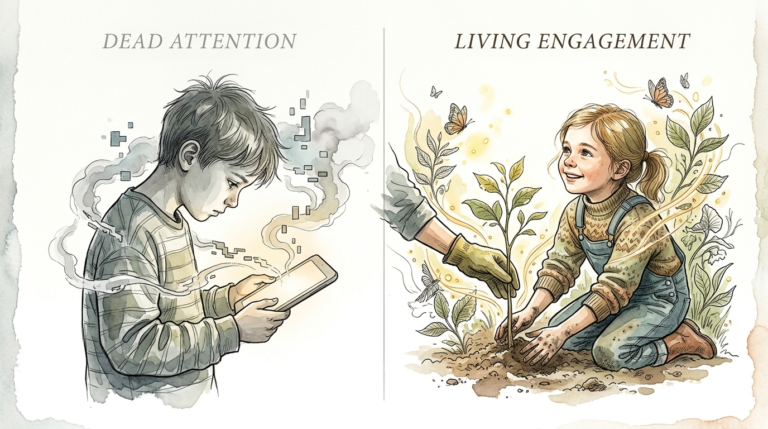
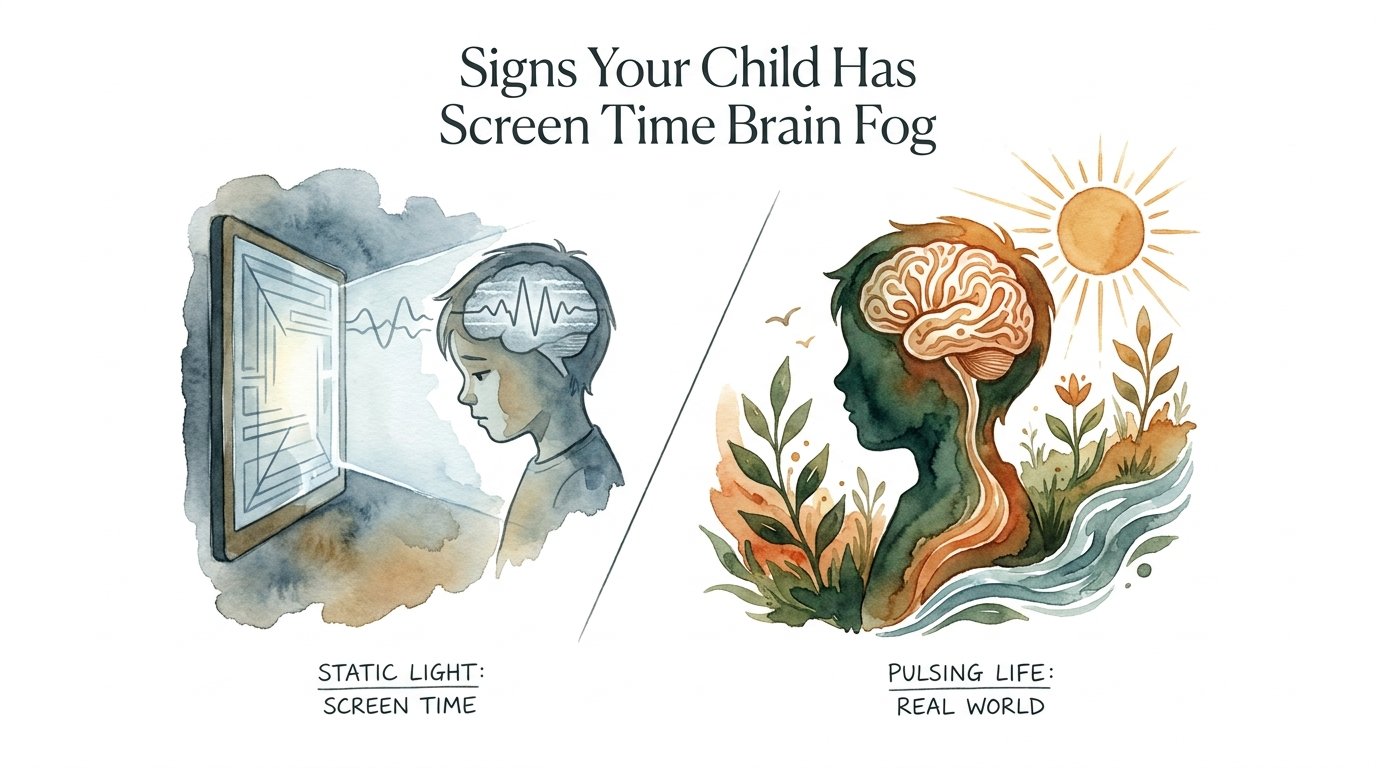
When the high-definition world makes real life look dull, your child isn’t just bored—they’re becoming sensory-numb. A major sign that screen time has crossed into overuse is when the ‘real world’ no longer has enough stimulus to keep them engaged. If they prefer the flicker of a pixel over the texture of the earth, it’s time to wake up their nervous system.
Screens provide a curated, high-intensity reality that our biology isn’t designed to handle 24/7. While digital devices offer entertainment, they often lack the pulsing life and multisensory depth required for healthy brain growth. In contrast, the real world is messy, slow, and tactile—exactly what a developing mind needs to thrive.
Today, we are seeing more children struggle with what experts call “digital fog.” This isn’t just a mood swing. It is a physiological response to a brain that has been conditioned to expect constant, high-speed hits of dopamine. When that stream stops, the silence of the physical world feels unbearable to them.
The goal isn’t to demonize technology but to restore balance. By understanding how digital overstimulation works, you can guide your child back to a state of “calm alertness.” Let’s dive into the signs of this modern “brain fog” and how to clear it.
Signs Your Child Has Screen Time Brain Fog
Screen time brain fog is a state of cognitive and emotional dysregulation caused by excessive digital input. It occurs when a child’s nervous system becomes overwhelmed by the constant “static light” of high-speed media. This overstimulation can lead to a literal thinning of the brain’s cortex in areas responsible for critical thinking and reasoning.
Think of it like a sensory “hangover.” The brain has been running at 100 miles per hour, and returning to a normal pace feels frustratingly slow. In the real world, this manifests in several observable ways:
- The “Transition Meltdown”: Intense aggression or emotional collapse when asked to put the device away.
- Reduced “Play Independence”: An inability to figure out what to do with physical toys without digital guidance.
- Sensory Seeking or Numbing: Either crashing into furniture to feel “something” or appearing glazed and unresponsive to your voice.
- Fragmented Focus: Difficulty sticking to a single task, like a puzzle or a book, for more than a few minutes.
A classic example is a child who sits in a room full of toys and claims they have “nothing to do.” Their brain is waiting for the high-intensity delivery of a screen. Without it, their imagination feels stalled, and their internal motivation is low.
How Digital Overstimulation Hijacks the Brain
The core of screen time brain fog lies in the dopamine loop. Modern apps and games are designed with “gambling mechanics”—bright colors, unpredictable rewards, and instant feedback. These elements flood the brain with dopamine, the chemical responsible for pleasure and motivation.
When a child engages with this “static light” for hours, their brain starts to downregulate its dopamine receptors. They essentially build a tolerance. Normal activities like walking in the park or drawing a picture don’t release enough dopamine to satisfy them anymore. This creates a cycle where the child craves more screen time just to feel “normal.”
Additionally, high-speed media bypasses the “anticipation” phase of the reward cycle. In the real world, you have to build the Lego tower to see it stand. On a screen, the reward comes before the effort. This trains the brain to struggle with delayed gratification, a critical skill for school and social success.
Research from 2024 and 2025 highlights that early screen exposure can even lead to “accelerated but inefficient” brain maturation. While the visual networks may develop quickly, the networks for emotional regulation and cognitive control often lag behind, leading to higher anxiety later in life.
Benefits of Reconnecting with the Real World
When you clear the digital fog, you aren’t just taking something away—you are giving the brain room to grow. Reducing screen reliance allows the nervous system to recalibrate to the pace of pulsing life. This shift brings measurable improvements to a child’s daily functioning.
One of the most immediate benefits is restorative sleep. Screens emit blue light that suppresses melatonin, the hormone that tells the body to sleep. Removing screens—especially 60 minutes before bed—helps the brain “clean house” and consolidate learning during the night.
Other practical advantages include:
- Enhanced Neuroplasticity: Real-world play (like building blocks or playing tag) builds more complex neural pathways than tapping a flat screen.
- Improved Social Cues: Face-to-face interaction teaches empathy and tone, which digital emojis cannot replicate.
- Emotional Resilience: Without the “escape” of a screen, children learn to sit with boredom and manage their own frustration.
Challenges and Common Mistakes
The biggest hurdle for most parents is the “Quiet Trap.” Screens are incredibly effective at keeping children quiet, which allows parents to finish chores or work. However, using screens as a default “pacifier” prevents the child from developing their own internal regulatory tools.
Another common mistake is the “Cold Turkey” Crash. Abruptly removing all devices without providing a sensory alternative can lead to extreme behavioral spikes. The child’s brain is literally going through a “dopamine letdown,” and they need help bridging the gap.
Parents often feel a sense of “digital guilt,” either for letting the screen time happen or for the struggle that ensues when trying to stop it. It is important to remember that these devices are professionally engineered to be addictive. It is a battle against billion-dollar algorithms, not just a “bad habit.”
Limitations and Realistic Constraints
We live in a digital world, and complete avoidance is rarely practical or even ideal. Research shows that high-quality, educational content can support school readiness when used in moderation. The key is intentionality.
Limitations to a “total detox” approach include:
- Educational Requirements: Many schools now require tablets for homework and communication.
- Social Connectivity: For older children, some gaming is a primary social outlet with their peers.
- Caregiver Capacity: There are times when a parent’s mental health requires the “digital babysitter” for a short period.
The goal is to find a balance where the screen is a tool, not a destination. If the screen use is active (like learning a language) rather than passive (scrolling endless short videos), the impact on brain fog is often less severe.
Comparing Stimuli: Digital vs. Physical
Understanding the difference between these two worlds helps in choosing the right activities for your child’s recovery.
| Feature | Static Light (Digital) | Pulsing Life (Physical) |
|---|---|---|
| Sensory Input | Flat, 2D visual/auditory only. | 3D, tactile, olfactory, vestibular. |
| Pace of Reward | Instant and constant. | Delayed and earned. |
| Brain State | Stress-based alertness. | Calm alertness. |
| Creative Demand | Low (Passive consumption). | High (Open-ended play). |
Practical Tips for Clearing the Fog
If you suspect your child is suffering from brain fog, you can begin a “sensory reset” immediately. The objective is to replace high-intensity digital dopamine with low-intensity, high-quality sensory input.
- The 20-20-20 Rule: Every 20 minutes of screen use, have them look at something 20 feet away for 20 seconds. This resets the visual system and reduces brain fatigue.
- Sensory Bins: Fill a container with rice, beans, or kinetic sand. This provides the tactile “grounding” that screens lack.
- “Green Time”: Spend at least 30 minutes outdoors. Natural sunlight and varied textures (bark, grass, wind) are the ultimate antidote to static light.
- Tech-Free Zones: Declare the dining table and bedrooms as screen-free zones. This forces the brain to engage with the immediate environment.
- The “Transition Bridge”: Instead of just taking the tablet, give a 5-minute warning and immediately offer a high-movement activity, like a “dance-off” or a quick obstacle course.
These small shifts help the nervous system “downshift” without the emotional crash. You are essentially retraining their brain to find value in the slower, richer vibrations of real life.
Advanced Considerations: Executive Function and Pruning
For parents of older children or those deeply concerned about long-term effects, it’s worth understanding synaptic pruning. The brain is a “use it or lose it” organ. If a child spends their peak developmental years in a digital vacuum, the neural pathways for complex problem-solving and deep focus may not be reinforced.
Serious practitioners of “digital minimalism” often look at Executive Function. This includes working memory, flexible thinking, and self-control. Screens often do the “thinking” for us—calculating moves in a game or suggesting the next video. To strengthen executive function, children must engage in activities that require planning and trial-and-error, such as baking, woodworking, or complex board games.
Recent neuroimaging suggests that heavy screen use can disrupt the white matter integrity in the brain. White matter is like the “cabling” that connects different brain regions. By prioritizing “pulsing life” activities, you are ensuring those cables remain strong and efficient for a lifetime of learning.
Real-World Scenario: The Saturday Morning Reset
Imagine it’s Saturday morning. Usually, your child wakes up and reaches for a tablet. By 10:00 AM, they are irritable, rubbing their eyes, and refusing to eat breakfast. This is the Digital Fog in action.
Try a “Reset Morning”:
- Keep the devices off and out of sight.
- Set up a “pancake station” where they have to mix and stir—high tactile input.
- Play upbeat music to provide auditory stimulation without a visual screen.
- Go for a 15-minute walk to “collect treasures” (rocks, leaves).
By noon, you will likely notice a child who is more vocal, has better eye contact, and is more willing to play independently. Their brain has successfully transitioned from the high-speed digital track to the natural pace of the home.
Final Thoughts
When the high-definition world makes real life look dull, it is a signal that your child’s nervous system is out of sync. Screen time brain fog is a modern challenge, but it is not a permanent state. By choosing pulsing life over static light, you are giving your child the tools to reconnect with their own curiosity and creativity.
Focus on progress, not perfection. Every hour spent digging in the dirt or building a fort is an investment in your child’s cognitive health. Start small, set clear boundaries, and watch as the “fog” lifts to reveal a more engaged, resilient, and happy child.
Remember, the most beautiful pixels in the world cannot compete with the complexity of a single blades of grass. It’s time to help them look up and see it.
Sources
1 thehood.ae | 2 sarahwilsonpsychology.co.uk | 3 medium.com | 4 neurosciencenews.com | 5 amenuniversity.com | 6 rochester.edu | 7 mlhco.ca | 8 childcareed.com