Signs Of Toddler Screen Addiction And Loss Of Patience
When did the ability to wait for a snail become an emergency for our children? Our ancestors didn’t have iPads to silence ‘I’m bored’ screams; they had the observation of the slow world. If your child can no longer handle the pace of a real-life insect, the digital pulse has taken over. This is the first sign: the death of the pause.
The digital world is moving at a speed that the human brain was never designed to process, especially not at age three. We are witnessing a fundamental shift in how the next generation perceives time, rewards, and frustration. When every desire is met with a swipe and every “lull” is filled with a bright, flashing animation, the muscle of patience begins to atrophy. This isn’t just about “too much TV” anymore. It is about a rewiring of the reward system.
In practical terms, the “death of the pause” means children are losing the ability to exist in the space between a desire and its fulfillment. This space is where creativity, problem-solving, and emotional resilience are born. Without it, the brain remains in a constant state of high-alert, craving the next hit of dopamine that only a screen can provide.
Understanding this shift is the first step toward reclaiming your child’s focus. We aren’t just fighting for less screen time; we are fighting for their ability to be present in a world that doesn’t move at 60 frames per second. Let’s look at the red flags and the science behind this modern struggle.
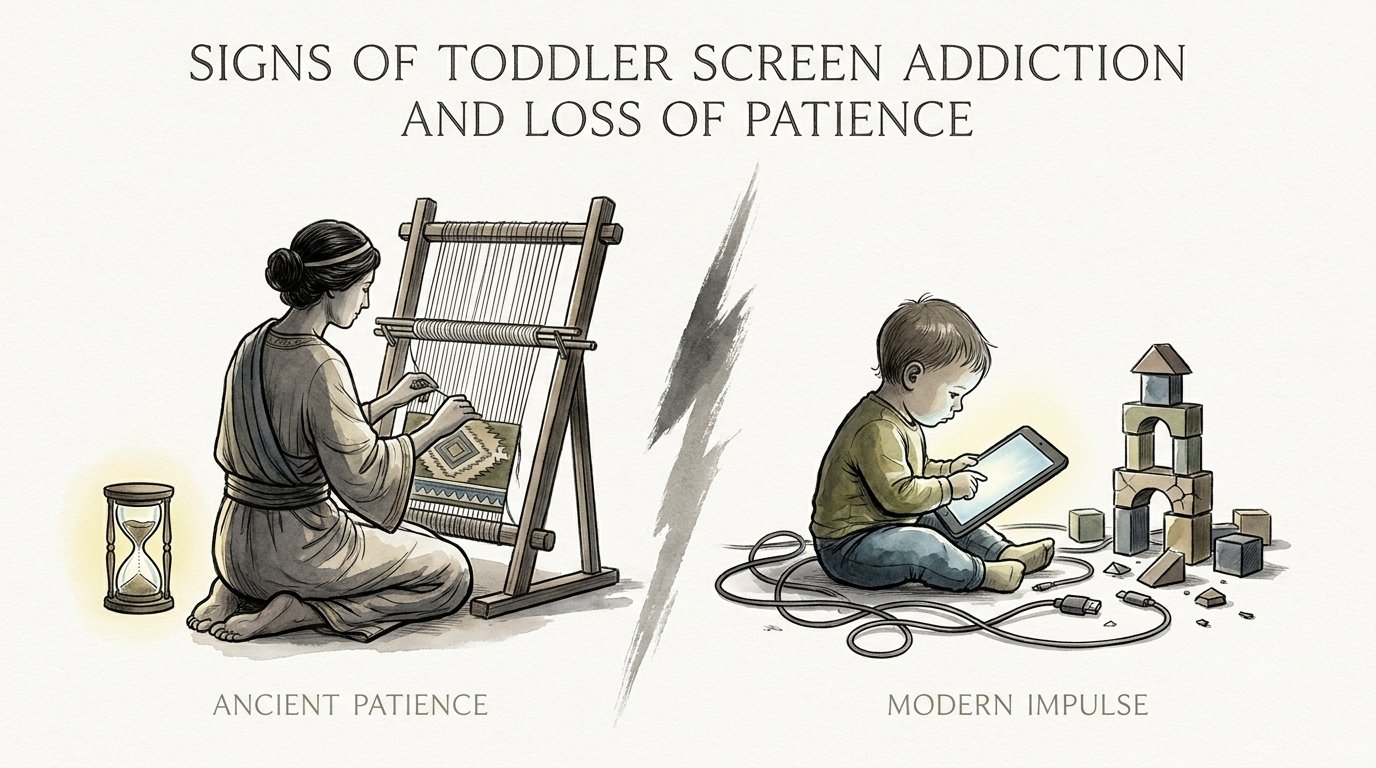
Signs Of Toddler Screen Addiction And Loss Of Patience
Identifying screen addiction in toddlers is different than spotting it in adults. For a young child, the symptoms often manifest as a complete breakdown of emotional regulation and a refusal to engage with the physical world. This isn’t just a “bad mood.” It is a physiological response to the absence of high-intensity stimulation.
The most common sign is the “rebound-type agitation state.” When you remove the device, the child doesn’t just get sad; they become hyper-stimulated, aggressive, or inconsolable. Their brain has been operating at such a high frequency that the “slow” reality of a quiet living room feels physically uncomfortable.
Another major red flag is the loss of interest in non-digital play. If a child who once loved blocks, coloring, or sandbox play now finds those activities “boring” or walks away after thirty seconds, their reward threshold has shifted. The brain is now desensitized to natural dopamine releases from simple achievements. It wants the “smother mode” of apps that offer constant, unearned rewards.
Watch for the “negotiation loop.” If your toddler’s first question upon waking or entering the car is about the iPad, the device has become their primary source of security and entertainment. They are no longer looking to the environment for cues on what to do; they are looking for the “digital pulse” to tell them how to feel.
Finally, notice the lack of “joint attention.” In a healthy developmental state, a toddler wants to show you things—a bug, a leaf, or a drawing. In cases of digital dependence, this social drive diminishes. The screen becomes a closed loop, excluding the parent and preventing the vital social-emotional learning that happens through face-to-face interaction.
The Dopamine Trap: Why The Brain Craves The Pulse
To understand why your child can’t wait for a snail, you have to understand the nucleus accumbens. This is the brain’s reward center. When a child plays a fast-paced game or watches short-form videos, this area is flooded with dopamine. Unlike real life, where you have to build a tower to feel proud, digital rewards are instant, bright, and loud.
Over time, this repeated stimulation causes the brain to become desensitized. It essentially “turns down the volume” on its dopamine receptors to protect itself from the overload. Now, the child needs *more* screen time or *faster* content just to feel “normal.” This is why a slow-paced educational show might eventually lead to a craving for chaotic, high-speed YouTube clips.
The “death of the pause” also affects the anterior cingulate gyrus. This region handles emotion regulation and attention shifting. When screens take over the job of “soothing,” this part of the brain doesn’t get the practice it needs to manage frustration. The screen becomes an external “emotional regulator,” and the child never learns how to self-soothe.
Recent research published in JAMA Pediatrics (2024) suggests that excessive tablet use in early childhood can disrupt the development of white matter in the brain. This white matter is the “wiring” that connects different regions. Underdevelopment here can slow down processing speeds for language and literacy, making the real world feel even more difficult to navigate.
The brain is literally being conditioned to expect a high-velocity reward environment. When that environment is taken away, the child experiences a “crash.” They aren’t just being “naughty”; they are experiencing a withdrawal from a digital environment that has bypassed their natural executive functions.
How To Rebuild The Pause: Reintroducing Healthy Boredom
Rebuilding patience starts with reintroducing the concept of “unstructured time.” Boredom is not a void; it is a laboratory. When a child is bored, their brain activates the Default Mode Network (DMN). This is the system responsible for daydreaming, reflection, and creative problem-solving. If we fill every gap with a screen, the DMN never turns on.
Start by practicing “micro-waits.” These are intentional gaps in the day where no entertainment is provided. While you are making a sandwich or waiting in a short line, resist the urge to hand over your phone. Let them look at the floor, the ceiling, or the person next to them. These tiny moments of “nothing” are like push-ups for the brain’s patience muscle.
Next, implement a “slow play” environment. Provide open-ended materials that do nothing on their own. A tablet does everything for the child; a cardboard box does nothing until the child decides it is a rocket ship. This shift from passive consumption to active creation is essential for resetting the dopamine threshold.
Introduce “planned transitions.” One of the hardest things for a digitally-dependent brain is stopping. Use visual timers or the “5-minute/2-minute” warning system. Consistency is key here. The child needs to know that the screen *will* go away, but also that they are safe and have something else to look forward to, like a shared snack or outdoor play.
Finally, model the “pause” yourself. Children are biological mirrors. If they see you reaching for your phone the second you have a free moment, they will learn that stillness is something to be avoided. Show them how to sit quietly. Narrate your own waiting process: “We are waiting in this line, so let’s see how many blue things we can find.”
Practical Steps for Transitioning Away from Screens
- The “First/Then” Rule: Use screens as a structured part of the day rather than a constant background noise. “First we finish our puzzle, then we can watch ten minutes of your show.”
- Curate the Speed: If you allow screen time, choose content that mimics real-life pacing. Opt for slow-moving animations or documentaries over fast-cut, high-energy “unboxing” videos.
- Physical Replacement: When the screen goes off, immediately engage in high-sensory activity. Jumping on a trampoline, playing with water, or using play-dough helps ground the child back in their physical body.
The Benefits of Reclaiming the Slow World
When you successfully reduce the digital pulse, the changes in your child’s behavior can be measurable and profound. The first benefit is a noticeable increase in “sustained attention.” You will find them playing with a single toy for fifteen minutes instead of jumping from one thing to another every sixty seconds.
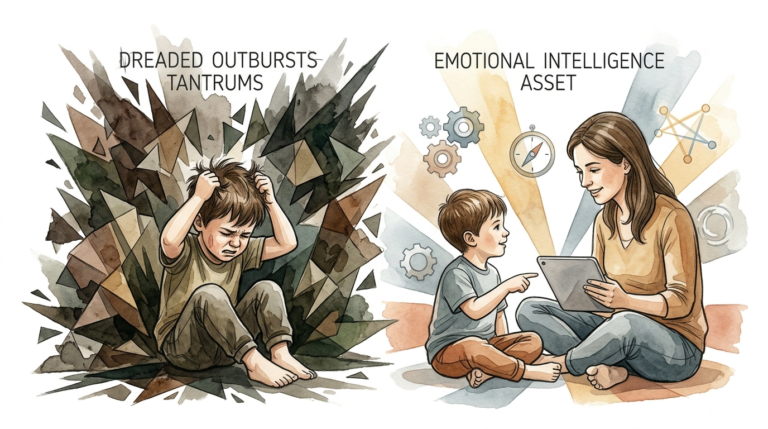
Emotional resilience also sees a significant boost. A child who has learned to handle the “boredom” of waiting is a child who can handle the “frustration” of a tower falling over. They are no longer reliant on an external device to regulate their moods, which leads to fewer and shorter tantrums.
Creativity undergoes a massive expansion. Without the “ready-made” imagination of the screen, children are forced to invent. You will see more “make-believe” play, which is a critical developmental milestone for social understanding and empathy. They begin to project feelings onto their dolls or action figures, practicing the social skills they will need for life.
There is also a physical benefit. More time away from screens almost always leads to more movement. This improves motor skills, sleep quality, and even appetite regulation. A brain that isn’t overstimulated by blue light and rapid imagery is a brain that can transition into deep, restorative sleep much more easily.
Comparing Passive vs. Active Engagement
| Feature | Passive Screen Time | Active/Tactile Play |
|---|---|---|
| Reward Frequency | High/Instant (Dopamine Spikes) | Low/Delayed (Earned Satisfaction) |
| Attention Type | Fragmented/Reactive | Sustained/Focused |
| Brain State | Overstimulated/Passive | Problem-Solving/Creative |
| Social Impact | Isolated/Closed Loop | Interactive/Cooperative |
| Regulation | External (The Device) | Internal (Self-Soothing) |
Challenges And Common Mistakes To Avoid
The biggest mistake parents make is using the screen as an “emotional band-aid.” When a child is having a meltdown, the quickest way to stop the noise is to hand them a tablet. However, this creates a “vicious cycle.” The child learns that a tantrum results in high-value digital rewards, and their brain never learns to process the actual emotion causing the distress.
Another common pitfall is “background noise.” Keeping the TV on while the child plays with other toys might seem harmless, but it creates “split attention.” The child’s brain is constantly being pulled away from their task by the flashing lights and sounds, preventing them from ever reaching a state of “deep play.”
Do not fall into the trap of “educational guilt.” Many apps are marketed as “learning tools,” but if they rely on constant rewards, flashing lights, and “smother mode” (where the app does the thinking for the child), they are doing more harm to their patience than good for their ABCs. A child will learn more about physics by dropping a real spoon than by tapping a virtual one.
Avoid “abrupt endings.” Turning off a device in the middle of a scene without warning is a recipe for disaster. This triggers a panic response in a brain already flooded with dopamine. Always use a clear, consistent signal that the time is coming to an end.
Finally, don’t forget about your own digital habits. If you are trying to teach your child to “wait for a snail” while you are scrolling through your feed, the message is lost. Your child values your attention above all else; if they have to compete with your phone for it, they will seek that same digital “connection” themselves.
Limitations: When Screens Might Be Necessary
It is unrealistic to expect a 100% screen-free life in the modern world. There are situations where technology can be a bridge rather than a barrier. Video calls with grandparents, for example, are highly interactive and support social-emotional development. The “video deficit effect” is often mitigated when there is a real, responsive human on the other side of the screen.
In cases of extreme weather, illness, or travel, limited and curated screen time can be a practical tool. The goal is not total elimination, but “intentional use.” When the screen is used as a specific activity with a start and end time—rather than a default state for every “quiet” moment—it loses its addictive power.
Children with certain neurodivergent profiles may also use tablets for communication or specific sensory regulation. In these cases, the device is a “prosthetic” for a missing skill rather than a replacement for development. It is important to distinguish between “screen use for function” and “screen use for distraction.”
If you find that your child’s tantrums are becoming dangerous or their withdrawal from the family is complete, these are limitations that require professional intervention. A digital detox can be hard, but if the “death of the pause” has led to developmental regression, a simple timer might not be enough.
Practical Tips For Rebuilding Patience
Rebuilding the “muscle” of waiting requires a structured approach. You are essentially retraining the brain’s reward system to appreciate the slow world. This doesn’t happen overnight, but consistent small wins lead to a total shift in household energy.
- Establish “Phone-Free Zones”: Make the dining table and the car “no-screen areas.” These are the places where conversation and “looking out the window” happen.
- The “Boredom Jar”: Fill a jar with scraps of paper containing simple tasks: “Find 5 smooth rocks,” “Draw a purple dog,” or “Build a tower as high as your knee.” When they say they are bored, they pull one out.
- Use Audiobooks: If your child needs a “distraction” during a long drive, try audiobooks or music. This engages the auditory cortex and imagination without the “visual pulse” that triggers the dopamine loop.
- Celebrate the Wait: When your child waits patiently for their turn or for their food, acknowledge it. “I saw how you waited so calmly while I was on the phone. That was very grown-up of you.”
- Nature Exposure: Take them outside. Nature is the ultimate “slow” environment. There are no skip buttons on a growing flower or a moving snail. It forces the brain to downshift its expectations.
Advanced Strategies: Strengthening Executive Function
For those who want to go deeper, focus on “Executive Function” (EF) training. EF is the command center of the brain—it handles working memory, flexible thinking, and self-control. Screens bypass EF; real-world challenges build it.
“Executive Function” is best built through complex, multi-step play. Cooking a simple recipe with your toddler is an EF powerhouse. They have to wait for the eggs to crack, follow a sequence, and manage the frustration of a spill. This is the exact opposite of a screen experience where the “result” is instant.
Another advanced technique is “Co-Regulation.” When your child is struggling because the screen is gone, don’t just tell them to “calm down.” Sit with them. Breathe loudly and slowly. Let them lean against you. You are literally using your calm nervous system to “reset” theirs. Over time, they will internalize your calm and learn to do it for themselves.
Encourage “Divergent Thinking.” Ask open-ended questions that don’t have a “yes/no” or “tap” answer. “What do you think that cloud looks like?” or “How could we get this toy across the room without touching the floor?” These questions force the brain out of the “reactive” mode and into the “active” mode.
Real-World Scenario: The Grocery Store Test
Imagine you are at the grocery store. The line is long. Your toddler is starting to whine. The “old” response was to hand them your phone to prevent a scene. This silenced the noise but killed “the pause.”
Instead, try the “Scanner Game.” Ask them to find all the items in the cart that are red. Then, ask them to find something that feels fuzzy. Next, explain why the lady in front of you is buying so many apples. “Maybe she’s making a big pie!” This turns a “boring” wait into a social and cognitive exercise.
Does it take more energy? Yes. But you are investing in a child who can handle 10 minutes of stillness without a digital IV drip. You are teaching them that their own mind is an interesting place to be. That is a gift that will serve them for the rest of their lives.
By the time you reach the car, the child hasn’t just “survived” the wait; they have practiced observation, language, and patience. They have successfully handled a “pause” in the world’s input, and their brain is better for it.
Final Thoughts
The “death of the pause” is a silent crisis, but it is one we have the power to reverse. We have to decide that our children’s ability to focus, create, and regulate their own emotions is more important than our own short-term convenience. It is hard to listen to the “I’m bored” screams, but those screams are the sound of a brain trying to find its own way.
Reclaiming the slow world isn’t about being “anti-tech.” It is about being “pro-human.” It is about ensuring that the digital pulse remains a tool in their hands, rather than a leash around their brain. Start small. Reintroduce the snails. Let them watch the rain.
Experiment with these strategies for one week. Watch the tantrums. Experience the “boredom” alongside them. You might find that as your child learns to handle the pause, you rediscover the value of the slow world yourself. There is a whole universe in the “nothing” between the swipes—make sure your child doesn’t miss it.
Sources
1 mayoclinichealthsystem.org | 2 sandwichmontessori.org | 3 childcare.gov | 4 mcm.org | 5 1stepfamilywellness.com | 6 kutubooku.com | 7 thejacobsladdergroup.org | 8 kidswellhealth.com | 9 bluecrossnc.com | 10 kidsincorporated.org | 11 kongacademy.org | 12 buildingbrains.ca | 13 nih.gov | 14 powershealth.org | 15 childcareed.com | 16 cedars-sinai.org | 17 therapiesoftherockies.com | 18 nih.gov | 19 mother.ly | 20 childmind.org