Signs Child Screen Habit Is Overuse
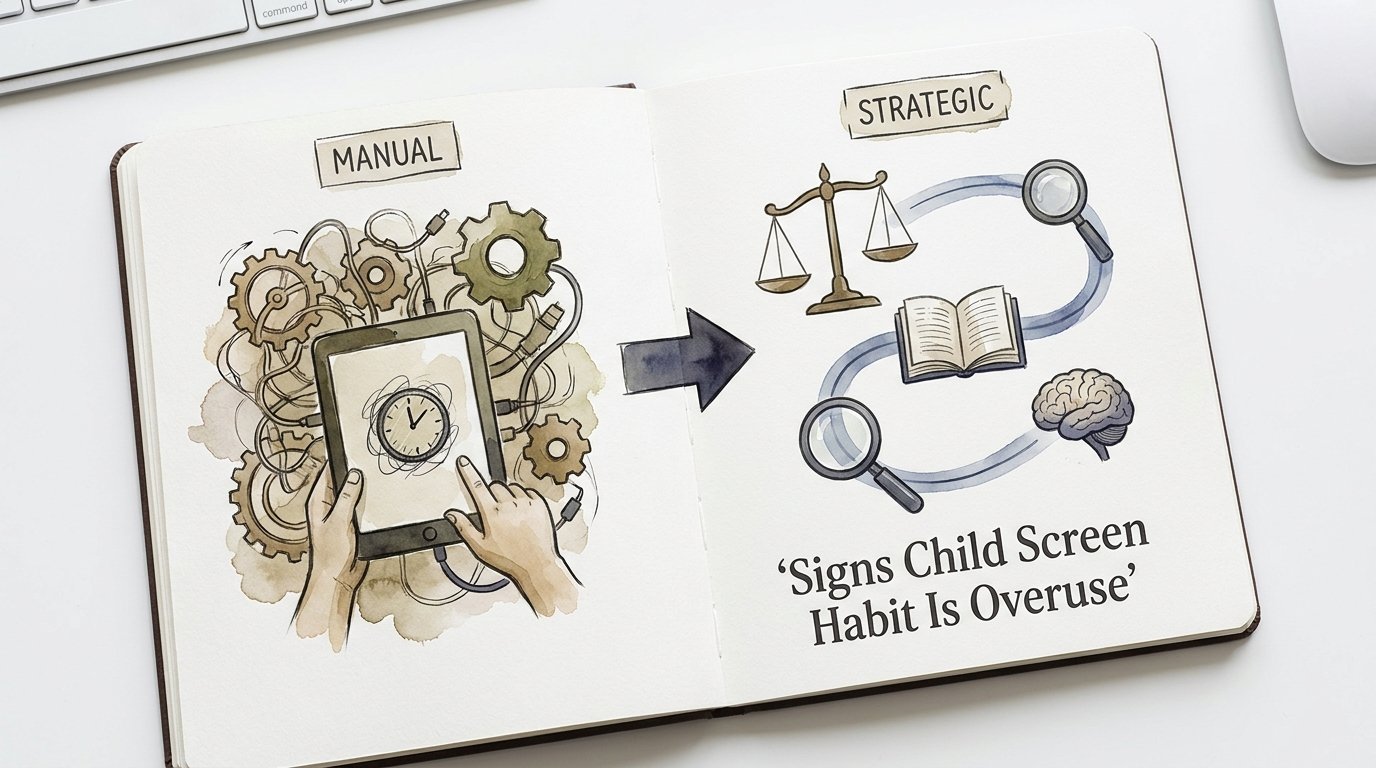
If you have to work harder than the device to keep them entertained, the habit has become a dependency. When screen use crosses into overuse, your child loses the ‘internal engine’ to play. You find yourself manually prompting every activity, only to be met with ‘I’m bored.’ Here is how we switch from manual entertainment to strategic environment design.
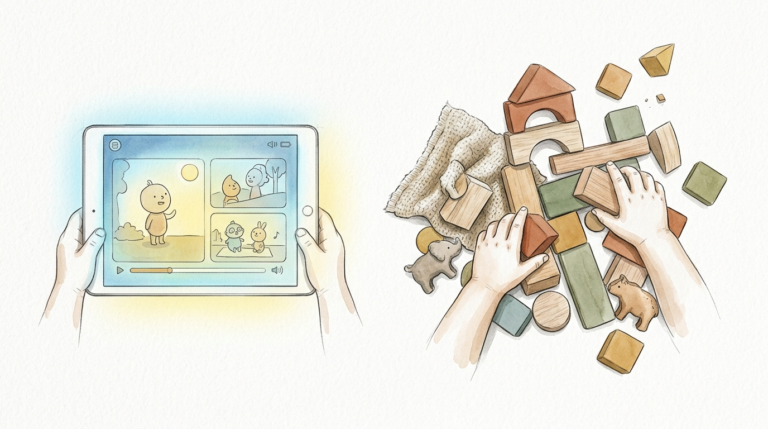
Managing digital habits isn’t just about a timer or a lockout code. It is about psychology and physics. If the environment is a vacuum, the screen will always fill it. If the brain is desensitized by high-speed dopamine loops, a wooden block feels like a paperweight. We are moving away from being the “Entertainment Director” and toward being the “Architect of Opportunity.”
Signs Child Screen Habit Is Overuse
The transition from “regular use” to “overuse” is often invisible until a conflict occurs. Overuse is not just about the number of hours on a clock. It is about the displacement of essential human functions. When a screen habit becomes a dependency, it begins to cannibalize the child’s natural curiosity and resilience.
One of the most obvious signs is emotional dysregulation during transitions. If turning off a tablet triggers a 30-minute meltdown, the brain is experiencing a dopamine crash. The device has become a primary tool for emotional regulation rather than a source of entertainment. Without it, the child feels physically and mentally unequipped to handle the “quiet” of the real world.
Another red flag is the atrophy of the internal engine. This manifests as a chronic inability to initiate play. You might see a room full of toys, yet the child stands in the middle and claims they have nothing to do. Their brain has been conditioned to wait for a high-intensity external prompt. Passive consumption has replaced active creation.
Physical symptoms also emerge. You might notice “tech neck,” recurring headaches, or significant changes in sleep patterns. High-arousal content late in the day suppresses melatonin and keeps the nervous system in a state of “fight or flight” long after the device is put away. If your child is constantly checking for the device or lying about how much they have used it, the habit has moved into the territory of problematic use.
How Strategic Environment Design Works
Strategic environment design is the antidote to the “manual entertainment” trap. In a manual setup, the parent is the source of all ideas. In a strategic setup, the physical room does the prompting for you. This approach relies on the neuroscience of “affordances”—the idea that an object’s physical properties suggest how it should be used.
The first step is Recalibrating the Baseline. The brain’s reward system, specifically the nucleus accumbens, becomes desensitized by the rapid-fire rewards of apps and games. To fix this, the environment must offer “low-friction” entry points to real-world play. If a child has to dig through a messy bin to find a toy, the friction is too high. They will choose the screen every time because it is the path of least resistance.
Next, we use “Invitations to Play.” This is a technique borrowed from Montessori and Reggio Emilia philosophies. Instead of telling a child to “go play with your blocks,” you set up a small scene. You might place three blocks on a tray with two plastic animals and a piece of blue fabric representing water. This visual prompt is a “hook” for the brain’s Default Mode Network (DMN), which is responsible for imagination and daydreaming.
Strategic design also involves Zoning. Just like a professional kitchen has stations, a child’s room should have clear zones. A “Quiet Zone” with soft pillows and books, a “Construction Zone” with hard surfaces for building, and a “Messy Zone” for art. These zones provide mental boundaries. When the child enters the Construction Zone, their brain receives a physical signal that it is time for spatial reasoning and problem-solving.
Benefits of Strategic Environment Design
Switching from manual prompting to strategic design changes the power dynamic in the home. You are no longer the “bad guy” taking away the fun. The environment becomes the primary influencer. This leads to a massive reduction in parental burnout. When the room is designed to spark curiosity, you gain back hours of your day.
One of the most profound benefits is the development of Executive Function. Screens often do the thinking for the child. They tell them where to click, what to watch next, and how to feel. Real-world play requires the child to plan, organize, and execute a sequence of actions. By designing the environment for self-directed play, you are effectively “weightlifting” for their prefrontal cortex.
Children also develop High Distress Tolerance. In a game, if you fail, you hit “restart.” In the real world, if your tower falls, you have to deal with the frustration. Strategic environments provide “safe failures.” The child learns that they can solve problems without an algorithm doing it for them. This builds a core sense of agency that carries over into school and social life.
Finally, there is the Dopamine Reset. Over time, as the child engages more with tactile, slow-paced activities, their dopamine receptors become more sensitive. Suddenly, the “boring” pebble in the backyard becomes interesting again. They regain the ability to find joy in simple, non-electronic interactions.
Challenges and the ‘Withdrawal’ Phase
The biggest challenge is the Extinction Burst. When you first change the environment and limit screens, behaviors will get worse before they get better. The child’s brain is literally “craving” the high-intensity stimulus it is used to. You will face intense resistance, bargaining, and perhaps some of the loudest “I’m bored” complaints you’ve ever heard.
Another hurdle is Parental Guilt. It is hard to watch your child be unhappy. Our modern parenting culture often frames “boredom” as a failure on the parent’s part. You have to reframe this: Boredom is the incubation period for creativity. If you solve the boredom for them immediately, you are “saving” them from the very thing that will make them more capable.
Physical organization is also a commitment. Strategic design requires a level of curation. You can’t just have 5,000 random toys in a heap. It requires rotating toys out of the room so the space stays fresh and uncluttered. If there are too many choices, the child experiences “choice paralysis” and retreats back to the ease of a digital interface.
Limitations: When This Method May Not Work
While environment design is powerful, it is not a magic wand for every situation. For neurodivergent children, screens can sometimes be a vital tool for sensory regulation or communication. In these cases, a “complete detox” or “high-limit” approach may actually be counterproductive. The strategy must be adjusted to include “digital tools” as part of the environment rather than just a distraction.
Environmental limitations are also a factor. If you live in a small apartment or lack outdoor access, creating “movement zones” is significantly harder. You have to get creative with vertical space or shared community areas. Strategic design requires physical square footage or very clever storage solutions to be truly effective.
Lastly, the method fails if there is a lack of consistency. If the environment is “strategic” on Tuesday but the parent uses the screen as a “manual” babysitter on Wednesday because they are tired, the child will simply wait out the “boring” periods. The brain prioritizes the highest-value reward it knows is coming. If the screen is always a possibility, the internal engine won’t kick in.
Manual vs. Strategic Parenting
| Feature | Manual Entertainment | Strategic Environment |
|---|---|---|
| Parental Role | Director / Entertainer | Architect / Observer |
| Primary Prompt | “Go play with X” | Visual “Invitation to Play” |
| Child’s State | Passive / Reactive | Active / Self-Directed |
| Conflict Level | High (Parent is the barrier) | Low (Room sets the pace) |
| Long-term Skill | Dependency | Executive Function |
Practical Tips for Strategic Setup
Start by Decluttering the Sightlines. If your child’s toys are in opaque bins with lids, they don’t exist. Use low, open shelving where toys are visible and reachable. This reduces the “cognitive load” required to start an activity. If they can see it, they are much more likely to touch it.
Implement a Toy Rotation System. Keep 70% of the toys in a “closed” closet or the garage. Every Sunday, swap out two items from the playroom with two from the closet. This creates a “novelty spike” similar to a new app update, but without the neurological downsides. Novelty is the engine of engagement.
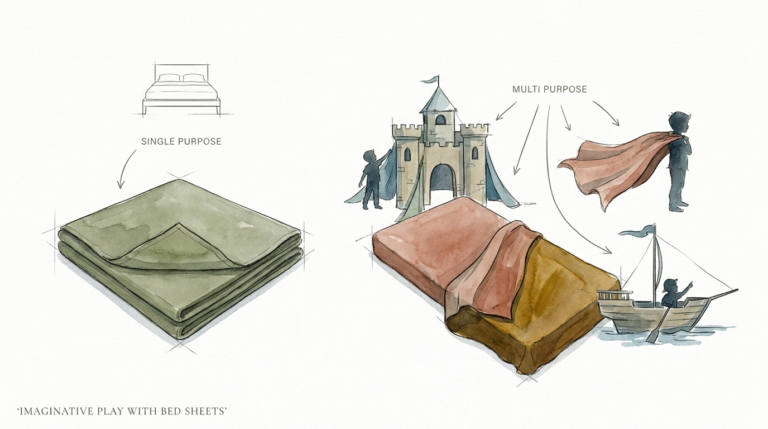
Use “Loose Parts.” These are materials that don’t have a single “right” way to be used—sticks, stones, cardboard boxes, scarves, or plastic cups. Unlike a toy that only does one thing (like a talking doll), loose parts require the child to assign meaning. This is how you rebuild the imaginative capacity that screens often dampen.
Establish Physical Transition Markers. Instead of just shouting “5 minutes left,” use a visual sand timer or a digital clock that counts down. When the time is up, have a “Bridge Activity.” This is a high-interest physical task that happens immediately after the screen goes off, like jumping on a mini-trampoline or a quick “I Spy” game. This helps clear the “brain fog” associated with screen use.
Advanced Considerations: The Dopamine Baseline
Serious practitioners of this method understand that Dopamine Baselines are not static. If a child has a high-intensity weekend with 6 hours of gaming, their “boredom threshold” on Monday will be much lower. You must look at the “Stimulation Budget” for the entire week.
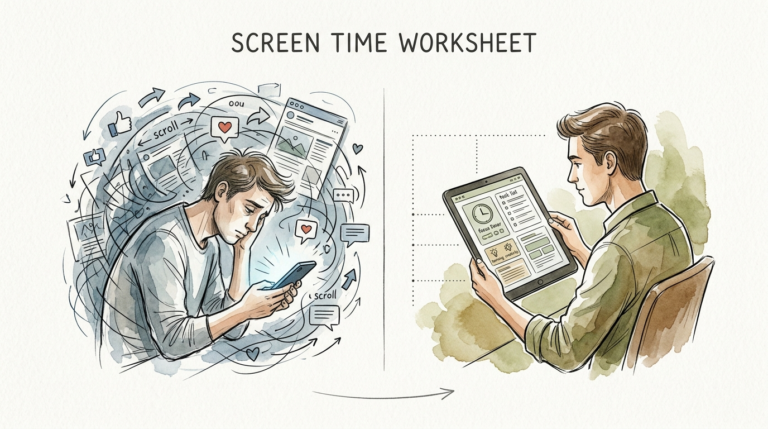
Consider the “Arousal Level” of content. Not all screens are equal. A slow-paced nature documentary has a very different effect on the nervous system than a high-speed “unboxing” video or a competitive battle royale game. Strategic design also applies to the digital environment. Set up the tablet so only low-stimulation, educational, or creative apps (like drawing or music composition) are on the home screen.
Scaling this approach means involving the child in the design process. Ask them, “What is hard about stopping the game?” or “What would make this corner more fun to sit in?” When they help build the environment, they gain a sense of ownership over their own habits. This is the beginning of true digital literacy and self-regulation.
Example: A Tuesday Afternoon Reset
Imagine a typical Tuesday where the child usually watches YouTube while you cook dinner. In a “manual” home, you might try to force them to read a book, leading to a fight. In a strategically designed home, you set the stage 10 minutes before the transition.
You place a large roll of butcher paper on the kitchen floor and throw down a handful of washable markers. You don’t say a word. You simply turn off the screen using the pre-agreed visual timer. The child, experiencing the “withdrawal” of the screen, looks around. Their eyes land on the paper.
Because the friction is zero—the paper is already there, the markers are uncapped—the “Internal Engine” has a low-energy way to start. Within minutes, the child is drawing. You haven’t had to prompt, beg, or entertain. The environment did the heavy lifting.
Final Thoughts
Moving from manual entertainment to strategic environment design is a fundamental shift in how we view the role of a parent. It requires us to stop being the source of “fun” and start being the architect of “flow.” By focusing on the physical and psychological landscape of our homes, we give our children the space they need to rediscover their own curiosity.
The goal isn’t to live in a world without technology. The goal is to ensure that our children are the masters of their tools, not the other way around. When you focus on building the “internal engine,” you are giving them a gift that lasts far longer than any battery charge. You are teaching them how to be alone with their thoughts, how to solve their own problems, and how to find wonder in the world right in front of them.
Experiment with these setups. Start small with one zone or one invitation to play. You will soon see that when the environment is right, the child doesn’t need to be “kept entertained”—they are perfectly capable of entertaining themselves.
Sources
1 medium.com | 2 childrenandscreens.org | 3 nyp.org | 4 communityplaythings.com | 5 thejacobsladdergroup.org | 6 buildingbrains.ca | 7 first5oc.org | 8 manhattanchildrenscenter.org | 9 nhahealth.com | 10 dhs.gov | 11 childrenandscreens.org | 12 daar.com.au | 13 workspaceforchildren.com | 14 kidsusamontessori.org