Fixing Child Frustration After Ipad
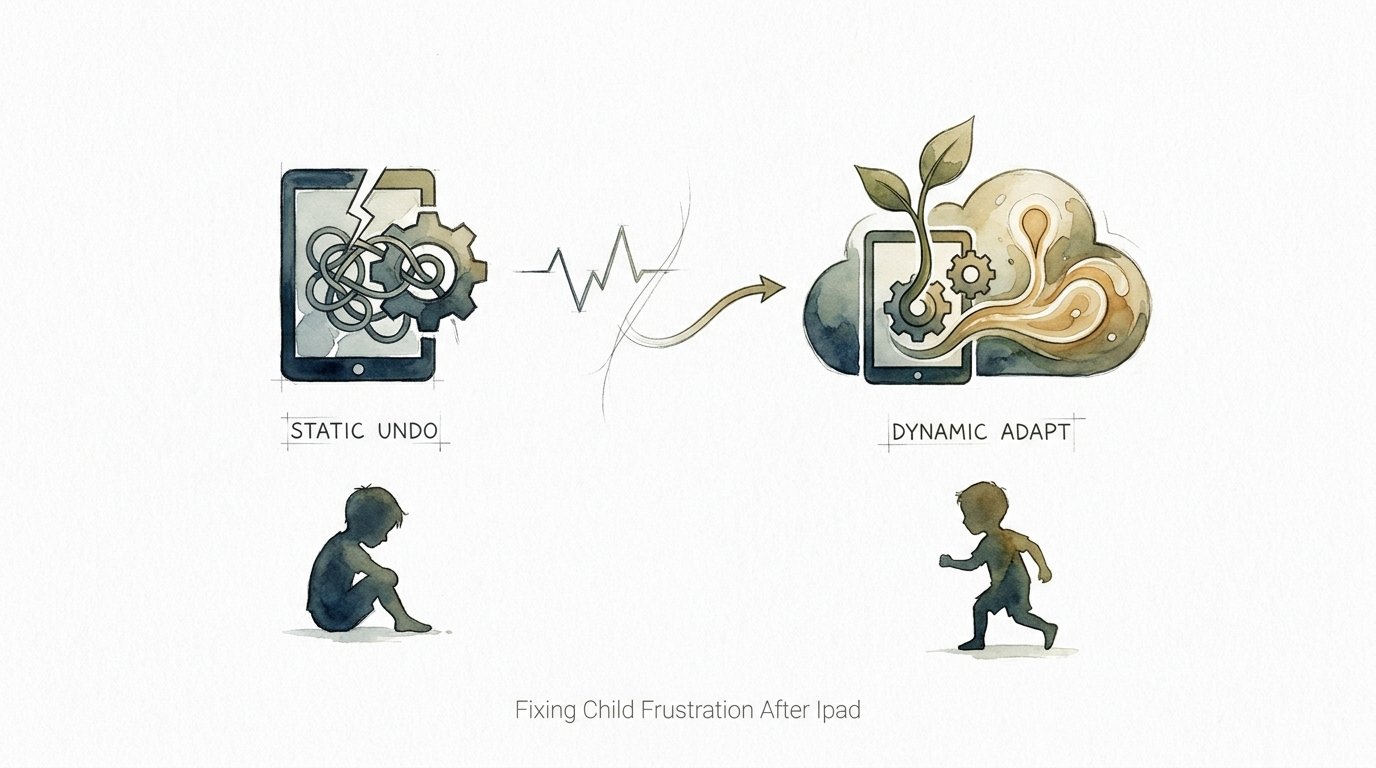
When life doesn’t have an ‘Undo’ button, will your child know how to adapt? In the digital world, errors are static and erasable with a tap. In the real world, errors are dynamic feedback. Day 6 of the Reset is about the ‘Grit Gap.’ We move away from the instant reset of the screen and toward the physical adaptation of the real world. This is where resilience is born.

Children today spend hours navigating environments where every mistake is temporary. If a character falls in a game, they respawn instantly. If a drawing looks wrong, they hit ‘undo.’ This digital safety net creates a comfort zone that is entirely artificial. Real life is messy, loud, and often unforgiving.
Bridging the Grit Gap means teaching your child that mistakes are not the end of the road. They are simply data points. When we remove the ‘Undo’ button, we force the brain to engage in higher-level problem solving. This shift is the foundation of emotional intelligence and long-term success.
Fixing Child Frustration After Ipad
Fixing child frustration after iPad use starts with understanding the “digital hangover.” This phenomenon occurs when a child moves from a high-dopamine digital environment to the low-stimulation real world. The transition is jarring for a developing nervous system.
The digital world provides constant, effortless rewards. Games and apps are designed to keep the brain in a state of hyper-arousal. When the device is turned off, the brain experiences a sudden drop in dopamine levels. This crash often manifests as irritability, tantrums, or “device rage.”

Real-world situations do not offer the same instant feedback. Building a tower with physical blocks requires gravity, balance, and fine motor control. If the tower falls, there is no button to restore it. The frustration a child feels in this moment is the “Grit Gap” in action. They expect the instant fix of the digital world, but they find the friction of reality.
Addressing this frustration requires a change in perspective. Instead of seeing the tantrum as bad behavior, see it as a biological response to a sensory shift. The child is essentially experiencing a form of withdrawal. Helping them navigate this requires patience, structure, and a clear understanding of how their brain is reacting to the loss of the screen.
How to Bridge the Gap and Restore Balance
Transitioning away from the screen requires a strategy known as “bridging.” You cannot expect a child to jump from a high-intensity video game straight to a boring task like homework or cleaning their room. The neurological gap is simply too wide.
Start by giving predictive warnings. Most parents use a “five-minute” warning, but for a child in a “flow state” on a tablet, time does not exist. Use visual timers or external cues that they can actually see. This helps the prefrontal cortex begin the process of switching gears before the physical device is taken away.
Engage in a “bridge activity” for five to ten minutes. This activity should be low-stimulation but sensory-rich. Think about playdough, coloring, or jumping on a trampoline. These activities provide a middle ground where the brain can begin to regulate its dopamine levels without the intensity of a screen.
Practice co-regulation. If you approach a frustrated child with anger, you will only escalate the situation. Your calm presence acts as an anchor. Speak in a low, boring voice. Acknowledge their feelings without giving in to the demand for more screen time. Validating that “it’s hard to stop when you’re having fun” goes a long way in lowering their defenses.
Benefits of Building Real-World Grit
Developing resilience outside of the digital world offers lifelong advantages. When children learn to handle errors without an ‘Undo’ button, they build executive function. This includes working memory, mental flexibility, and self-control. These skills are far more predictive of future success than any grade or test score.
Persistence becomes a habit. A child who has learned to fix a broken Lego set or navigate a difficult social interaction has developed “grit.” They understand that effort leads to results. In the digital world, results are often given; in the real world, results are earned.
Emotional regulation is another massive benefit. Children who regularly face and overcome small frustrations become less prone to meltdowns. They develop a “frustration tolerance” that allows them to stay calm when things go wrong. This internal strength is the ultimate shield against anxiety and stress later in life.
Creative problem-solving flourishes in the real world. Without the constraints of a programmer’s code, a child’s imagination is the only limit. They learn to use materials in ways they weren’t intended. They learn that there are multiple ways to solve a single problem, a concept that is often lost in linear digital games.
Challenges and Common Mistakes
Negotiating “one more minute” is a trap many parents fall into. When you give in to the plea for more time, you teach the child that boundaries are flexible. This actually increases their frustration in the long run because they never know where the true limit lies. Consistency is the only way to reduce transition-related anger.
Using screens as a pacifier is another common error. If you hand over an iPad every time a child is bored or upset, you deprive them of the chance to learn self-soothing. They become dependent on an external device to manage their internal emotions. Over time, this weakens their ability to handle even minor stress.
Expecting immediate compliance is unrealistic. A child’s brain is literally being rewired by the high-speed feedback of the tablet. Moving from that state to a “slow” real-world environment takes time. Getting angry at their slow response only adds more stress to an already overloaded nervous system.
Failing to have a plan for what comes after the screen is a major pitfall. If the child turns off the iPad and has nothing to do, the vacuum of boredom will quickly be filled with irritation. Always have the next activity ready or clearly defined before the screen time begins.
Limitations of the Reset Method
Environmental constraints can sometimes make a full reset difficult. If you live in an area with limited outdoor space or high noise levels, finding “calm” real-world activities might require more creativity. The method works, but the tools you use must be adapted to your specific living situation.
Neurodiversity is a significant factor to consider. Children with ADHD or Autism Spectrum Disorder often find digital environments incredibly soothing because of their predictability. For these children, the “Grit Gap” might be much wider. They may require more intensive bridging strategies and a slower transition process than neurotypical children.
Time is a luxury that not every family has in abundance. Implementing a structured reset requires active parental involvement. If you are working multiple jobs or dealing with high levels of personal stress, the energy required to co-regulate a frustrated child can be hard to find. It is important to be kind to yourself and realize that progress is better than perfection.
Physical limitations or health issues can also impact how a child interacts with the real world. If a child cannot engage in high-energy physical play, the “bridge” activities must be tailored to their physical abilities. The focus should always remain on the transition from passive consumption to active engagement, regardless of the physical scale.
Static Undo vs. Dynamic Adapt
The following table highlights the core differences between the digital “Undo” mindset and the real-world “Adapt” mindset. Understanding these differences helps parents identify where their child might be struggling.
| Feature | Digital (Static Undo) | Real World (Dynamic Adapt) |
|---|---|---|
| Response to Error | Immediate erasure; no permanent consequence. | Mistakes remain; requires physical or social correction. |
| Feedback Speed | Instantaneous and high-stimulus. | Varied and often delayed. |
| Cognitive Load | Low; the app often provides “scaffolding” or hints. | High; requires multisensory integration and focus. |
| Resilience Growth | Stagnant; challenges are artificial and limited. | High; overcomes gravity, friction, and human nuance. |
Practical Tips for a Smoother Transition
Implement “The 5-4-3-2-1 Technique” when a child is spiraling after screen time. Ask them to name five things they see, four things they can touch, three things they hear, two things they can smell, and one thing they can taste. This sensory grounding pulls them out of the digital fog and back into their physical body.
Use “low-tech” versions of their favorite digital activities. If they love Minecraft, give them a box of mismatched Lego bricks or even empty cardboard boxes. If they love drawing apps, provide high-quality markers and large sheets of paper. This maintains the interest while introducing real-world physics and effort.
Establish “Tech-Free Zones” and times that are non-negotiable. Meals and the hour before bed are the most critical. This creates a natural rhythm where the brain knows it must settle down. Consistency in these zones reduces the “battle of the will” because the rule is a permanent part of the day.
Encourage outdoor play as the ultimate “reset button.” Nature provides a level of sensory input that no screen can match. The uneven ground, the changing light, and the wind all force the brain to adapt constantly. This is the most efficient way to close the Grit Gap and build a resilient nervous system.
Advanced Considerations for Serious Practitioners
Brain plasticity is your greatest ally. The child’s brain is remarkably adaptable. Every time they navigate a frustration without a screen, they are strengthening neural pathways associated with emotional regulation. Over months and years, these small wins accumulate into a robust and flexible mind.
Understand the role of the Prefrontal Cortex (PFC). This part of the brain handles decision-making and impulse control. High-stimulation screens often bypass the PFC and go straight to the Amygdala (the emotional center). A screen reset is essentially an exercise program for the PFC, helping it regain control over the child’s reactions.
Boredom is not the enemy; it is a catalyst. When a child is “bored,” their brain is looking for stimulation. If we don’t provide a screen, the brain is forced to look inward. This is where original thought and deep creativity are born. Protecting your child’s “right to be bored” is one of the greatest gifts you can give their development.
Consider the “Boredom Threshold.” Constant screen use lowers this threshold, making everything in the real world seem painfully slow. Increasing the threshold takes time. You are essentially recalibrating their “reward sensors” to appreciate the subtler joys of life, like finishing a book or climbing a tree.
Real-World Scenario: Building vs. Tapping
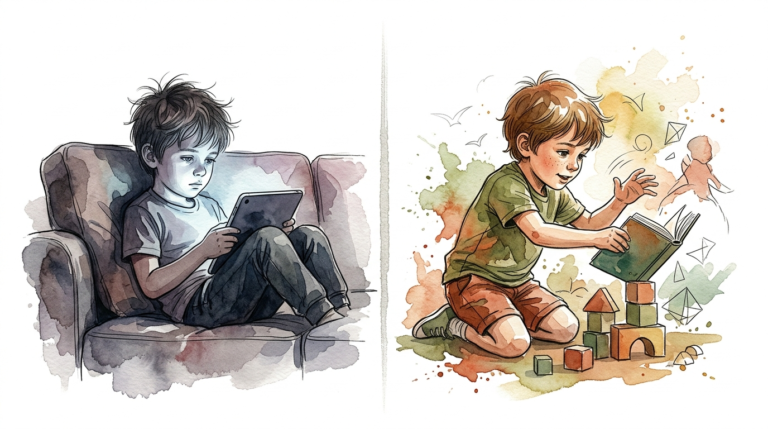
Imagine two children. Child A spends an hour playing a building simulator on a tablet. Every block snaps into place perfectly. If they make a mistake, they tap a button and the block disappears. They feel a sense of accomplishment, but it is based on a simplified model of reality.
Child B spends an hour building a fort out of blankets and chairs. They have to figure out how to keep the blankets from sliding. They have to negotiate space with a sibling. When the fort collapses, they feel a flash of hot frustration. But then, they try a different clip. They use a heavier chair.
Child B is closing the Grit Gap. They are learning that the physical world has rules that cannot be bypassed with a tap. When the fort finally stays up, the “dopamine hit” they receive is earned through persistence. This child is building the mental muscles required to handle the complexities of adult life.
Fixing child frustration after iPad use is about moving from Child A’s world to Child B’s world. It is about trading the easy “Undo” for the hard-won “Adapt.” This is the core mission of the Reset.
Final Thoughts
Building resilience in a digital age is one of the most challenging tasks a modern parent faces. The “Undo” button is a powerful seduction, offering a world without consequences. However, true growth only happens when we meet resistance. By understanding the Grit Gap, you can help your child navigate the “digital hangover” and find their footing in the real world.
The goal is not to demonize technology but to restore it to its proper place as a tool, not a substitute for experience. Every time you hold a boundary, provide a “bridge” activity, or encourage a child to solve a physical problem, you are investing in their future. You are teaching them that they have the internal resources to handle whatever life throws at them.
Experiment with these strategies. Start small. Observe how your child’s frustration levels change as they spend more time in “dynamic” environments. You will likely find that as their grit grows, the tantrums decrease, and their natural curiosity returns. This is the power of the Reset—giving your child back the world in all its messy, beautiful, and un-erasable glory.
Sources
1 daar.com.au | 2 maggiedent.com | 3 drroseann.com | 4 psychologytoday.com | 5 healthychildren.org | 6 bannerhealth.com | 7 tanagerplace.org | 8 laparent.com | 9 rockwoodprep.com | 10 substack.com | 11 bucknell.edu | 12 cradlehospital.com | 13 adaptiveoffice.ca | 14 allinahealth.org