
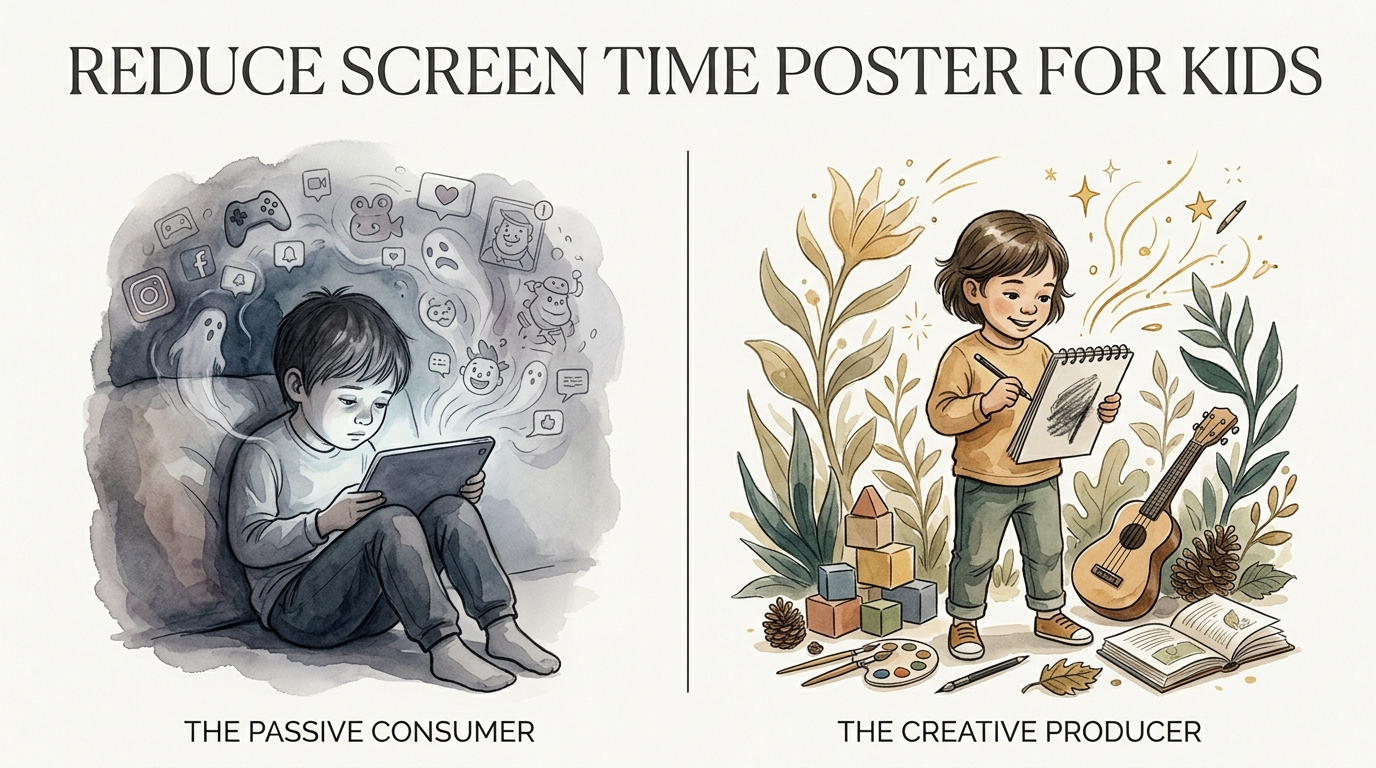
reduce screen time poster for kids
What is a SDFU_PLACEHOLDER_2 poster for kids?
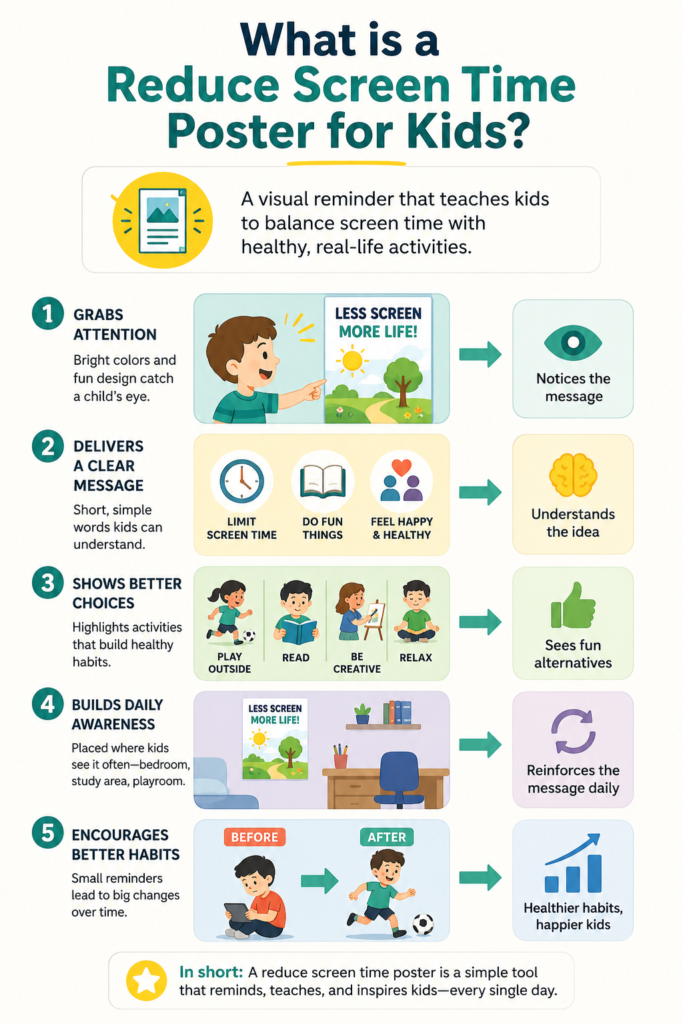 A reduce screen time poster for kids is a high-visibility, physical tool designed to redirect a child’s attention from passive consumption to active creation. It is more than just a list of rules or a “no-phones” sign. It is a visual invitation to engage with the physical world. These posters typically live in high-traffic areas like the kitchen, the playroom, or near the device charging station.
In real-world situations, these posters serve as “boredom menus.” When a child experiences the inevitable dip in dopamine after turning off a tablet, they often feel lost or irritable. This is known as the “dopamine loop,” where the brain craves the next quick hit of digital stimulation. The poster provides a concrete path forward during this transition. It offers a structured list of “Producer” activities that help the brain recalibrate toward more sustainable, long-term satisfaction.
Many parents use these posters to gamify the household routine. Instead of a parent constantly policing the clock, the poster acts as the neutral authority. It sets the “Create Before You Consume” rule. It lists specific tasks or projects that must be completed to “earn” digital time, or better yet, it lists “Screen-Free Quests” that are more exciting than the apps themselves. By placing these options in a visual format, you remove the mental load of decision-making for a child who is already feeling overstimulated.
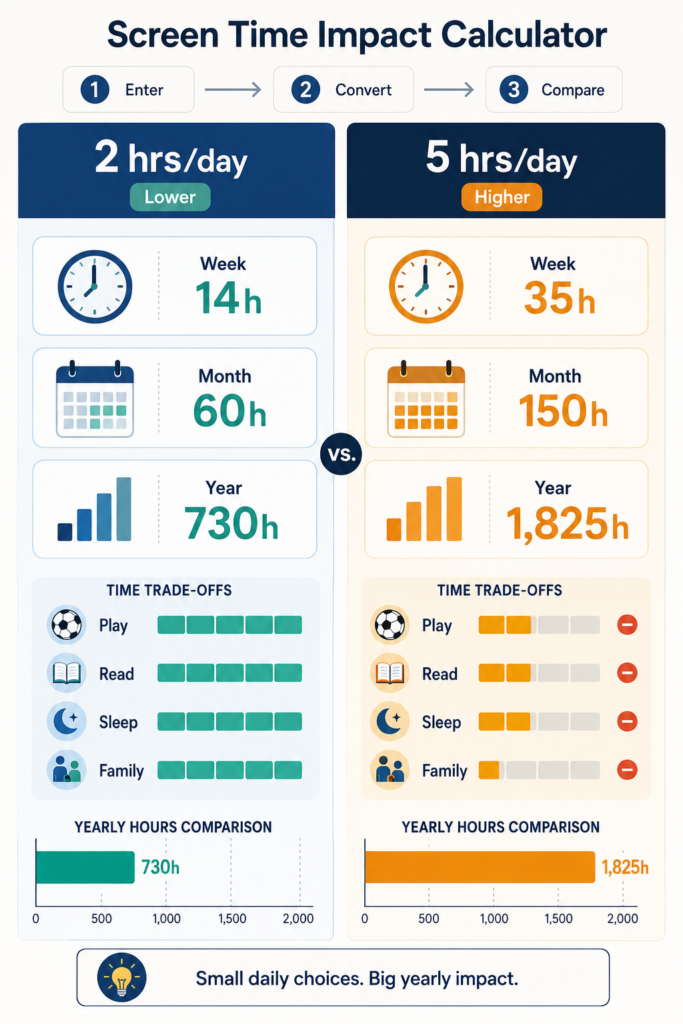
To make this easier, use the Screen Time Impact Calculator below.
A reduce screen time poster for kids is a high-visibility, physical tool designed to redirect a child’s attention from passive consumption to active creation. It is more than just a list of rules or a “no-phones” sign. It is a visual invitation to engage with the physical world. These posters typically live in high-traffic areas like the kitchen, the playroom, or near the device charging station.
In real-world situations, these posters serve as “boredom menus.” When a child experiences the inevitable dip in dopamine after turning off a tablet, they often feel lost or irritable. This is known as the “dopamine loop,” where the brain craves the next quick hit of digital stimulation. The poster provides a concrete path forward during this transition. It offers a structured list of “Producer” activities that help the brain recalibrate toward more sustainable, long-term satisfaction.
Many parents use these posters to gamify the household routine. Instead of a parent constantly policing the clock, the poster acts as the neutral authority. It sets the “Create Before You Consume” rule. It lists specific tasks or projects that must be completed to “earn” digital time, or better yet, it lists “Screen-Free Quests” that are more exciting than the apps themselves. By placing these options in a visual format, you remove the mental load of decision-making for a child who is already feeling overstimulated.
To make this easier, use the Screen Time Impact Calculator below.
SDFU_PLACEHOLDER_7 Impact Calculator
 5
5
function calculateImpact() {
const screenTime = parseFloat(screenTimeInput.value);
const activityLevel = parseInt(activityLevelInput.value);
if (isNaN(screenTime) || screenTime < 0) {
resultDiv.textContent = 'Enter a valid screen time.';
return;
}
const creativityImpact = Math.max(0, 10 - screenTime + activityLevel);
let recommendation = '';
if (creativityImpact > 8) {
recommendation = 'Great balance! Keep encouraging creative activities.';
} else if (creativityImpact > 5) {
recommendation = 'Consider reducing screen time for more engagement.';
} else {
recommendation = 'High screen time may impact creativity. Try to limit it.';
}
resultDiv.textContent = `Creativity Impact Score: ${creativityImpact}. ${recommendation}`;
}
screenTimeInput.addEventListener('input', calculateImpact);
activityLevelInput.addEventListener('input', function() {
activityLevelValue.textContent = this.value;
calculateImpact();
});
// Initial calculation
calculateImpact();
})();
How can you gamify screen time with creative quests?
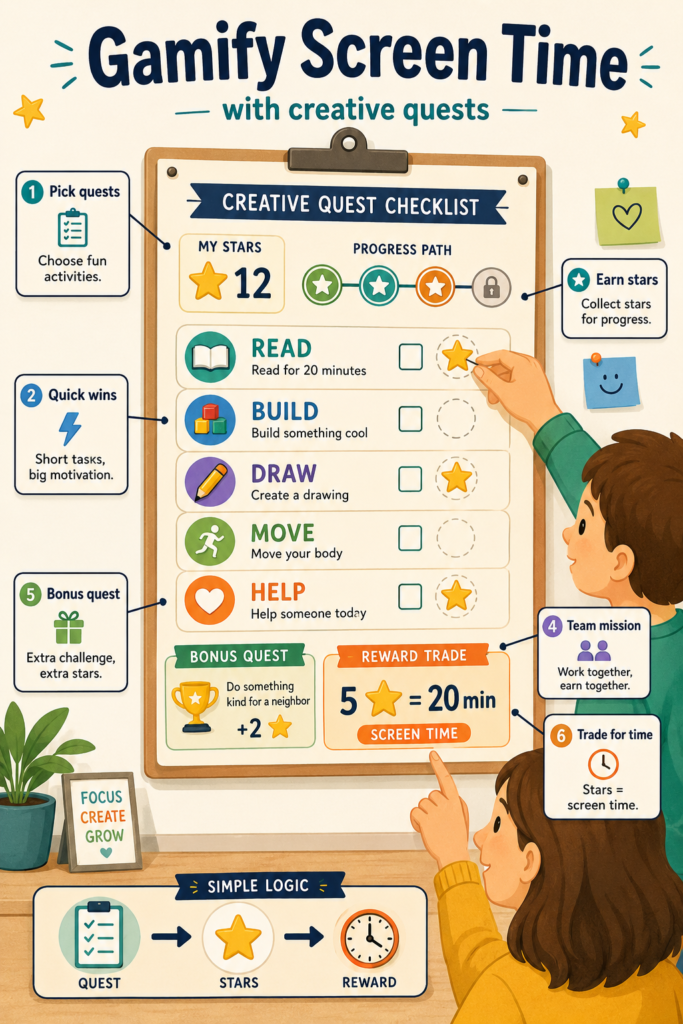 Gamifying screen time can make the transition from passive consumption to active creation more engaging for children. By introducing creative quests, you can reward screen time through fun tasks that encourage creativity and responsibility.
For example, you might create a list of “quests” that children can complete to earn their screen time. These could include:
– **Art Challenge**: Create a drawing or painting based on their favorite story.
– **Chore Completion**: Help with household chores, like tidying up their room or setting the table.
– **Creative Writing**: Write a short story or poem about an adventure they would like to go on.
– **Outdoor Exploration**: Spend time outside, like going on a nature walk or playing a sport.
By framing these tasks as quests, children are more likely to see them as fun challenges rather than chores. This not only makes the process enjoyable but also instills a sense of accomplishment and responsibility. As they complete these quests, they can earn points or stickers that accumulate toward screen time, making it a rewarding experience.
Gamifying screen time can make the transition from passive consumption to active creation more engaging for children. By introducing creative quests, you can reward screen time through fun tasks that encourage creativity and responsibility.
For example, you might create a list of “quests” that children can complete to earn their screen time. These could include:
– **Art Challenge**: Create a drawing or painting based on their favorite story.
– **Chore Completion**: Help with household chores, like tidying up their room or setting the table.
– **Creative Writing**: Write a short story or poem about an adventure they would like to go on.
– **Outdoor Exploration**: Spend time outside, like going on a nature walk or playing a sport.
By framing these tasks as quests, children are more likely to see them as fun challenges rather than chores. This not only makes the process enjoyable but also instills a sense of accomplishment and responsibility. As they complete these quests, they can earn points or stickers that accumulate toward screen time, making it a rewarding experience.
What are the age-based recommended screen time limits?
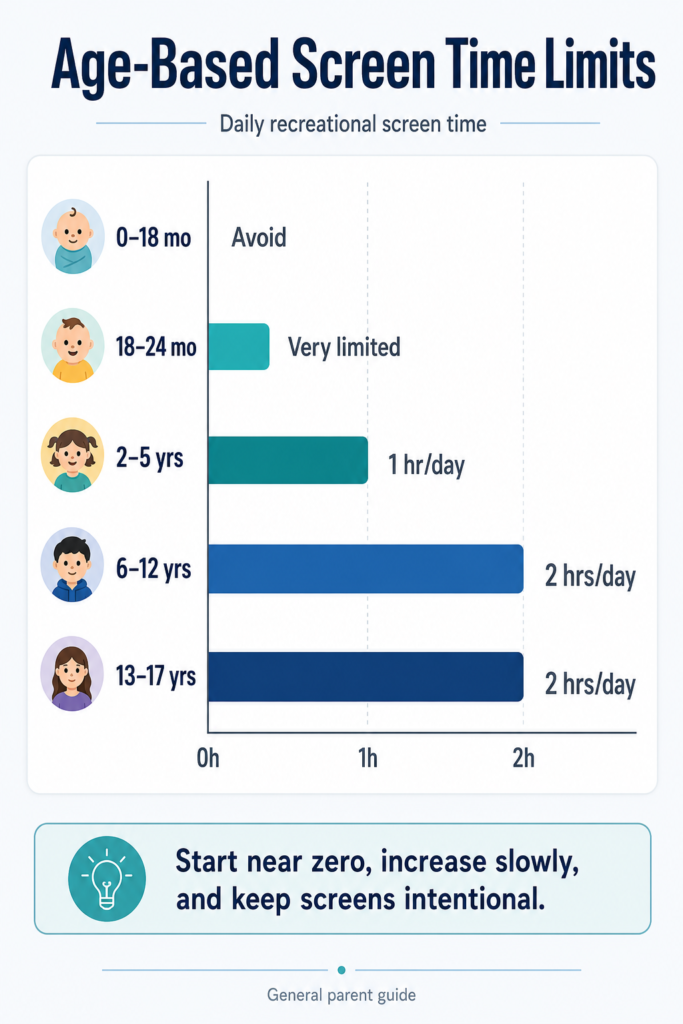 It is important to understand the recommended screen time limits for children based on their age. The American Academy of Pediatrics (AAP) provides guidelines to help parents manage their children’s screen time effectively.
– **Children under 18 months:** Avoid the use of screen media other than video chatting.
– **Children 18 to 24 months:** Parents who want to introduce digital media are encouraged to choose high-quality programming. They should watch it with their children to help them understand what they are seeing..
– **Children ages 2 to 5 years:** Limit screen use to one hour per day of high-quality programming. Parents should watch with their children to help them understand the content.
– **Children ages 6 years and older:** Consistent limits on screen time are recommended to ensure adequate time for sleep, physical activity, and other healthy behaviors.
These guidelines help create a balanced approach to screen time, allowing for both digital engagement and active, creative play.
It is important to understand the recommended screen time limits for children based on their age. The American Academy of Pediatrics (AAP) provides guidelines to help parents manage their children’s screen time effectively.
– **Children under 18 months:** Avoid the use of screen media other than video chatting.
– **Children 18 to 24 months:** Parents who want to introduce digital media are encouraged to choose high-quality programming. They should watch it with their children to help them understand what they are seeing..
– **Children ages 2 to 5 years:** Limit screen use to one hour per day of high-quality programming. Parents should watch with their children to help them understand the content.
– **Children ages 6 years and older:** Consistent limits on screen time are recommended to ensure adequate time for sleep, physical activity, and other healthy behaviors.
These guidelines help create a balanced approach to screen time, allowing for both digital engagement and active, creative play.
How do you build your visual creator guide?
Creating a poster that actually works requires more than just a piece of paper and some markers. It needs to be an interactive part of the home. Follow these steps to build a guide that sticks.How do you identify consumption vs. production?
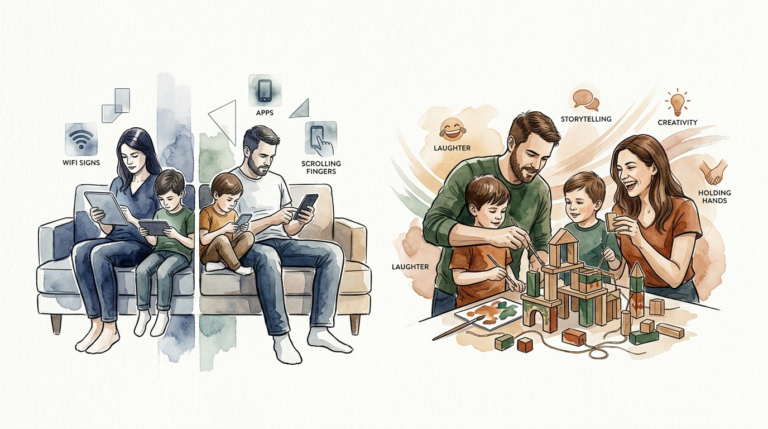
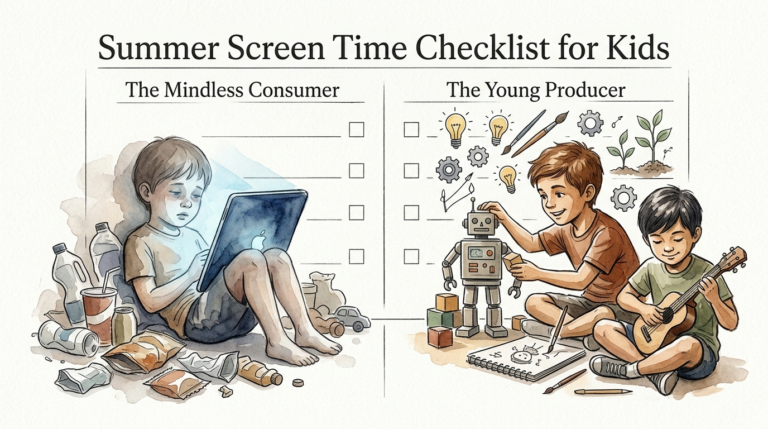
Define the two categories clearly for your child. Consumption is watching a YouTube video; production is filming a movie. Consumption is playing a video game; production is drawing a map of a game world. Use the poster to draw a line between “The Passive Consumer” and “The Creative Producer.” This distinction helps the child understand the goal is not just “less tech,” but “more creation.”How do you categorize activity “sparks”?
Break the poster into sections based on the type of energy your child has.- The Maker Station: LEGOs, cardboard engineering, clay, or drawing.
- The Explorer Zone: Backyard scavenger hunts, bug collecting, or bike riding.
- The Skill Lab: Learning a magic trick, practicing an instrument, or cooking a snack.
- The Digital Workshop: Coding a simple game, digital art, or stop-motion animation.
How do you make it interactive?
A static poster eventually becomes invisible “wallpaper.” Use Velcro strips or magnets so the “Quest of the Day” can be changed. Allow your child to add their own ideas to the list. When they have ownership over the options, they are much more likely to choose them. You can even include a “Progress Tracker” where they move a pin every time they complete a “Producer” activity.Why use clear visual icons?
If you have younger children who are pre-readers, icons are essential. Draw a small hammer for building or a paintbrush for art. Research shows that visual schedules and cues provide predictability and consistency, which reduces the anxiety and meltdowns associated with screen transitions.What are the benefits of the Producer Mindset?
This shift not only reduces screen time but also fosters creativity and problem-solving skills in children. Transitioning a child from a consumer to a producer offers measurable cognitive and emotional benefits. It changes how they perceive their own agency in the world. Creating things sharpens mental and physical health. When a child builds a physical object, they engage in problem-solving by necessity. They have to figure out why a cardboard tower falls or how to mix colors to get the right shade of green. This builds resilience. Unlike a digital game where you can just hit “restart,” physical creation involves real-world friction. Dealing with that friction is how children develop critical thinking and grit. Reduced screen time is linked to improved sleep and better focus. The blue light from screens can disrupt circadian rhythms, making it harder for the brain to produce melatonin. By replacing the last two hours of the day with “Producer” activities from the poster, you allow the central nervous system to decompress. Parents often report that children who engage in hands-on play are less irritable and show higher levels of empathy toward others.What are the challenges and common mistakes?
The biggest mistake parents make is treating the poster as a “punishment list.” If the poster only comes out when a child is in trouble, they will associate creativity with boredom and restriction. Resistance is a natural reaction to a drop in dopamine. When a screen goes off, a child’s dopamine levels drop sharply, which can manifest as defiance or bargaining. This is a neurological response, not a character flaw. Expect a “transition period” where the child rejects the poster. The key is to be a partner in the first few activities. Do not just point at the poster; sit down and start building the LEGO set with them for the first ten minutes. Consistency is the second hurdle. If the “Screen-Free” rules only apply when the parents are not busy, the child learns to wait for the moment of least resistance. You must model the behavior you want to see. If you are constantly scrolling while telling your child to look at the “Maker Station” on the poster, the message will fail. The house needs a “Deep Work” or “Creation Hour” where everyone—parents included—engages in a producer activity.What are the limitations of visual reminders?
A poster is a powerful tool, but it is not a cure-all for deep-seated digital addiction. In some cases, the pull of the algorithm is too strong for a simple visual cue to overcome. Environmental factors often override the poster. If the house is cluttered or the creative supplies are locked away in a hard-to-reach cupboard, the child will choose the “low-effort” path of the tablet every time. For the poster to be effective, the “Producer” activities must be just as accessible as the “Consumer” devices. This means having a dedicated “Maker Space” that is always ready for action. Age-specific limitations also apply. A teenager will likely roll their eyes at a colorful poster with stickers. For older kids, the “Visual Guide” might need to look more like a “Goal Board” or a “Skill Tree” from a video game. The concept remains the same, but the delivery must evolve to match their developmental stage. If a child is using screens for high-quality educational purposes or social connection, a rigid “No Screen” rule might backfire and cause social isolation.How does the Passive Consumer differ from The Creative Producer?
Understanding the difference between these two states is vital for long-term habit change. Use the table below to see how these mindsets differ across key metrics.| Metric | The Passive Consumer | The Creative Producer |
|---|---|---|
| Dopamine Type | Quick spikes; short-lived “highs.” | Slow release; sustained satisfaction. |
| Effort Level | Very low; requires only scrolling or watching. | High; requires planning and execution. |
| Long-term Skill | Minimal; mostly entertainment-based. | High; builds craftsmanship and logic. |
| Sense of Agency | External; dependent on content creators. | Internal; confident in ability to change the world. |
| Social Impact | Often isolating; parasocial relationships. | Collaborative; creates value for others. |
What are some practical tips for success?
Start small to avoid overwhelming the household. You do not need to ban all screens on day one. Implement a “Creation Hour” where the TV remains off and the poster ideas are the only option. Place the poster at eye-level for the child. If it is high up on a fridge, they might miss it. Put it right next to where they usually store their devices. The moment they go to reach for a phone, the poster should be there to offer an alternative. This creates a “decision point” that didn’t exist before. Stock the “Maker Station” with open-ended materials. Cardboard boxes, duct tape, string, and old magazines are better for creativity than expensive kits with specific instructions. One study found that children are more creative when they have “loose parts” to play with. This allows them to project their own imagination onto the objects rather than following a pre-set path. Rotate the activities weekly. If the poster stays exactly the same for a month, it will lose its “spark.” Keep a secret stash of new materials—like a fresh set of paints or a new book of paper airplane designs—and swap them onto the poster when you notice the child’s interest waning.How can you advance from consumer to entrepreneur?
Once your child is comfortable with the “Producer” mindset, you can raise the challenge. Transition from “Making” to “Publishing.” If they have been drawing a comic book, help them scan it and print copies for the family. If they have been building a LEGO city, have them record a “Guided Tour” video to explain the architecture. This bridges the gap between the physical and digital worlds. It teaches children that technology is a tool for magnifying their voice, not just a window for watching others. You can introduce simple digital production tools like Canva for graphic design or Scratch for basic coding. The goal is to move from “watching a coding tutorial” to “building a game.” Encourage them to identify problems in the household and “produce” solutions. If the shoe rack is always messy, can they build a better organization system out of scrap wood or cardboard? This shifts the mindset from “What is in it for me?” to “What is in me for others?” Raising a producer is about raising someone who sees themselves as a problem-solver for their community.What are some example scenarios?
Consider the “Saturday Morning Trap.” Usually, a child wakes up and immediately goes for the iPad while the parents sleep in. With the “Producer Poster” in place, the rule is “No Screens Until 10:00 AM.” The poster lists “The Morning Quest”: Build a breakfast menu, draw the dream you had last night, or do a 15-minute yoga routine. By 10:00 AM, the child has already engaged their brain in active production, making them less likely to “binge” when the screen finally comes on. Imagine a “Boredom Emergency” on a rainy afternoon. Instead of the parent feeling pressured to entertain the child, they simply point to the “Emergency Menu” on the poster. This might include “The Floor is Lava” obstacle course, writing a letter to a grandparent, or organizing a “Stuffed Animal Olympics.” The poster provides the structure, but the child provides the execution. This develops their “creative muscles” and reduces their reliance on external stimulation.How can you use a quick-print boredom menu poster?
To help parents easily implement the “Producer Mindset,” we have created a downloadable template for a boredom menu poster. This template is designed for quick printing and can be customized with your child’s favorite activities. Simply download, print, and hang it in a visible spot. [Download the Boredom Menu Poster Template](#)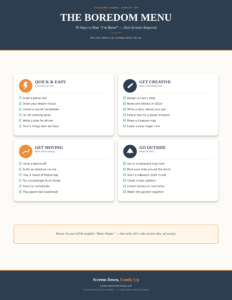 https://screensdownfamilyup.com/blog/wp-content/uploads/2026/07/boredom-menu-poster.pdf
This poster can serve as a go-to resource for those moments when your child says, “I’m bored.” It provides a variety of options that encourage creativity and engagement without screens. Customize it with activities that resonate with your child’s interests, ensuring it remains fresh and exciting.
https://screensdownfamilyup.com/blog/wp-content/uploads/2026/07/boredom-menu-poster.pdf
This poster can serve as a go-to resource for those moments when your child says, “I’m bored.” It provides a variety of options that encourage creativity and engagement without screens. Customize it with activities that resonate with your child’s interests, ensuring it remains fresh and exciting.
What are the final thoughts?
The transition from a passive consumer to a creative producer is a lifelong journey. It starts with the simple realization that we are meant to be givers and makers. A reduce screen time poster for kids is the first step in reclaiming the home from the noise of the digital world. It provides the visual cues necessary to break bad habits and replace them with meaningful action. By focusing on production, you are giving your children the tools to build a resilient and independent future. They will learn that their worth is not measured by the content they consume, but by the value they create. Experiment with different poster designs, involve your kids in the process, and watch as the household dynamic shifts from “I’m bored” to “Look what I made.” Encourage your kids to see the world as a giant workshop. Every stick is a sword, every box is a castle, and every screen is a tool, not a master. When the focus is on creation, the world becomes a place of endless possibility. Start building your guide today and transform the way your family interacts with the world.Key statistics
- Adolescents in the U.S. now spend an average of seven to nine hours per day on entertainment screens. (U.S. Department of Health and Human Services, Office of the Surgeon General)
- Children ages 8–18 in the United States spend on average 7½ hours a day watching or using screens. (American Academy of Child & Adolescent Psychiatry (AACAP))
- Children ages 0–8 average 2 hours and 27 minutes per day on screens, with 0–2 year‑olds at about 1 hour and 3 minutes, 2–4 year‑olds at 2 hours and 8 minutes, and 5–8 year‑olds at about 3½ hours. (OECD report “How’s Life for Children in the Digital Age”)
- In 2026, 98% of U.S. parents allow their children some screen time, and 44% allow more than two hours per day. (Lingokids, Kids Interactive Entertainment Report 2026)
- According to PwC’s 2026 survey, children ages 7–14 spend an average of 3.6 hours per day on screens for recreation. (PwC Generation Alpha Survey Report)
- About 50.4% of U.S. teenagers report four or more hours of daily screen time. (Centers for Disease Control and Prevention (CDC) — National Health Interview Survey‑Teen)
Related

2 Comments