Off-grid Travel Activities For Kids
What happens to your child’s curiosity when the Wi-Fi disappears and the battery hits zero? We’ve created a fragile childhood where ‘adventure’ stops the moment the signal drops. A travel journal is a resilient tool that requires no charging, no updates, and no subscription. It turns ‘boredom’ into a mission and a ‘lost signal’ into a found discovery.
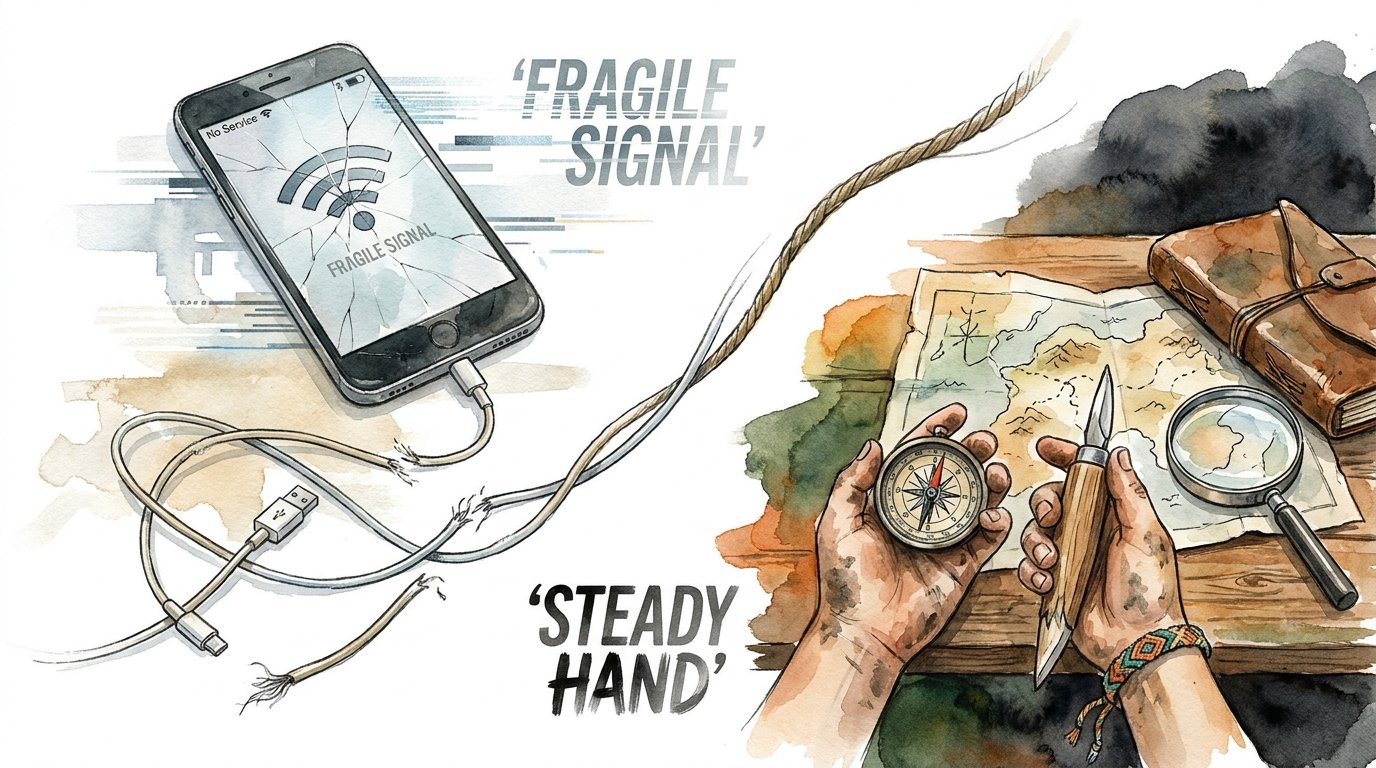
Digital entertainment acts as a temporary patch for a child’s attention. When the tablet dies, the patch falls off, and the underlying lack of engagement is exposed. Off-grid travel activities are about more than just “killing time.” They are about building a **Steady Hand** in a world of **Fragile Signals**. Instead of passively consuming a story, your child becomes the primary narrator of their own journey.
Practical off-grid exploration forces children to engage with their physical environment. This shift from the glowing screen to the tangible world builds cognitive resilience. It teaches them to look up, look out, and look deep. This guide will walk you through the systems and tools needed to reclaim the adventure of travel.
Off-grid Travel Activities For Kids
Off-grid travel activities are intentional, analog engagements designed to keep a child mentally active when technology is unavailable. These activities exist because they tap into the natural human desire to explore, categorize, and document. In a real-world situation, like a long mountain pass with no cell tower or a remote coastal village, these activities transform a “boring” transition into a high-stakes investigation.
Think of an off-grid activity as a bridge between the child and the destination. While a video game isolates the player from their surroundings, a travel journal or a map-reading challenge pulls them into it. These activities include nature sketching, analog navigation, sensory documentation, and physical collection of artifacts like ticket stubs or pressed leaves.
Analog travel tools do not compete with the environment; they enhance it. When a child is tasked with finding five different types of deciduous trees along a trail, they aren’t just walking. They are scanning, comparing, and learning. This is the difference between being a passenger and being an explorer.
These activities are used everywhere from National Parks and backroad road trips to international city treks. They work because they rely on human observation rather than algorithmic delivery. By removing the digital filter, you allow your child to experience the “raw data” of the world around them.
How to Launch a Kids’ Travel Journal System
The most powerful tool in your off-grid kit is the travel journal. It is a portable command center for a child’s thoughts. To make this work, you need to move beyond a blank notebook and provide a structured system for observation.
Selecting the Right Hardware
Do not buy a flimsy spiral notebook that will fall apart after one rainstorm. A resilient travel journal should have a hard cover and thick, unlined pages. Unlined paper is crucial because it allows for both writing and sketching without the psychological barrier of “staying inside the lines.”
Equip the journal with a dedicated pen pouch. A “Steady Hand” requires the right tools: a high-quality pencil, a few colored pencils, a small glue stick for artifacts, and a roll of washi tape. This kit should be self-contained so the child can grab it the moment they see something worth recording.
The “Live It Three Times” Technique
A travel journal allows a child to live an experience three times. First, they experience it in real-time. Second, they reflect and document it in the journal. Third, they relive it weeks or years later when they read it. This repetition is what builds lasting neural pathways and vivid memories.
Prompt-Based Documentation
If you give a child a blank page, they might freeze. Use “Field Mission” prompts to get them started. Instead of saying “write about your day,” give them specific tasks:
- The Sensory Scan: Write down one thing you smell, one thing you hear, and one thing you feel (like the wind or a rough rock).
- The Dialogue Log: Write down a funny or strange thing someone said today.
- The Artifact Hunt: Find a flat item (a leaf, a receipt, a sugar packet) and tape it to the page.
- The Weather Report: Draw a symbol for the sun, rain, or clouds and record the approximate temperature.
The Sound Map Exercise
This is a high-level focus activity. Have your child sit in a spot for five minutes in total silence. They draw a small “X” in the middle of their page to represent themselves. Every time they hear a sound, they draw a symbol representing that sound in the direction it came from. A bird chirp to the north becomes a small feather icon; a distant truck to the west becomes a small wheel. This activity builds incredible spatial awareness and patience.
Navigation and Map Reading: The Analog GPS
Teaching a child to navigate without a phone is a core survival skill. It builds spatial reasoning and a sense of direction that digital tools often erode. When the “Fragile Signal” of a GPS disappears, the child who can read a map is the one who remains calm.
Introduction to the Compass
Start by teaching the cardinal directions: North, South, East, and West. A physical compass is a fascinating tool for a child. Let them find North in the backyard, then in the car, then at the trailhead. Explain that North is a constant, a “Steady Hand” that never moves regardless of which way the car turns.
The Legend and the Scale
Show your child the map legend. Explain that it is the “dictionary” of the world. Let them hunt for symbols—blue lines for rivers, green patches for forests, and dotted lines for trails. Once they understand the symbols, introduce the scale. Use a piece of string to measure a trail on the map, then use the scale to calculate how many miles the hike will actually be.
The “Navigator-in-Chief” Mission
Give the child a physical map of the area you are visiting. If you are in an airport, use the terminal map. If you are in a city, use a tourist map. Task them with finding the gate, the museum entrance, or the nearest park. Let them lead the way. It will take longer. You might take a wrong turn. However, the confidence they gain from “finding the way” is worth the extra ten minutes.
Analog Games for the Long Haul
When you are stuck in a car or a train for hours, boredom is inevitable. Instead of reaching for a screen, use games that require observation and communication.
The License Plate Alphabet
This is a classic for a reason. The goal is to find every letter of the alphabet, in order, on license plates. This forces the child to scan the environment constantly. It turns a boring highway into a massive, moving word search.
20 Questions: The Category Method
Standard “20 Questions” can get repetitive. Add depth by using specific categories like “National Park Animals,” “Historic Figures,” or “Things Found in a Forest.” This requires the child to access their memory and use logical deduction to narrow down the possibilities.
Collaborative Storytelling
Start a story with one sentence: “The old map led us to a cave that smelled like burnt toast.” The next person adds a sentence, and so on. This activity builds narrative skills and encourages the child to think creatively under the constraints of what the previous person said.
Nature-Based Activities: Field Research
Off-grid travel often puts you in contact with the natural world. Use this opportunity to turn your child into a amateur scientist or “Field Researcher.”
Leaf and Bark Rubbings
All you need is a crayon (with the paper peeled off) and a page in the journal. Place a leaf under the page and rub the crayon flat against the paper. The skeleton of the leaf appears like magic. This is a tactile way to study botany without needing a textbook.
The Scavenger Hunt List
Create a list before you leave the car or the tent. The list should include things that are common but require focus to find:
- A rock with more than three colors.
- A plant that feels fuzzy to the touch.
- A bird with yellow feathers.
- A piece of wood shaped like an animal.
- An insect carrying something.
Sketch-Noting Landscapes
Encourage your child to draw what they see, but remind them that it’s not about art; it’s about information. A “sketch-note” includes a drawing of a mountain plus labels for things like “snow on top,” “really steep part,” or “where we saw the hawk.” This turns drawing into a tool for observation rather than just a hobby.
Survival Skills as Adventure
Treating basic survival skills as a “game” prepares children for real-world challenges. It builds the “Steady Hand” mentality—the ability to look at a problem and solve it with the tools at hand.
Knot Tying Missions
A length of rope and a “cheat sheet” of three basic knots (the Square Knot, the Clove Hitch, and the Bowline) can keep a child occupied for hours. Give them missions: “Use a Square Knot to tie these two sticks together,” or “Use a Clove Hitch to secure this rope to a tree branch.” These are physical puzzles that build fine motor skills and practical knowledge.
Shelter Building (Backyard or Campsite)
If you are camping, let the child “engineer” a small shelter for a toy or a “survival fort” for themselves. Explain the principles of insulation and protection from the wind. This activity teaches them to look at the environment as a source of materials and solutions.
Benefits of Off-grid Travel Activities
The practical benefits of these activities extend far beyond the duration of the trip. Engaging in analog exploration builds foundational skills that translate to academic and personal success.
Cognitive Resilience and Problem Solving
When a child has to navigate a map or solve a physical puzzle, they are engaging in “high-load” cognitive tasks. Unlike the “low-load” consumption of a video, these activities require active decision-making. If they get lost on a map, they have to re-evaluate their landmarks. This builds a “growth mindset” where mistakes are seen as data points rather than failures.
Enhanced Memory Retention
Research shows that the act of physically writing or drawing an experience significantly increases the brain’s ability to recall it later. By documenting their travels in a journal, children are effectively “saving” their memories to a permanent hard drive in their own minds.
Emotional Regulation and Patience
Off-grid travel involves waiting. Waiting for the rain to stop, waiting for the train to arrive, or waiting to reach the destination. Analog activities like the “Sound Map” or knot tying teach children to occupy their own minds. This reduces the “instant gratification” loop created by digital devices and builds the ability to stay calm in quiet or stressful moments.
Strengthened Family Bonds
Off-grid activities are often collaborative. When the whole family is trying to find the letter “Q” on a license plate or debating the best way to tie a knot, they are communicating. These “face-to-face” interactions activate connection pathways in the brain that are often interrupted by individual screen use.
Challenges and Common Mistakes
Transitioning from a screen-heavy travel style to an off-grid approach is not always easy. Avoiding these common pitfalls will make the process much smoother.
The Perfectionism Trap
Parents often expect their child’s travel journal to look like a professional scrapbook. If you criticize their “messy” drawing or “bad” handwriting, they will stop wanting to do it. The goal is documentation, not art. Value the effort of observation over the aesthetic of the page.
Over-Scheduling the Adventure
Do not turn off-grid activities into “schoolwork.” If a child feels forced to write three pages every night, they will view the journal as a chore. Keep sessions short and high-energy. If they only want to draw one bug today, let that be enough. The habit is more important than the volume.
Forgetting the Prep Work
The biggest mistake is waiting until the Wi-Fi is gone to introduce these ideas. If you hand a child a compass for the first time while you are actually lost in the woods, they will panic. Practice these skills in the backyard or at a local park first. Make the tools familiar before they become necessary.
Underestimating Boredom
Boredom is the “raw material” of creativity, but too much of it without a tool leads to a meltdown. Always have the “Adventure Bag” ready. Do not expect a child to simply “be creative” without a few starting points like a map or a blank book.
Limitations of Off-grid Activities
While analog activities are powerful, they have realistic constraints. Understanding these limits helps you plan better and manage expectations.
Environmental Constraints
Some activities are weather-dependent. You cannot do a detailed nature sketch in a torrential downpour, and you shouldn’t be practicing fire safety in a high-wind drought zone. Always have a “Plan B” (like indoor storytelling games) for when the environment doesn’t cooperate.
Developmental Appropriateness
A five-year-old cannot read a topographic map, and a fifteen-year-old might find “I Spy” insulting. You must scale the complexity of the activity to the child’s age. For younger kids, focus on sensory collection and simple symbols. For older kids, focus on technical navigation and complex narrative journaling.
Safety and Supervision
Activities like shelter building, using a pocket knife, or practicing fire-starting require constant adult supervision. Off-grid does not mean “unsupervised.” Ensure that the child understands the boundaries of the activity before they begin.
Practical Tips and Best Practices
To ensure success, follow these tactical steps to integrate off-grid activities into your next trip.
Build a Dedicated “Adventure Bag”
Give each child a small, durable backpack that contains their off-grid essentials. This bag should live in the car or stay with them in the terminal.
- The Travel Journal and pen pouch.
- A high-quality physical map of the destination.
- A basic compass and a 5-foot length of rope for knots.
- A small magnifying glass for inspecting insects or plants.
- A “surprise” analog item (like a new pack of cards or a specialized field guide).
Ritualize the Documentation
Set aside a specific time each day for “The Briefing.” This could be while waiting for dinner at a restaurant or right before bed in the tent. Spend 15 minutes as a family sharing one highlight and recording it. Making it a ritual ensures it doesn’t get forgotten in the chaos of travel.
Use “The Pilot and the Navigator” System
In the car, the driver is the Pilot. The child in the passenger seat (or the oldest in the back) is the Navigator. The Navigator is responsible for watching the paper map, announcing upcoming towns, and spotting landmarks. This gives the child a job and a sense of responsibility for the trip’s success.
Advanced Considerations for Serious Practitioners
If your family travels off-grid frequently, you can take these activities to a more professional level.
The Narrative Arc of a Trip
Teach older children to look for the “story” of the journey. A trip isn’t just a series of events; it has a beginning, a middle (the struggle/adventure), and an end. Encourage them to write “Character Profiles” of interesting people they meet or “Mission Reports” for difficult hikes. This builds high-level writing and analytical skills.
Environmental Stewardship (Leave No Trace)
Incorporate the “Leave No Trace” principles into every activity. If they are collecting leaves, teach them to only take what has already fallen. If they are building a shelter, they must “deconstruct” it before leaving. This turns off-grid travel into a lesson in ethics and environmental responsibility.
Data Visualization for Kids
For children interested in math or science, teach them to turn their observations into charts. They can track the number of different license plates they see or the elevation changes on a hike. This makes “raw data” feel exciting and visual.
Example Scenarios
To see how this works in practice, let’s look at a few common travel situations.
Scenario A: The 8-Hour Desert Drive
Without a screen, this could be a nightmare. Using the system: The kids are tasked with “The Horizon Watch.” They use their journals to draw the changing shape of the mountains every hour. They play the “Alphabet License Plate” game for the first 100 miles. During the “Quiet Hour,” they each do a “Sound Map” of the car’s interior—the hum of the tires, the wind on the window, the clicking of the turn signal.
Scenario B: The Rainy Day in a Remote Cabin
With the Wi-Fi out and the rain pouring, the “Adventure Bag” comes out. The kids practice their knot-tying missions, trying to build a “cat’s cradle” or a miniature bridge out of sticks and string. They work on a collaborative story about a traveler trapped in a cabin, passing the journal back and forth to add illustrations.
Scenario C: The Crowded International Airport
Instead of sitting by the charging station, the child is the “Terminal Scout.” Armed with a printed map of the airport, they have to find the shortest path to the gate, identifying three “emergency exits” and one place to get water along the way. They record the different languages they hear in their “Dialogue Log.”
Final Thoughts
The goal of off-grid travel activities isn’t to be a “Luddite” or to reject modern technology entirely. It is to ensure that your child’s curiosity isn’t dependent on a battery. By providing them with a **Steady Hand** and a resilient set of analog tools, you are giving them the freedom to explore any environment, regardless of the “Fragile Signal.”
A travel journal that is filled with messy sketches, taped-in receipts, and smudged fingerprints is a trophy of a life well-lived. It represents a child who looked at the world and found it interesting enough to document. These activities build the independence, patience, and observation skills that will serve them long after the trip is over.
Start small. Buy the journal, find a map, and leave the tablet at home for just one day trip. Watch how your child’s eyes change when they realize that the most interesting thing in the world isn’t on a screen—it’s right in front of them. Encourage them to be the narrator of their own adventure and watch their curiosity catch fire.
Sources
1 theartofsimple.net | 2 hickeyseverywhere.com | 3 bark.us | 4 legacybox.com | 5 kubrio.com | 6 talesofamountainmama.com | 7 upack.com | 8 nanny.org | 9 calleva.org | 10 familytravel411.com | 11 jointhewildlife.com | 12 campsited.com | 13 reserveamerica.com | 14 theartofsimple.net | 15 planetschooling.com | 16 nhm.org | 17 fwni.org | 18 thimbleandtwig.com | 19 mom2.com | 20 exquisitexchange.com | 21 hypergogo.com | 22 everyday-reading.com | 23 aaa.com | 24 treehouseschoolhouse.com | 25 worldhealth.net