Upcycling Travel Ephemera Into Kids Journals
Your hotel trash can is currently holding the raw materials for your child’s most cherished travel memory. Most parents see a museum map as clutter. A Pro Parent sees it as the fuel for a narrative engine. When kids learn to see ‘waste’ as a resource for their journal, they stop being consumers of a trip and start being the historians of their own adventure.
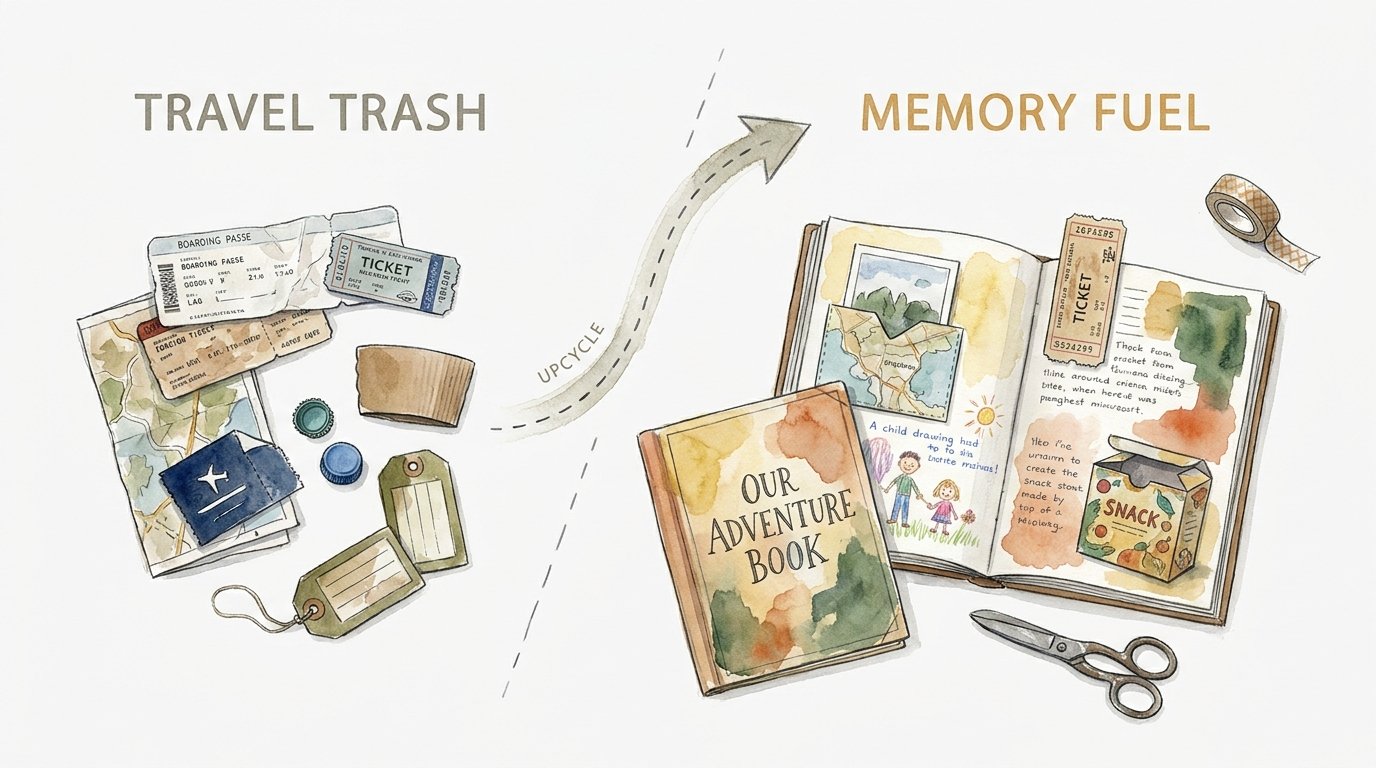
Travel is a fast-moving stream of sensory data. You visit a monument, eat a local pastry, and navigate a subway system all before lunch. Without a way to anchor these moments, they evaporate. This is where the concept of “memory fuel” transforms ordinary vacations into life-long lessons. Instead of buying plastic souvenirs, teach your children to hunt for the authentic paper trail of their journey.
Upcycling Travel Ephemera Into Kids Journals
Upcycling travel ephemera is the art of taking transitory paper items—tickets, maps, receipts, and wrappers—and giving them a permanent home in a personal journal. Ephemera refers to things that exist only for a short time. In a travel context, this includes the boarding pass for your flight, the colorful napkin from a Parisian boulangerie, or the hand-stamped ticket from a Tokyo train station.
These items are usually destined for the recycling bin. However, when a child pastes a museum map into a notebook, it ceases to be a navigation tool and becomes a primary source document. It serves as visual proof of where they stood and what they saw. This practice exists at the intersection of scrapbooking and traditional journaling, often referred to as “smash booking” or junk journaling.
Real-world applications of this method are everywhere. Families who practice worldschooling use upcycled journals to turn geography and history into a tactile experience. Even on a short weekend getaway, this method helps children focus on the small details that make a place unique. A candy wrapper from a foreign grocery store tells a richer story about local culture than a generic postcard ever could.
The “Smash” System: How to Turn Junk into Art
Turning travel trash into memory fuel requires a simple, repeatable system. You do not need to be an artist to make this work. The goal is to “smash” the memories onto the page as they happen, avoiding the perfectionism that often leads to unfinished projects.
The Daily Collection Phase
Success starts with a collection strategy. Give each child a dedicated “treasure pouch” or a simple Ziploc bag. Throughout the day, encourage them to look for interesting paper items. Think beyond the obvious museum tickets. Business cards from a favorite cafe, fruit stickers from a local market, or even a printed hotel key card envelope are all fair game.
Train your kids to look for “location markers.” These are items that feature local languages, unique logos, or specific dates. A receipt showing the price of a gelato in Euros is a fantastic artifact for a math-minded child. A bus transfer with a local city seal helps them understand civic structures.
The Curation and Assembly Process
Once you return to your hotel or home for the evening, spend fifteen minutes sorting the haul. Curation is a critical skill. Explain that not every scrap of paper needs to go into the book. Choose the items that trigger a specific memory or emotion.
Start by dating the page. Use a glue stick or washi tape to secure the items. Washi tape is particularly effective because it allows kids to adjust the placement without tearing the paper. Encourage layering. Place a small ticket stub over a larger brochure. This creates a tactile, three-dimensional feel that makes the journal more engaging to flip through later.
Adding the Narrative Layer
Paper alone is only half the story. The narrative engine requires input. Ask your child to write one “power sentence” for each item. Instead of “We went to the museum,” prompt them with “The armor at the museum looked like it was made for a giant.” This connects the physical object to their personal observation, cementing the memory in their long-term storage.
The Intellectual Edge: Benefits of Upcycling Memories
The advantages of travel journaling go far beyond simple memory preservation. This practice engages multiple parts of a child’s brain, fostering skills that serve them well in a classroom setting.
Enhanced Observational Skills
When children know they are looking for “journal fuel,” they become more observant. They start noticing the design of a logo, the color of a stamp, or the specific shape of a leaf. This heightened awareness transforms them from passive tourists into active explorers. They are no longer just looking at a city; they are analyzing its components.
Literacy and Communication Growth
Journaling provides a low-pressure environment for practicing writing. Unlike a school assignment, there are no wrong answers in a travel journal. Children practice summarizing events, expressing opinions, and using descriptive language. Even young children can participate by dictating sentences to a parent, which helps them understand the connection between spoken word and written text.
Emotional Regulation and Mindfulness
Travel can be overwhelming. The constant change in environment can lead to sensory overload. Taking twenty minutes at the end of the day to “smash” memories into a journal acts as a grounding exercise. It allows the child to process the day’s events in a quiet, reflective way. This mindfulness reduces travel anxiety and helps children appreciate the present moment.
Avoiding the “Glue Trap”: Common Challenges
While the process is simple, there are common pitfalls that can derail a young historian. Recognizing these early ensures the journal remains a joy rather than a chore.
The Perfectionism Pitfall
Many children (and parents) get stuck trying to make every page look like a professional scrapbook. This is a recipe for failure. When the process becomes too precious, kids stop doing it. The goal is a “smash book”—it should be messy, crowded, and authentic. Encourage crooked edges and overlapping stickers.
The Collection Overload
It is easy to end a trip with a suitcase full of paper and a completely empty journal. This happens when you focus too much on collecting and not enough on assembly. To avoid this, set a “glue as you go” rule. Aim to complete at least one page every two days. It is much easier to spend ten minutes on a train or plane than to spend three hours at the kitchen table once the vacation is over.
The Glue Failure
Standard school glue sticks often dry out and lose their grip over time. This leads to tickets falling out and memories getting lost. Use high-quality acid-free glue sticks or double-sided tape runners. For heavier items like coins or thick cardboard, consider using small envelopes taped into the journal rather than trying to glue the object directly to the page.
Real-World Constraints and Limitations
Upcycling ephemera is a powerful tool, but it is not a universal solution for every travel scenario. Understanding the boundaries helps you choose the right approach for your specific trip.
Space and Weight Boundaries
If you are backpacking or traveling with strictly carry-on luggage, a thick journal and a kit of supplies may be too bulky. In these cases, focus on collecting the ephemera in a slim envelope and doing the assembly once you return home. The tradeoff is a loss of “in-the-moment” reflection, but it preserves the artifacts without weighing down your gear.
The Humidity Factor
In tropical or very humid climates, paper ephemera can curl or mold if not stored properly. Glue may also fail to dry or become sticky. If you are traveling in high humidity, use a journal with a waterproof cover and consider using plastic sheet protectors or a “smash” style journal with pre-pasted pages that are more resistant to environmental shifts.
Age Appropriateness
Children under the age of five may lack the fine motor skills to cut and paste effectively without constant supervision. For the very young, the journal might become a “parent-child” project where the child chooses the items and the parent handles the assembly. This still builds the narrative engine but prevents the frustration of sticky fingers and torn paper.
Comparing Methods: Paper vs. Pixels
In a world of smartphones, many parents ask why they should bother with paper journals. Both have value, but they serve different purposes in a child’s development.
| Feature | Digital Photo App | Upcycled Paper Journal |
|---|---|---|
| Sensory Engagement | Visual only. | Tactile, visual, and even scent (old paper). |
| Creation Effort | Low (Point and click). | Moderate (Curating and gluing). |
| Memory Retention | Lower; photos often forgotten. | Higher; physical interaction cements memory. |
| Longevity | Dependent on cloud/battery. | Physical artifact for decades. |
Pro-Level Curation Hacks
To take your child’s journal to the next level, incorporate these efficiency-boosting techniques. These tips help keep the momentum high and the “travel trash” organized.
- Carry a Portable Date Stamp: Use a self-inking date stamp to quickly mark pages. It adds a professional look and ensures the timeline is clear without needing to write out dates repeatedly.
- The “Postcard Shortcut”: If you missed a photo of a specific landmark, buy a postcard. Cut it up and glue it in. This is often cheaper and faster than printing your own photos while on the move.
- Use Glassine Envelopes: Tape small translucent envelopes into the journal. These are perfect for holding loose items like foreign coins, pressed flowers, or sand from a beach.
- Invest in a Mini Printer: Devices like the Kodak Ivy or Canon Ivy allow you to print small, sticky-backed photos directly from your phone. Mixing these “real” photos with upcycled tickets creates a high-energy, modern aesthetic.
- Hunt for Local Rubber Stamps: Many train stations and visitor centers in countries like Japan or the UK have free rubber stamps for tourists. Stamp these directly into the journal as a free, high-quality “check-in” marker.
Advanced Considerations for Serious Practitioners
For the “Pro Parent” who wants a museum-quality result, consider the long-term preservation of the journal. Ephemera is often printed on low-quality, acidic paper (like thermal receipts). These will fade or turn yellow over time.
Dealing with Thermal Receipts
Thermal paper is notorious for fading until the text is invisible. If a receipt is particularly important, take a photo of it. You can print the photo and paste it alongside the original. Alternatively, use a clear UV-resistant spray if you are doing a high-end project, though for most kids’ journals, a simple photocopy or photo backup is sufficient.
Thematic Curation
Instead of a strictly chronological journal, try a thematic approach. Dedicate one spread to “Transportation,” another to “Food Labels,” and a third to “Local Language.” This forces children to categorize their experiences, which is a higher-level cognitive skill. It also makes for a more interesting visual experience when flipping through the book years later.
Archival Storage
Once the trip is over and the journal is full, store it in a cool, dry place. Avoid plastic bins that trap moisture. A high-quality notebook with heavy-weight, acid-free paper will protect the upcycled items from deteriorating. Label the spine with the destination and year to make it easy to find on a bookshelf.
Example Scenario: A Day in London
Imagine your family has just finished a day in London. Your child’s pouch is full of “trash.” Here is how a single day looks when translated into a narrative engine.
First, they paste the Underground map across a full spread. They draw a red line connecting the stations you visited. Next, they glue a ticket stub from the Tower of London in the center. Beside it, they place a napkin from a fish-and-chips shop that has a small grease stain—authentic proof of a local meal.
They find a sugar packet from the hotel tea service and tape it down. Their “power sentence” reads: “The Queen probably drinks this tea, but she might not eat as much jam as I did.” Finally, they use a portable printer to add a photo of them standing next to a red phone booth. This page now holds the sights, the movement, and the literal flavor of their London experience.
Final Thoughts
The transition from TRAVEL TRASH to MEMORY FUEL is more than just a craft project. It is a fundamental shift in how your family interacts with the world. By valuing the “worthless” bits of a journey, you teach your children that every moment has a story worth telling. They learn that the best souvenirs aren’t bought in a gift shop; they are discovered in the pockets of their own coats and at the bottom of their day bags.
Encourage your kids to experiment with their layouts. Let them fail, let them over-glue, and let them find their own voice. A messy journal filled with authentic scraps is infinitely more valuable than a pristine, empty book. It is a record of growth, a witness to adventure, and a tangible piece of their childhood.
Start on your next trip. Look for that first ticket stub or that first local business card. Hand it to your child and tell them they are now the historian of the family. Watch as they start to see the world not as a series of things to buy, but as a collection of stories to save.
Sources
1 forsomethingmore.com | 2 chantae.com | 3 therealisticmama.com | 4 handsonaswegrow.com | 5 vintagepagedesigns.com | 6 kellehampton.com | 7 ruthnuss.com | 8 kidstravelbooks.com | 9 reddit.com | 10 vintagepagedesigns.com | 11 youtube.com | 12 artjournalist.com | 13 thertwguys.com | 14 2aussietravellers.com | 15 planetschooling.com | 16 theflyingkids.com | 17 worldhealth.net | 18 artsyfartsylife.com | 19 medium.com