Montessori Tactile Discrimination Ideas
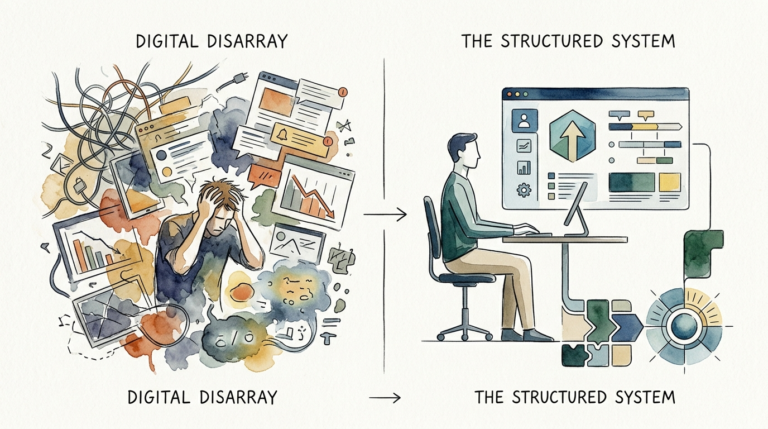
Can your child tell the difference between 400 and 600 grit by touch alone? Stop overwhelming their brains with a chaos of random shapes and loud colors. True sensory mastery comes from precision. When you grade textures from coarse to fine, you’re not just “playing”—you’re calibrating their nervous system for high-level focus and discrimination. Efficiency in play leads to efficiency in thought.
Montessori Tactile Discrimination Ideas
Tactile discrimination is the ability to differentiate between various textures, temperatures, weights, and shapes using only the sense of touch. In a Montessori context, this is not a random sensory experience. It is a structured, scientific approach to refining the nervous system. While traditional sensory play often involves “messy bins” filled with a variety of conflicting stimuli, Montessori tactile work focuses on the isolation of quality.
Isolation of quality means that if a child is learning to distinguish between “rough” and “smooth,” every other variable—like color, size, and shape—stays exactly the same. This allows the brain to focus entirely on the tactile input without being distracted by visual noise. This practice exists because the hands are the primary instruments of human intelligence. During the first six years of life, children possess what Dr. Maria Montessori called the “Absorbent Mind.” They literally build their mental structures through physical interaction with their environment.
Real-world applications of this skill are everywhere. A surgeon must rely on tactile feedback to distinguish between different types of tissue. A mechanic feels for the slight vibration or grit in a fluid that indicates engine wear. Even a child learning to write uses tactile discrimination to feel the resistance of the pencil against the paper and the specific shapes of the letters they are forming. By honing these skills early, you are providing a foundation for high-level cognitive work.
How to Implement Montessori Tactile Activities
Implementing these activities requires a shift from “entertainment” to “precision.” The goal is to move the child through a sequence of increasingly difficult challenges. You start with high contrast and move toward subtle gradations.
Sensitizing the Fingertips
Before any tactile work begins, Montessori practitioners often use a technique called “sensitizing the fingertips.” This involves having the child wash their hands in warm water and dry them thoroughly. Warm water increases blood flow to the nerve endings, making the skin more receptive to subtle stimuli. It also removes any oils or dirt that might dull the sensation. This small ritual signals to the child that the work they are about to do requires special attention and respect.
The Three-Period Lesson
To give the child the language for their experiences, use the Three-Period Lesson:
- First Period (Naming): Touch the material and say, “This is rough.” Let the child touch it and repeat the word.
- Second Period (Recognition): Place two contrasting items down and ask, “Can you show me the rough one?” This is the longest and most important phase, where the child builds a mental connection between the feeling and the word.
- Third Period (Recall): Point to an item and ask, “What is this?” This confirms the child has internalized the concept.
Using a Blindfold
The ultimate test of tactile discrimination is removing the visual sense entirely. Using a soft sleep mask or a “mystery bag” forces the brain to reroute its processing power to the fingertips. When the eyes are closed, the “tactile image” becomes much sharper. Start with simple matching games while blindfolded, then move to grading sequences where the child must arrange five different sandpaper grits from roughest to smoothest without looking.
Benefits of Tactile Calibration
Calibrating the nervous system through graded textures offers measurable cognitive advantages. It isn’t just about identifying sandpaper; it is about building a brain that can notice fine details.
One primary benefit is the development of the mathematical mind. Tactile discrimination requires the child to compare, contrast, and categorize. When they arrange sandpaper tablets from 40 grit to 600 grit, they are performing a “linear ranking” exercise. This is the same logic used in sequencing numbers or understanding the hierarchy of decimal place values.
Refined touch also prepares the child for writing and literacy. In Montessori, children trace “Sandpaper Letters” before they ever pick up a pen. The rough texture of the letter creates a strong muscular memory of the shape. When it comes time to write on paper, the hand already knows the movement because it has been “carved” into the brain via the sense of touch.
Furthermore, these activities foster concentration and internal order. Because the materials are self-correcting—for instance, if a child matches the wrong fabrics, they will eventually have a leftover piece that doesn’t fit—the child learns to solve problems independently. This builds a sense of confidence that comes from actual competence, not just empty praise.
Challenges and Common Mistakes
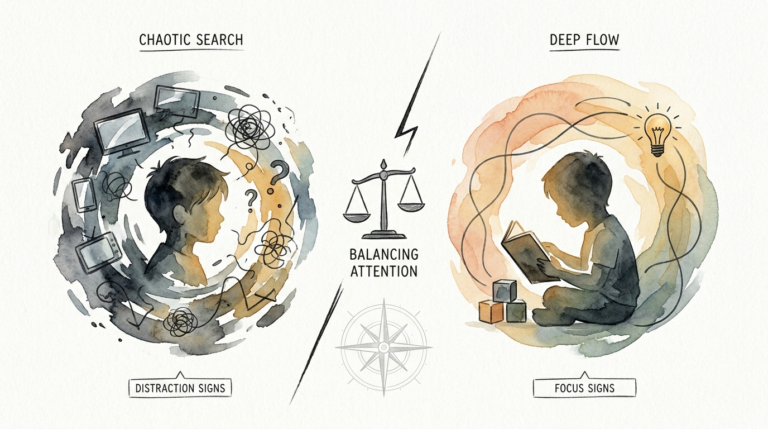
The most frequent error in tactile education is over-stimulation. Parents often think that more is better, so they create “sensory walls” with dozens of different textures, colors, and moving parts. This creates a “chaos of the senses.” The brain cannot isolate the specific quality of “roughness” if it is also trying to process a bright red color and a jingling bell at the same time. To avoid this, keep your materials as visually neutral as possible.
Another pitfall is skipping the contrast phase. You cannot expect a child to distinguish between 400 and 600 grit if they haven’t first mastered the difference between a rough rock and a smooth silk scarf. Always start with the extremes. If the child is struggling, go back to a more dramatic contrast. Success in the early stages is what fuels the desire to tackle more difficult challenges later.
Finally, many people forget to model the movement. Tactile discrimination isn’t just about touching; it’s about *how* you touch. Show the child how to use the pads of their index and middle fingers to lightly skim the surface. If they press too hard, they dull the sensitivity of the receptors. If they move too fast, they miss the subtle “peaks and valleys” of the texture.
Limitations and Environmental Constraints
Tactile work is highly effective, but it does have practical boundaries. Environmental factors like humidity and temperature can significantly alter the experience. High humidity can make smooth wood feel slightly “tacky” or “sticky,” which might confuse a child trying to distinguish it from a polished surface. Similarly, if a child’s hands are very cold, their tactile sensitivity drops significantly.
Another limitation is sensory processing differences. Some children are hypersensitive to certain textures, such as wool or sandpaper. For these children, the activity can be physically painful or emotionally distressing. In these cases, the “Montessori way” is to observe and adapt. Never force a child to touch a material that causes a negative reaction. Instead, find “bridge textures” that are less intense but still allow for the development of discrimination skills.
It is also worth noting that tactile discrimination is a developmental window. While adults can certainly improve their touch, the “sensitive period” for sensory refinement is between ages three and six. If this window is missed, the child can still learn the skills, but the process will require more conscious effort and will not be as “effortless” as it is for a preschooler.
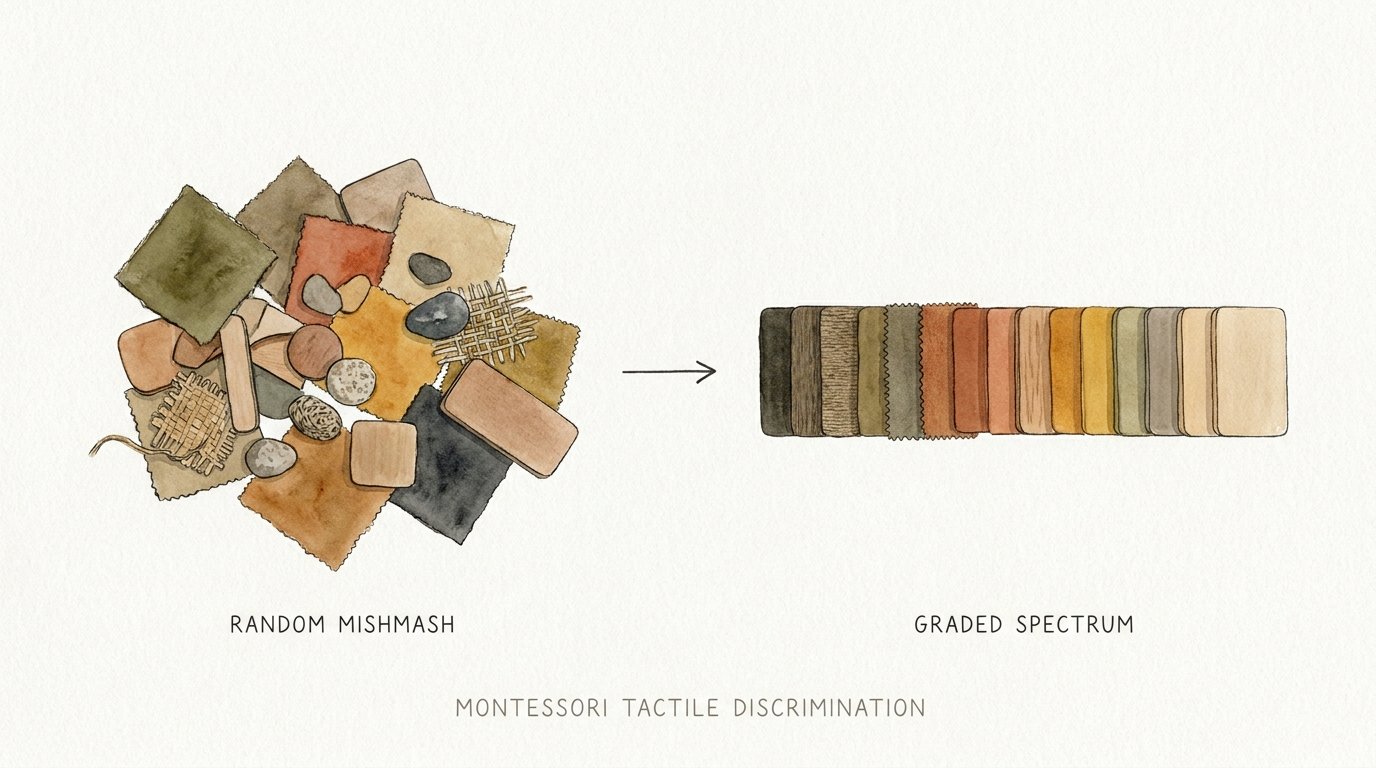
Random Mishmash vs. Graded Spectrum
Understanding the difference between generic sensory play and the Montessori graded approach is crucial for parents and educators.
| Feature | Random Mishmash (Sensory Bins) | Graded Spectrum (Montessori) |
|---|---|---|
| Primary Goal | Entertainment / Exposure | Refinement / Discrimination |
| Variables | Multiple (color, shape, texture) | Isolated (one quality at a time) |
| Difficulty | Static | Progressive (easy to hard) |
| Feedback | External (from adult) | Internal (self-correcting) |
While a bin of colored rice is fun, it doesn’t necessarily teach a child to notice the difference between two types of grain. The graded spectrum approach ensures that the child is moving toward precision. This precision is the catalyst for higher cognitive functions like analysis and synthesis.
Practical Tips and Best Practices
If you want to start calibrating your child’s tactile sense today, follow these best practices:
- Isolate the hands: Use a “mystery bag” (an opaque drawstring bag) and place 5-10 familiar household objects inside. Ask the child to find the “cold metal spoon” or the “fuzzy cotton ball” by touch alone.
- Create matching pairs: Use two identical sets of fabric swatches (silk, wool, cotton, corduroy, denim). The child must match the pairs while blindfolded.
- Focus on temperature: Use “Thermic Tablets.” You can make these at home using small tiles of different materials: marble, wood, felt, and metal. Even when kept at the same room temperature, they feel different because of their thermal conductivity.
- Go for weight: Use “Baric Tablets.” These are small wooden tablets of the same size and color but made from different woods (like pine, oak, and mahogany) so they vary in weight. The child balances one on the fingertips of each hand to compare the “heft.”
- Keep it quiet: Silence is a tool. When the child is working on a tactile task, avoid narrating. Let the brain focus entirely on the signals coming from the fingers.
Advanced Considerations for Serious Practitioners
For those who want to take tactile discrimination to the professional or “serious hobbyist” level, consider the concept of the Stereognostic Sense. This is the ability to recognize an object’s form and 3D structure without seeing or hearing it. It involves a complex interplay between tactile receptors and muscular memory.
Advanced exercises involve the “Geometric Solids.” A child might be asked to identify a “triangular prism” versus a “cone” while blindfolded. This requires them to not only feel the surface texture but to mentally reconstruct the three-dimensional geometry of the object. This is a massive leap in cognitive processing.
Scaling these activities also means looking at pressure sensitivity. You can challenge an older child to “write” a letter in a tray of fine sand with such a light touch that they don’t hit the bottom of the tray. This develops incredible fine motor control and “proprioceptive” awareness—the sense of where your body is in space. These advanced techniques are what separate “playing with blocks” from “engineering a mind.”
Example Scenario: The Fabric Box
Imagine a four-year-old named Leo. Leo is introduced to the “Fabric Box 1.” This box contains two swatches each of silk, burlap, and cotton. All the swatches are cut into 4×4 inch squares and are the same neutral off-white color.
Leo’s teacher first shows him how to “sensitize” his fingertips by rubbing them together. Then, the teacher takes one piece of burlap and one piece of silk. Leo touches both. The teacher says, “This is rough. This is smooth.”
Leo then puts on a sleep mask. The teacher mixes the pieces on the table. Leo skims his fingers over the fabrics. He feels the “hairy” and “prickly” nature of the burlap and matches it with its pair. He feels the “slippery” and “cool” nature of the silk and matches it. Because there are no colors to guide him, Leo’s brain is forced to create a “tactile map” of the fibers.
Over the next few weeks, the teacher adds more fabrics—velvet, corduroy, and linen. Eventually, Leo can match 12 different pairs of fabric blindfolded. This mastery of the “Fabric Box” isn’t just a party trick; it’s evidence that Leo has developed a high level of neurological focus and the ability to process complex data sets through a single sensory channel.
Final Thoughts
Refining a child’s sense of touch through Montessori tactile discrimination ideas is one of the most direct ways to support their neurological development. By moving away from random “sensory play” and toward a graded spectrum of precise experiences, you allow the child’s brain to build order, concentration, and a capacity for fine-grained analysis. This isn’t just about textures; it’s about the very way they perceive and categorize the world around them.
When you invest time in these activities, you are providing your child with the “keys to the universe.” A child who can tell the difference between 400 and 600 grit sandpaper is a child who has been trained to look for details in everything they do—whether that is solving a math problem, reading a complex text, or observing the natural world.
Start small, keep the variables isolated, and don’t be afraid to use a blindfold. The results will manifest not just in their hands, but in their ability to think with clarity and precision. True intelligence is built from the fingertips up. Encourage your child to explore, categorize, and master the textures of their world today.
Sources
1 montessoridaoshi.com | 2 montessori4teachers.com | 3 montessorigeneration.com | 4 goldcoastmontessorichildcare.com | 5 sensorynstuff.com | 6 mosaicmontessori.org | 7 gardenmontessorischools.com | 8 montessoriservices.com | 9 berkshiremontessori.org | 10 hudsonmontessori.net | 11 msofe.com | 12 montessoricommons.cc | 13 reachformontessori.com | 14 mcdcpoway.com | 15 reachformontessori.com