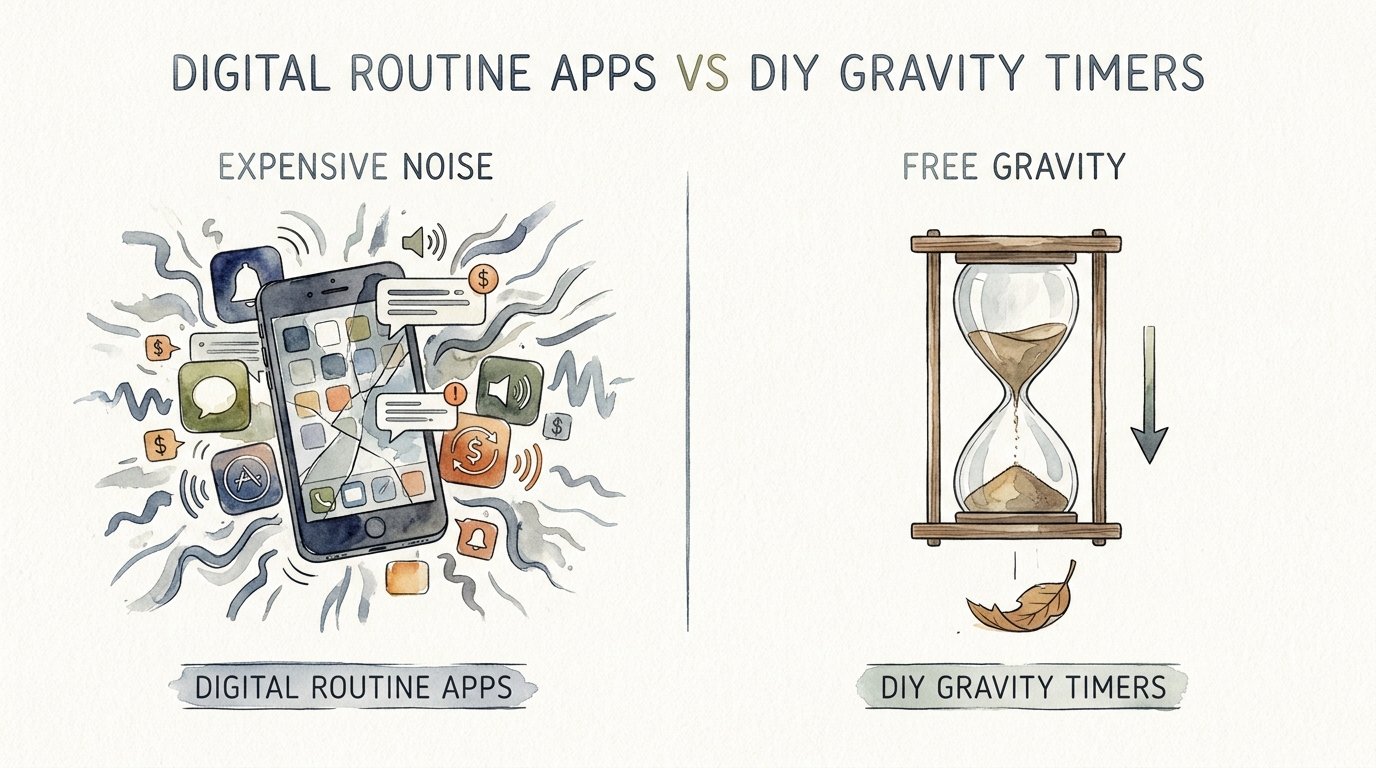
Digital Routine Apps Vs Diy Gravity Timers
Why are we paying monthly fees for digital noise when gravity provides the perfect focus tool for free? We are sold the lie that ‘smart’ apps will solve our child’s routine problems. In reality, the flashy lights and subscription notifications just add to the chaos. A ‘Free’ gravity system—sand or water—provides a silent, visual representation of time that a child’s brain can actually process without the digital hangover.

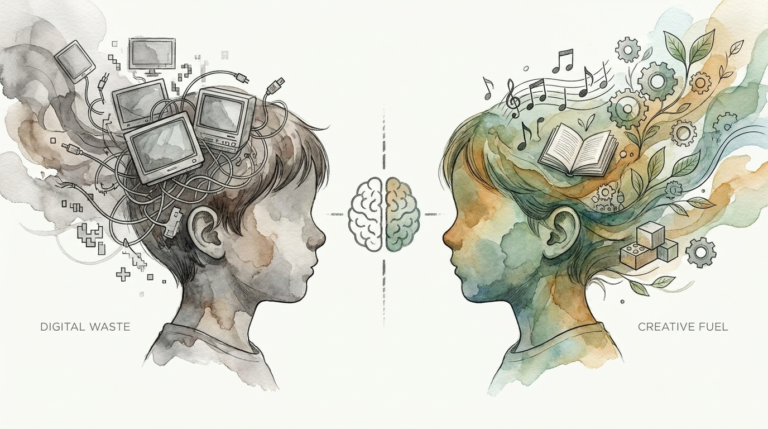
Most parents reach for their phones the moment a morning routine stalls. We download an app that promises to gamify teeth-brushing or chore-completion. Then we realize we just handed a dopamine-seeking brain a high-powered distraction machine. The notifications beep, the screen glows, and the child’s focus shatters.
Instead of paying $10 a month for a digital reminder, we can use the most consistent force in the universe. Gravity doesn’t need a Wi-Fi connection. It doesn’t send push notifications about sales or updates. It simply moves mass from one point to another at a constant, undeniable rate.
This article explores why physical gravity timers often outperform the most expensive software on the market. We will look at the neuroscience of time blindness and provide a blueprint for building your own focus tools at home.
Digital Routine Apps Vs Diy Gravity Timers
Digital routine apps are software platforms designed to manage tasks through notifications, timers, and reward systems. Popular options like Brili, Goally, or Tiimo attempt to replace the parent’s voice with a digital coach. They use colorful interfaces and progress bars to show how much time is left for a specific activity. While these tools offer complex scheduling, they require a screen to function.
DIY gravity timers, on the other hand, are physical objects that use sand or water to represent the passage of time. They are analog tools that require no batteries or data plans. Because they exist in three-dimensional space, they engage the senses in a way that pixels cannot. You can see the weight of the sand and hear the soft hiss of the grains falling.
The fundamental difference lies in the “switching cost.” Every time a child looks at a phone to check a timer, their brain faces the temptation of other apps. Research suggests it can take over 23 minutes to regain deep focus after a digital interruption. A sand timer in the peripheral vision provides a “signal” without the “noise” of the digital world.
Gravity timers are often used in Montessori and neurodivergent-friendly environments. They help bridge the gap between abstract numbers and the physical reality of time. For a child who struggles with executive function, seeing the pile of sand grow at the bottom is more meaningful than a shrinking digital circle.
How the Physics of Focus Works
Gravity timers work by exploiting the relationship between mass, friction, and an orifice. In a sand timer, the size of the hole between two chambers determines the flow rate. Because gravity is a constant force on Earth, the flow remains steady regardless of the environment. This creates a reliable, repeatable “physical clock” that the human eye can track effortlessly.
The human brain is wired to process physical motion more intuitively than digital countdowns. When we watch sand fall, our brains use the visual system to estimate “how much” is left based on volume. This is a low-energy cognitive task. In contrast, reading digital numbers requires the brain to translate symbols into concepts, which consumes more mental bandwidth.
Digital apps operate on “code” which can glitch, lag, or be interrupted by a low battery. These interruptions create anxiety. A gravity timer is a closed system. It follows the laws of physics, making it a “source of truth” that a child can trust implicitly.
To use these tools effectively, you must place them in the “point of performance.” This means the timer should be exactly where the task is happening. If the child is brushing their teeth, the timer should be on the sink. If they are doing homework, it should be at eye level on the desk.
The Benefits of Physical Gravity over Digital Noise
Physical timers offer a sensory grounding that digital apps cannot replicate. For children with ADHD or Sensory Processing Disorder, the visual and tactile nature of a sand timer provides a “calm” signal. It reduces the “time blindness” that makes transitions so difficult. Seeing the sand run out creates a natural, soft deadline rather than a jarring alarm.
One major advantage is the lack of screen glare and blue light. Using a digital app for a bedtime routine can actually interfere with melatonin production. A gravity timer uses ambient light. It signals to the brain that the day is winding down, not that it is time for more digital stimulation.
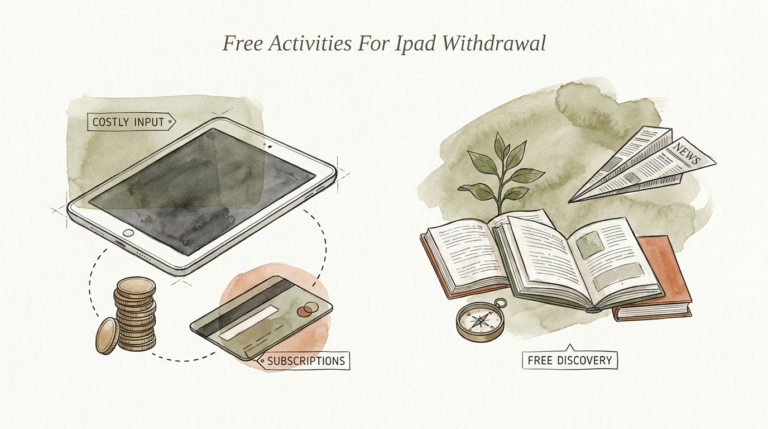
Cost is another undeniable benefit. Many routine apps now require monthly subscriptions ranging from $5 to $15. Over a year, you could spend $120 on a tool that might actually be distracting your child. A DIY sand timer costs almost nothing to make and lasts forever as long as it is handled with care.
Peripheral awareness is perhaps the most underrated benefit. You can see a sand timer out of the corner of your eye while working. You don’t have to “check” it or unlock it. This allows for a state of “flow” where you are aware of time passing without being pulled out of your task by a glowing screen.
Challenges and Common Mistakes
The biggest challenge with DIY gravity timers is precision. It is difficult to make a homemade sand timer that is accurate to the second. If you need a timer for a 5-minute task and it lasts 5 minutes and 20 seconds, it may not matter. However, for time-sensitive experiments, this lack of precision can be a drawback.
Fragility is another common pitfall. Glass sand timers can break, and plastic DIY versions can leak if not sealed correctly. Parents often make the mistake of using wet sand or sand with large pebbles. This causes the timer to clog, which can lead to frustration and a loss of trust in the tool.
Many people also struggle with the “one-way” nature of gravity. You cannot “pause” a sand timer like you can a digital app. If an interruption occurs, the sand keeps falling. This requires a shift in mindset—viewing time as a continuous flow rather than something that can be stopped and started at will.
Avoid the mistake of using a timer that is too long for the child’s developmental stage. A 30-minute timer for a toddler is useless. They cannot conceptualize that much time. Start with 1-minute or 2-minute timers for simple tasks like putting on shoes or picking up toys to build the “timing muscle.”
Limitations of the Gravity Method
Gravity timers are not ideal for complex, multi-step routines that require specific instructions. An app can tell a child to “brush the top teeth now,” whereas a sand timer just shows time passing. For children who need high levels of verbal prompting, a physical timer must be paired with a printed visual schedule.
Environmental factors can also play a role. Humidity can cause sand to clump inside a plastic bottle, slowing the timer down. If you live in a very humid climate, you may need to use a desiccant or ensure your sand is baked and bone-dry before sealing the container.
Portability is another limitation. While you can take a phone anywhere, carrying a large DIY sand timer to a restaurant or a doctor’s office is less practical. Physical timers are best used as “anchors” in specific rooms of the house to establish location-based habits.
Finally, gravity timers have a limited duration. It is difficult to build a functional 60-minute sand timer that isn’t massive. For tasks longer than 15 or 20 minutes, digital tools or mechanical “Time Timers” (which use a red disk) are often more practical than pure gravity-based systems.
Comparing Digital Apps to DIY Gravity Timers
Choosing the right tool depends on your goals and your child’s specific needs. Digital apps excel at data tracking and complexity, while gravity timers excel at focus and simplicity. Below is a comparison of the two systems across key metrics.
| Feature | Digital Routine Apps | DIY Gravity Timers |
|---|---|---|
| Cost | $60 – $150 per year (Subscription) | Free to $5 (Recycled materials) |
| Distraction Level | High (Notifications, other apps) | Zero (Silent, non-digital) |
| Sensory Input | Visual only (2D Screen) | Visual, Auditory, Tactile |
| Reliability | Medium (Battery, Wi-Fi, Glitches) | High (Laws of Physics) |
| Complexity | High (Multi-step schedules) | Low (Single-task focus) |
Practical Tips for Implementing Gravity Timers
Start small by introducing the timer for a single, high-friction task. Mornings are usually the best time to test this. Place a 2-minute sand timer on the bathroom counter and tell the child they need to finish brushing before the “sand stops dancing.” This gamifies the task without the need for a digital reward.
Use different colored sand for different tasks. Red sand could represent “high-energy” tasks like cleaning up, while blue sand could represent “calming” tasks like reading. This color-coding helps the brain prepare for the specific type of focus required for the activity.
Calibration is key for DIY projects. Use a digital stopwatch to time your gravity device once it is built. If it runs too fast, you can add more sand or use a smaller opening. Mark the “halfway” point on the bottle with a permanent marker so the child can see their progress more clearly.
Layer your timing systems for maximum effectiveness. You can use a physical gravity timer for the task itself, but keep a simple, non-digital wall clock in the room for overall time awareness. This provides a “micro” and “macro” view of the schedule without ever needing to look at a phone.
Advanced Considerations for Executive Function
For older children or adults with ADHD, the concept of “Temporal Myopia” is critical. This is the inability to “see” time that isn’t in the immediate present. Gravity timers turn the future (the sand at the top) into the present (the sand falling) and the past (the sand at the bottom). This physical mapping is a powerful hack for the prefrontal cortex.
Consider the “Signal-to-Noise Ratio” of your home environment. Steve Jobs famously aimed for an 80/20 ratio, where 80% of energy went to the “signal” (the mission) and only 20% to the noise. Digital apps often flip this ratio by introducing thousands of lines of code and notifications. Gravity timers are 100% signal.
If you are dealing with a child who has severe transition anxiety, try using a “pre-timer.” Flip a 1-minute sand timer to signal that the “big” timer is about to start. This provides a gentle runway for the brain to switch tasks, reducing the likelihood of a meltdown.
You can also experiment with liquid gravity timers (water clocks). These use viscosity rather than friction. They are often more visually stimulating and can be used as a “fidget” and a timer simultaneously. For a DIY water clock, you can use two bottles and a connector, varying the size of the hole to change the drip rate.
Scenario: The Stress-Free Morning
Imagine a Tuesday morning. Usually, you are yelling from the kitchen for your child to put on their socks. Today, you place a 3-minute DIY sand timer on the rug. You don’t say a word; you simply point to the falling sand.
The child sees the sand disappearing from the top chamber. There is no beeping alarm to trigger their fight-or-flight response. Instead, they feel a natural sense of urgency. They see that they are halfway done because the pile at the bottom is half-full.
By the time the last grain falls, the socks are on. The child feels a sense of accomplishment because they “beat the sand.” You didn’t have to pay a subscription fee for this result. You used the same force that keeps the planets in orbit to get a 6-year-old ready for school.
This scenario demonstrates the power of externalizing time. When time is a “feeling” inside a child’s head, it is unreliable. When time is a physical object on the floor, it is a teammate. This shift transforms the morning from a power struggle into a shared experiment with physics.
Final Thoughts
Relying on digital apps to fix human routine problems is a modern trap. We are trading our attention and our money for tools that often increase our cognitive load. Gravity offers a better way. It is a silent, free, and perfectly consistent partner in the quest for focus and routine.
Building a DIY sand timer or using a simple physical visual tool isn’t just about saving money. It is about reclaiming the “signal” in your home. It is about teaching your child that they can manage their own brain without needing a piece of silicon to tell them what to do.
Experiment with these physical tools this week. Turn off the notifications, put the phone in a drawer, and let gravity do the heavy lifting. You might find that the “smartest” solution to your routine problems was discovered thousands of years ago in the form of falling sand.
Sources
1 reachlink.com | 2 dev.to | 3 instructables.com | 4 novatools.org | 5 brainbalancecenters.com | 6 timetimer.com | 7 tiimoapp.com | 8 sommerpg.com | 9 medium.com | 10 hallowelltodaro.com | 11 signal-noise.app | 12 vermontmoms.com