Preschool Handwriting Improvement Tips
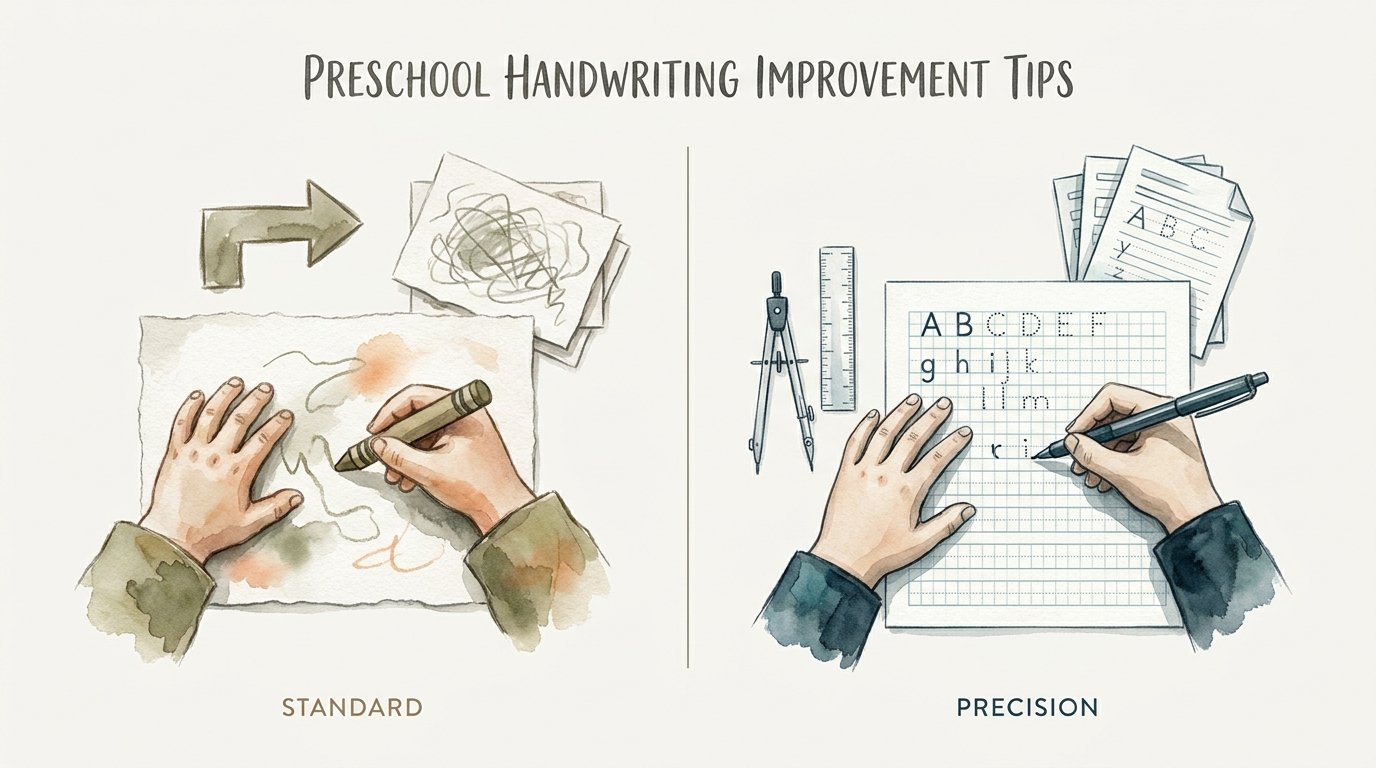
Why do some worksheets build confidence while others build frustration in a child’s hand? We thought any tracing was good tracing, but random dots actually confuse the developing hand. Standard sheets create shaky habits, but Precision paths create the muscle memory that makes handwriting effortless for a lifetime. It’s not about how much they write; it’s about the path they follow.
Every parent and teacher wants to see that moment when a child proudly signs their own name. This milestone represents a massive leap in cognitive and physical development. Yet, the journey to legible handwriting often feels like a battle of wills. Many children face tears and refusal because the tools they are given do not match the way their bodies grow. Moving from messy scribbles to crisp letters requires more than just a pencil; it requires a specific roadmap for the brain.
Preschool Handwriting Improvement Tips
Preschool handwriting improvement starts with understanding that writing is a full-body activity. It is the end result of a complex chain reaction that begins in the core and ends at the fingertips. In real-world terms, handwriting readiness is the ability to control small hand movements while maintaining a stable body posture. This is why children spend years playing with blocks, climbing playgrounds, and using scissors before they ever pick up a No. 2 pencil.
Handwriting improvement in the preschool years isn’t actually about the letters themselves. It is about “pre-writing strokes.” These are the vertical lines, horizontal bars, and circles that make up every letter in the alphabet. If a child cannot draw a cross or an “X,” their brain isn’t quite ready to tackle the letter “K” or “W.” True improvement comes from following a developmental ladder. We must focus on the “Precision” of the movement rather than the “Standard” result of a finished page.
The Foundation: How Handwriting Development Works
Handwriting follows a “proximal to distal” development pattern. This means children gain control of their shoulders and elbows before they master their wrists and fingers. If you want to improve a child’s handwriting, you must first ensure they have the strength to sit still and the shoulder stability to move their arm across a page.
The process follows a specific sequence of shapes. Research shows that children typically master vertical lines around age two, circles around age three, and crosses or squares between ages four and five. Trying to force a three-year-old to write their name when they haven’t mastered a circle is like asking someone to run a marathon before they can walk. You build the hand’s “internal map” by practicing these foundational shapes first.
The brain creates a neural “blueprint” for each letter. When a child follows a “Precision path”—a solid, guided line that shows exactly where to start and stop—the brain records that movement. This creates automaticity. Eventually, the child won’t have to think about how to form a “B”; their hand will simply know the way. Standard dotted lines often fail here because they encourage a “connect the dots” mentality, which results in choppy, hesitant strokes instead of fluid ones.
Benefits of Precision Handwriting Training
Choosing a structured, precision-based approach to handwriting offers measurable advantages that extend far beyond the classroom.
- Activates the “Reading Circuit”: Scans show that the brain’s reading centers light up when a child writes a letter by hand, but stay dim when they type or simply look at it.
- Increases Speed and Fluency: When muscle memory is established early, children write faster. This allows them to focus on *what* they are saying rather than *how* to form the letters.
- Reduces Hand Fatigue: Proper training teaches an efficient grip. This prevents the “death grip” that makes a child’s hand cramp after just two sentences.
- Boosts Confidence: Success breeds success. A child who can produce a legible letter on their first try is much more likely to enjoy schoolwork.
- Corrects Reversals: Structured paths help the brain understand directionality, which reduces the common “b” and “d” or “p” and “q” mix-ups.
Challenges and Common Mistakes
Even the most well-meaning adults often fall into traps that slow down a child’s progress. Recognizing these pitfalls is the first step toward fixing them.
One frequent error is rushing into formal worksheets too early. When a child’s hand muscles haven’t fully “ossified” (turned from cartilage to bone), holding a heavy pencil is physically painful. This leads to an immediate dislike of writing. Another massive mistake is using “jumbo” pencils or crayons. While marketed for small hands, these thick tools actually make it harder for fingers to wrap around correctly, often forcing a fisted grip that is hard to break later.
Bottom-up letter formation is a habit that plagues many students. Letters like “f,” “l,” and “t” should always start at the top. When children learn to “draw” letters from the bottom, they lose the natural flow of English writing, which moves from top to bottom and left to right. Rushing is another culprit. Children often race to finish a page, creating shaky, “Standard” habits. Implementing a “Slow-Motion Robot” rule can help them focus on the precision of the path instead of the speed of completion.
Limitations: When to Hit the Pause Button
Handwriting training is not a one-size-fits-all solution. There are realistic boundaries to what a preschooler can achieve. Environmental factors like the height of the chair and table play a huge role. If a child’s feet are dangling, their core is unstable, and their handwriting will suffer.
Individual development varies wildly. A four-year-old with high-energy “gross motor” dominance might not be ready to sit and trace for ten minutes. Forcing the issue can lead to sensory “overload,” where the child associates the pencil with stress. Furthermore, children with specific needs, such as hyper-mobility or visual processing delays, may require different tools than their peers. It is vital to remember that handwriting is a physical skill, much like sports, and every player has a different starting line.
Standard Sheets vs. Precision Paths
The difference between a standard worksheet and a precision-guided path is the difference between a blurry map and a GPS.
| Feature | Standard Dotted Sheets | Precision Guided Paths |
|---|---|---|
| Visual Cues | Faint, confusing dots | Solid lines with start/stop points |
| Movement | Fragmented “point-to-point” | Fluid, continuous strokes |
| Muscle Memory | Weak; promotes “sketching” | Strong; internalizes the shape |
| Confidence | Medium; frustration when dots are missed | High; easy to follow the “road” |
Practical Tips for Immediate Improvement
Implementation doesn’t have to be complicated. You can start improving a child’s handwriting today with these simple, high-impact strategies.
- Use Golf Pencils: These short, lightweight pencils naturally encourage a “tripod” grip because there isn’t enough room for a full-fisted grasp.
- Vertical Surfaces: Tape paper to a wall or use an easel. Writing on a vertical surface builds the wrist and shoulder strength needed for paper-and-desk work.
- The Pompom Trick: Have the child hold a small pompom or cotton ball against their palm with their pinky and ring fingers. This “tucks” the extra fingers away, leaving the thumb and index finger to control the pencil.
- Sensory Trays: Practice shapes in a tray of sand, salt, or shaving cream. This provides “tactile feedback” that helps the brain remember the path better than paper alone.
- Highlight the Baseline: Use a yellow highlighter to mark the bottom line. This gives the child a clear “landing strip” for their letters so they don’t “float” away.
Advanced Considerations for Long-Term Success
Serious practitioners look beyond the paper to the “neurological plumbing” of the child. One advanced concept is “crossing the midline.” This is the ability to reach across the middle of the body with one hand. If a child switches the pencil from their right hand to their left hand when they reach the middle of the page, they haven’t mastered this skill yet. Activities like “figure-eight” drawing or playing with ribbons in the air can help bridge this gap.
Visual-motor integration is another deep-dive topic. This is the brain’s ability to translate what the eyes see into what the hands do. If a child can identify a letter but cannot copy it, they may need more “gross motor” practice with large-scale drawing (using chalk on a driveway) before returning to small-scale paper. Consistent practice, even for just five minutes a day, is far more effective than a once-a-week hour-long session.
The “Shaving Cream” Scenario: A Practical Example
Imagine a four-year-old named Sam. Sam hates writing because he feels he can’t stay on the “Standard” dotted lines. His hand shakes, and he often starts his “S” from the bottom. To help Sam, his teacher moves him away from the desk and over to a table covered in a thin layer of shaving cream.
First, the teacher draws a large, solid “S” in the cream and has Sam trace it with his index finger while saying “Start at the top, curve around.” Next, Sam does it three times on his own. The resistance of the cream provides a “Precision path” that his brain can actually feel. After Sam masters the fluid motion in the cream, he moves to a piece of paper with a solid-line “Precision” template. Because his muscles already “know” the curve, the transition to the pencil is smooth and successful. Sam is no longer “guessing” where the dots go; he is following a path he has already traveled.
Final Thoughts
Building a child’s handwriting skills is a marathon, not a sprint. Success lies in shifting our focus from the quantity of the letters to the quality of the path. We must respect the developmental milestones of the hand and provide tools that empower the child rather than frustrate them.
Precision paths, short pencils, and sensory play create the “muscle memory” that eventually makes writing as natural as breathing. Every stroke a child makes is a brick in the foundation of their future academic success. By ditching the random dots and embracing structured, guided movements, we give them the confidence to put their thoughts on paper with ease.
Encourage your child to experiment with different textures and tools. Watch their grip, mind their posture, and always celebrate the progress of the “path.” Legible, effortless handwriting is a gift that starts with a single, well-guided line.
Sources
1 wollastonchildcare.org | 2 developlearngrow.com | 3 acttherapyservices.com | 4 growinghandsonkids.com | 5 growinghandsonkids.com | 6 scholastic.com | 7 dynamilis.com | 8 whizki.com | 9 lillegendsbooks.com | 10 lwtears.com | 11 treehouseelc.com | 12 reachallreaders.com | 13 upub.net | 14 pre-kpages.com | 15 bigcityreaders.com | 16 learningandliteracyclinic.com.au | 17 elationfactory.com | 18 claymaze.com