How To Keep Bugs Away During Outdoor Movies
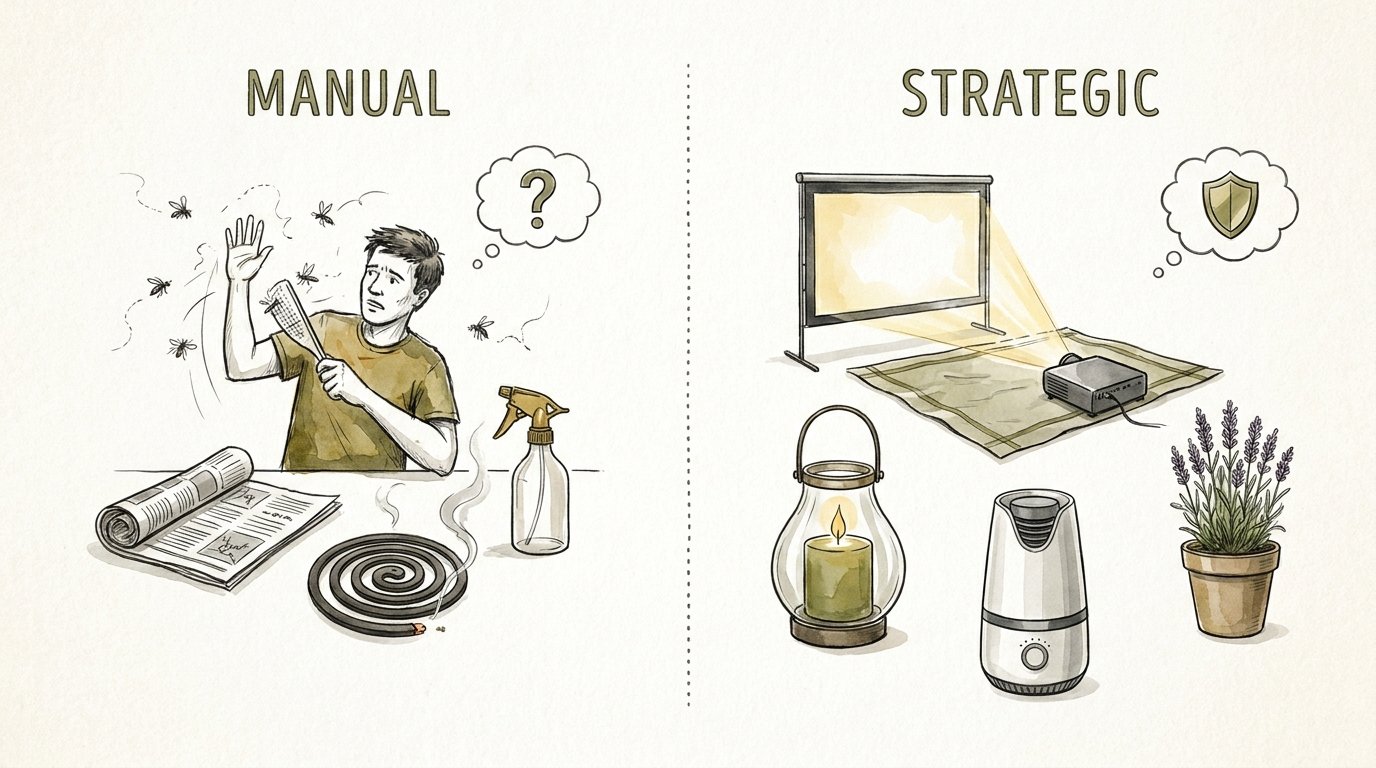
Stop fighting the mosquitoes and start outsmarting their biology. You can spend the whole movie swatting and spraying chemicals, or you can use physics. Mosquitoes are notoriously weak fliers; a simple low-noise fan creates enough ‘wind’ to keep them from ever landing. Add in some strategic aromatic planting, and you’ve built a fortress that doesn’t smell like a chemistry lab.
Hosting an outdoor movie night is the ultimate summer flex. You have the projector humming, the screen glowing, and the snacks ready. Then the sun dips below the horizon and the uninvited guests arrive. Swarms of mosquitoes and moths can turn a cinematic masterpiece into a nightmare of itching and slapping.
Most people reach for the nearest can of heavy-duty bug spray. This creates a sticky, smelly environment that ruins the vibe. Instead, you can use a combination of biological understanding and simple environmental tweaks. This guide walks you through every layer of a professional-grade bug defense.
How To Keep Bugs Away During Outdoor Movies
Keeping bugs away during outdoor movies is the process of creating a controlled environment where insects are either physically blocked, chemically deterred, or naturally disinterested in your space. This isn’t just about one “magic” product. It is about a multi-layered defense strategy that addresses different types of pests at once.
Mosquitoes are the primary enemy because they are attracted to your breath and body heat. Moths and beetles are the secondary nuisance, drawn to the bright light of your projector and screen. A successful setup manages both groups by using tools like high-CFM fans, yellow spectrum lighting, and spatial repellents.
Think of your movie area as a fortress. You don’t just put a lock on the front door; you build a wall, a moat, and a lookout tower. In the world of outdoor cinema, your “moat” is the airflow from fans, and your “lookout tower” is a bug zapper placed far away to draw insects to a different location.
This strategy works in any real-world backyard, patio, or park setting. Whether you are using a professional 20-foot inflatable screen or a white sheet pinned to a fence, the principles of pest management remain the same. You are disrupting the insects’ ability to find you and making the environment too difficult for them to navigate.
How Airflow Destroys Mosquito Ambitions
The most effective tool in your arsenal is a simple electric fan. Mosquitoes are incredibly weak fliers, typically moving at speeds between 1 and 1.5 miles per hour. Any breeze stronger than that makes it impossible for them to land on your skin or even navigate toward you.
Fans do more than just blow the bugs away. They also disperse the carbon dioxide (CO2) and lactic acid that your body emits. These are the primary “scent trails” that mosquitoes follow to find a meal. When a fan mixes the air, it breaks these trails into tiny, confusing fragments that the bugs cannot track.
To maximize this effect, use oscillating pedestal fans or high-velocity box fans. Place them at the corners of your seating area, angled to blow across the legs and torsos of your guests. Since many mosquito species are “low fliers” that target ankles and legs, ground-level airflow is critical for complete protection.
Choosing the Right Fan Speed
You don’t need a hurricane-force wind to be effective. A fan set to medium or high speed usually generates enough Cubic Feet per Minute (CFM) to exceed the 10 mph gust threshold where mosquitoes generally give up on flight. Low-noise fans are preferable so they don’t interfere with your movie’s audio track.
Strategic Lighting: The Spectrum Secret
Most insects are not attracted to “light” in a general sense. They are attracted to specific wavelengths of light, particularly ultraviolet (UV) and blue light. Traditional incandescent bulbs and cool-white LEDs emit a lot of this blue energy, which acts as a beacon for moths and beetles.
Switching your ambient lighting to the warm end of the spectrum is a game-changer. Look for bulbs labeled “Bug Lights” or those with a Kelvin rating between 2000K and 3000K. These amber or yellow-toned LEDs are much harder for insects to detect, making your seating area “invisible” to many flying pests.
The projector itself is a major light source. High-lumen projectors emit a broad spectrum of light that insects love. To mitigate this, place the projector as far back as possible and use a long-throw lens if available. This keeps the heat and the “light tunnel” away from your guests’ heads.
Managing the “Shadow Show”
Moths are notorious for flying directly into the projector beam, casting giant fluttering shadows on your screen. You can prevent this by placing a single, very bright white light or a bug zapper at the far end of your yard. This “decoy” light draws the moths away from the projector and toward a different focal point.
Botanical Barriers: Planting Your Defense
Plants are the original chemical engineers. Many species have evolved to produce oils that naturally repel insects. While a single plant in a pot won’t clear an entire yard, a strategic “perimeter of protection” can significantly reduce the number of bugs that enter your space.
Citronella grass is the most famous example, but it only works if the leaves are crushed to release the oil. Planting it in high-traffic areas where guests might brush against it is a smart move. Similarly, lavender and rosemary produce scents that humans find relaxing but mosquitoes find repulsive.
Marigolds contain pyrethrum, a compound used in many commercial insect repellents. These are hardy flowers that can be placed in pots around your movie seating. They provide a double benefit: they look great and they emit a scent that keeps aphids and mosquitoes at bay.
Herbs That Work Overtime
- Lemongrass: Contains high concentrations of citronella oil.
- Peppermint: The strong menthol scent can mask human odors.
- Basil: Specifically Lemon Basil and Cinnamon Basil are known for their repellent properties.
- Catnip: Studies suggest it may be even more effective than DEET at repelling mosquitoes.
Advanced Considerations: Spatial Repellents
When natural methods and fans aren’t enough, you may need a spatial repellent. Devices like the Thermacell use a small heating element to vaporize a repellent mat. This creates a “bubble” of protection—usually about 15 to 20 feet in diameter—that is odorless and highly effective.
These devices use chemicals like allethrin, a synthetic version of a natural repellent found in chrysanthemum flowers. They take about 10 to 15 minutes to warm up and build the “zone,” so turn them on before you start the movie. They are best used in relatively still air, as a strong wind will blow the repellent away before it can work.
For furniture and gear, consider using permethrin. This is an insecticide that you spray onto fabrics like outdoor rugs, pillows, or chair covers. Once it dries, it is odorless and stays effective for up to six weeks. It kills ticks and mosquitoes on contact, providing a silent layer of defense beneath your seating.
Benefits of a Multi-Layered Approach
The biggest advantage of this strategy is comfort. You can enjoy your movie without the greasy feeling of spray on your skin or the choking smell of citronella coils. It creates a cleaner, more professional atmosphere for your guests.
Efficiency is another key factor. By using physics (fans) and lighting (yellow spectrum), you are addressing the root causes of why bugs come to your yard in the first place. This is much more effective than trying to “kill” every bug with a zapper after they have already arrived.
Health and safety are also improved. Mosquitoes carry diseases like West Nile and Zika. Ticks can carry Lyme disease. By creating a barrier that includes permethrin-treated rugs and high-airflow zones, you are significantly reducing the risk of bites for your family and friends.
Common Mistakes to Avoid
One of the most frequent errors is placing a bug zapper right next to the seating area. Bug zappers use UV light to attract insects. If you put one near your guests, you are essentially inviting every bug in the neighborhood to fly right past your friends’ faces. Always place zappers at least 20 to 30 feet away from the crowd.
Neglecting yard maintenance is another pitfall. Mosquitoes can breed in as little as a tablespoon of water. Check your gutters, flower pots, and children’s toys for standing water. If you mow your lawn the day of the movie, you remove the tall grass where mosquitoes hide during the heat of the day.
Relying solely on “repellent plants” without crushing the leaves is a common misunderstanding. A stationary plant doesn’t release enough oil to protect a whole yard. You need to activate the plant by brushing against it or occasionally pruning a few leaves to release the scent into the air.
Limitations of These Methods
Environmental factors can occasionally override your best efforts. On extremely humid nights with zero wind, mosquitoes are at their peak activity. In these cases, you might need to double up on spatial repellents and fans to maintain a clear zone.
High-wind conditions are a trade-off. While wind naturally keeps mosquitoes away, it makes spatial repellents like Thermacell or citronella candles almost useless. If it’s a breezy night, focus on lighting and physical barriers rather than vapor-based chemicals.
Large open areas are harder to protect than enclosed patios. If your movie night is in the middle of a vast grass field, you will need significantly more fans and decoy lights to manage the sheer volume of insects that might be drawn to the screen.
Comparison: Fans vs. Spatial Repellents
| Feature | Electric Fans | Spatial Repellents (e.g., Thermacell) |
|---|---|---|
| Mechanism | Physics (Airflow) | Chemical Vapor |
| Effective Area | Direct path of air | 15-20 ft radius bubble |
| Wind Sensitivity | Low (Works better with wind) | High (Wind blows repellent away) |
| Noise Level | Moderate (Humming) | Silent |
| Maintenance | Needs power outlet | Needs fuel/mat refills |
Practical Tips and Best Practices
Start your “bug prep” about two hours before the movie begins. Walk the yard and tip over any standing water. Mow the grass short to eliminate resting spots. This gives the local insect population time to relocate before your guests arrive.
Set up your “decoy” station early. Place a bright white LED light or a bug zapper on the far side of the yard. This establishes a “distraction” for phototactic insects like moths, drawing them away from the projector beam before the first frame of the movie even rolls.
Encourage guests to wear light-colored clothing. Mosquitoes are often attracted to dark colors like navy blue or black because they stand out against the horizon at dusk. Lighter colors like tan or white make your guests less visible to the bugs’ compound eyes.
- Use Outdoor Rugs: Treat them with permethrin to stop ground-dwelling insects like ticks or ants.
- Cover the Snacks: Use mesh food covers to keep flies and wasps off the popcorn and soda.
- Sync Your Fans: Position multiple fans to create a “curtain” of air rather than just a single stream.
Advanced Considerations: The Professional Perimeter
For those who host frequent outdoor events, consider a permanent lighting upgrade. Replace all your porch and garden lights with amber LEDs. This permanently lowers the insect load in your yard, making every movie night easier to manage.
Look into “Smart” pest control. Some systems use sensors to track mosquito activity and release tiny amounts of repellent only when needed. For large-scale movie nights with 50+ people, you may need to rent high-velocity industrial fans to ensure the entire seating area is covered by consistent airflow.
Thermal imaging can actually show you where your yard is “hot.” Mosquitoes use heat signatures to find people. If you have a dark-colored patio that retains heat from the sun, it can attract bugs long after sunset. Using a fan to cool down the patio surface can reduce this thermal attraction.
Example Scenario: The Weekend Blockbuster Setup
Imagine you are hosting a screening for ten friends on a Saturday night. Your yard has a central grass area and a stone patio. You set the screen up against the house and the projector on a table 15 feet away.
First, you mow the lawn at noon. At 6:00 PM, you place two oscillating fans at the edge of the patio, pointing toward the chairs. You turn on two Thermacell units—one near the food table and one under the projector. By 7:30 PM, the “zone” is established.
As the movie starts at 8:15 PM, you turn off the white patio lights and turn on the yellow string lights overhead. You notice moths hovering around a bright security light 40 feet away near the garage, but the projector beam remains clear. Your guests sit comfortably, snacks are covered by mesh tents, and not a single person reaches for a can of spray. This is the power of a strategic setup.
Final Thoughts
Mastering the outdoor movie experience requires more than just a good 4K projector and a loud soundbar. It requires a fundamental shift in how you view your backyard environment. By leaning into the physics of airflow and the biology of insect vision, you can reclaim your summer evenings from the pests that usually dominate them.
Remember that consistency is key. A single fan helps, but a perimeter of fans, yellow lights, and decoy zappers works exponentially better. Experiment with different fan placements and light temperatures until you find the “sweet spot” for your specific yard layout.
The goal is to focus on the film, not the feeling of a bite on your arm. Apply these strategies once, and you’ll find that “outsmarting the biology” is much easier than fighting a losing battle with a fly swatter. Enjoy the show, keep the air moving, and let the bugs find someone else’s yard to crash.
Sources
1 kestrelmeters.com | 2 outdoorlife.com | 3 westwoodinsurance.com | 4 ledlightexpert.com | 5 millcreekgardens.com | 6 decktok.com | 7 zylighting.com.au | 8 suncoastoutdoorlighting.net | 9 premiereoutdoormovie.com | 10 eliminateem.com | 11 thermacell.com | 12 washington.edu | 13 youtube.com | 14 palmer-electric.com | 15 dodsonbros.com | 16 terminix.com | 17 cnet.com | 18 sawyer.com | 19 westwoodgardens.com | 20 youtube.com | 21 midwestpest.com | 22 gardenia.net