Screen Time Vs Real World Skill Development
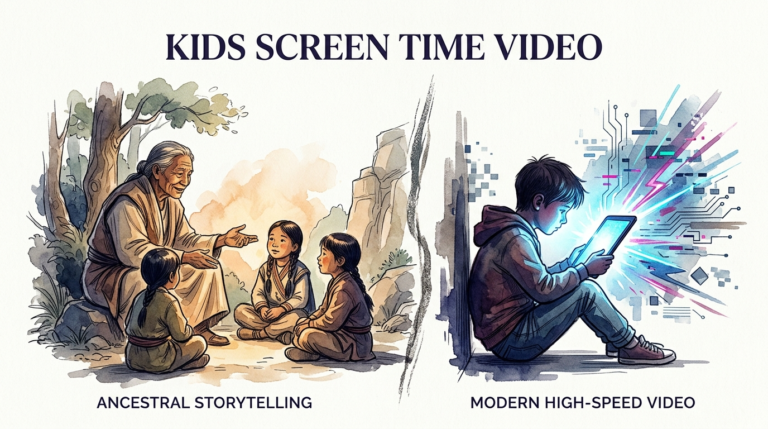
A major sign of overuse is when a child prefers watching someone else live their life rather than living their own. The ultimate sign that the balance has shifted is when the ‘viewer’ identity overtakes the ‘maker’ identity. We are raising a generation of expert consumers, but the real world belongs to the producers. Which path is your child on today?
Every hour spent scrolling is an hour taken from potential mastery. This is not just about “screen time” as a generic metric. It is about the fundamental displacement of skill acquisition by passive observation. When a child watches a 10-minute video of someone building a complex Lego set, they receive a hit of dopamine as if they had done the work themselves, but their hands remain idle and their brain remains unchallenged.
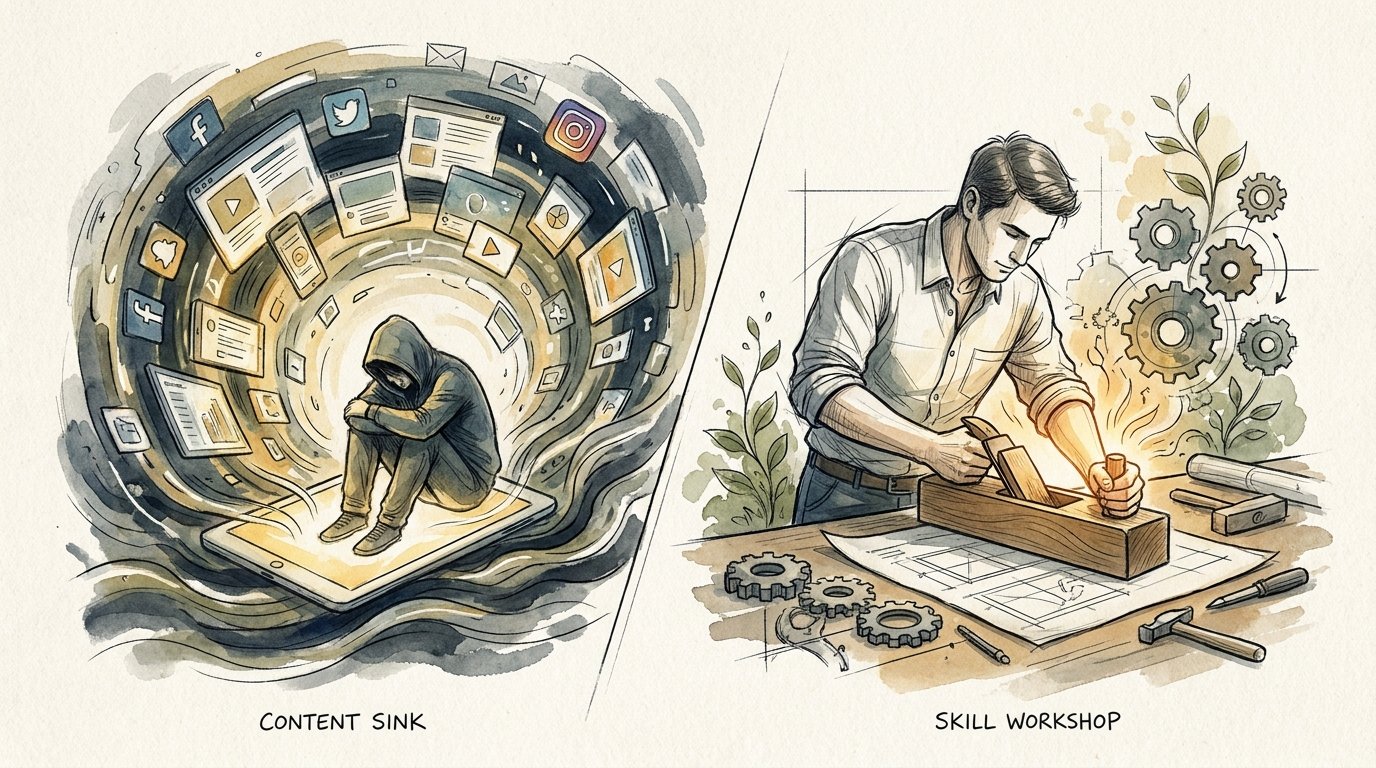
This article explores how we can pivot from the “content sink” of mindless consumption toward a “skill workshop” mindset. We will look at why this shift is critical for development and how you can guide your child back to the path of production. The goal is to transform digital tools from passive entertainment into instruments of creation.
Screen Time Vs Real World Skill Development
Screen time is often treated as a single, monolithic category. This is a mistake that prevents us from seeing the real impact on development. Real-world skill development requires friction, failure, and physical or mental engagement. Most digital consumption is designed to remove friction entirely, leading to a state of “passive absorption.”
Passive screen time exists to keep the eyes glued to the glass. It leverages algorithmic loops to provide constant novelty without requiring any output from the user. In contrast, real-world skill development—whether it is learning to play the guitar, code a program, or build a birdhouse—requires the brain to move from “receive mode” into “process and output mode.”
Think of it like the difference between eating a meal and learning to cook one. Eating is necessary, but if you never learn to cook, you are entirely dependent on others for your nourishment. In the digital age, if a child only knows how to consume, they are becoming “intellectually malnourished” despite the abundance of information available to them.
Real-world situations demand “applied intelligence.” This is the ability to take a concept and manifest it in the physical or digital world. When a child spends thousands of hours watching others play Minecraft instead of building their own complex redstone circuits, they miss the chance to develop spatial reasoning and logic skills that translate directly into engineering and computer science.
The Mechanics of Consumption vs. Production
Understanding why children get stuck in the “viewer” trap requires looking at the mechanics of modern platforms. Most apps are designed as “Content Sinks.” They are built to pull the user in and keep them there through variable reward schedules. Every swipe is a gamble for a better video, creating a loop that is hard for a developing brain to break.
Production, on the other hand, operates on a “Delayed Gratification” model. There is no immediate dopamine hit when you start practicing a piano scale or writing the first line of a story. The reward comes at the end of the process, or after significant milestones. This “Skill Workshop” environment builds grit and cognitive endurance.
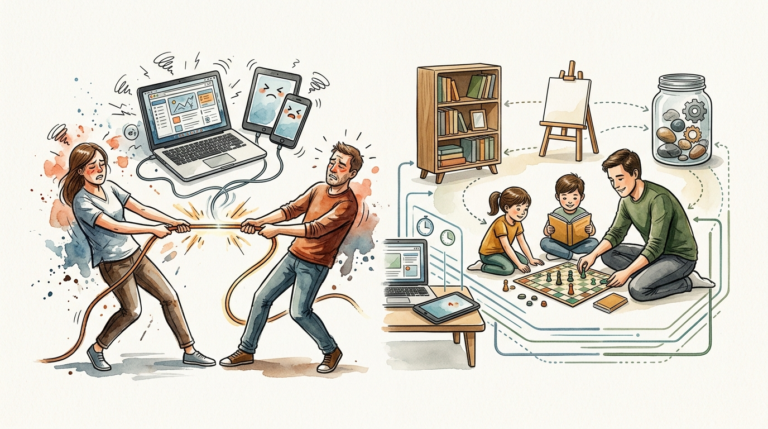
To move a child from consumption to production, you must introduce the “Producer-to-Consumer Ratio.” This is a simple mental framework where for every hour spent watching content, a certain amount of time must be spent creating something. This shifts the focus from “avoiding screens” to “using screens for a purpose.”
The Architecture of a Skill Workshop
A skill workshop isn’t necessarily a physical room. It is a state of mind where digital devices are treated as tools rather than toys. In this environment, a tablet is a drawing pad, a laptop is a recording studio, and a smartphone is a high-definition camera for cinematography. The device becomes the means to an end, not the end itself.
The process of creation usually follows a three-step cycle: Inspiration, Iteration, and Integration. Most children get stuck at Inspiration. They watch endless tutorials but never move to Iteration—the messy part where things don’t work and they have to try again. Real learning happens exclusively in the Iteration phase.
Benefits of Choosing the Maker Path
The move toward production offers measurable advantages that extend far beyond childhood. When a child identifies as a “maker,” their relationship with technology changes. They no longer see themselves as victims of an algorithm, but as architects of their own digital and physical experiences.
One of the primary benefits is the development of “Executive Function.” This includes planning, organizing, and executing tasks. Creating a 30-second stop-motion animation requires more executive function than watching 300 hours of cartoons. It forces the brain to manage resources, time, and creative vision simultaneously.
Increased Cognitive Resilience: Makers are used to things breaking. In the “viewer” world, everything is curated and perfect. In the “maker” world, the code crashes, the paint smears, and the wood splits. Learning to handle these small failures builds the resilience needed for complex adult challenges.
Portfolio Building: We are entering an era where “what you have done” matters more than “where you went to school.” A teenager who spent their screen time learning 3D modeling or video editing leaves childhood with a portfolio. A teenager who spent that time watching influencers leaves with nothing but fading memories of someone else’s life.
Challenges and Common Mistakes
The biggest challenge in shifting from viewer to maker is the “Dopamine Gap.” Real-world skills are hard. They are frustrating. Compared to the instant, effortless entertainment of a TikTok feed, learning a real skill feels like walking through mud. Many parents try to force this transition too quickly, leading to total resistance.
A common mistake is treating all screen time as “bad.” If you ban the screen entirely, you may be removing the very tool the child needs to learn a modern skill. The problem isn’t the screen; it’s the passivity. If you take away the laptop, you might be taking away their access to coding environments or graphic design software.
Another pitfall is the “Over-Instruction” trap. Parents often buy complex kits or sign kids up for rigid classes that turn making into another form of consumption. If the child is just following a manual step-by-step without any room for experimentation, they are still just “consuming” the instructions. They need “Sandbox Time” where they can play and fail without a grade or a manual.
The Boredom Crisis: We have reached a point where children are rarely bored. Boredom is actually the precursor to creativity. When you remove the easy dopamine of the “Content Sink,” the child will initially be bored and irritable. This is the “Withdrawal Phase.” Many parents cave here. If you can push through the boredom, that is where the maker identity is born.
Limitations and Realistic Constraints
It is important to acknowledge that not every child is going to be a digital prodigy or a master craftsman. Forcing a “maker” identity on a child who is genuinely exhausted or in need of downtime can backfire. Balance is necessary. There is a place for pure, mindless relaxation; the issue is when that becomes the default state of existence.
Environmental limitations also play a role. A child living in a small apartment may not have the space for a woodworking bench. A child without a high-speed internet connection may struggle to use cloud-based creation tools. In these cases, the “Skill Workshop” must be adapted to the available resources.
Additionally, some digital tools have steep learning curves. Expecting a ten-year-old to master professional-grade software like Blender or Adobe Premiere without significant support is unrealistic. The “Zone of Proximal Development” must be considered—the task should be hard enough to be challenging, but not so hard that it leads to total shutdown.
Comparison: Passive Consumption vs. Active Creation
| Feature | Passive Consumption (Viewer) | Active Creation (Maker) |
|---|---|---|
| Brain State | Alpha waves (relaxed, receptive) | Beta/Gamma waves (active, focused) |
| Reward Timing | Instant (Dopamine spikes) | Delayed (Sense of accomplishment) |
| Skill Growth | Zero to Low (Surface knowledge) | High (Neuroplasticity & Mastery) |
| Economic Value | You are the product (Data) | You create value (Products/Skills) |
| Emotional Impact | Comparison, Envy, Boredom | Confidence, Autonomy, Flow |
Practical Tips for Transitioning
The transition from a consumer to a producer does not happen overnight. It requires a deliberate restructuring of the digital environment. Start by categorizing apps on your child’s device. Move the “Content Sinks” (YouTube, Netflix, TikTok) into a folder labeled “Toys” and move creation tools (GarageBand, Canva, Swift Playgrounds) into a folder labeled “Tools.”
Implement the “Maker’s Tax.” For every 30 minutes of watching videos, the child must spend 30 minutes working on a project. This creates a natural limit on consumption because the “cost” of watching becomes higher. It also ensures that the brain is regularly switched into “output mode.”
- Curate the Input: If they love watching gaming videos, point them toward “Devlogs”—videos where creators show how they actually build the games. This bridges the gap between watching and doing.
- Provide Low-Friction Tools: Ensure they have the basic supplies needed for their interest. If they want to draw, have a stylus or high-quality paper ready. Reducing the “startup cost” of making is key.
- Display the Work: Create a physical or digital “Gallery” where their creations are shown. Recognition is a powerful non-digital dopamine source that encourages further production.
- Model the Behavior: If you spend your evening scrolling, they will too. Let them see you working on a hobby, fixing something, or learning a new skill.
Focus on “Micro-Wins.” In the beginning, the projects should be small enough to complete in one sitting. A completed 10-second animation is better for the ego than a half-finished, overly ambitious 5-minute film. Success breeds the desire for more complex challenges.
Advanced Considerations: The Creator Economy and Beyond
For older children and practitioners, the “Maker” identity is the gateway to the modern economy. We are no longer in an era where following instructions is enough to secure a career. AI and automation are rapidly taking over tasks that are predictable and repetitive. What remains is the need for creative problem-solving and unique production.
Encourage your child to think about “Scalable Skills.” Learning to edit video is a skill. Learning to tell a story through video that resonates with an audience is a scalable asset. When a child learns to code, they aren’t just learning a language; they are learning how to build systems that work while they sleep.
Digital Literacy vs. Digital Fluency: Literacy is knowing how to use the tools. Fluency is knowing when and why to use them to achieve a specific goal. An advanced practitioner moves beyond the software and focuses on the underlying principles of design, logic, and human psychology. This is the level where “maker” becomes “innovator.”
Scenario: From Minecraft Player to Game Designer
Consider a typical scenario. A child spends three hours a day playing Minecraft. In a “Consumer” path, they simply walk through worlds others have built or watch “Let’s Play” videos. They are gaining some spatial awareness, but the return on time spent is diminishing.
In a “Producer” path, the parent intervenes to pivot the interest. The child is introduced to “Redstone,” which is Minecraft’s version of electrical engineering. They start building logic gates. From there, they move to “Modding,” which requires learning basic Java or using tools like MCreator. They aren’t just playing a game anymore; they are practicing systems design.
The final step in this evolution is moving off the Minecraft platform entirely and into a game engine like Unity or Godot. Now, the skills are 100% professional and transferable. The child has moved from a “Viewer” who watches game trailers to a “Maker” who understands the architecture of digital worlds. The screen time is the same, but the developmental outcome is polar opposite.
Final Thoughts
The goal is not to eliminate digital life, but to dominate it. When we allow children to slip into the role of the permanent viewer, we are essentially allowing them to be spectators in their own lives. By shifting the focus to production, we give them the keys to the kingdom. They stop being the product and start being the creator.
The real world belongs to the producers. It belongs to those who can take an idea and manifest it through effort, skill, and persistence. Whether that is a physical object, a line of code, or a piece of art, the act of making is what builds a person of substance.
Start small today. Find one area where your child is currently a viewer and look for the “maker” door. It might be hidden, and there might be resistance, but walking through that door is the most important journey they will ever take. Encourage them to stop watching the world and start building it.