family media agreement
Stop fighting the same battle every night. Build a legacy of balance. Stopgap rules only last as long as your patience. A Family Media Agreement builds a legacy of self-regulation and mutual respect. Download our template and end the tech-wars for good. #FamilyValues #ScreenTimeContract #ParentingGoals

Parenting in the digital age often feels like trying to hold back a tidal wave with a plastic shovel. Every new app, every viral trend, and every “one more level” in a video game creates a friction point. You want your children to be safe and balanced, while they want to explore the infinite digital playground. The result? A cycle of nagging, confiscating devices, and feeling like the “bad guy” every single evening.

What if you could shift from being the screen-time police to being a digital mentor? This transformation starts with a fundamental shift in how your household approaches technology. Instead of reactive rules made in the heat of an argument, you need a proactive framework. This is where a formal agreement changes the game, moving the conversation from “why can’t I have my phone?” to “how do we use our tools responsibly?”
Transitioning to a collaborative system might seem daunting at first, but it is the most effective way to foster long-term self-regulation. When children understand the “why” behind the boundaries, they are far more likely to respect them. We are going to walk through exactly how to build this foundation for your family, ensuring that technology serves your household rather than ruling it.
family media agreement
A family media agreement is a collaborative, written document that outlines the expectations, responsibilities, and boundaries for technology use within a household. Think of it as a “tech mission statement” or a digital roadmap. It isn’t just about how many minutes a child can spend on a tablet; it covers the “how, when, where, and why” of digital life for every member of the family—including parents.
This document exists to bridge the gap between parental concern and child autonomy. In the real world, these agreements are used to set clear non-negotiables, such as “no devices in the bedroom” or “no social media until a certain age.” They serve as a reference point when conflicts arise, allowing parents to point to a previously agreed-upon standard rather than making up a punishment on the fly. It is a tool for accountability that grows alongside your children.
Imagine a sports team. Without a playbook, every player does what they think is best in the moment, leading to chaos on the field. A family media agreement is your household’s playbook. It defines what “winning” looks like—healthy sleep, safe interactions, and balanced lives—and provides the rules of engagement for every digital device, from smartphones and gaming consoles to smart TVs and laptops.
These agreements are widely recommended by organizations like the American Academy of Pediatrics (AAP) and Common Sense Media. They are used in homes ranging from those with toddlers just discovering educational apps to those with teenagers navigating the complex world of social media. The core principle remains the same: clear communication leads to fewer conflicts and safer digital habits.
How to Create Your Family Media Roadmap
Building an effective agreement is not a top-down mandate. It requires a “meeting of the minds” where everyone feels heard. If you simply print a list of rules and demand signatures, you will likely meet resistance. Instead, follow these steps to create a living document that your family actually respects.
1. Conduct a “Tech Audit”
Start by observing your current habits for a few days without judgment. Notice when the most friction occurs. Is it at the dinner table? Is it right before bed? Tracking current usage helps you identify the specific pain points your agreement needs to address. You might realize that the problem isn’t the amount of time spent, but the quality of the content or the timing of the usage.
2. Call a Family Meeting
Schedule a dedicated time to talk—preferably over snacks or a meal. Frame the conversation around values rather than restrictions. Tell your children that you want to help them have more fun online while staying safe and getting enough sleep. Ask them what they love about their favorite games or apps. When kids feel you are interested in their world, they are much more open to discussing boundaries.
3. Define Your Non-Negotiables
Every family has a few rules that are simply not up for debate. These often center on safety and health. Common non-negotiables include keeping devices out of bedrooms overnight, sharing all passwords with parents, and immediate reporting of any cyberbullying or uncomfortable interactions. Write these down first so they are crystal clear.
4. Negotiate the Flex-Zones
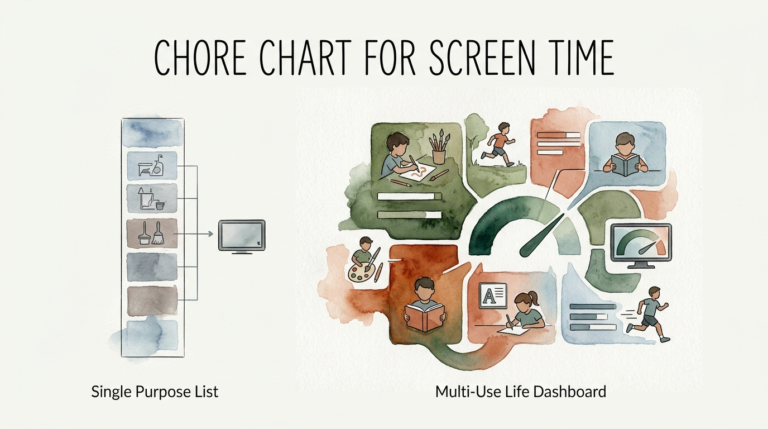
This is where the collaboration happens. Discuss time limits and earnable screen time. Perhaps your child can earn an extra thirty minutes of gaming on the weekend by completing their chores or reading for an hour. Discuss which apps are allowed and which are off-limits. Giving children a say in these “flex-zones” gives them a sense of ownership, making them much more likely to police themselves.
5. Establish Clear Consequences
An agreement without consequences is just a suggestion. Decide together what happens when the rules are broken. Make the consequences logical and tiered. For example, if a device isn’t handed over at the agreed-upon bedtime, the child might lose access to that device for the next 24 hours. Establishing these “if/then” scenarios in advance removes the emotional volatility from the moment of discipline.
The Practical Benefits of a Written Contract
Why go through the trouble of writing everything down? The benefits of a formal family media agreement extend far beyond just reducing daily screen time. It fundamentally changes the emotional landscape of your home.
- Reduction in Daily Arguments: Because the rules are written down and agreed upon, the “nagging” phase is eliminated. When a child stays on their console too long, you aren’t “being mean”—you are simply following the contract you both signed.
- Fostering Digital Citizenship: FMAs teach children that technology use is a privilege tied to responsibility. It encourages them to think critically about their online presence, privacy, and how they treat others in digital spaces.
- Increased Safety: By making “open communication” a core part of the agreement, you create a safety net. Children are more likely to come to you with problems if they know you are a partner in their digital journey rather than an adversary.
- Parental Accountability: Most agreements include a section for parents. When your children see you putting your phone away at dinner or following the same “no screens before bed” rule, it builds massive credibility and trust.
- Clarity and Predictability: Children thrive on routine and clear boundaries. Knowing exactly when they can play and when they need to stop reduces the anxiety and “FOMO” (fear of missing out) that often drives tech addiction.
Ultimately, the biggest advantage is the “legacy of balance” mentioned earlier. You aren’t just surviving the week; you are training your children to have a healthy, lifelong relationship with technology. This skill is perhaps more important than any academic subject in the 21st century.
Tech-War Traps: Common Mistakes to Avoid
Even with the best intentions, parents often fall into traps that can undermine the effectiveness of a family media agreement. Recognizing these pitfalls early is key to maintaining the system’s integrity.
One major error is being too rigid or unrealistic. If you set a rule that says “zero screens during the week,” but your child needs a laptop for homework, the rule is already broken. Rigid rules that don’t account for the reality of modern education or social lives lead to resentment and “sneaky” behavior. Aim for flexibility that rewards responsibility.
Another frequent mistake is insincerity during the creation process. If you approach the family meeting with a “my way or the highway” attitude, it isn’t an agreement—it’s a decree. Kids, especially teenagers, can spot a lack of genuine collaboration from a mile away. If they feel tricked into a conversation that is actually just a lecture, they will disengage immediately.
Failing to update the agreement as children grow is also a common pitfall. A contract designed for an eight-year-old is completely irrelevant for a thirteen-year-old. Technology moves fast, and so do children’s needs. If the agreement feels outdated, it will be ignored. Schedule “version updates” every six months or at the start of every new school year.
Finally, the most damaging mistake is hypocrisy. If the agreement says “no phones at the table,” but you are checking your work email during dinner, the system collapses. You are the primary role model for your child’s digital habits. If you can’t follow the rules, they won’t either. The agreement must apply to everyone to carry real weight.
Realistic Constraints and When the System Bends
No system is perfect, and a family media agreement is no exception. It is important to understand the realistic limitations of this approach so you don’t feel discouraged when life gets messy.
Environmental factors often pose a challenge. During a long road trip or a week-long illness, screen time limits almost always go out the window. This is okay. The agreement should have a “special circumstances” clause that allows for temporary flexibility. The key is to communicate that these are exceptions, not a permanent change to the baseline rules.
Another limitation is the “outside world.” Your child may follow your rules at home, but they will eventually visit a friend’s house where there are no limits. You cannot control every environment. The goal of the agreement isn’t to create a bubble, but to instill internal values. You want your child to eventually be the one who says, “I’ve had enough screen time for now,” even when you aren’t there to watch them.
It is also important to recognize that an agreement is not a substitute for active parenting. You still need to co-play, co-view, and talk about what your children are seeing online. A piece of paper cannot replace the nuanced conversations needed to navigate complex topics like digital footprints or online strangers. Use the agreement as a foundation, not a replacement for your presence.
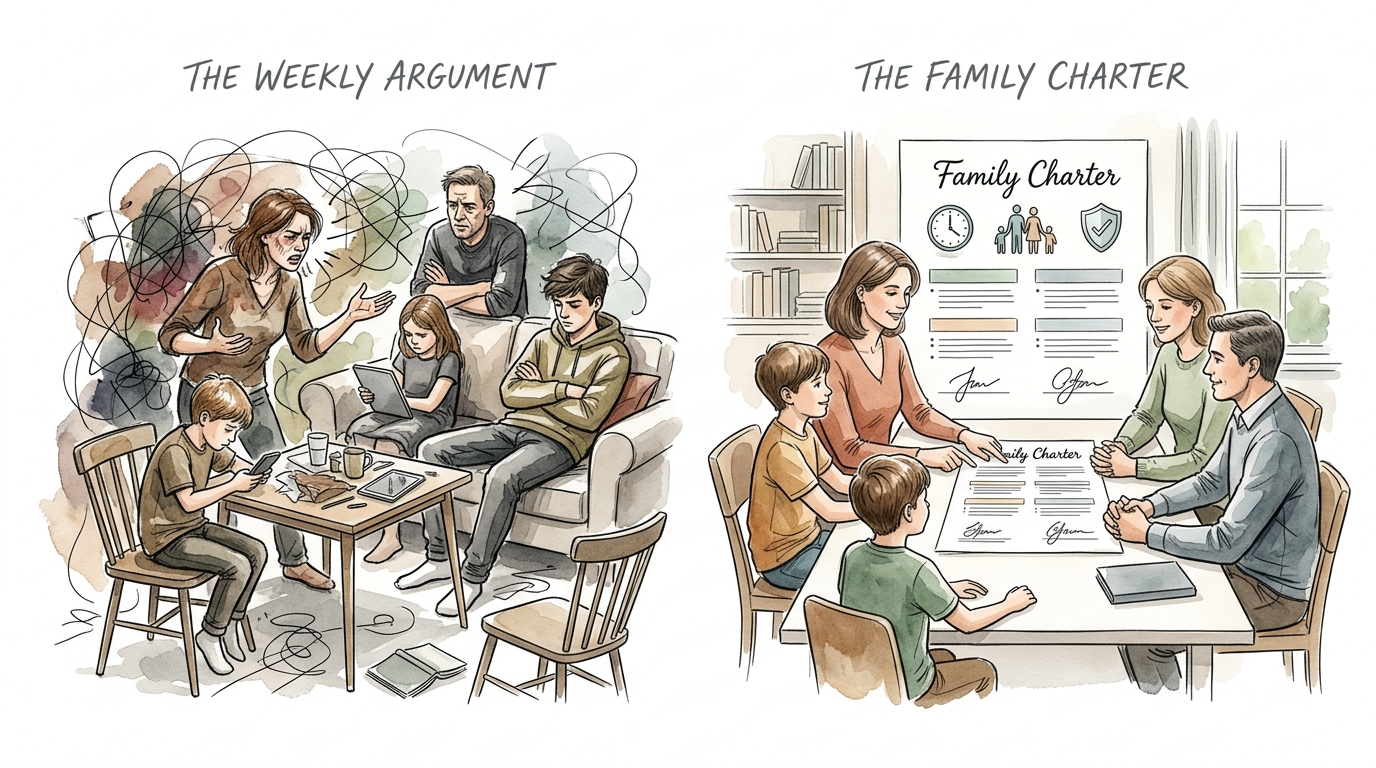
The Weekly Argument vs. The Family Charter
How does a family media agreement compare to other parenting strategies? Understanding the difference between a reactive approach and a proactive charter can help you stay committed to the process.
| Feature | The Weekly Argument (Reactive) | The Family Charter/FMA (Proactive) |
|---|---|---|
| Focus | Short-term compliance and stopping the noise. | Long-term self-regulation and value-building. |
| Emotional Tone | High stress, yelling, and resentment. | Calm, structured, and collaborative. |
| Consistency | Varies based on parent’s mood or energy. | Fixed and predictable for everyone. |
| Child’s Role | Passive recipient of punishment. | Active participant in decision-making. |
| Outcome | Children learn to hide behavior. | Children learn to manage their own time. |
While the “Weekly Argument” is the default for many families, it is exhausting and rarely produces lasting change. Moving toward a “Family Charter” model—a broader document that governs family values, including media—creates a culture of respect. The media agreement is essentially a specific chapter of that broader charter, focusing on the most volatile area of modern parenting.
Best Practices for Lasting Digital Harmony
To ensure your agreement sticks, you need to implement a few best practices that keep the document relevant and respected. These tips will help you move from the “honeymoon phase” of the agreement into a sustainable lifestyle.
Make it visible. Don’t tuck the agreement away in a drawer. Post it on the refrigerator or in the family “charging station.” Seeing it daily serves as a silent reminder of the commitments everyone has made. It also makes it much easier to reference during a disagreement.
Use tech to help tech. Leverage parental control apps and built-in screen time features on devices. These shouldn’t be used “secretly,” but rather as tools to enforce the agreement. For instance, if the agreement says screens off at 8:00 PM, use a router setting to automatically pause the Wi-Fi at that time. This removes the “human element” of the enforcement, reducing friction between parent and child.
Focus on “Screen-Free Zones.” Rather than just counting minutes, focus on physical spaces. Keeping the kitchen table and the car as phone-free zones encourages face-to-face connection. When you define a space as “human-only,” it becomes a sacred part of your family culture that isn’t dependent on a timer.
Celebrate successes. When you see your child put their device away without being asked, acknowledge it. Positive reinforcement is a powerful tool. You might even include a “bonus” system in your agreement where consistent adherence to the rules earns a family outing of the child’s choice.
Advanced Strategies for Digital Citizens
For those who have mastered the basics and have older children, you can take the family media agreement to the next level. This involves shifting from “rules” to “mentorship” and focusing on higher-level digital skills.
Introduce the concept of Digital Reputation. Help your teenagers understand that everything they post is a permanent part of their “brand.” Discuss how future employers or colleges might view their online activity. Your agreement can include a section on “Thinking Before Posting,” where kids agree to a 24-hour waiting period before posting anything highly emotional or controversial.
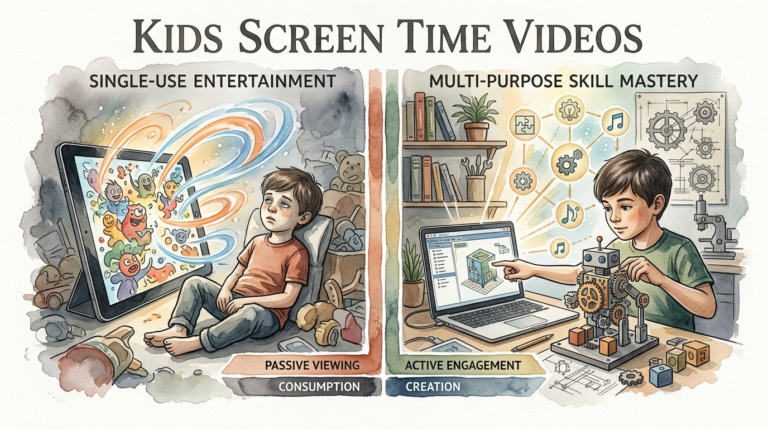
Focus on Content Creation vs. Consumption. Not all screen time is created equal. An hour spent coding or editing a video is vastly different from an hour spent mindlessly scrolling through short-form video feeds. Your advanced agreement can reflect this by allowing unlimited time for creative pursuits while maintaining strict limits on passive consumption.
Teach Data Privacy and Algorithmic Awareness. Discuss how social media apps are designed to keep them hooked. Explain how their data is used for advertising. An advanced digital citizen understands how the “engine” works, which makes them less likely to be manipulated by it. Include a commitment to reviewing privacy settings together every month.
Real-World Scenarios and Sample Scripts
Theory is great, but how does this actually sound in practice? Here are a few ways to handle common situations using your family media agreement as the foundation.
Scenario A: The “One More Minute” Plea
Child: “Please! I just need five more minutes to save my game!”
Parent: “I hear you, and I know that game is important. However, our agreement says devices are away by 7:30. If you keep playing now, you’ll lose tomorrow’s gaming time. Do you want to finish now and save your time for tomorrow, or keep going and lose it?”
The Logic: You are placing the choice and the consequence back on the child, referencing the “contract” rather than your own authority.
Scenario B: The New App Request
Teen: “Everyone is on this new app, why can’t I get it?”
Parent: “Let’s check the agreement. It says we research new apps together before downloading. Let’s look at the privacy settings and what other parents say about it tonight after dinner. If it meets our safety standards, we can add it to the ‘Approved’ list.”
The Logic: You aren’t saying “no”—you are saying “not yet” and following the established process for approval.
Scenario C: Parent Breaking the Rule
Child: “You’re on your phone at the table, that’s against the rules!”
Parent: “You are absolutely right. I broke our agreement because I got a work notification. I’m sorry. I’m putting it in the other room now. Thank you for holding me accountable.”
The Logic: Modeling humility and accountability is the fastest way to earn your child’s respect and ensure they follow the rules themselves.
Final Thoughts: Moving Beyond the Screen
The goal of a family media agreement isn’t to eliminate technology. We live in a digital world, and trying to hide from it only leaves our children unprepared. Instead, the goal is to build a foundation of intentionality. By creating a clear, written framework, you are teaching your children that their time and their attention are valuable resources that deserve protection.
Remember that this is a marathon, not a sprint. There will be days when the agreement is ignored and nights when the tech-wars flare up again. Don’t be discouraged. The document is a tool for recalibration—it gives you a place to return to when things go off the rails. Every time you revisit the agreement, you are reinforcing the values of mutual respect and self-regulation.
Start small if you need to. Focus on one or two key areas, like meal times or bedtimes, and build from there. As your family grows and the digital landscape shifts, your agreement will evolve, but the “legacy of balance” you are building today will serve your children for the rest of their lives. Stop fighting the battle and start building the system. You’ve got this.
Sources
1 hmd.com | 2 care.com | 3 wholeheartily.com | 4 digitalwellnesslab.org | 5 digitalparentingcoach.com | 6 digitalparentingcoach.com | 7 sbesyes.org | 8 sbesyes.org | 9 jessicaspeer.com | 10 happilyfamily.com | 11 momswithapps.com | 12 healthychildren.org | 13 pandasecurity.com | 14 pandasecurity.com | 15 pandasecurity.com | 16 screenagersmovie.com | 17 kpbs.org | 18 kpbs.org | 19 bark.us | 20 digitalwellnesslab.org