kids screen time schedule
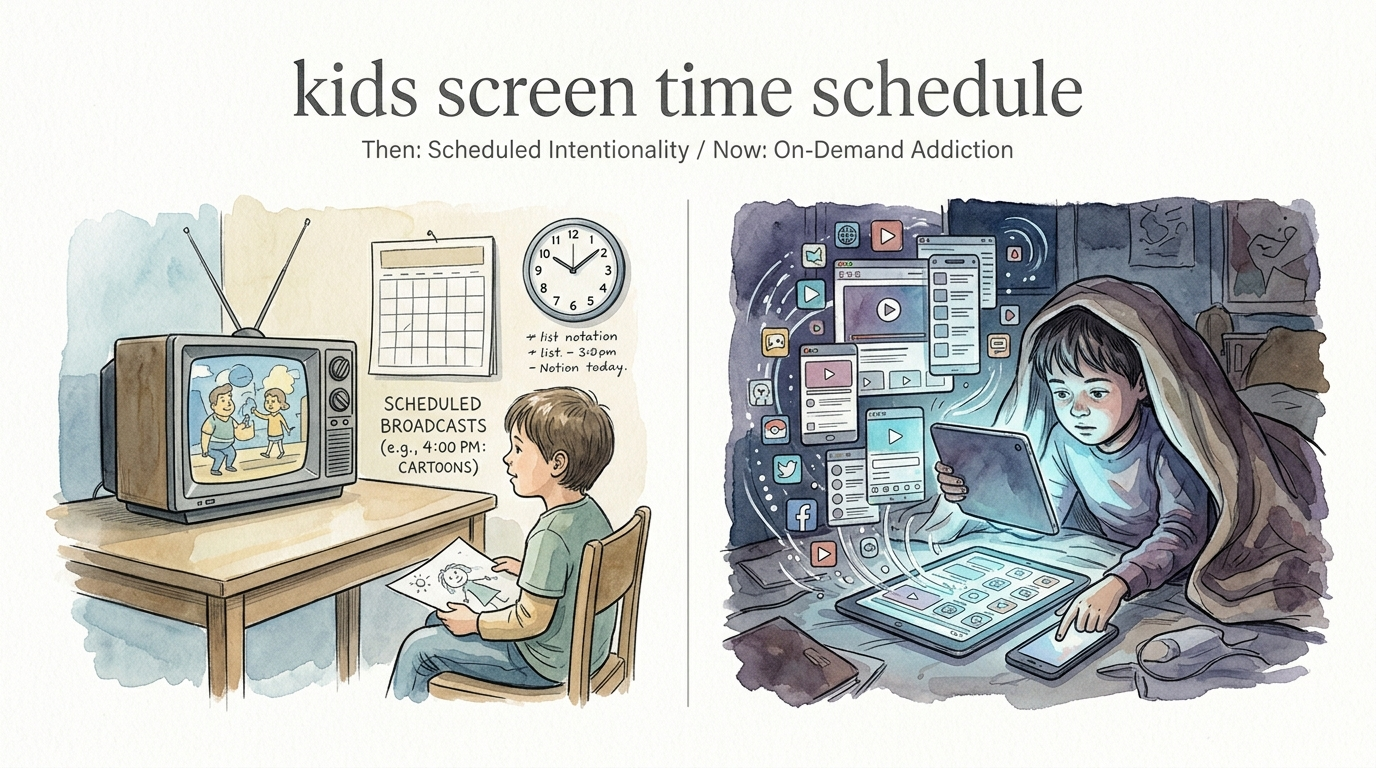
We lost the ‘schedule’ and gained a digital vacuum. In the past, TV ended. Today, it never stops. Reclaiming a ‘schedule’ is the only way to save your child’s dopamine receptors.
The modern home has become a 24/7 broadcast station. Gone are the days of waiting for a Saturday morning cartoon or a specific evening special. Now, every child carries a literal infinite library of high-stimulation content in their back pocket or on a tablet. This shift from scheduled viewing to on-demand consumption has fundamentally altered how developing brains process reward and patience.
Parents often feel like they are fighting a losing battle against algorithms designed by the world’s smartest engineers. These platforms are built to keep eyes glued to the glass. Without a deliberate structure, the “digital vacuum” sucks up every spare moment of boredom, creativity, and face-to-face connection. Understanding how to build a resilient framework is the first step in taking back your family’s time.
kids screen time schedule
A kids screen time schedule is a proactive management system that defines when, where, and how digital devices are used within a household. It moves away from “reactive parenting”—where a tablet is handed over to stop a tantrum—and toward “intentional parenting.” This framework acts as a roadmap, providing children with clear expectations and helping them develop the self-regulation skills they need for a digital world.
Think of it like a nutritional meal plan. You wouldn’t let a child eat whatever they wanted from an open buffet of candy 24 hours a day. A screen schedule ensures that “digital calories” are consumed at the right time and in the right amounts. It protects essential “non-negotiables” like deep sleep, physical movement, and social interaction. By creating these boundaries, you are not just limiting technology; you are creating space for everything else that makes a childhood healthy.
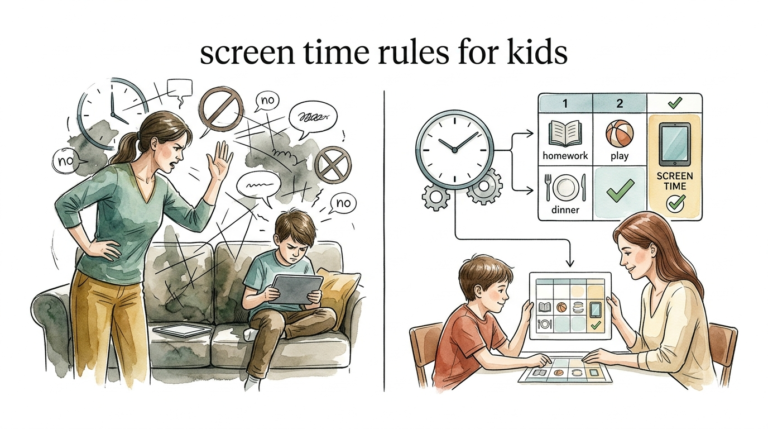
In real-world terms, this might look like a physical chart on the fridge or a set of digital “house rules” that everyone agrees to follow. It provides a sense of security for children. When they know exactly when they will get to play their favorite game, they are less likely to obsess over it during off-hours. It replaces the constant “Can I have my tablet?” with a predictable rhythm that the whole family can rely on.
How to Build a Tiered Screen Time Strategy
Building a schedule requires a nuanced approach based on developmental stages. A one-size-fits-all rule rarely works because a toddler’s brain has vastly different needs than a teenager’s. Current guidelines from the American Academy of Pediatrics (AAP) and the World Health Organization (WHO) emphasize that the younger the child, the more critical the limits.
The Foundational Years (Ages 0–2)
Focus on high-touch, zero-screen environments for infants. Experts recommend avoiding all digital media for children under 18 to 24 months, with the sole exception of video chatting with loved ones. At this stage, the brain needs “serve and return” interaction—the back-and-forth of eye contact, touch, and conversation—to build neural pathways. Screens offer impoverished stimulation that cannot replace a human caregiver’s face.
The Structured Introduction (Ages 2–5)
Limit high-quality programming to no more than one hour per day. The key here is “co-viewing.” Instead of using the screen as a solo activity, watch with your child. Explain what is happening on screen and help them connect it to the real world. This turns a passive activity into a linguistic and social learning opportunity. Choose slow-paced, educational content over high-speed, “brain-hacking” animations that can lead to overstimulation.
The Balanced Habit (Ages 6–12)
Shift the focus toward “digital hygiene” and balance. At this age, schoolwork often requires a device, making strict “time limits” harder to enforce. Instead, use a “First, Then” system. First, complete homework, chores, and 60 minutes of physical activity; then, earn a specific window of recreational screen time. This teaches delayed gratification and reinforces that digital entertainment is a reward, not an entitlement.
The Guided Autonomy (Ages 13+)
Transition into a mentorship role. Teens spend an average of nearly 9 hours a day on screens, often driven by social media. Rather than just setting timers, involve them in the creation of the family media plan. Discuss the “why” behind the rules, such as how blue light affects their sleep or how algorithms track their behavior. Focus on “device-free zones” like the dinner table and bedrooms rather than just total minutes.
Benefits of a Structured Digital Life
The primary benefit of a schedule is the preservation of the brain’s reward system. High-stimulation apps and games trigger massive releases of dopamine in the nucleus accumbens. Without a schedule, a child’s brain can become desensitized, meaning they need more and more “hits” of digital stimulation to feel the same level of pleasure. A schedule creates a “dopamine fast” that allows receptors to reset and helps children find joy in slower activities like reading or drawing.
Routines also significantly reduce “transition friction.” Most parents dread the meltdown that happens when it is time to turn off the TV. When the end-time is a known, predictable part of the day—rather than an arbitrary decision by a parent—children are more likely to comply without a fight. This predictability lowers cortisol levels and makes the household much calmer.
Improved sleep hygiene is another measurable advantage. By scheduling “screens off” at least 60 minutes before bed, you allow the natural production of melatonin to occur. This leads to deeper REM sleep, which is essential for memory consolidation and emotional regulation. A well-rested child is more resilient, better at problem-solving, and less prone to the irritability often associated with “digital hangovers.”
Challenges and Common Mistakes
The most frequent pitfall is using screens as a “default babysitter.” It is an easy trap to fall into during a busy workday or a long car ride. However, relying on devices to manage a child’s boredom prevents them from developing “internal regulation.” Boredom is actually the birthplace of creativity; if a child never feels bored, they never learn how to entertain themselves or think deeply.
Another common mistake is “background TV.” Many households leave a screen running in the background while the family eats or plays. Research shows this “passive exposure” reduces the quality of parent-child interaction and can delay language development in younger children. It creates a constant state of partial attention, preventing the “deep work” and focus that a developing brain needs to master.
Inconsistency is the ultimate schedule-killer. If the rules apply on Tuesday but disappear on Friday because the parents are tired, the child learns that the schedule is negotiable. This leads to “intermittent reinforcement,” which actually makes the child more likely to whine and beg for more time because they know there is a chance they might win. Stick to the plan, even when it is inconvenient.
Limitations and Realistic Constraints
Every family faces unique challenges that might make a rigid schedule difficult to maintain. For example, children with neurodivergent needs, such as ADHD or autism, may use certain digital tools for regulation or communication. In these cases, the “quality” of the screen time is much more important than the “quantity.” A blanket rule could inadvertently strip away a vital coping mechanism.
Environmental factors also play a role. Families living in urban areas with limited access to safe outdoor play spaces may rely more heavily on indoor digital entertainment. Similarly, during extreme weather or illness, screen time naturally increases. It is important to view the schedule as a flexible framework rather than a source of parental guilt. The goal is long-term balance, not daily perfection.
School-mandated technology is perhaps the biggest hurdle. When a child is required to be on a laptop for six hours at school and then two hours for homework, their “digital budget” is already spent before they even get to relax. In these situations, the focus must shift entirely to “analog recreation” during non-school hours to ensure the brain gets the necessary break from the blue light and high-focal-point strain.
Scheduled Intentionality vs. On-Demand Addiction
To understand the value of a schedule, we must look at how consumption has changed. The following table highlights the differences between a structured approach and the modern “infinite scroll” model.
| Feature | Scheduled Intentionality | On-Demand Addiction |
|---|---|---|
| Content Source | Curated, age-appropriate choices. | Algorithmic “Next Up” suggestions. |
| Reward Cycle | Delayed; earned through activity. | Instant; requires zero effort. |
| Brain Impact | Protects dopamine sensitivity. | Floods and desensitizes receptors. |
| End Point | Natural stop (timer or episode end). | Infinite scroll; no stopping point. |
| Control | Parent and child share agency. | The platform dictates the duration. |
Practical Tips for Immediate Implementation
Start by identifying your “Device-Free Zones.” The kitchen table and the bedroom should be the first priorities. Removing screens from the bedroom alone can increase sleep quality by 20–30% for most children. Charging all devices in a central family “docking station” overnight prevents the temptation of late-night scrolling.
Implement the “20-20-20 Rule” to protect physical health. For every 20 minutes of screen time, have your child look at something 20 feet away for at least 20 seconds. This reduces “text neck” and eye strain. It also provides a micro-break for the brain, helping to prevent the “trance-like” state that many children fall into during long gaming sessions.
Use parental control software as a “safety net,” not a substitute for parenting. Tools like Apple’s Screen Time, Google Family Link, or third-party apps can help enforce the schedule automatically. However, these tools should be used to support the conversation, not to replace it. Explain to your child that these limits are there to help their brain grow, just like a bike helmet is there to protect their head.
Model the behavior you want to see. Children are biologically wired to imitate their parents. If you are constantly checking your phone during “family time,” your child will view your schedule as hypocritical. Be the first to put your phone in the “docking station” and show them that life is richer when you are fully present.
Advanced Considerations: Executive Function
For parents of older children, the goal shifts from restriction to the development of executive function. The prefrontal cortex—the part of the brain responsible for impulse control and planning—isn’t fully developed until the mid-20s. This is why a 14-year-old struggles to stop playing a game even when they know they have a test tomorrow. The “infinite” nature of the internet is an unfair fight for a developing brain.
Teach your children about “attention economy.” Help them understand that social media companies make money by keeping them on the app as long as possible. When they realize they are being “hacked” by an algorithm, they often feel a sense of pushback. This psychological “reactance” can be a powerful tool in helping them choose to put the phone down.
Consider the “Active vs. Passive” ratio. Not all screen time is equal. Creating a digital painting, coding a game, or editing a video requires high-level cognitive engagement and problem-solving. This is vastly different from passively scrolling through TikTok. An advanced schedule might allow for more “creative” time while strictly limiting “consumption” time.
Scenarios: Real-World Applications
Scenario A: The Grocery Store Meltdown
In the past, you might have handed over your phone the second your toddler started to fuss in the checkout line. With a schedule, you have a different plan. You engage the child by asking them to help you find the red apples or count the items in the basket. Because the child knows they get “iPad time” at 4:00 PM when they get home, they are less likely to demand it now. You are training their “patience muscle” in a real-world setting.
Scenario B: The Saturday Morning “Vacuum”
Without a schedule, a child might wake up at 7:00 AM and stay on a tablet until noon, effectively losing their most productive hours to a digital vacuum. With a “Saturday Rhythm,” the family has a “Nature First” rule. No screens until after the morning walk and a shared breakfast. This ensures the brain is primed with physical movement and sunlight before it encounters the high-stimulation of a screen.
Final Thoughts
Reclaiming a schedule is about more than just “limiting” technology; it is about protecting the sanctity of childhood. The digital vacuum is powerful, but it is not invincible. By setting clear boundaries, you provide your child with the structure they need to navigate a complex world without losing their ability to focus, create, and connect.
Be patient with yourself and your children during this transition. Breaking the “on-demand” habit takes time, and there will be resistance. However, the long-term rewards—better sleep, fewer tantrums, and a more engaged family life—are worth the effort. Start today by choosing one device-free zone and one “non-negotiable” time for analog play.
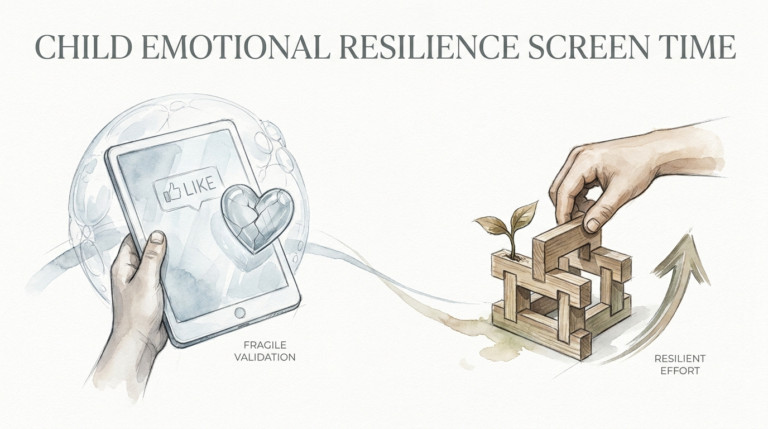
Encourage your child to find hobbies that don’t require a battery. Whether it is building with blocks, playing an instrument, or exploring the backyard, these activities provide the “slow dopamine” that builds a resilient and happy brain. You are the architect of your child’s environment; build one that helps them thrive.
Sources
1 lindnercenterofhope.org | 2 hubspotusercontent20.net | 3 mayoclinic.org | 4 mayoclinic.org | 5 bklynlibrary.org | 6 newcanaanpediatrics.com | 7 upandupaba.com | 8 thejacobsladdergroup.org | 9 mayoclinichealthsystem.org | 10 nsw.gov.au | 11 henryford.com | 12 ewu.edu | 13 harvard.edu