Creative Travel Journaling Techniques For Kids
Journaling shouldn’t feel like a school assignment—it should feel like an investigation. Most kids hate journaling because we ask them to write essays. Pro parents teach them to curate. A ticket stub, a leaf rub, and a 10-word secret are worth more than a thousand words of ‘what I did today.’ Work smarter, not harder, on your memories.
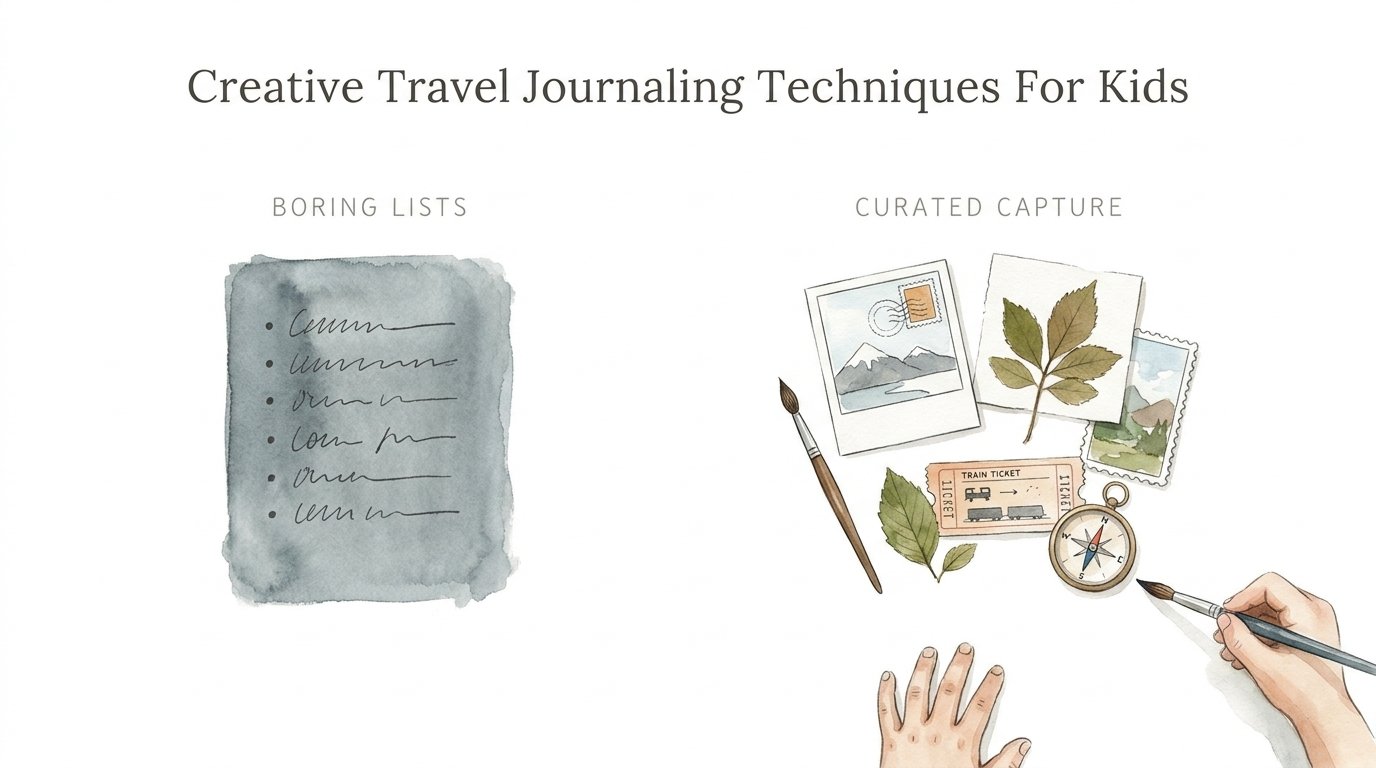
Traditional travel diaries often end up as half-finished chores gathering dust in a suitcase. This happens because the approach is wrong. Instead of forcing a child to sit down and recount every historical fact they learned at a museum, shift the focus toward capturing the sensory details of the journey. This transition from “BORING LISTS” to “CURATED CAPTURE” is what turns a reluctant writer into a lifelong documentarian.
Capturing a trip is about gathering the physical fragments of an experience. When a child glues a candy wrapper from a Tokyo convenience store next to a quick sketch of a strange-looking bird, they aren’t just making a book; they are building a time capsule. This guide will show you how to transform the way your family remembers adventures by focusing on tactile, low-pressure techniques that kids actually enjoy.
Creative Travel Journaling Techniques For Kids
Creative travel journaling for kids is the practice of documenting a journey through a mix of art, ephemera, and short-form writing. It moves away from the “Dear Diary” format and toward a scrapbook-style investigation of a new environment. This method relies heavily on “ephemera”—the temporary items like metro tickets, sugar packets, or brochures that are usually thrown away. These items provide immediate visual context and act as “memory anchors” that help children recall specific feelings and events later.
In the real world, this looks like a child carrying a small pouch of supplies to a restaurant or on a long train ride. Instead of staring at a screen, they are busy arranging a “ticket tower” or doing a coin rubbing from the local currency. This technique works because it is low-stakes. There is no right or wrong way to stick a sticker, and a single sentence about how sour a local fruit was is often more descriptive than a page of generic travelogue.
Think of the journal as a “Discovery Log.” It is used to record the weird, the funny, and the unexpected. It exists to capture the child’s perspective—which is often very different from an adult’s. While a parent might want to remember the architecture of a cathedral, the child might want to remember the giant pigeon they saw on the steps. Creative journaling gives them permission to prioritize those small, authentic details.
How to Start the Curated Capture Process
Transitioning to a curation-based journal requires a shift in how you prepare for the trip. You don’t need a fancy, expensive leather-bound book. In fact, a simple spiral-bound sketchbook or a plain composition notebook often works best because it removes the “fear of the blank page.”
Step 1: Assemble the “Capture Kit”
A portable kit is essential for keeping the habit alive on the go. Use a clear Ziploc bag or a small pencil pouch to hold these basics:
- A glue stick or double-sided tape for immediate “field sticking.”
- A set of “anti-roll” pens or markers, such as Triplus Fineliners, which stay on airplane trays.
- Kid-safe scissors for trimming brochures and maps.
- Washi tape in bright colors to create instant borders.
- A small envelope glued to the back cover for loose “treasures” found during the day.
Step 2: The “Immediate Stick” Rule
Encourage kids to glue items in as they receive them. The metro ticket from the morning should go in during lunch. The museum sticker goes on the page as soon as you exit the building. This prevents the “pile of paper” problem that overwhelms kids at the end of the day. If the item is in the book, the memory is safe.
Step 3: Use Micro-Prompts
If a child freezes up, give them a specific, tiny mission. Instead of saying “write about today,” try these investigations:
- “List the top 3 weirdest smells you encountered today.”
- “Draw the logo of the soda you just drank.”
- “Ask the waiter how to say ‘delicious’ in the local language and write it down.”
- “Trace the shape of your hotel room key.”
Benefits of the Curation Method
The practical benefits of this approach go far beyond having a nice souvenir. Curation-based journaling is a powerful tool for cognitive and emotional development. It reinforces memory through a “triple-exposure” effect: kids experience the moment, they process it while choosing what to keep, and they relive it when they look back at the finished page.
Strengthened Memory Retention: Research shows that writing by hand and engaging with tactile materials activates more regions of the brain than typing or just looking at photos. The act of rubbing a pencil over a textured plaque or peeling a sticker creates a sensory memory that sticks much longer than a digital snapshot.
Development of Observational Skills: When a child knows they are looking for “treasures” for their journal, they become more present. They notice the colors of the street signs, the patterns on the floor tiles, and the specific sounds of a bustling market. They aren’t just tourists; they are explorers on a mission.
Emotional Regulation and Downtime: Travel is overstimulating. Sitting down for 15 minutes at the end of the day with a glue stick and some markers provides a necessary “brain break.” It allows children to process the day’s high-energy events in a quiet, grounded way. It turns “waiting time” at airports or restaurants into a productive, calming activity.
Challenges and Common Mistakes
The biggest pitfall in kids’ journaling is the “Essay Trap.” When parents treat the journal like a school requirement, it becomes a chore. As soon as a child feels they are being graded on their spelling, grammar, or handwriting, the creativity dies. This is why you must resist the urge to “red pen” their memories.
The Perfectionist Block: Some kids are afraid to start because they want the page to look “perfect.” They see professional scrapbooks online and feel intimidated. To avoid this, model “messy journaling.” Show them your own journal where you’ve crossed things out, made mistakes, or just taped in a crumpled receipt. Emphasize that the “mess” is what makes it look like a real adventure.
Hoarding vs. Curating: Kids often want to keep every single brochure and every single rock. This leads to a bulging, heavy book that is impossible to manage. Teach them to “pick the best one.” If you visited three parks, ask them which one had the coolest leaf and keep only that. This helps them develop decision-making skills and keeps the project sustainable.
The “End of Day” Fatigue: Waiting until 9:00 PM to start journaling is a recipe for failure. Kids are exhausted by the end of a travel day. The best time to journal is during “transition moments”—while waiting for food, riding the bus, or during the mid-afternoon “quiet time” back at the hotel.
Limitations and Realistic Constraints
While creative journaling is highly effective, it has practical boundaries. Space is the primary constraint. If you are backpacking or traveling with carry-on only, carrying a bag of craft supplies and a thick notebook is not always feasible. In these cases, you may need to limit the “kit” to a single multi-color pen and a small pocket-sized notebook.
Environmental factors also play a role. Trying to glue ticket stubs into a book during a rainy hike or on a windy beach is frustrating and messy. You must be realistic about when and where the “crafting” happens. Sometimes, it is better to just collect the items in a “daily catch-all envelope” and do the sticking once you are back in a stable environment.
There is also the “Reluctant Writer” limit. Some children genuinely dislike the act of holding a pen. For these kids, forcing an analog journal can create resentment toward the trip itself. In these situations, a “Hybrid Method” or a purely digital approach (like a photo-journaling app) might be a better fit to keep the spirit of documentation alive without the friction of physical writing.
Comparison: Scrapbooking vs. Digital Documenting
Deciding between a physical journal and a digital alternative depends on your child’s age and interests. Both have merits, but they serve different psychological needs.
| Feature | Analog Scrapbook | Digital Vlog/App |
|---|---|---|
| Tactile Experience | High (glue, paper, textures) | Low (touch screen only) |
| Memory Trigger | Sensory-based | Visual/Audio-based |
| Ease of Use | Requires supplies | Fast, lightweight |
| Risk Factor | Easy to lose/damage | Cloud-backed, safe |
| Focus Level | Deep (distraction-free) | Mixed (notifications) |
The “Scrapbook” method is superior for younger children and for those needing a break from screens. It encourages fine motor skills and patience. However, “Digital Documenting” is excellent for older kids or teens who are already skilled at video editing or photography. A middle ground—the Hybrid Method—involves taking digital photos and printing them out on a portable printer like a Canon Ivy to stick into a physical book later.
Practical Tips and Best Practices
To make travel journaling a success, integrate it into the rhythm of your trip. It shouldn’t be a standalone “task” but part of the experience. Here are some actionable tips to keep the momentum going:
- The “Secret Pocket”: Glue an envelope into the back of the journal. Tell the child this is for “Top Secret” finds like interesting rocks, flattened bottle caps, or notes they don’t want anyone else to see.
- Tourist Stamps: Many train stations, museums, and national parks (especially in places like Japan or Taiwan) have rubber stamps available for free. Always look for these; they are the easiest way to “decorate” a page instantly.
- Postcard Mailing: If the journal feels too big, buy a postcard in every city. Have the child write one sentence on the back and mail it to your home address. By the time you get back, you’ll have a chronological series of memories waiting in the mailbox.
- The “Soundtrack” Entry: Ask your child what song they hear most often on the trip (in cafes, on the radio, etc.) and write the title down. Years later, hearing that song will trigger an instant “flashback” to the trip.
Modeling behavior: The most effective tip is for the parent to keep their own journal. If your child sees you sketching a coffee cup or taping in a receipt, they will naturally want to emulate you. Turn “journaling time” into a shared family activity at a cafe or in the hotel lounge.
Advanced Considerations: The Pro-Level Capture
For families who travel frequently or for older kids who want more depth, you can introduce advanced documentation techniques. One pro-level strategy is the inclusion of “Metadata.” Encourage kids to record the “technical” details of a moment: the exact temperature, the altitude, or the exchange rate of the local currency. This adds a layer of “real-world” context that makes the journal feel more like a professional logbook.
Portable Photo Printers: Investing in a device like an Instax Mini or a Zink printer (like the HP Sprocket) changes the game. Being able to take a photo and have a physical sticker of it 60 seconds later keeps the “immediate capture” loop closed. It removes the delay between taking a photo and seeing it in the book, which is crucial for maintaining a child’s interest.
Thematic Journaling: Instead of a chronological diary, try a “themed” investigation. A child could decide to make a “Burger Journal” of the world, where they rate every burger they eat in different countries. Or a “Flora and Fauna” log where they only document the plants and animals they see. Having a specific theme provides a clear “filter” for what to include and makes the project feel like a specialized hobby rather than a general task.
Example Scenario: A Day in London
Let’s look at how this works in practice during a standard sightseeing day. Instead of writing “Today we went to London and saw the tower,” a curated journal might look like this:
10:00 AM: The child tapes in the bright red “Underground” ticket they used to get to the Tower of London. Next to it, they use a red marker to draw a quick stick-figure guard with a giant hat.
1:00 PM: At lunch, they peel the label off a “Ribena” bottle (a drink they don’t have at home) and stick it on the page. They write one word: “PURPLE.”
3:00 PM: While sitting in a park, they do a coin rubbing of a British 50p piece because they noticed it has seven sides. They write: “The money is weirdly shaped.”
7:00 PM: Before bed, they add a sticker they got from a museum shop and write the name of the “Best Thing I Ate” (Fish and Chips). Total time spent: less than 10 minutes total throughout the day. The result: a vibrant, high-energy page that captures the *vibe* of London perfectly.
Final Thoughts
Creative travel journaling for kids is about celebrating the small stuff. It’s a shift in perspective that honors a child’s natural curiosity and their love for “stuff.” By moving away from long-form writing and toward curation, you remove the pressure and replace it with a sense of play. The goal isn’t to create a perfect literary work; it’s to create a messy, tactile, and deeply personal record of an adventure.
Remember that the journals your kids create today will become some of your most prized possessions ten years from now. They offer a window into how your child saw the world at that exact moment—what they found funny, what they found strange, and what they found delicious. Encourage them to be investigators, not just observers.
Start small on your next trip. Pack a glue stick and a few good pens, and see what “investigations” your children come up with. You might find that the “10-word secret” they write down becomes the most important memory of the entire vacation.
Sources
1 magictraveljournals.com | 2 agradeahead.com | 3 insidethetravellab.com | 4 vintagepagedesigns.com | 5 kellehampton.com | 6 kidstravelbooks.com | 7 medium.com | 8 vintagepagedesigns.com | 9 twisttravelmag.com | 10 medium.com | 11 tripmemo.app | 12 hellobrio.com | 13 exquisitexchange.com | 14 mom2.com | 15 worldhealth.net | 16 medium.com | 17 handsonaswegrow.com