
Travel Journal Prompts For Long Layovers
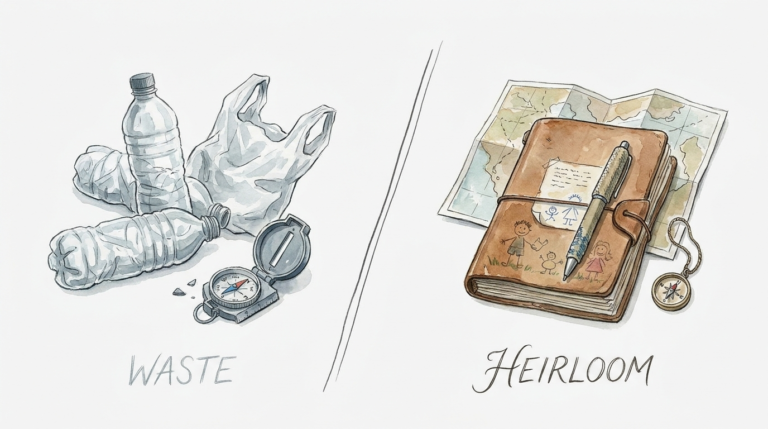
A flight delay is either a parenting nightmare or the best chapter in their book. The ‘nuisance’ of a 3-hour delay is actually a high-value opportunity for observation. When the battery dies, the story begins. Teach your kids to find the comedy in the chaos through the lens of their travel journal.
Most parents view an airport terminal as a holding cell. They see rows of bolted-down chairs and overpriced snacks. They see a ticking clock and a dying iPad. You are going to help your child see a stage. Every traveler is a character. Every announcement is a plot twist. Every suitcase is a mystery waiting to be solved.
Journaling transforms a child from a passive passenger into an active explorer. Instead of asking “Are we there yet?”, they start asking “Where is that person with the giant purple hat going?”. This shift in perspective is the difference between a meltdown and a masterpiece. It turns WASTED TIME into STORY GOLD.
Travel Journal Prompts For Long Layovers
Travel journal prompts are creative sparks designed to ignite a child’s imagination during the stagnant hours of a flight delay or layover. They serve as a roadmap for observation, helping kids focus on the world around them rather than the frustration of the wait. These prompts are more than just writing exercises; they are tools for emotional regulation and cognitive development [1.1, 1.20].
In the real world, travel journaling is used by explorers, writers, and artists to document the nuances of a journey. For a child, it acts as a tactile record of their adventure. It allows them to capture the “core memories” that often get lost in the blur of transit [1.13, 1.25]. Here are several categories of prompts to keep your young traveler engaged for hours:
The Sensory Series
Airports are sensory overloads. Use these prompts to help kids filter and document what they experience.
- The Smell Test: Describe three different smells in this terminal. Does it smell like burnt coffee, expensive perfume, or cinnamon rolls?
- Sound Mapping: Close your eyes for 60 seconds. What are the three loudest sounds you heard? What was the quietest?
- Texture Hunt: Find something smooth, something bumpy, and something surprisingly cold. Draw them or describe how they feel.
- Menu Critic: Look at the menu of the nearest airport restaurant. If you had to eat one thing from there for the rest of your life, what would it be?
The People Watcher’s Perspective
Airports are the best places on Earth for people-watching. These prompts encourage empathy and storytelling [1.12].
- The Mystery Traveler: Pick one person walking by. Where do you think they are going? What is the weirdest thing inside their suitcase?
- Uniform Watch: Draw a picture of a pilot or a flight attendant. What do you think their “secret” superpower is?
- The Reunion: Look at the arrivals gate. Describe the happiest reunion you see. Why do you think they missed each other so much?
- The Tired Traveler: Find the person who looks the most tired. Invent a story about the 24-hour adventure they just had.
The Logistics and Logic Prompts
Help your child understand the “how” and “why” of travel to build critical thinking skills [1.6].
- The Information Board: Find the flight board. Which city has the coolest name? How far away do you think it is?
- Gate Architect: If you could redesign this waiting area, what would you add? A trampoline? A giant slide to the plane? Draw your blueprint.
- Sky Spy: Look out the window at the planes on the tarmac. Count the different tail colors. Which logo is your favorite and why?
- The Baggage Journey: Imagine you are a piece of luggage. Describe your journey from the check-in counter through the secret underground tunnels to the plane.
Emotional and Reflective Prompts
Journaling is a powerful tool for processing the “lows” of travel, like delays [1.20].
- The Boredom Buster: On a scale of 1 to 10, how bored are you? What is the one thing that could make this wait 100% better right now?
- Gratitude in the Terminal: List three things you are thankful for in this airport. (Is it the comfortable seat? The chocolate bar? The fact that you’re with your family?) [1.23]
- Future Me: Write a letter to yourself for when you land. What is the first thing you want to do when you reach your destination?
- The Comedy of Chaos: What is the funniest thing that has happened since we got delayed? Write it down before you forget the details.
How to Start Your Travel Journal Kit
Setting up a travel journal doesn’t require a high-end leather book or expensive calligraphy pens. In fact, a low-stress setup is often more effective for kids because they don’t feel the pressure to be perfect [1.13]. A simple $1 notebook can become a prized souvenir if used correctly.
To begin, gather the following essential supplies and store them in a zippable pouch or Ziploc bag for portability [1.2, 1.4]:
- A sturdy notebook: A5 size is ideal. Blank pages allow for a mix of drawing and writing [1.10].
- Adhesives: A small glue stick or rolls of washi tape. These are vital for “smashing” ephemera like boarding passes, sugar packets, or receipts into the pages [1.4, 1.11].
- Writing and drawing tools: A mix of colored pencils and a reliable black fine-liner. Avoid markers that bleed through thin paper [1.11].
- Ephemera pouch: A simple envelope taped to the inside back cover to hold loose treasures until they can be glued in [1.7].
- Portable photo printer (Optional): Devices like the Instax Mini or HP Sprocket allow kids to see their perspective instantly and tape it into the journal [1.11, 1.13].
The process is straightforward: Encourage your child to observe, collect, and record. Do not force a specific structure. Some days will be 10 pages of drawings, and others will be two sentences about a great sandwich [1.25]. The goal is consistency over perfection.
Benefits of Journaling During Delays
Journaling is not just “busy work.” It provides significant developmental advantages that digital entertainment simply cannot match. While a tablet offers passive consumption, a journal demands active creation.
Cognitive Development: Navigating the unique challenges of an airport stimulates mental agility. Journaling forces children to analyze their surroundings, helping them develop critical thinking and problem-solving skills [1.1].
Emotional Intelligence: Writing or drawing about feelings helps children name and manage their emotions [1.20]. In the high-stress environment of a flight cancellation, a journal provides a safe, private outlet for frustration, which can significantly reduce anxiety and improve mood.
Literacy and Communication: Travel journaling is an undercover way to practice grammar, vocabulary, and storytelling [1.9]. It bridges the gap between what they see and how they describe it, building a stronger “voice” in their writing.
Long-term Memory Retention: Research shows that the tactile act of writing by hand lights up more parts of the brain than typing [1.16]. By recording the “small” moments—the taste of a specific pastry or the sound of the airport tram—the memories become much more vivid and lasting [1.25].
Challenges and Common Mistakes
The biggest hurdle in travel journaling is often perfectionism. Many children (and parents) feel that a journal needs to look like a curated scrapbook from social media. This mindset leads to “journaling burnout” before the first flight even takes off.
Another common mistake is treating the journal as a chore. If a parent insists on “mandatory journaling time” during a moment of extreme exhaustion, the child will associate the activity with stress rather than fun [1.15, 1.25].
How to avoid these pitfalls:
- Model the behavior: If your child sees you journaling, they are much more likely to join in [1.15].
- Embrace the mess: Smudges, scribbles, and misspelled words are part of the story. Do not correct their grammar unless they ask for help.
- Keep it short: Some of the best entries are just three bullet points and a sticker [1.8].
- Avoid the “I’m Bored” barrier: Use pre-written prompt cards or “Secret Prompt” envelopes to provide a starting point when they feel stuck [1.8, 1.14].
Limitations: When Not to Journal
Travel journaling is a powerful tool, but it has its boundaries. It is important to recognize when the environment or the child’s state is not conducive to creative work.
Physical Exhaustion: If your flight was canceled at 2:00 AM and your child is cross-eyed with fatigue, put the journal away. Pushing for “reflection” during sleep deprivation leads to meltdowns, not memories.
Age Constraints: Very young children (under 3 or 4) may not have the motor skills or attention span for traditional journaling. For this age group, the parent should act as the “scribe,” recording the child’s dictated observations or helping them stick a single sticker on a page [1.10, 1.25].
High-Transit Moments: Trying to journal while running between gates or standing in a security line is impractical and adds to the chaos. Journaling works best during the “dead time” when you are settled at a gate or eating at a terminal restaurant [1.2, 1.15].
Comparison: Analog vs. Digital Journaling
In the age of smartphones, many wonder if a physical journal is still necessary. While digital apps offer convenience, they lack the tactile benefits of paper.
| Feature | Physical Journal | Digital Journaling App |
|---|---|---|
| Battery Requirement | None—always ready [1.16]. | Requires charging/power bank. |
| Tactile Experience | High (Glue, stickers, handwriting). | Low (Typing/tapping). |
| Memory Retention | Higher (Writing by hand boosts brain activity) [1.16]. | Lower (Passive input). |
| Multimedia Integration | Limited to flat items (tickets, photos). | Unlimited (Video, audio, live maps) [1.24]. |
| Distraction Level | Zero (No notifications) [1.17]. | High (Notifications, social media). |
For most families, a hybrid approach works best. Use a physical journal for the creative process and the airport wait, and use your phone to take photos that can be printed later and added to the book [1.16, 1.22].
Practical Tips for Parents
Successful travel journaling is 50% preparation and 50% timing. Use these best practices to ensure the experience is seamless:
- The “Secret Supply” Trick: Don’t give them all the stickers and pens at once. Hold back a “new” sheet of stickers or a special glitter pen for the moment the 3-hour delay is announced. This novelty provides an instant mood boost [1.14].
- Collect the “Garbage”: Encourage your child to see beauty in ephemera. A colorful boarding pass, a paper coaster from an airport bar, or even a local candy wrapper makes for a great journal page [1.2, 1.11].
- Use the Environment: Airports are full of free resources. Grab a terminal map and have your child circle where you are. Find free postcards at tourist kiosks and glue them in [1.2, 1.8].
- Set a “Reflection Ritual”: Make it a habit to journal while waiting for food or right before boarding the plane. This helps the child process the experience in real-time [1.8, 1.15].
Advanced Considerations for Older Kids
For pre-teens and teenagers, “coloring in a notebook” might feel too childish. To keep older kids engaged, shift the focus toward documentation and design.
Mixed Media and Photography: Encourage them to use their phones for “intentional” photography. Instead of random selfies, challenge them to take a photo of “The Ugliest Carpet in the Airport” or “Shadows on the Tarmac.” These can be printed at home to create a sophisticated travel log [1.21].
The Gate Agent Interview: If the airport isn’t too busy, encourage your older child to politely ask a gate agent or airport worker one question, such as “What is the furthest city you’ve ever sent a plane to?” Recording real-world interactions adds a journalistic depth to their book.
Architectural Sketching: Many modern airports are architectural marvels. Challenge your teen to sketch the ceiling of the terminal or the way the light hits the glass. This moves the journal from “diary” to “sketchbook” [1.16].
Example Scenario: The Atlanta Layover
Imagine you are stuck in Hartsfield-Jackson Atlanta International Airport for four hours due to a thunderstorm. Your 8-year-old is starting to pace.
Step 1: The Setup. You pull out the journal kit and the “Secret Prompt” envelope. Inside is a card that says: “Airport Spy Mission: Find 5 people wearing hats, 3 people running, and 1 person sleeping in a funny position. Draw them.”
Step 2: The Observation. The child spends 30 minutes walking (with you) near the gate, observing the crowd. They find a man in a cowboy hat and a toddler sleeping face-down on a suitcase. They are no longer thinking about the rain outside; they are on a mission.
Step 3: The Recording. Back at the seats, they glue in their boarding pass (the “evidence”) and draw the sleeping toddler. They write a one-sentence theory: “I think he’s a secret agent who stayed up all night fighting bad guys.”
The Result: The delay didn’t just “pass.” It was documented. That 8-year-old now has a story to tell their friends about the “Secret Agent Toddler” in Atlanta, rather than just complaining about a boring flight [1.25].
Final Thoughts
A travel journal is the ultimate “low-tech” solution to a “high-stress” problem. It reframes the airport terminal as a place of discovery rather than a place of waiting. By providing your child with the right prompts and a simple kit, you are giving them the tools to process their world, build their skills, and preserve their childhood adventures in a way that no digital cloud ever could.
Remember that the goal is not to produce a professional travelogue. The goal is to capture the messy, funny, and sometimes frustrating reality of the journey. Years from now, those scribbled notes about a delayed flight will be more valuable than any souvenir you could buy in a terminal gift shop.
Encourage your kids to start today. Hand them a notebook, a glue stick, and a mission. Watch as the “nuisance” of a delay transforms into the most creative chapter of their travel story.
Sources
1 insidethetravellab.com | 2 planetschooling.com | 3 medium.com | 4 youtube.com | 5 youtube.com | 6 playtivities.com | 7 medium.com | 8 worldhealth.net | 9 magictraveljournals.com | 10 vintagepagedesigns.com | 11 teawithmum.com | 12 twisttravelmag.com | 13 mom2.com | 14 thewildcherryfarm.com | 15 emorahealth.com | 16 journalfy.co | 17 pleasenotes.com | 18 kidstravelbooks.com | 19 diy.org | 20 handsonaswegrow.com