Heavy Duty Fine Motor Activities For Toddlers
Your toddler doesn’t need ‘toy’ versions of the world; they need the real weight of it to build true hand-eye mastery. We give toddlers plastic beads because they are ‘safe,’ but we rob them of the weighted feedback their nervous systems crave. Watch what happens to their focus when you swap hollow plastic for the cool, heavy resistance of a brass bolt.
Most parents start with brightly colored plastic sets. These toys are light and easy to move. They offer almost zero resistance to a developing hand. This lack of feedback makes it harder for a child to judge force and distance accurately.
The real world is heavy. It has texture, friction, and resistance. When a toddler interacts with industrial-grade hardware, they aren’t just playing. They are calibrating their internal sensors.
Introducing heavy-duty activities transforms a simple playtime into a session of deep concentration. It moves beyond “keeping them busy” and enters the realm of skill acquisition. You will see a level of engagement that plastic toys rarely achieve.
Heavy Duty Fine Motor Activities For Toddlers
Heavy-duty fine motor activities involve using real-world objects and industrial hardware to develop hand strength and coordination. Instead of lightweight plastic, these activities prioritize materials like brass, steel, and solid wood. These materials provide significant proprioceptive feedback, which is the brain’s ability to sense the position and movement of the body.
You might see these concepts in advanced Montessori classrooms or occupational therapy clinics. They exist to bridge the gap between simple grasping and the complex manipulation required for life skills. Real-world hardware like nuts, bolts, hinges, and locks offers a tactile experience that mimics actual construction.
Think of it like the difference between lifting a balloon and lifting a paperweight. The balloon requires almost no effort to move, so the brain doesn’t have to plan much. The paperweight demands a specific grip and a calculated amount of force. This “heavy work” for the fingers is what builds lasting neural pathways.
Toddlers are naturally drawn to the tools they see adults using. They want the shiny wrench or the heavy padlock because they sense the importance of those objects. By providing a curated selection of hardware, you satisfy their curiosity while providing an elite level of motor training.
How It Works: Setting Up the Heavy Hardware Station
Starting with heavy hardware is simpler than you think. You do not need a full workshop to begin. A small wooden tray and a few select items from your local hardware store are all it takes to create a professional-grade learning station.
First, select a variety of brass or stainless steel bolts. Choose bolts with a large diameter, such as 1/2 inch or 3/4 inch, so they are easy for small hands to grip. Ensure the threads are smooth and free of sharp burrs.
Pair each bolt with a matching nut. You can also include heavy washers to add an extra layer of complexity and weight. The goal is for the child to thread the washer onto the bolt before screwing on the nut.
Create a “Bolt Board” by drilling holes into a thick piece of scrap wood. Secure the bolts into the wood so they stand upright. This allows the toddler to use both hands to manipulate the nuts and washers without the bolt sliding around.
Introduce these items one by one. Show your toddler how the threads catch and how the nut moves down the bolt with a twisting motion. Allow them to feel the weight of the metal before they start the task.
Focus on the sound and feel of the materials. The “clink” of metal on metal provides an auditory cue that the task is being performed correctly. This sensory loop reinforces the learning process.
Benefits of Real-World Resistance
One of the most immediate benefits is the development of “graded force.” Graded force is the ability to know exactly how much strength to use for a specific task. Plastic toys are so light that children often over-apply force, which can lead to clumsiness in other areas.
Industrial hardware provides natural resistance. A brass nut won’t spin freely if it is cross-threaded or if the hands are too shaky. This forces the toddler to slow down, adjust their grip, and apply precise pressure.
Hand strength is another major advantage. Screwing a heavy metal nut onto a bolt requires the use of the small intrinsic muscles in the palm and fingers. These are the same muscles needed for holding a pencil, using scissors, and buttoning a coat later in life.
Proprioceptive input is the “secret sauce” of heavy-duty play. The weight of the metal sends strong signals to the joints and muscles of the hand. This input is naturally calming and helps children who struggle with focus or high energy levels.
Finally, the sense of accomplishment is much higher. A child knows the difference between a toy and a real tool. Successfully opening a heavy padlock or tightening a real bolt provides a massive boost to their self-esteem and independence.
Challenges and Common Mistakes
The biggest mistake is choosing hardware that is too small. Tiny nuts and bolts are not only a choking hazard but also frustrating for toddlers who are still developing their pincer grasp. Always choose the largest sizes available in the hardware aisle.
Avoid using hardware that is rusty or has sharp edges. While the goal is “real world,” the items must still be safe for a child’s skin. Take a moment to sand down any rough spots or wipe away factory grease before handing them over.
Supervision is non-negotiable. Real hardware often includes small parts like washers that can be tempting for a curious toddler to put in their mouth. This is an activity meant for guided discovery, not unsupervised solo play.
Another pitfall is providing too many options at once. A tray with twenty different nuts and bolts will quickly become a pile of clutter. Start with one bolt and one nut to ensure the child understands the mechanics before adding variety.
Do not rush the process. Some toddlers may just want to carry the heavy bolts around or clank them together for the first few days. Let them explore the physical properties of the metal before pushing for the technical skill of threading.
Limitations: When to Stick to the Basics
Industrial hardware is not ideal for every environment. Because the items are heavy and made of metal, they can damage hardwood floors or glass tables if dropped. Use a thick rug or a dedicated work mat to protect your home.
If your child is in a heavy “throwing” phase, metal hardware might need to be put away temporarily. A heavy brass bolt can cause significant injury or damage if tossed across a room. Assess your child’s current behavior before introducing these materials.
Portability is another constraint. A bag full of steel hardware is significantly heavier than a bag of plastic blocks. This isn’t the best activity for a “diaper bag toy” meant for waiting rooms or car rides.
Some children with extreme sensory sensitivities might find the cold feel or the loud noise of metal off-putting. If your child pulls away from the texture of the metal, try starting with heavy wooden blocks or weighted bean bags first.
Industrial Hardware vs. Plastic Beads
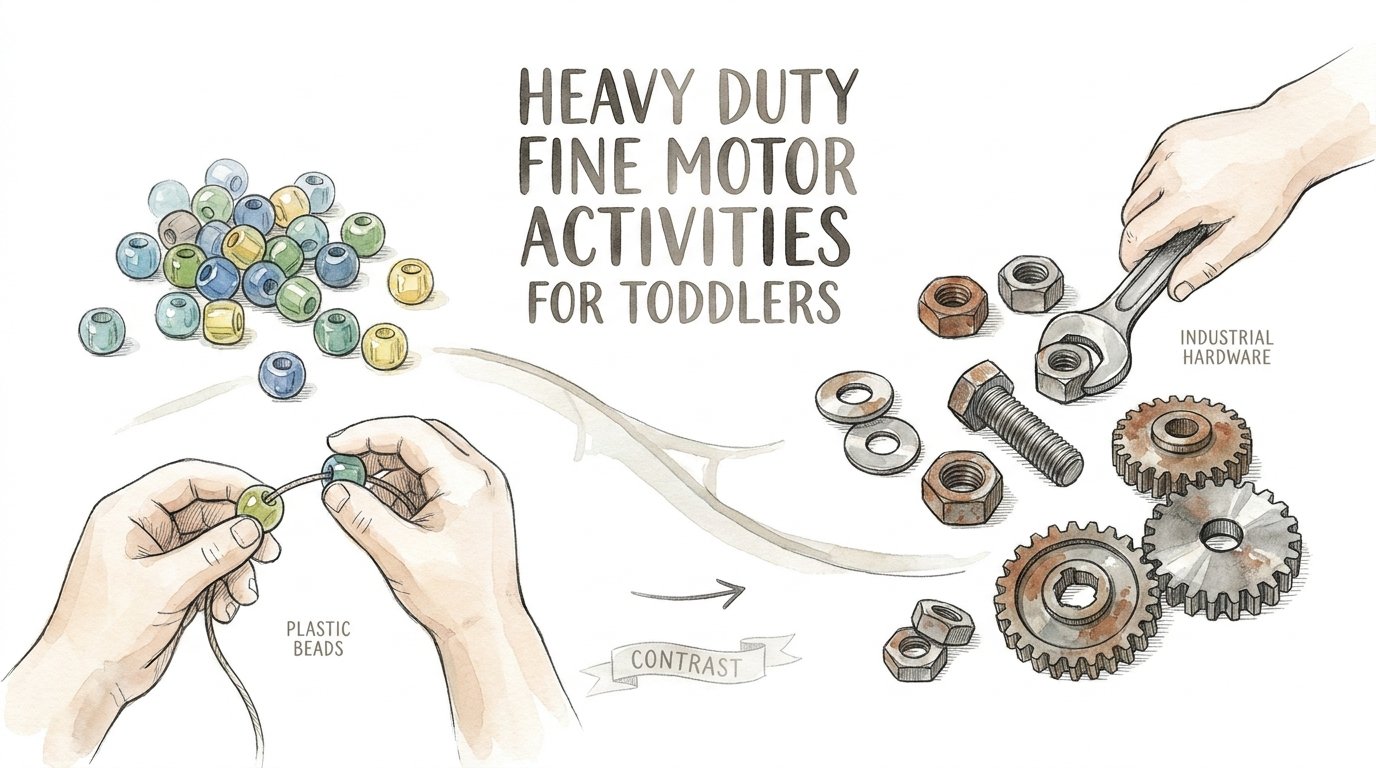
When comparing industrial hardware to traditional plastic beads, the differences are measurable in both durability and developmental impact. Plastic beads are designed for high-volume manufacturing and low cost, whereas hardware is designed for performance and longevity.
| Feature | Plastic Beads | Industrial Hardware |
|---|---|---|
| Sensory Feedback | Low (Lightweight) | High (Weighted/Tactile) |
| Durability | Fragile / Can Break | Indestructible |
| Resistance Level | Minimal | Adjustable/Significant |
| Cost Value | Disposable | Lifetime Investment |
| Real-World Utility | Zero | High (Life Skill Prep) |
Plastic beads often lead to repetitive, mindless “stringing” which has value but plateaus quickly. In contrast, working with hardware requires constant problem-solving. The weight ensures the child stays “grounded” in the activity.
Practical Tips for Sourcing and Maintenance
Visit your local hardware store and look for the “bulk” section. This allows you to hand-pick specific sizes and materials. Brass is often the best choice because it is heavy, rust-resistant, and aesthetically pleasing.
Look for “wing nuts” as a great introductory piece. The “wings” provide a larger surface area for small fingers to push against. They are excellent for children who are just beginning to master the twisting motion.
Clean your hardware before the first use. A simple soak in warm soapy water followed by a thorough drying will remove any industrial residue. You can also use a drop of mineral oil on the threads to ensure they spin smoothly.
Store your hardware in a heavy-duty container. A small metal toolbox or a thick wooden tray adds to the “real work” theme. It also prevents the heavy items from breaking through flimsy plastic bins.
Suggest internal linking to a guide on Montessori practical life activities for more ideas on integrating real-world tools into the home. Learning to use a screwdriver or a small hand-drill is a natural next step once the bolt board is mastered.
Advanced Considerations: Graded Resistance and Complexity
Once your toddler can easily thread a nut onto a bolt, it is time to increase the challenge. You can do this by introducing different thread pitches. Some bolts require more turns to reach the bottom, which builds endurance in the hand muscles.
Introduce a “Lock and Key” tray. Find three or four different types of padlocks and color-code the keys with small pieces of electrical tape. The weight of a heavy steel padlock requires the child to stabilize the lock with one hand while precisely turning the key with the other.
Pulleys and ropes are excellent for full-arm coordination. Mount a small pulley to a sturdy frame and let your toddler pull a weighted bucket up and down. This combines fine motor grip with gross motor strength.
Consider adding a “Mechanical Disassembly” station. An old, non-functional item like a large flashlight or a sturdy clock can be fascinating. Letting a child take something apart with real tools teaches them about the internal logic of how things are built.
The “Brass Bolt Challenge” Scenario
Imagine a three-year-old sitting at a low table. In front of them is a heavy wooden block with three upright brass bolts. Next to it is a tray containing three large nuts and three heavy washers.
The child picks up a washer. They feel the weight and the cold temperature of the metal. They carefully slide it over the bolt, hearing the “clink” as it hits the wooden base. This sound signals a successful first step.
Now comes the hard part. They pick up the brass nut. They have to align the threads perfectly. If they push too hard or tilt the nut, it won’t catch. They have to breathe, slow down, and feel for the “click” of the threads engaging.
They begin to twist. Their fingers are working hard, using muscles they never used with plastic toys. As the nut travels down the bolt, the resistance increases. By the time they reach the bottom, they have completed a complex series of motor calculations.
Final Thoughts
Shifting from plastic toys to heavy-duty hardware is more than just a change in materials. It is a change in philosophy. It acknowledges that toddlers are capable of handling the weight and complexity of the real world.
The resistance provided by metal hardware builds a foundation of strength and focus that lightweight toys simply cannot match. You aren’t just teaching them to screw a nut onto a bolt. You are teaching them to observe, to calibrate, and to respect the tools of creation.
Start small and choose quality materials. Watch as your child’s focus deepens and their confidence grows. When you give them the real weight of the world, they learn exactly how to hold it.
Sources
1 plusplususa.com | 2 montessorigeneration.com | 3 kidsusamontessori.org | 4 themontessoriroom.com | 5 handyfamm.com | 6 prekinders.com | 7 mytoywagon.com | 8 napacentre.com.au | 9 sandpal.com.au | 10 ecofriendlymama.com | 11 playroomcollective.com | 12 procaresoftware.com | 13 occupationaltherapy.com.au