Urban Rewilding Activities For Kids
The city looks like concrete to us, but to your child’s map, it’s a thriving, wild metropolis hiding in plain sight. Standard urban worksheets teach children to see the city as a grid of services. A ‘Wild’ mapping approach teaches them to see the ecosystem surviving beneath the asphalt. Charting where the moss grows on the north side of the brick and where the pigeons gather shows your child that ‘Wild’ isn’t somewhere else—it’s right here.
Modern childhood often feels trapped behind screens or structured schedules. Most kids know more about the Amazon rainforest than the dandelion growing through the crack in their own sidewalk. This disconnect creates what experts call nature-deficit disorder, but the cure is literally at your doorstep. Urban rewilding isn’t about tearing down skyscrapers; it’s about shifting our perspective to notice and nurture the life that already shares our zip code.
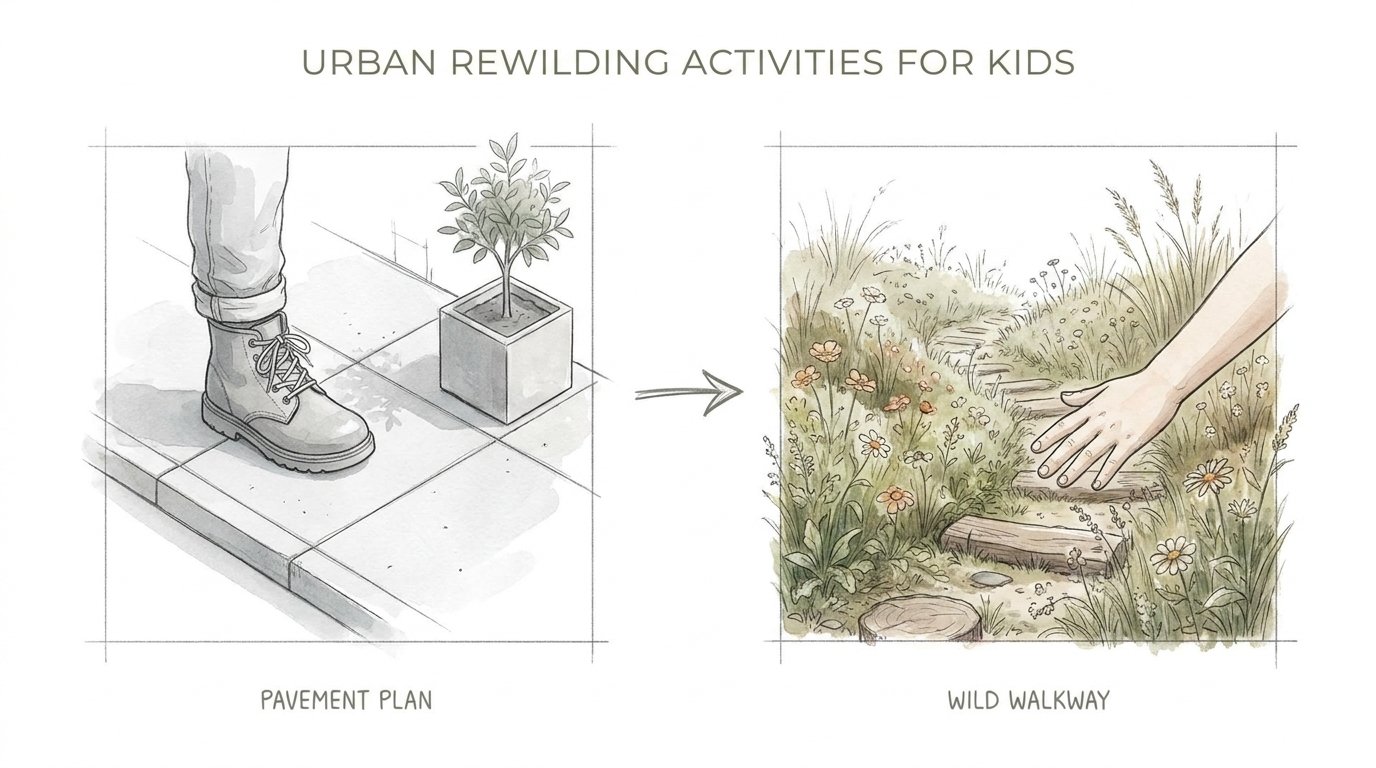
When you invite your child to become an urban explorer, you turn a boring walk to the grocery store into a high-stakes ecological survey. You help them build a WILD WALKWAY where others only see a gray pavement plan. This journey transforms their relationship with the environment from passive observer to active participant.
Urban Rewilding Activities For Kids
Urban rewilding for kids is the practice of finding, documenting, and supporting nature within human-made environments. It exists because cities are not biological deserts; they are unique habitats with specialized residents. In real-world situations, this approach is used by urban planners to create “green corridors” and by scientists to track how species adapt to climate change.
Moss hunting is one of the easiest ways to start. Mosses are non-vascular plants that act like tiny sponges, absorbing up to 20 times their weight in water. They often grow in the damp, shaded corners of alleyways or on the north side of old brick walls. Teach your child to feel the texture and look for different shades of green. These tiny forests are micro-ecosystems that provide homes for microscopic tardigrades and small insects.
Pollinator spotting is another high-energy activity. Even a single flowering pot on a balcony can serve as a “one-stop snack shop” for bees and butterflies. Encourage your child to watch a specific patch of flowers for ten minutes. They will likely see hoverflies, honeybees, or even bold urban butterflies like the Cabbage White. This activity illustrates the concept of life corridors, showing how small green patches connect to form a larger survival network.
Seed bombing offers a more hands-on way to “wild” the neighborhood. Mix clay, compost, and native wildflower seeds into small balls. Your child can toss these into neglected dirt patches or fenced-off lots. When the rain comes, the seeds sprout, turning an eyesore into a pollinator pitstop. This gives children a sense of agency, proving they can improve their environment with just a bit of dirt and intention.
How to Map Your Wild Metropolis
Mapping the “wild” side of your neighborhood requires a different set of tools than a standard GPS. You are looking for biological landmarks rather than street names. Follow these steps to create a comprehensive urban nature map with your child.
Step 1: Define Your Territory
Choose a small, manageable area for your first map. A single block or the route from your house to the local park works best. Keeping the area small allows your child to focus on the fine details they usually sprint past.
Step 2: Identify the Anchors
Look for “anchor” organisms. These are the permanent residents of your block. An old oak tree, a large patch of ivy on a fence, or a persistent clump of ferns in a basement window well serve as your map’s North Stars. Mark these clearly on your paper.
Step 3: Track the Residents
Record the movement of animals. Where do the squirrels cross the street? Which rooftop do the pigeons prefer for their morning meetings? Use arrows to show “wild highways” across the pavement. This helps children understand that animals have their own logic and routines within our human world.
Step 4: Layer the Micro-Climates
Note the physical conditions. Use blue for “drip zones” where water collects after rain. Use yellow for “heat islands” like sun-baked concrete steps. These layers explain why certain plants, like heat-loving succulents or water-loving moss, grow exactly where they do.
Step 5: Add the “Invisible” Elements
Encourage your child to use all their senses. Mark spots where the air smells like damp earth or where the traffic noise is muffled by a thick hedge. These sensory notes turn a flat drawing into a living document of the urban experience.
Benefits of Choosing the Wild Path
Connecting with urban nature offers measurable advantages for a child’s development. Research shows that regular interaction with natural settings supports cognitive growth and reduces mental fatigue. Urban environments often demand “directed attention,” which is exhausting. Nature provides “soft fascination,” allowing the brain to rest and recover.
Physical health sees a significant boost. Spending time outdoors is linked to reduced rates of nearsightedness and improved motor skills. Negotiating uneven terrain—even if it’s just a rocky vacant lot—builds better balance and coordination than walking on perfectly flat floors.
Emotional resilience is perhaps the most profound benefit. When a child observes a weed thriving in a tiny crack, they learn about persistence. They see that life doesn’t need a pristine forest to survive; it just needs a little bit of light and a lot of grit. This fosters a sense of responsibility and empathy for the living world.
Socially, urban rewilding projects often bring communities together. When children start “adopting” street trees or planting window boxes, neighbors take notice. It sparks conversations and encourages others to value their local environment. These interactions teach children that their actions have a ripple effect on the people and wildlife around them.
Challenges and Common Mistakes
The biggest mistake adults make is over-cleaning the “wild.” We are conditioned to see dandelions as weeds and dead leaves as litter. To a child mapping the city, these are essential components of the ecosystem. Removing every “weed” destroys the very biodiversity you are trying to study.
Focusing only on charismatic megafauna is another pitfall. Everyone loves a hawk or a fox, but urban nature is mostly made of the “unloved” species. Spiders, ants, and pigeons are the backbone of city ecosystems. Ignoring them prevents children from seeing the full picture of how energy moves through an urban food web.
Over-structuring the experience can also kill the curiosity. If you turn every walk into a mandatory science lecture, your child will eventually tune out. The goal is to facilitate “slow-looking” and allow them to make their own discoveries. Your role is to provide the magnifying glass and the notebook, not to dictate exactly what they should find.
Safety is a valid concern that sometimes leads to over-restriction. While you should avoid broken glass or heavy traffic, being too afraid of dirt can limit exploration. Provide gloves and teach “look but don’t touch” rules for unknown plants or insects. This empowers children to explore safely rather than avoiding nature altogether.
Limitations of Urban Rewilding
Cities present unique constraints that we must acknowledge. High levels of pollution can affect certain species. Moss and lichens, for example, are excellent air quality indicators. If you can’t find any lichen on the trees in your area, it may be due to high levels of nitrogen oxides or sulfur compounds from traffic.
Space is the most obvious boundary. You might not have a backyard, or even a balcony. In these cases, rewilding happens in the public square. This requires navigating city bylaws or seeking permission for community gardens. It teaches children about the complexities of shared space and civic engagement.
Fragmented habitats are another reality. A single tree in a sea of concrete is an island. While it provides some benefits, it cannot support the same level of biodiversity as a connected park system. Acknowledging these gaps helps children understand the importance of urban planning and why “green bridges” are necessary for wildlife movement.
Climate change also creates “heat island” effects that favor some species while punishing others. Urban nature is often in a state of high stress. This means your “wild” map might change rapidly from year to year. While this can be discouraging, it provides a real-time lesson in ecological flux and adaptation.
Comparing Urban Approaches
Understanding the difference between a standard urban view and a rewilded view helps clarify why this approach matters.
| Factor | Pavement Plan (Standard) | Wild Walkway (Rewilded) |
|---|---|---|
| View of “Weeds” | Pests to be removed. | Resilient native flora. |
| Focus | Infrastructure and services. | Habitat and connectivity. |
| Primary Goal | Efficiency and cleanliness. | Biodiversity and health. |
| Child’s Role | Passive commuter. | Active ecological explorer. |
| Outcome | Standardized knowledge. | Systems thinking and empathy. |
Practical Tips for Budding Naturalists
Starting your urban rewilding journey doesn’t require a lot of gear. A simple kit can turn any afternoon into a scientific expedition.
- Keep a “Calendar of Firsts.” Record the first leaf to turn yellow in autumn or the first bird to sing in spring. Consistent recording helps children notice subtle seasonal shifts.
- Use Citizen Science Apps. Tools like iNaturalist or Merlin Bird ID allow children to upload photos and get help with identification. This connects their local find to a global database used by real scientists.
- Adopt a Single Tree. Visit the same tree every week. Observe how its bark changes when it rains, what insects live in its crevices, and how its shadow moves across the pavement throughout the year.
- Create a “Nature Corner” at Home. Designate a shelf for interesting rocks, fallen leaves, or empty cicada shells. Bringing bits of the outside in helps solidify the connection to the local environment.
- Practice “Window Birding.” If you have limited mobility or no outdoor space, set up a suction-cup bird feeder on a window. Even high-rise apartments often see visits from peregrine falcons or hardy sparrows.
Advanced Considerations for Deep Exploration
For those who want to go beyond the basics, consider the chemistry and physics of the city. Urban environments are shaped by specific forces like the “Heat Island Effect.” Dark surfaces like asphalt absorb heat during the day and radiate it at night. This creates micro-climates that allow non-native plants to survive in cold climates.
Teach your child about “succession.” When a building is torn down, the first plants to arrive are often hardy “pioneer species.” Watching a vacant lot over several months reveals a predictable sequence of growth. First come the small grasses, then the tall wildflowers, and eventually small shrubs. This is the same process that happens after a forest fire, just on a smaller, urban scale.
Invasive species provide another deep-dive topic. Many city plants were brought from other continents for decoration. Discussing why a plant like English Ivy is a “good neighbor” in London but a “bully” in Seattle helps children understand ecological balance. It moves beyond “pretty vs. ugly” and into the realm of biological function.
A Real-World Scenario: The Bus Stop Bioblitz
Imagine you are waiting for the bus. Instead of staring at a phone, you and your child spend five minutes doing a “Mini Bioblitz.” You look at the square of dirt around a street tree.
Your child notices a line of ants carrying crumbs to a hole in the concrete. You find a patch of silvery-green lichen on the tree bark, indicating the air is relatively clean. High above, a red-tailed hawk circles, looking for a meal among the pigeons. In those five minutes, the bus stop has transformed from a place of boredom into a bustling ecological intersection.
By the time the bus arrives, your child has documented three different species and two distinct micro-climates. They aren’t just waiting; they are working. This shift in mindset is the ultimate goal of urban rewilding. It proves that nature is not a destination you visit on the weekend—it is a constant companion.
Final Thoughts
The city is far more than a collection of buildings and roads. It is a living, breathing landscape where life finds a way through every crack and corner. When we teach our children to map the “wild” side of their streets, we give them a gift that lasts a lifetime. We help them see the world as a series of interconnected systems rather than a series of obstacles.
Encouraging this exploration builds the next generation of environmental stewards. These children will grow up understanding that protecting the planet starts with protecting the street tree outside their window. They will see themselves as part of the ecosystem, not separate from it.
Go outside today. Don’t look for the park; look for the plant growing in the shadow of the dumpster. Don’t look for the forest; look for the moss on the brick. The wild metropolis is waiting for its newest explorer to draw the first line on the map.
Sources
1 outdoors.org | 2 projectnaturewa.com | 3 childhoodbynature.com | 4 brighthorizons.com | 5 timeforkids.com | 6 michigan.gov | 7 naturemappingfoundation.org | 8 nps.gov | 9 nwf.org | 10 theurbanwanderer.co.uk | 11 hyggeintheearlyyears.co.uk | 12 activeforlife.com | 13 shivnadarschool.edu.in | 14 medium.com | 15 childmind.org | 16 getthekidsoutside.com | 17 tierneyfamilyfarms.com | 18 mysimplewild.com | 19 curiodyssey.org | 20 experientiallearningdepot.com | 21 childrenandnature.org | 22 naturalstart.org