Functional Fine Motor Tasks For Toddlers
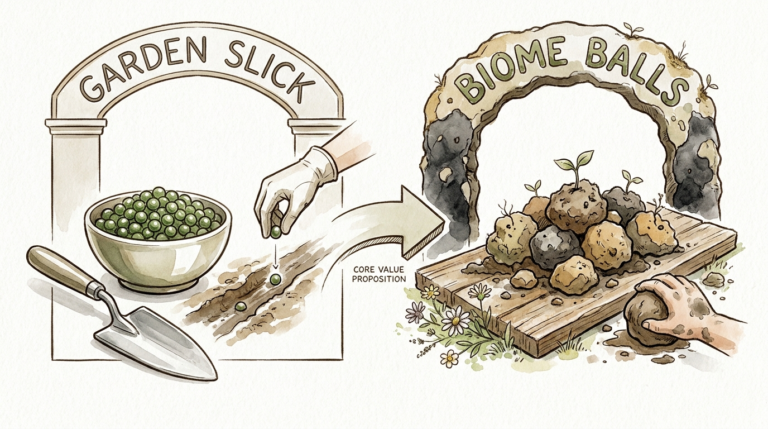
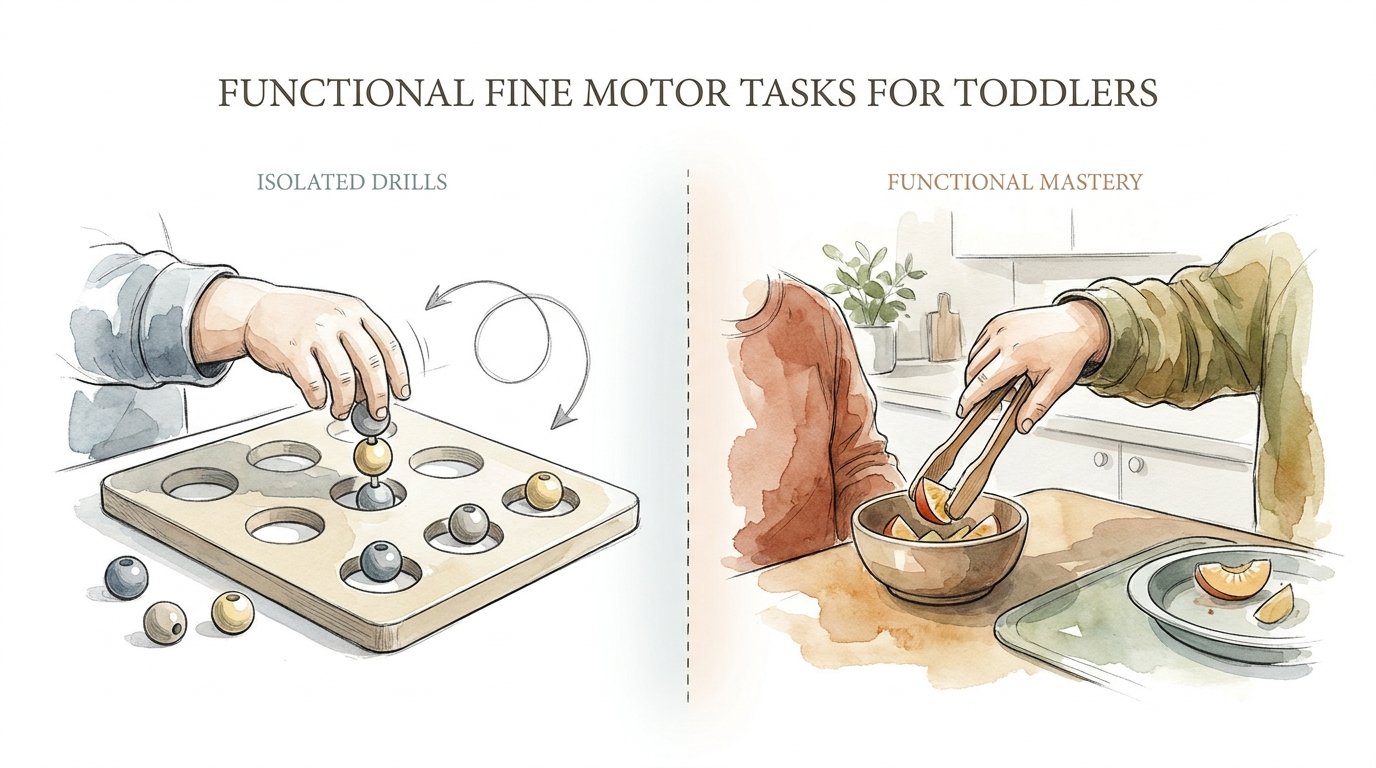
The brain learns 10x faster when the movement has a meaning. Why do we give kids ‘isolated’ boards to practice locks that lead nowhere? Integrated learning happens when the task is real. Shelling a pea requires the same precision as a latch, but it ends with a contribution to the family meal. When fine motor skills are integrated into life, the child isn’t just ‘busy’—they are becoming a producer.
Toddlers are biologically wired to mimic the adults they love. They don’t want a plastic version of your life; they want your actual life. This drive for “real work” is the most powerful engine for development in the early years.
When a child uses their hands to solve a real-world problem, their brain fires in a way that isolated drills cannot replicate. This connection between movement and meaning is what transforms a simple physical action into a profound cognitive building block.
Focusing on functional mastery over isolated drills prepares a child for more than just handwriting. It builds the foundation for concentration, self-reliance, and a deep sense of belonging within the family unit.
Functional Fine Motor Tasks For Toddlers
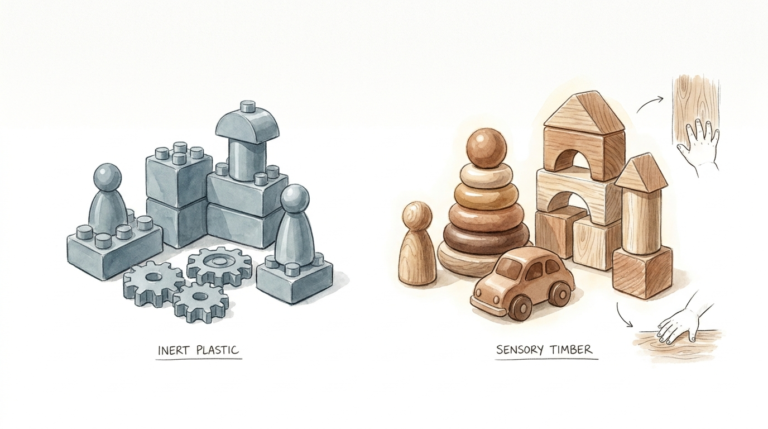
Functional fine motor tasks are purposeful activities that require the use of small muscle groups in the hands, fingers, and wrists to achieve a real-world outcome. Unlike “busy boards” where a child flips a switch that turns nothing on, functional tasks have a logical beginning, middle, and end.
These tasks are often referred to as “Practical Life” activities in the Montessori tradition. They involve the care of the self, the care of the environment, and food preparation. The goal is never just to move the fingers, but to complete a job that actually needs doing.
Real-world movement is the driving force behind brain development in these critical early years (elevategymnasticsut.com, 2025). When a child squeezes a sponge to clean a spill, they are developing the same muscles they will later use to hold a pencil. However, because they are cleaning a real mess, they are also developing executive functions like planning and problem-solving (childcareed.com, n.d.).
Examples of functional tasks include:
- Squeezing: Squeezing a spray bottle to water plants or a sponge to wash a table.
- Pinching: Peeling a hard-boiled egg or picking out seeds from a bell pepper.
- Twisting: Opening the lid of a jam jar or turning a doorknob.
- Pulling: Zipping up a jacket or pulling Velcro straps on shoes.
- Pushing: Pushing a button on the elevator or using a stamp on a piece of mail.
These activities exist because children have a “most vital need” to develop through purposeful movement (amshq.org, 2024). In the real world, these skills are used every hour a child is awake, from flipping through the pages of a book to operating a remote control (montessorigeneration.com, n.d.).
How to Implement Functional Learning at Home
Transitioning from isolated toys to functional tasks requires a shift in how you view your daily routine. Instead of seeing a toddler’s presence as a hindrance to your chores, you begin to see the chores as the curriculum.
The first step is to prepare the environment. This means making sure tools are child-sized and functional. A dull plastic knife that cannot cut a banana will only frustrate a child and lead to inappropriate use (montessoriguide.org, n.d.). The knife must actually cut, and the pitcher must actually pour.
Following a structured process helps ensure success:
- Model the task: Show your child the movement slowly and with very few words. Focus their eyes on your hands.
- Scaffold the challenge: Break the task into manageable pieces. If they cannot put on a shirt yet, let them do the very last step—pulling it down over their belly (lovevery.com, 2024).
- Allow for repetition: Toddlers learn through “meaningful repetition.” They may want to wash the same table five times in a row (thetoddlerplaybook.com, 2019).
- Prepare for the mess: Functional tasks involve real materials like water, flour, or dirt. Keep a “spill kit” (a child-sized mop or cloth) nearby so they can also practice the fine motor task of cleaning up.
Guidance should be minimal. Research suggests that preschoolers who engage in structured, purposeful play show significant improvements in working memory and inhibitory control (gsl.academy, 2025). Let them struggle slightly; this “productive struggle” is where the most neural growth occurs.
Benefits of Functional Mastery
Moving toward functional tasks offers benefits that extend far beyond physical dexterity. While isolated drills might keep a child quiet, functional work integrates their physical, cognitive, and emotional selves.
Cognitive Growth and Executive Function
Research shows a strong link between fine motor skills and later performance in literacy and mathematics (montessoriacademy.com.au, 2016). Every purposeful movement strengthens neural pathways that support attention, memory, and emotional control (brainbalancecenters.com, n.d.). Recent studies even correlate fine motor development at 42 months with visuospatial deductive reasoning in adolescence (montessori.org, 2022).
Confidence and Independence
A child who can peel their own orange or zip their own coat feels a sense of agency. This mastery leads to higher self-esteem and a positive self-concept (kidsusamontessori.org, 2024). They stop seeing themselves as “toddlers who need help” and start seeing themselves as “capable contributors.”
Emotional Regulation
Physical activity, even at the fine motor level, can increase neurotransmitters like dopamine and serotonin (brainbalancecenters.com, n.d.). Engaging in a focused, tactile task like kneading dough or scrubbing a potato can have a calming effect, helping children regulate their stress levels.
Academic Preparedness
Functional tasks are the “pre-writing” exercises of the real world. Handling a spoon, using tongs, and turning pages refine the pincer grasp and hand-eye coordination needed for future pencil work (crescentridgeacademy.org, 2024).
Challenges and Common Mistakes
The biggest challenge in functional learning isn’t the child; it is the adult’s desire for efficiency. We are often in a rush, and letting a two-year-old pour their own milk is objectively slower than doing it ourselves.
Common pitfalls include:
- Forcing participation: Practical life work should be an invitation, not a chore. If a child is forced, they will develop resistance (thetoddlerplaybook.com, 2019).
- Intervening too soon: Jumping in to “fix” a mistake or speed up the process undermines the child’s confidence (amshq.org, 2024).
- Overcomplicating the setup: You don’t need elaborate DIY kits. The best activities are often the simplest ones already happening in your kitchen (montessoriparentguide.com, 2026).
- Focusing on the product: If the floor is still a bit dirty after they sweep, that is okay. The goal is the development of the child, not a spotless house (amshq.org, 2024).
Comparing your child’s development to others is another frequent error. Pushing a child to complete a task they aren’t ready for will only create frustration (montessorirocks.org, n.d.).
Limitations and Realistic Constraints
While functional learning is ideal, it is not always practical in every moment. There are times when safety, time, or environmental constraints must take priority.
Safety Boundaries
Real tools are essential, but they must be age-appropriate and supervised. A toddler should not have unsupervised access to sharp knives or heavy glass jars until they have demonstrated the coordination to handle them safely.
Time Management
In the middle of a busy morning commute, you may not have twenty minutes to wait for your child to button their own coat. It is perfectly okay to say, “I will help you today so we can get to school on time, and we will practice this evening.”
Environment Limitations
Practical life is culture-specific. If you don’t have a garden, “watering the garden” isn’t a functional task for your child. Stick to activities that are prevalent in your actual home life (montessoriguide.org, n.d.).
Functional Tasks vs. Isolated Drills
It is helpful to look at the differences between traditional “busy” activities and functional work. Both aim to improve motor skills, but the depth of engagement varies significantly.
| Feature | Isolated Drill (Busy Board) | Functional Task (Practical Life) |
|---|---|---|
| Outcome | Disconnected; the latch opens to nothing. | Purposeful; the latch opens the chicken coop. |
| Engagement | Short-term; loses interest quickly. | Deep; high concentration and repetition. |
| Skill Transfer | Limited to the specific toy. | Universal; applies to daily living. |
| Brain Impact | Focuses on muscle repetition. | Integrates muscle, planning, and executive function. |
| Contribution | The child is a consumer of play. | The child is a producer in the family. |
While a busy board has its place for car rides or waiting rooms, it should never replace the rich, sensory experience of real work.
Practical Tips for Immediate Application
You can start integrating functional tasks today without buying a single new toy. Look at your daily routine and identify one area where you usually “do it for them.”
In the Kitchen:
- Let them wash vegetables in a large bowl of water.
- Provide a small pitcher for them to pour their own water or milk.
- Invite them to tear lettuce or kale for a salad.
- Give them a dull spreader to put jam or butter on toast (speechblubs.com, 2026).
In the Bathroom:
- Put a small amount of toothpaste on their brush so they can practice the “scrubbing” motion.
- Provide a stool so they can reach the faucet to wash their own hands.
- Let them practice zipping their toiletry bag.
Around the House:
- Use clothespins to hang wet socks on a low drying rack (napacenter.org, 2025).
- Give them a small spray bottle and a cloth to “clean” the windows or baseboards.
- Let them help match socks during laundry time.
Always remember to show, don’t tell. Use slow, exaggerated movements to demonstrate the task, then step back and let them try.
Advanced Considerations for Practitioners
For those looking to deepen this practice, consider the concept of “Hand-Brain neighbor regions.” The parts of the brain that control finger movements are neighbors with the regions responsible for speech and language (speechblubs.com, 2026). Strengthening one often supports the other.
As the child masters basic tasks, increase the complexity. This is called “leveling up.” For example, once they can peel a banana (pincer grasp), move them to peeling a mandarin orange (which requires more strength and precision). Once they can pour water into a wide bowl, give them a smaller cup to target.
Advanced practitioners also focus on bilateral coordination. This is the ability to use both hands together, like one hand holding the toast while the other spreads the butter (speechblubs.com, 2026). Multi-step tasks—like fetching a plant, getting the watering can, filling it, watering the plant, and returning the can—build the “sequencing” skills necessary for later academic success.
Real-World Example: The Pea-Shelling Lesson
Imagine a toddler sitting at the kitchen table with a bowl of fresh sugar snap peas. To shell a pea, the child must:
- Grasp the pod firmly with one hand.
- Pinch the end of the pod to break the seal.
- Pull the “string” down the side of the pod.
- Use the thumb to slide the individual peas into a bowl.
This activity requires the exact same pincer grasp and finger strength as a “busy board” latch. However, the child sees the bowl filling up. They see the peas being cooked. Finally, they eat the peas at dinner and hear you say, “Thank you for helping us make dinner.”
The “meaning” of the task provides the dopamine hit that keeps them engaged for much longer than an isolated drill. They have moved from being a child who is “kept busy” to a producer who contributes to the family’s survival.
Final Thoughts
Integrating fine motor skills into daily life is one of the most effective ways to support a toddler’s holistic development. By choosing functional tasks over isolated drills, you are providing your child with more than just a physical workout. You are offering them the chance to build a brain that is better at planning, a heart that is more confident, and a hand that is ready for the challenges of the future.
The transition doesn’t require a total home renovation or a massive budget. It simply requires a change in perspective. When we stop seeing toddlers as people who need to be “entertained” and start seeing them as people who want to be “involved,” the entire dynamic of the home shifts.
Experiment with one small task today. Let them peel the egg, water the plant, or scrub the potato. Watch their concentration deepen. You will quickly see that when the movement has a meaning, the learning truly does happen 10x faster.
Sources
1 speechblubs.com | 2 montessorigeneration.com | 3 ocodile.com | 4 montessori.org | 5 montessoriguide.org | 6 amshq.org | 7 montessoriparentguide.com | 8 kidsusamontessori.org | 9 montessoriacademy.com.au | 10 napacenter.org | 11 napacentre.com.au | 12 thetoddlerplaybook.com | 13 brainbalancecenters.com | 14 montessorirocks.org | 15 thedenvervillage.com | 16 childcareed.com