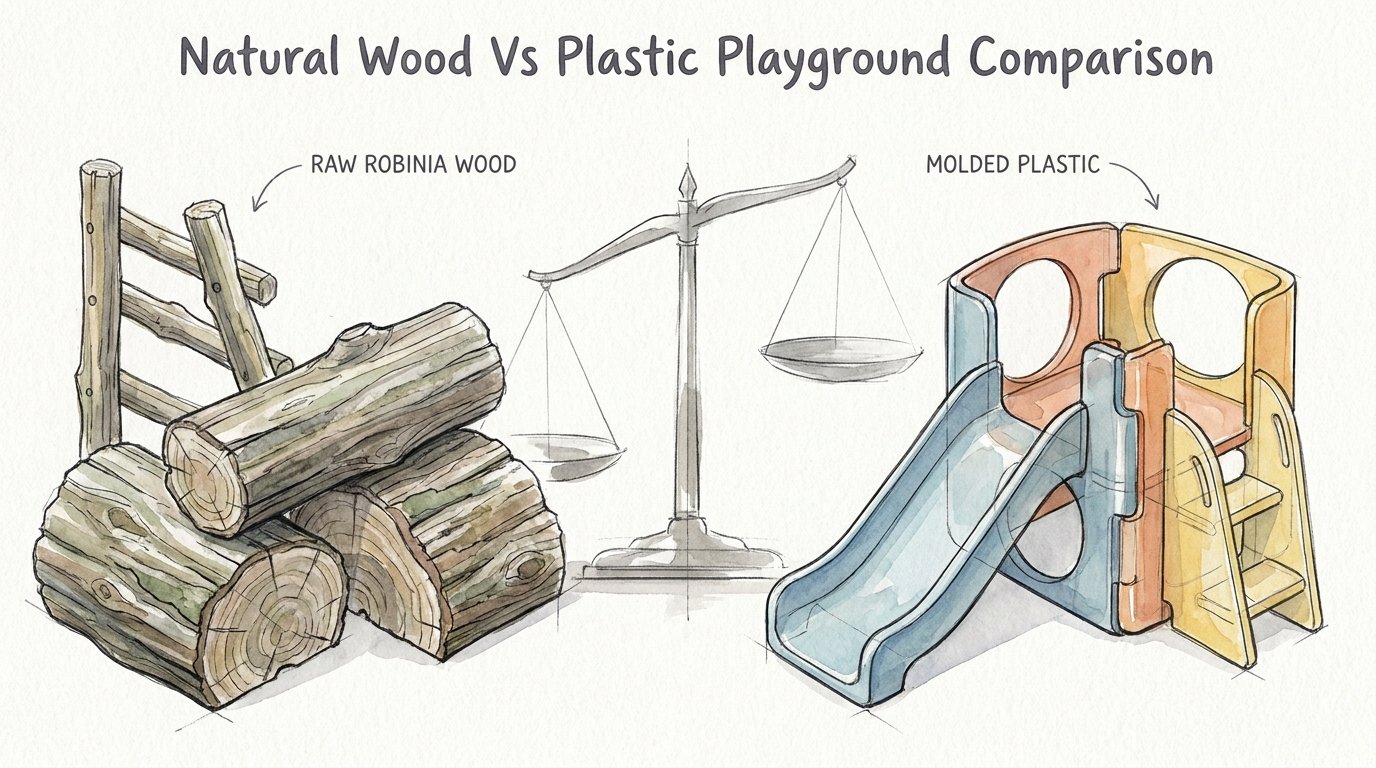
Natural Wood Vs Plastic Playground Comparison
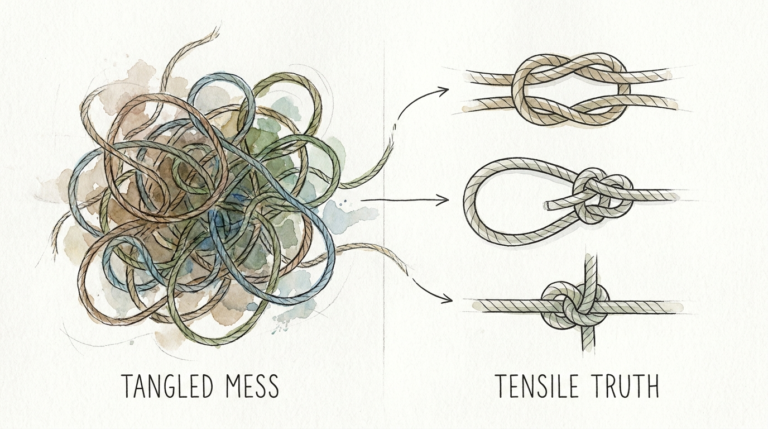
One will end up in a landfill in five years; the other will become a permanent part of your landscape’s legacy. Faded colors, microplastic shedding, and structural sagging—why do we keep buying plastic? Robinia hardwood is rot-resistant, stronger than oak, and mimics the natural world. It’s time to stop building eyesores and start building environments that age like fine wine.

Choosing between high-density plastic and natural timber isn’t just about looks. It is about how a space feels and how long it survives the elements. Robinia, also known as Black Locust, is the gold standard for outdoor durability. It offers a sensory richness that molded materials simply cannot replicate.
In this guide, we will explore why the shift toward natural materials is more than a trend. We will look at the science of durability, the environmental impact of our choices, and how to build structures that last for generations.
Natural Wood Vs Plastic Playground Comparison
This comparison defines the divide between temporary utility and long-term investment. Modern playgrounds and landscapes often rely on high-density polyethylene (HDPE) or “molded plastic.” These materials exist because they are cheap to mass-produce and offer bright, prescriptive colors. You see them in every suburban park: the same red slides and yellow panels.
Robinia hardwood stands at the opposite end of the spectrum. It is a dense, “wonky” timber that grows with character. Where plastic is uniform and predictable, Robinia is unique. No two logs are the same, which forces designers to work with nature rather than against it.
Real-world use cases show a stark difference in performance. Plastic absorbs heat, often becoming too hot for children to touch during summer months. In contrast, Robinia remains thermally stable and cool. While plastic eventually becomes brittle under UV exposure, Robinia develops a silver-grey patina that actually hardens its exterior.
How the Robinia Process Works
Building with Robinia is a craft that starts in the forest. Unlike softwoods that require chemical pressure treatment, Robinia is naturally “Class 1” durable. This means the wood itself contains high concentrations of tannins and tyloses that block rot and insects.
The manufacturing process follows several critical steps to ensure safety and longevity. First, craftsmen harvest the trees and select only the heartwood. The sapwood—the outer, softer layer—is removed because it lacks the same rot-resistance as the core.
Once the sapwood is gone, the logs are debarked and sanded to a smooth finish. This “de-barking and sapwood-free” requirement is essential for any structure meant to touch the soil. Finally, structural engineers use the natural curves of the logs to create frames. Because the logs are irregular, each joint must be custom-fitted, requiring a higher level of skill than assembling a plastic kit.
Benefits of Choosing Hardwood Legacy
The practical advantages of Robinia are measurable and significant. It is one of the hardest woods in the Northern Hemisphere, often outperforming White Oak in strength tests. This high density makes it nearly impossible for vandals to scratch or dent, a common problem with plastic panels.
Durability is the primary reason for choosing this wood. A Robinia post can stay in direct contact with the ground for 30 to 50 years without failing. Plastic structures often see their colors fade and their joints loosen within a single decade.
Environmental health is another major factor. Research shows that plastic play structures contribute to microplastic concentrations in urban parks. Choosing timber removes this risk entirely. Furthermore, wood acts as a carbon sink, sequestering carbon for the life of the structure, whereas plastic production is a high-emission process.
Challenges and Common Mistakes
Working with a living material brings unique challenges. The most common mistake is failing to account for “surface checking.” These are small cracks that appear as the wood seasons and dries. Beginners often panic when they see a crack, but in Robinia, these are rarely structural.
Another pitfall is using the wrong hardware. Because Robinia is so dense and contains natural tannins, it can corrode standard steel screws. You must use high-quality stainless steel (Grade 304 or 316) to prevent black staining and structural failure.
Failing to remove the sapwood is perhaps the most expensive error. If a builder leaves the light-colored sapwood on a log, that outer layer will rot within two years. Always ensure your supplier provides “sapwood-free” certified timber.
Limitations of Natural Timber
Robinia is not a “plug-and-play” material. Its organic shape means you cannot easily build perfectly straight, modular systems. If your project requires millimeter-perfect uniformity, timber may not be the ideal choice.
Cost is another realistic constraint. The initial investment for a Robinia structure is typically 20% to 40% higher than a plastic alternative. This cost covers the manual labor of hand-sanding and custom-fitting every joint.
Sourcing can also be a hurdle. While Robinia is abundant in parts of Europe and North America, the supply of large, structural logs is limited. You may face longer lead times compared to ordering a mass-produced plastic kit from a catalog.
Comparing MOLDED PLASTIC vs RAW ROBINIA
| Feature | Molded Plastic (HDPE) | Raw Robinia Hardwood |
|---|---|---|
| Lifespan | 10–15 Years | 30–50+ Years |
| Maintenance | Low (Cleaning) | Moderate (Sanding/Checking) |
| Thermal Comfort | High Heat Absorption | Stays Cool |
| Eco-Impact | Microplastic Risk | Biodegradable / Carbon Sink |
Practical Tips for Best Results
Apply these best practices to ensure your project stands the test of time. First, prioritize the “Silver Patina.” Many people try to stain Robinia to keep its golden hue, but the sun always wins. Allow the wood to weather to a natural silver-grey; this layer acts as a shield against further UV damage.
If you are building a playground, follow the EN 1176 safety standards. These guidelines specify the required diameters for structural posts and the depth of safety surfacing. For Robinia, ensure that any natural cracks do not exceed 8mm to avoid “finger entrapment” hazards.
Always pre-drill your holes. Robinia is so hard that it will snap standard drill bits and sheer off screw heads if you try to drive them directly. Using a beeswax-based lubricant on your screws can also make the installation process much smoother.
Advanced Engineering Considerations
Serious practitioners look at the chemistry of the soil before installation. While Robinia is incredibly rot-resistant, highly acidic or waterlogged soils can still impact the lifespan of the footings. Consider using steel “shoes” or galvanized steel brackets to elevate the wood 50mm above the ground level.
Think about “Movement and Tensions.” Hardwoods are living materials that expand and contract. When designing large-scale structures, allow for 2-3% dimensional change. This prevents joints from binding or bolts from bending during seasonal shifts.
Structural “irregularity” is an engineering advantage if handled correctly. The natural tapers of Robinia logs provide inherent strength. Use the thicker base of the log for the ground-contact point and the thinner end for overhead beams to optimize the center of gravity.
Examples and Real-World Scenarios
Consider a public park in a coastal environment. A plastic playground here will suffer from salt-air degradation and color bleaching within five years. A Robinia structure in the same location will thrive. The salt air has little effect on the hardwood’s internal structure, and the silvering process happens even faster, creating a beautiful “driftwood” aesthetic.
In a residential setting, a Robinia deck or climbing frame adds property value. It looks like a custom architectural feature rather than a temporary toy. A homeowner who invests in a “Raw Robinia” setup avoids the cycle of dismantling and disposing of cracked plastic every few years.
Finally, look at urban “Heat Islands.” Cities with concrete and plastic playgrounds record much higher surface temperatures. Replacing these with Robinia structures and natural bark mulch can lower the local temperature by several degrees, making the space usable even in mid-July.
Final Thoughts
Building with Robinia is a commitment to the long game. It requires moving away from the “buy-break-replace” cycle that defines so much of modern construction. While the initial effort is higher, the reward is a landscape that feels permanent and purposeful.
Nature provides the best architecture. By using a wood that defends itself against rot and heat, we create spaces that are safer for children and better for the planet. You are not just building a playground; you are planting a legacy.
Experiment with the “wonky” beauty of natural timber. Start with a small feature, like a balance beam or a garden bench, and watch how it interacts with the environment. Once you see the silver-grey resilience of Robinia in person, you will never go back to plastic.
Sources
1 atozwoodcompany.com | 2 robidecking.com | 3 touchwoodplay.com | 4 buglo.pl | 5 signetplay.co.uk | 6 kompan.com | 7 robiwood.com | 8 legnolandia.com | 9 obraplayground.co.uk