Screen Time And Social Isolation In Children
We are paying for 20 minutes of quiet today with a lifetime of social distance. The tablet is the most expensive babysitter in the world. It doesn’t charge by the hour; it charges by the connection. When a child is physically present but socially absent—unable to make eye contact or hold a conversation without a digital crutch—the habit has become a massive social debt.
Every swipe on a glass screen is a missed opportunity for a glance at a human face. While the silence in the living room feels like a relief, the long-term cost is quietly compounding in the background. Modern parenting has been hijacked by the convenience of the “off switch,” but we are finding that the social brain does not have a “resume” button that works quite as easily.
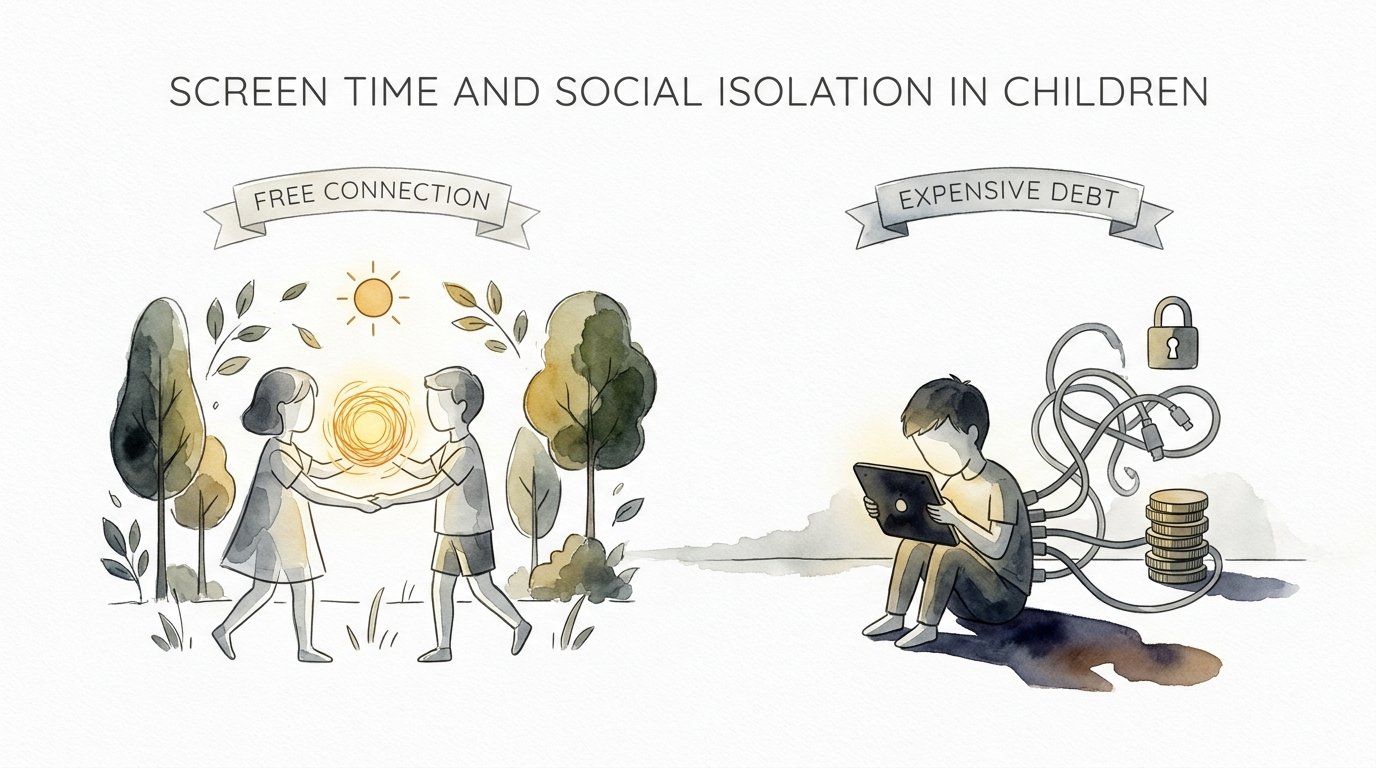
This is not a lecture on “bad parenting.” It is a roadmap for understanding the invisible trade-offs we make every time we hand over a device. If we want to raise children who can navigate the complexities of human emotion, we have to understand where the FREE CONNECTION of the home is being replaced by an EXPENSIVE DEBT of digital isolation.
Screen Time And Social Isolation In Children
Screen time and social isolation in children is a phenomenon where digital device usage replaces the critical face-to-face interactions required for healthy human development. It is often described as “displacement.” When a child is staring at a tablet, they are not practicing the subtle art of reading a sibling’s frustration or a parent’s pride. This isolation exists even when the child is sitting in a crowded room.
The primary reason this issue has reached a fever pitch is the sheer accessibility of high-fidelity entertainment. In previous generations, boredom was the gateway to social play. Today, boredom is “cured” instantly with a YouTube algorithm. This shift creates a vacuum where social skills should be growing. Instead of learning to negotiate rules in a game of tag, children are following pre-set digital paths that require zero social compromise.
Real-world examples are everywhere. Think of a family at a restaurant. If every child has a screen, the table is a collection of silos. There is no shared story, no “joint attention,” and no practice in waiting—a fundamental social skill. The child remains physically safe but becomes socially stranded, losing the ability to sync their emotions with the people who love them most.
The Mechanics of Connection: How Social Skills Are Built
Human social intelligence is not “pre-installed” at birth. It is a biological system that must be calibrated through thousands of hours of “serve-and-return” interactions. When a baby babbles and a parent responds, a neural circuit is completed. Screens disrupt this circuit by providing a “one-way” stream of information that never asks for a return.
Joint attention is the most critical missing piece in the digital age. This happens when two people focus on the same object—like a bird in a tree—and check back with each other’s eyes to share the experience. Research shows that infants exposed to high levels of screen time initiate significantly fewer signs of joint attention. They stop looking at the adult to see if the adult is seeing what they see.
The “Still Face” effect is also at play. When a parent is on their own phone, their face becomes unresponsive. Children find this deeply distressing and eventually stop trying to engage. This “technoference” creates a double-sided isolation: the child is lost in their screen, and the parent is lost in theirs. The bridge of connection is out on both ends.
The Immediate Benefits: Why the Trap Is So Effective
The “digital babysitter” offers a level of convenience that is hard to ignore. For a busy parent trying to cook dinner, finish a work email, or simply breathe for ten minutes, a tablet provides an instant, reliable quiet. This is the “short-term gain” that masks the “long-term debt.”
The Calming Effect
Screens act as a powerful emotional regulator. The bright colors, fast pacing, and dopamine hits of a video game can instantly stop a tantrum. It feels like a tool for peace, but it is actually a bypass. Instead of the child learning to regulate their own nervous system, they are being “sedated” by external stimuli.
Educational Content Myths
Many parents justify excessive screen time because the content is “educational.” While some apps can teach ABCs or 123s, they cannot teach the “soft skills” of empathy, turn-taking, or conflict resolution. Learning to count to ten on a screen is a poor substitute for learning how to share a toy with a peer.
The Hidden Challenges of Digital Over-Reliance
The most dangerous aspect of screen-induced isolation is that it doesn’t show up as a “broken” skill immediately. It shows up as “atrophy.” Like a muscle that isn’t used, the child’s social capacity begins to shrink.
- Social Skill Atrophy: Children lose the ability to maintain eye contact because screens never look back.
- Emotional Dysregulation: Without the practice of self-soothing, children become more prone to aggressive outbursts when the screen is eventually taken away.
- Reduced Empathy: Digital characters don’t have feelings that a child has to consider. This can lead to a “me-first” mentality in real-world play.
- Delayed Language: Passive watching does not encourage the “back-and-forth” talk that builds vocabulary and conversational rhythm.
Common mistakes include using the tablet as the *primary* reward for good behavior. This elevates the device to a status higher than human interaction. When a child views the screen as the “ultimate prize,” social time starts to feel like a chore they have to endure to get back to the glass.
Limitations: When Tech Simply Cannot Compete
Technology is a brilliant tool for information, but it is a terrible tool for intimacy. There are fundamental biological boundaries that a screen cannot cross. Human touch, the smell of a home-cooked meal, and the physical “vibe” of a room are all missing from the digital experience.
Environmental limitations also play a role. A child in a high-screen household often has less access to “loose parts” play—sticks, boxes, and dirt—that require imagination and social cooperation. The “walled garden” of an app limits the child to the programmer’s imagination, whereas a backyard requires the child to create their own world with others.
Furthermore, digital interaction is often “asynchronous” or edited. Social media and apps remove the “awkwardness” of real-time human connection. Real social life is messy, slow, and sometimes boring. Children who are conditioned for the high-speed “perfect” feedback of a screen find the “clunky” nature of real-life friends frustrating and unrewarding.
Comparing Analog Play vs. Digital Consumption
| Feature | Analog Play (Social) | Digital Consumption |
|---|---|---|
| Feedback Loop | Dynamic; based on human emotion. | Static; based on programmed loops. |
| Visual Focus | Central/Macular (Eye contact, depth). | Peripheral/Fixed (High contrast). |
| Skill Growth | Negotiation, empathy, patience. | Pattern recognition, reaction speed. |
| Social Cost | FREE (Builds capital). | DEBT (Displaces growth). |
Practical Tips to Repay the Social Debt
If you feel like your child is sliding into social isolation, the goal isn’t to throw the tablet in the trash. The goal is to re-integrate the child into the human circle. You have to “pay down” the debt with intentional presence.
- The “20-Minute Re-Entry”: After screen time, don’t jump straight into chores. Spend 20 minutes in “high-touch” play to help their brain transition back to the real world.
- Screen-Free Zones: Declare the dinner table and the car as “human-only” zones. These are the primary places where “micro-conversations” happen.
- Co-Viewing: If they must use a screen, sit with them. Ask questions. “Why did that character do that?” “What do you think happens next?” This turns a solo activity into a social one.
- Model the Behavior: Your child will not put down their screen if you are constantly scrolling yours. Eye contact is a two-way street.
- Externalize the Timer: Use a physical kitchen timer for screen sessions. It removes you as the “villain” and puts the boundary on an objective tool.
Advanced Considerations: Neurological Pruning
The brain of a child is a master of efficiency. Through a process called “synaptic pruning,” the brain keeps the pathways that are used often and discards the ones that aren’t. If a child spends their formative years stimulating the “digital” pathways—reaction speed, scrolling, and flashing lights—but ignores the “social” pathways—nuance, eye contact, and patience—the brain may literally prune away the hardware for social intelligence.
Visual health is another advanced concern. Screens primarily stimulate peripheral vision through fast-moving, high-contrast images. Real-world social interaction requires “central macular vision,” which is used for sustained eye contact and reading facial expressions. Excessive screen time can “lazy-up” the visual system, making it physically harder for a child to focus on a human face during a conversation.
We are also seeing shifts in the prefrontal cortex. This is the area of the brain responsible for “executive function” and impulse control. Because screens provide instant gratification, the child’s prefrontal cortex doesn’t get the “workout” it needs to learn how to wait, plan, or tolerate frustration.
Real-World Scenario: The Restaurant Test
Imagine two families at a local diner.
Family A arrives, and the parents immediately hand out two tablets. The children are silent. They eat their chicken nuggets while staring at Minecraft videos. There is zero conversation. When the food is finished, one child has a meltdown because the tablet battery died. They have spent 60 minutes in “social isolation” despite being in a public square.
Family B arrives. No tablets. The children are wiggly and a bit loud at first. They have to wait for their food. They play “I Spy” with their parents. They watch the waiter and learn how to say “thank you.” They navigate the “boredom” of waiting by talking about their day.
Family B is paying into their “social capital.” Family A is taking out a “social loan” that will eventually have to be repaid with interest in the form of social anxiety or behavioral issues later in life.
Final Thoughts
The tablet is not the enemy, but it is a powerful substitute that requires careful management. We cannot expect children to master the complex, “analog” world of human relationships if they are spending the majority of their waking hours in a “digital” vacuum. The quiet we buy today with a screen is a temporary fix for a permanent developmental need.
Choosing connection over convenience is hard. It is loud. It is messy. It requires us to be present even when we are tired. However, the reward is a child who can look someone in the eye, hold a steady conversation, and navigate the world with confidence and empathy.
Start small. Reclaim the dinner table. Put the “babysitter” back in the drawer. The most important connection your child will ever have isn’t found in a Wi-Fi signal; it’s found in the reflection of your eyes. Experiment with one screen-free afternoon this week and watch how the “social debt” begins to lift.
Sources
1 wellspringprevention.org | 2 medium.com | 3 familiesforwardva.org | 4 northstarearlyeducation.com.au | 5 nih.gov | 6 nih.gov | 7 childrenandscreens.org | 8 mdpi.com | 9 nih.gov | 10 dal.ca | 11 thejacobsladdergroup.org