Ipad Reset Mental Mapping For Kids
Your child can find a hidden level in a game, but can they find their way back from the park without a blue dot? Day 4 of the iPad Reset focuses on spatial awareness. When we outsource ‘where we are’ to a device, the brain’s hippocampus begins to prune the very connections used for physical navigation and memory. Ancestral wisdom didn’t need a ping; it needed a perspective.
Parents often notice their kids are wizards at navigating complex digital menus. They can find the settings icon in three seconds. Yet, those same kids might struggle to describe how to get to their grandmother’s house just four blocks away. This disconnect happens because digital screens offer a flattened, two-dimensional world that doesn’t challenge the brain’s internal GPS.
Spatial awareness is more than just not bumping into furniture. It is the foundation for high-level mathematics, engineering, and architectural thinking. It is the ability to visualize how objects move and relate in a three-dimensional space. When a child relies on a screen to tell them when to turn left or right, their brain stops doing the heavy lifting of building a “cognitive map.”
Today is about reclaiming that territory. We are moving from the glowing screen to the physical world. We are teaching our children to look up, look around, and truly see the environment they live in. This shift isn’t just about safety; it is about building a more robust, capable brain.
Ipad Reset Mental Mapping For Kids
Mental mapping is the process of creating an internal representation of the physical environment. It allows a person to visualize a route, recognize landmarks, and understand the relationship between different locations. In the context of the iPad Reset, mental mapping for kids involves shifting from “egocentric” navigation to “allocentric” navigation.
Most children today operate in an egocentric state. This means they navigate based on their immediate perspective: “I turn left at the red sign.” Digital devices reinforce this by keeping the user at the center of the screen at all times. The world moves around them, but they remain the static center.
Allocentric navigation is different. It requires the child to understand where they are in relation to external markers that don’t move. They see the park as being “north of the school” or “two blocks past the library.” This perspective is what builds the hippocampus—the part of the brain responsible for memory and spatial reasoning.
Real-world mapping occurs when a child has to think about the “big picture.” It happens when they have to draw a map of their bedroom or plan a route through a grocery store. Without a device to provide a “blue dot” to follow, the brain must actively engage with landmarks, distances, and directions.
How to Rebuild Spatial Navigation Step by Step
Building a mental map doesn’t happen overnight. It requires consistent, intentional practice. You can start small and gradually increase the complexity as your child becomes more confident in their surroundings.
Start with Room Familiarization
Begin inside the home. Have your child stand in the center of their bedroom and close their eyes. Ask them to point to the window, the door, and their toy box. This simple exercise forces the brain to access a stored mental image of the space.
Once they can do this, move to “Wall Numbering.” Assign numbers 1 through 4 to the walls of a room. Wall 1 is the entrance. Have the child identify what objects are on Wall 3 or Wall 4. This creates a structured grid in their mind, which is the precursor to more complex map reading.
The “Human GPS” Game
The next time you go for a walk, let your child be the navigator. Before you leave, look at a physical map of the neighborhood together. Identify your destination and two major landmarks you will pass along the way.
Put the phone in your pocket and let them lead. If they take a wrong turn, don’t correct them immediately. Let them realize the environment doesn’t match their mental plan. Navigating back from a “wrong” turn is one of the most powerful ways to strengthen the hippocampus.
Create a 3D Neighborhood Model
After your walk, come home and build the route. Use LEGOs, blocks, or even cardboard boxes to represent the houses and parks you saw. Physically building the environment helps transition 3D experiences into a stable mental map.
Encourage them to use “spatial language.” Use words like “between,” “parallel,” “adjacent,” and “perpendicular.” Research shows that children who use and hear rich spatial language perform significantly better on spatial reasoning tests later in life.
Benefits of Strong Spatial Awareness
Developing these skills provides measurable advantages that go far beyond finding a way home. Spatial intelligence is a primary predictor of success in Science, Technology, Engineering, and Math (STEM) careers.
- Mathematical Proficiency: Spatial skills are closely linked to number sense. Understanding where “8” sits on a mental number line requires spatial processing.
- Problem-Solving: Children with strong mental maps can “rotate” objects in their minds. This helps them visualize solutions to complex puzzles or mechanical problems.
- Independence and Confidence: A child who knows where they are is less anxious in new environments. They trust their ability to navigate and explore.
- Athletic Ability: Tracking a ball in flight or navigating a crowded soccer field requires high-level spatial awareness and coordination.
Studies have shown that spatial training can improve math performance by as much as 18 months of progress in just a few months of dedicated practice. By turning off the iPad and turning on the “internal GPS,” you are giving your child a massive academic edge.
Challenges and Common Mistakes
The biggest hurdle for most parents is the “efficiency trap.” It is faster to use the GPS. It is easier to hand over the phone to keep a child quiet in the backseat. However, every minute spent following a digital arrow is a minute the brain is in “passive mode.”
Mistake: Over-Correcting. When parents jump in to fix a navigational error instantly, the child stops paying attention. They learn that they don’t need to be aware because an adult (or a device) will handle the thinking.
Mistake: Abstract Mapping Too Early. Don’t start with a complex topographical map. Start with the child’s own body. If they don’t understand “left” and “right” on their own person, they cannot understand it on a piece of paper.
Mistake: Making it “Schoolwork.” Navigation should be an adventure, not a test. If the child feels pressured to get it right, they may shut down. Keep it high-energy and curiosity-driven.
Limitations of Mental Mapping
While mental mapping is a vital skill, it has realistic boundaries. Environmental factors and individual development play a role in how quickly a child picks up these techniques.
Environmental limitations are a major factor. If you live in a “grid-less” rural area with few landmarks, building a mental map is much harder than in a structured city. Conversely, in a highly repetitive suburban maze, everything might look the same, making landmark recognition difficult.
Developmental stages also matter. Younger children (under age 5) are naturally egocentric. They physically cannot see the world from an “overhead” or allocentric perspective yet. Pushing for complex map reading too early can lead to frustration rather than growth.
Neurodivergence can also impact spatial processing. Children with certain learning differences may struggle with “proprioception”—the sense of where their body is in space. For these children, the iPad Reset should focus more on physical movement and sensory input before moving to abstract maps.
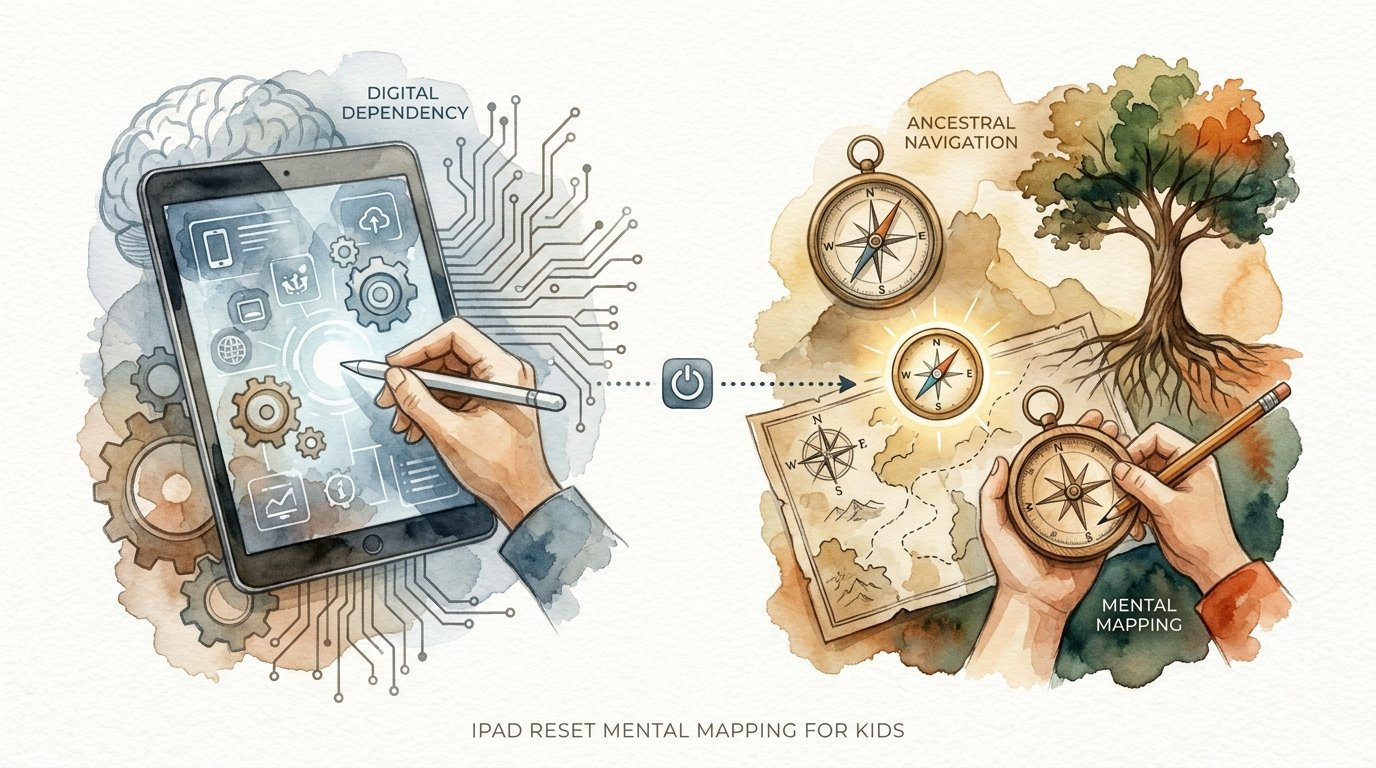
Comparison: Digital Navigation vs. Ancestral Navigation
Understanding the difference between these two modes helps explain why the “blue dot” is so detrimental to brain development.
| Feature | Digital (GPS) Navigation | Ancestral (Mental) Navigation |
|---|---|---|
| Brain Engagement | Passive (Follows instructions) | Active (Decision making) |
| Hippocampal Activity | Low (Circuit dormancy) | High (Growth and plasticity) |
| Landmark Recognition | Ignored (Eyes on screen) | Critical (Eyes on environment) |
| Skill Transfer | Zero (Dependent on battery/signal) | High (Applies to math/logic) |
| Perspective | Egocentric (Me-centered) | Allocentric (Map-centered) |
Practical Tips for Success
To make Day 4 of the iPad Reset effective, follow these best practices for immediate application.
- Ditch the Phone: For one week, commit to navigating locally without using a map app. Even if you know the way, talk through the landmarks with your child.
- Use Paper Maps: Keep a physical city or park map in your car. Let your child trace the route with their finger as you drive.
- Play “I Spy” Landmarks: Turn driving into a game. “I spy something that tells us we are halfway to school.” This trains them to look for permanent markers.
- Blindfolded Guiding: In a safe area (like your backyard), have one child wear a blindfold while the other gives verbal directions. This builds communication and spatial visualization.
- Geocaching: Use technology as a bridge. Geocaching uses GPS to find hidden “treasures,” but it requires the user to interpret the environment and physical clues to find the actual container.
Advanced Considerations for Practitioners
For those who want to take spatial intelligence to the next level, consider introducing orienteering. This is the sport of navigation using a highly detailed map and a compass. It requires the child to account for elevation, terrain types, and precise cardinal directions.
Advanced mental mapping also involves “mental rotation” exercises. Ask your child to imagine what the house looks like from the roof. Or, have them describe the route from the school back home, starting from the end and working backward. This “reverse navigation” is an elite-level hippocampal workout.
Consider the role of “Cardinal Directions.” Don’t just say “turn left.” Say “turn West.” Introducing the constant of the North/South/East/West grid provides a permanent framework that exists regardless of which way the child is facing. This is the ultimate tool for breaking egocentric dependency.
Example Scenario: The Weekend Hike
Imagine a family heading to a local nature trail. Usually, the parents have the trail map open on their phones. The kids are walking behind, eyes often drifting to the ground or looking for the next “stop.”
In the iPad Reset version, the parents print a physical map at the trailhead. They gather the kids and say, “We are at the Blue Circle. We need to get to the Red Star. What is the first landmark we should look for?”
The child identifies a wooden bridge on the map. As they walk, the child is actively scanning for that bridge. When they find it, they feel a surge of dopamine—not from a screen, but from successfully matching their mental map to the physical world. They then have to decide which way to turn at the fork. If they choose correctly, their confidence grows. If they choose wrong, they learn to “re-center” using the environment. This is how a resilient brain is built.
Final Thoughts
The iPad Reset is not about hating technology. It is about recognizing when technology is doing a job that our children’s brains *need* to do for themselves. Spatial awareness is a “use it or lose it” skill. By reclaiming navigation, you are physically shaping the architecture of your child’s brain.
You are moving them from being passive consumers of directions to active explorers of their world. This transition builds the hippocampus, sharpens mathematical reasoning, and instills a sense of rugged independence that no “blue dot” can ever provide.
Start today. Turn off the screen, look at the horizon, and ask your child, “Which way is home?” Let them find the answer in the world around them, not in the palm of their hand. Deepening their connection to physical space is the first step toward a more capable and confident future.
Sources
1 washingtonpost.com | 2 education.gov.uk | 3 coppellstudentmedia.com | 4 digitalpromise.org | 5 blairvadach.org.uk | 6 diamondmomstreasury.com | 7 youtube.com | 8 perkins.org | 9 edweek.org | 10 frontiersin.org | 11 funexpectedapps.com | 12 mathnasium.com | 13 jointhewildlife.com | 14 nih.gov | 15 liu.edu | 16 gitbook.io | 17 rightbrainchild.com