Best Multi Use Toys For Kids
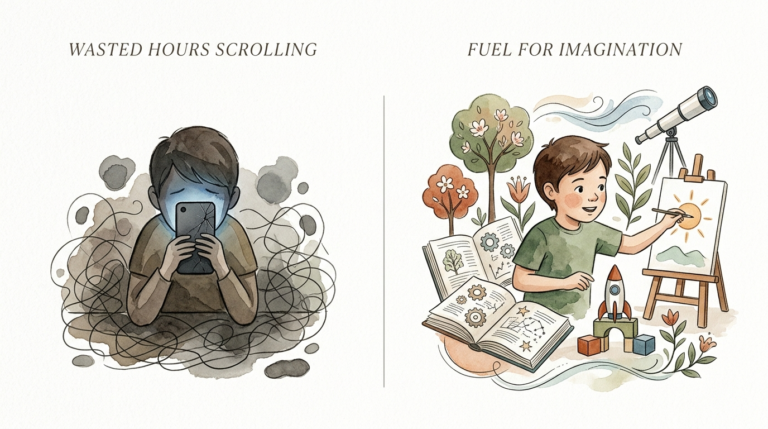
One device tells them what to think; the other asks them where they want to go. We’re flooding our homes with plastic gadgets that have ‘one-button’ outcomes. When a toy does everything for the child, the child’s brain does nothing for itself. Swap the single-purpose plastic for multi-use tools that turn a backyard into a kingdom.
Every parent knows the frustration of a noisy electronic toy that loses its charm in ten minutes. These gadgets often guide children through a scripted experience where the only requirement is to press “start.” In contrast, multi-use toys serve as the raw material for a child’s imagination. They don’t come with a manual because the child is the architect of the experience.
Choosing the right tools for play isn’t just about clearing the clutter. It is about fostering cognitive flexibility and problem-solving skills that last a lifetime. When a child looks at a wooden plank and sees a bridge, a ramp, or a throne, they are practicing high-level symbolic thinking. This shift from passive consumption to active creation is the hallmark of healthy development.
Practical play doesn’t need to be expensive or complicated. Often, the most effective tools are the ones that look the simplest on the shelf. This guide explores how to identify and use multi-use toys to maximize your child’s potential without turning your living room into a plastic graveyard.
Best Multi Use Toys For Kids
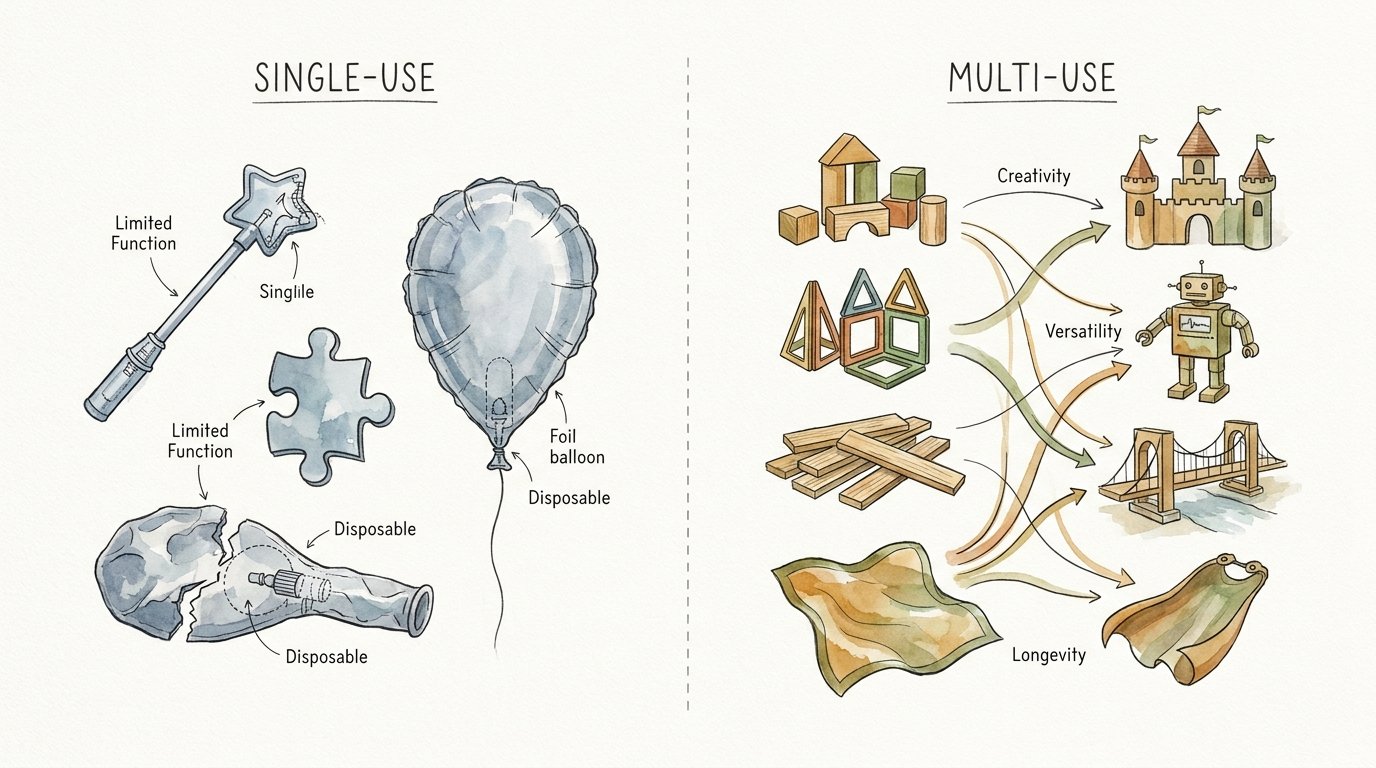
Multi-use toys, often called open-ended toys, are items that can be used in dozens of different ways depending on the child’s age and interest. Unlike a toy car that is always a car, a multi-use toy might be a building block today and a piece of “cake” tomorrow. These toys exist to facilitate play rather than dictate it, making them essential for a stimulating home environment.
Real-world examples include items like magnetic tiles, wooden blocks, and play silks. These are staples in Montessori and Waldorf classrooms because they grow with the child. A toddler might simply stack magnetic tiles to see them fall, while a seven-year-old uses those same tiles to build a complex geometric space station. The toy remains the same, but the play evolves as the child’s brain matures.
The concept of “Loose Parts” is another pillar of multi-use play. This involves providing children with a variety of materials—like stones, buttons, or cardboard tubes—that they can move, carry, and combine. These materials provide endless opportunities for invention. They are used in professional early childhood settings to encourage divergent thinking, where there is no “correct” answer, only possibilities.
Top Recommendations for 2024
- Magnetic Building Tiles: These offer lessons in physics, geometry, and color theory all at once.
- Solid Wooden Blocks: The ultimate classic that teaches balance, gravity, and spatial awareness.
- Play Silks and Scarves: These transform from capes and veils to rivers and fire in an instant.
- Stepping Stones or Balance Boards: Perfect for developing gross motor skills and core strength while pretending the floor is lava.
- Animal and Human Figures: Realistic, non-branded figures allow children to script their own social scenarios and stories.
How Multi-Use Toys Spark Cognitive Development
The process of playing with open-ended tools is actually a complex series of mental exercises. When a child is given a toy with a single function, their job is to figure out the “trick” and repeat it. Once the button is pushed and the song is played, the learning stops. Multi-use toys keep the brain in a state of constant inquiry.
Symbolic play is the first major milestone. This happens when a child uses one object to represent another. Research suggests that 90% of a toy’s value should come from the child, while only 10% comes from the toy itself. If the toy does 90% of the work—moving, talking, and lighting up—the child’s brain enters a passive “observer” mode.
Executive functions like planning and self-regulation are also put to the test. Building a tall tower with plain blocks requires the child to plan their base, regulate their movements to avoid a collapse, and problem-solve when things go wrong. These are the same “soft skills” required for success in higher education and professional life.
To implement this at home, start by observing your child’s current interests. If they are obsessed with “making dinner,” give them a bowl of wooden beads and some fabric scraps instead of a plastic pre-made pizza. Watch how they invent ingredients, name their dishes, and serve “customers.” You aren’t just giving them a toy; you’re giving them a laboratory.
The Advantages of Choosing Versatility Over Gadgets
The primary benefit of multi-use tools is their extraordinary longevity. A single-purpose toy is usually outgrown within months as a child moves to the next developmental stage. A set of high-quality blocks can stay in the play rotation from age one to age ten. This makes them significantly more cost-effective over time.
Space management becomes much easier with a versatile collection. Instead of a mountain of specialized plastic items, you only need a few baskets of high-quality materials. This reduces overstimulation, which is a major cause of behavioral meltdowns in young children. A calm, organized environment leads to longer periods of “deep play” and better focus.
Social skills also thrive when toys don’t have “rules.” In group play, children must negotiate what a specific object represents. “This blue silk is the ocean, and we are the sharks,” requires consensus and cooperation. These interactions build empathy and communication skills far more effectively than playing a structured digital game side-by-side.
Sustainability is a final, undeniable advantage. Most multi-use toys are made from durable, natural materials like wood, wool, or cotton. They don’t require batteries, they don’t have electronic circuits that break, and they don’t end up in a landfill as quickly as their plastic counterparts. They are heirlooms, often passed down through generations.
Common Pitfalls in Toy Selection
One frequent mistake is buying toys based on adult aesthetics or “educational” labels. Just because a toy is marketed as “STEM-certified” doesn’t mean it offers high-quality play. Often, these kits are just another form of “follow the instructions” workbooks disguised as fun. If the outcome is predetermined, the creativity is limited.
Parents often provide too many choices at once. A room overflowing with toys actually paralyzes a child’s ability to choose. They flit from one thing to another without ever engaging deeply. This is known as “toy fatigue.” It results in the child complaining they are bored despite being surrounded by hundreds of items.
Another error is choosing character-branded toys over neutral versions. A toy from a popular movie comes with a pre-written script. The child feels compelled to act out scenes they have already seen on screen. A generic wooden figure, however, can be anyone the child needs them to be at that moment, from a doctor to a space explorer.
Ignoring age recommendations for the sake of “advanced learning” can also backfire. Giving a toddler small magnetic balls meant for older kids is a safety hazard, but it also creates frustration. If a toy is too complex for their current motor skills, they won’t learn; they will simply give up and lose confidence in their ability to play independently.
Realistic Constraints: When Multi-Use Isn’t Enough
It is important to acknowledge that multi-use toys require a certain level of “parental scaffolding” initially. If a child is used to high-stimulus digital entertainment, they may struggle when presented with a pile of blocks. They might need you to sit on the floor and start a “build” with them before their own imagination takes over.
Space and safety can also be limiting factors. Loose parts play, involving small items like pebbles or beads, is fantastic for development but can be a choking hazard in homes with infants. Parents must be diligent about separating play areas or choosing “large-scale” loose parts like cardboard boxes and cushions until the child is older.
Cost can be a barrier upfront. High-quality wooden toys or brands like Magna-Tiles often have a higher initial price tag than a cheap plastic gadget. While they save money in the long run through durability, the entry price can be steep for some families. In these cases, DIY versions or thrifted natural materials are excellent alternatives.
Finally, environmental factors matter. A child in a small apartment might not have the room for a Pikler triangle or a large wooden kitchen. In these settings, “micro-play” sets like peg dolls and small building slats are better choices. Always match the tool to the environment to ensure it actually gets used.
Single-Purpose Gadgets vs. Multi-Use Tools
Understanding the difference between these two categories helps in making intentional purchases. Use the table below to compare how each type of toy impacts the play experience.
| Feature | Single-Purpose Gadgets | Multi-Use Tools |
|---|---|---|
| Main Driver | The Toy (Batteries/Microchips) | The Child (Imagination) |
| Longevity | Short (6-12 months) | Long (5-10 years) |
| Creativity | Passive (Follow Instructions) | Active (Create Rules) |
| Skill Building | Specific (ABC buttons) | Holistic (Motor/Logic/Social) |
| Maintenance | High (Batteries/Technical issues) | Low (Clean with damp cloth) |
Practical Tips for Building a Minimalist Toy Collection
Start by implementing a toy rotation system. You don’t need to throw away everything, but you should limit what is accessible at any one time. Put 70% of the toys in storage and leave out only a few high-quality, multi-use sets. Every few weeks, swap them out. This makes “old” toys feel new again and encourages deeper engagement.
Focus on “bridging items.” These are toys that help different sets work together. For example, a set of wooden “rainbow” arches can be used with blocks to make tunnels, with silks to make tents, or with animal figures to make fences. When buying new items, ask yourself: “Can this be used with the toys we already own?”
Don’t overlook the power of household items. A metal colander, a wooden spoon, and a stack of cardboard boxes are often more engaging than a $50 plastic playset. These items are the ultimate multi-use tools. They teach real-world physics and allow children to mimic the adult world, which is a fundamental drive in early childhood.
- Quality over quantity: Buy one set of beautiful wooden blocks instead of five plastic kits.
- Natural materials: Choose wood, cotton, and metal to provide varied sensory feedback.
- Neutral colors: These don’t overstimulate the brain and allow the child to imagine their own colors.
- Open storage: Use low, open shelves so children can see their tools and reach them independently.
Advanced Considerations: The Theory of Loose Parts
For serious practitioners of play-based learning, understanding the “Theory of Loose Parts” is a game-changer. Architect Simon Nicholson proposed this in 1971, stating that the richness of an environment is directly proportional to the number of variables in it. The more “variables” (loose parts) a child has, the more they can experiment and discover.
When you provide a child with a “finished” toy, you have removed all the variables. When you provide them with a bucket of pinecones, sticks, and colorful felt squares, you have provided a high-variable environment. The child must now invent the connections between these items. This is computational thinking in its purest form.
Scaling this concept involves creating “invitations to play.” Instead of just dumping a basket of items, arrange them in a way that suggests a starting point. For example, place a few wooden blocks in a circle with some blue fabric in the center. This “invites” the child to see a pond or a campfire, but leaves the final outcome entirely up to them.
Consider the “play value” of every square inch of your home. Can a hallway become a bowling alley with some soft balls and cardboard tubes? Can a kitchen corner become a sensory station with a bin of dried beans and measuring cups? Advanced play is about seeing the potential for learning in every material and every space.
Real-World Scenarios: From Living Room to Kingdom
Consider a simple rainy afternoon with a four-year-old. In a “gadget-heavy” home, the child might cycle through three different noisy tablets or electronic games, eventually ending up frustrated and asking for a screen. The play is fragmented and driven by external cues.
Now, look at a home with multi-use tools. The same child takes four large cardboard boxes, a set of play silks, and some masking tape. Within thirty minutes, they have constructed a multi-room castle. The blue silk becomes a moat. Wooden blocks are used to create a “drawbridge.” A set of plastic animal figures are the guards.
In this scenario, the child is using spatial reasoning to fit the boxes together. They are using fine motor skills to handle the tape. They are using narrative skills to create the story of the castle. Most importantly, they are practicing sustained attention. They might stay in this “flow state” for hours, constantly adding and modifying their kingdom.
This isn’t just “playing.” This is a masterclass in engineering, storytelling, and focus. When the child finally tires of the castle, the boxes are flattened for recycling, the silks go back in their basket, and the living room is clean. There are no broken plastic pieces or dead batteries to deal with—just a child who has successfully exercised their brain.
Final Thoughts
The transition from single-use gadgets to multi-use tools is a shift in philosophy. It requires moving away from the idea that toys should entertain children and toward the belief that toys should empower them. By choosing items that ask “What do you want to do today?” rather than “Press here for a song,” you are giving your child the greatest gift possible: their own imagination.
Remember that you don’t need a massive budget to make this change. Start small with a few baskets of natural materials and see how your child’s play changes. You will likely notice longer periods of focus, fewer meltdowns, and a surprising amount of creativity. The “kingdom” is already in your backyard or your recycling bin; your child just needs the right tools to build it.
Experiment with these concepts and observe the results. Every child is different, but the fundamental need for open-ended, creative play is universal. As you remove the “one-button” outcomes, you make room for a world of infinite possibilities. Happy building!
Sources
1 kidscareclub.com | 2 bankstreet.edu | 3 substack.com | 4 communityplaythings.com | 5 forbes.com | 6 simpleintentional.com | 7 kookaroo.com.au | 8 sigmatest.org | 9 msu.edu | 10 medium.com | 11 kidpowered.com | 12 miriambeloglovsky.com | 13 lillio.com | 14 skyrockettherapy.org | 15 storiesofplay.com | 16 theelefant.ai | 17 labebe.ge | 18 clubdesjouets.com | 19 kidsvillepeds.com | 20 chalkacademy.com | 21 naeyc.org | 22 twobirdsinc.com