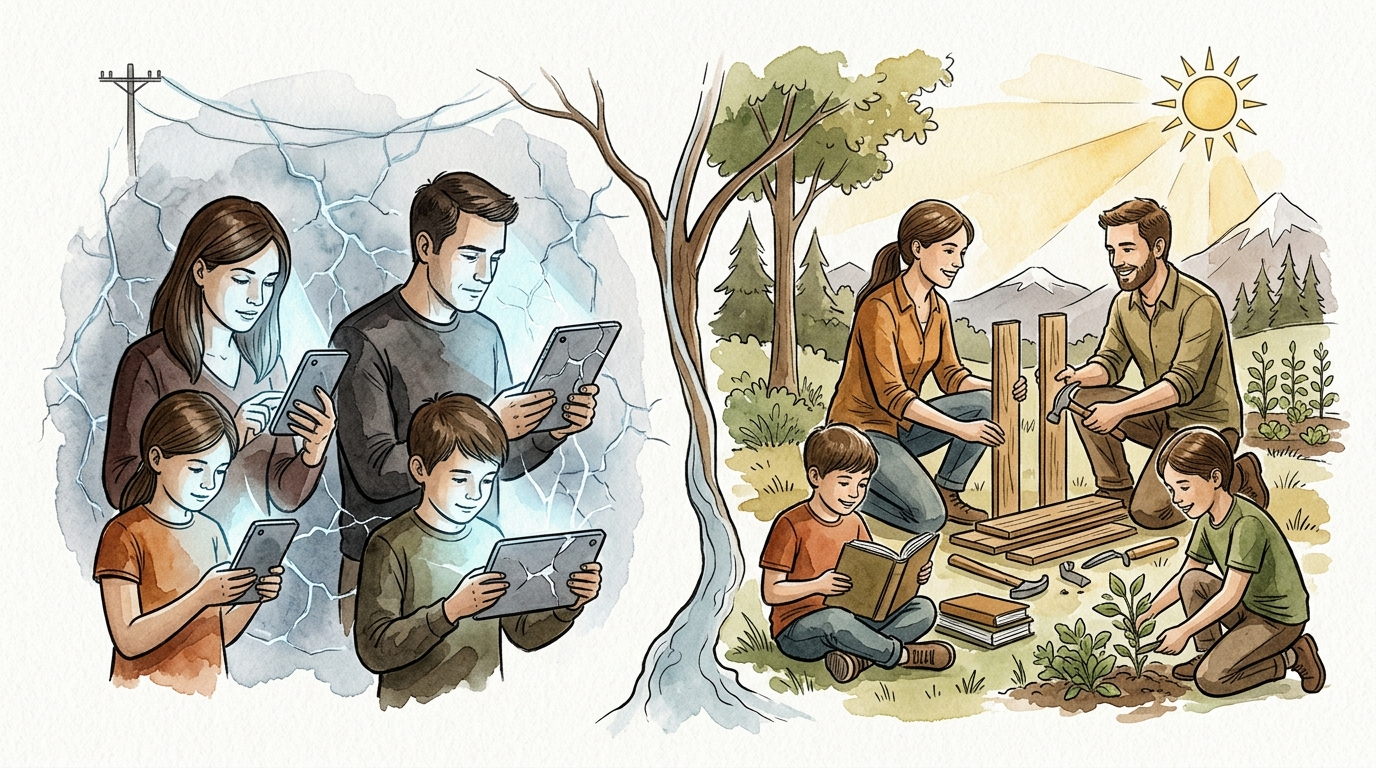
family screen free challenge
Is your family’s happiness dependent on a signal? It’s time to build resilience. The real test of a family is what happens when the WiFi goes down. We’re taking the Screen Free Challenge to prove our joy isn’t fragile.
The modern home has become a network of glowing rectangles. From the moment we wake up until the blue light fades into our pillows, we are tethered. It’s easy to mistake connectivity for connection. But research in 2025 and 2026 shows that while we are more “online” than ever, our internal family bonds are often under strain.
This guide isn’t about throwing your router in the trash. It’s about reclaiming your attention. It’s about moving from a state of fragile tech dependency toward resilient self-sufficiency. We want to help you guide your family through a transition that feels less like a punishment and more like a discovery.
family screen free challenge
A family screen free challenge is a structured commitment to reduce or eliminate non-essential digital use for a specific period. It is more than just a “digital detox.” It is a reset button for your household’s nervous system. In 2025, nearly 49% of parents admit to relying on screens daily just to manage parenting responsibilities. This challenge exists to break that cycle of “digital babysitting” and replace it with intentional presence.
Think of your family’s attention as a muscle. If you only exercise it by scrolling through short-form videos, that muscle becomes weak and easily distracted. The challenge is the training program that rebuilds your capacity for deep focus, long conversations, and creative play. It is used by families around the world to combat the rising tide of “technoference”—the frequent interruptions in interpersonal interactions caused by digital devices.
In real-world situations, this challenge looks different for everyone. For some, it is a “Screen-Free Sunday.” For others, it is a full week of unplugged living. The goal is to move the family from a default state of screen-seeking to a default state of world-seeking. When the tablet is no longer the first thing a child reaches for when bored, the challenge has succeeded.
How to Launch Your Own Challenge
Starting a family screen free challenge requires more than a simple announcement. It requires a strategy. If you go cold turkey without a plan, you will face a rebellion by Tuesday. You must build the infrastructure for success before you ever flip the switch.
First, identify your baseline. Research shows that 81% of children under 13 now have their own devices. Tracking your current usage for three days will give you a clear picture of where the “leaks” are. Do you use screens during meals? Is the first hour of the morning dominated by news apps? Use these insights to set your specific boundaries.
Second, involve everyone in the decision-making process. Children and teens are more likely to participate if they feel a sense of agency. Ask them what they think a fair “reset” looks like. They might suggest keeping the car screen-free or banning phones in the backyard. When the rules are co-created, the accountability becomes internal rather than external.
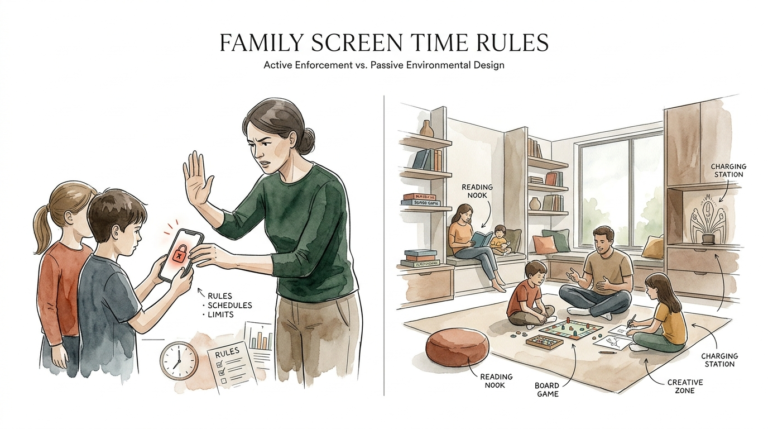
Third, prepare the “analogue environment.” You cannot remove a high-dopamine activity like gaming without providing a low-dopamine alternative. Stock up on board games, puzzles, art supplies, and outdoor gear. If the environment is rich with possibilities, the transition is much smoother.
The Science-Backed Benefits
The advantages of reducing screen time are measurable and life-changing. From physical health to emotional regulation, the data from 2025 studies is clear: less digital noise equals more human growth.
One of the most immediate benefits is improved sleep quality. Blue light from screens interferes with the production of melatonin, the hormone that tells our bodies it’s time to rest. Families who participate in a screen-free challenge often report falling asleep faster and waking up more refreshed within just 72 hours.
There is also a significant impact on social-emotional development. When we look at screens, we miss subtle facial expressions and vocal tones that are crucial for empathy. Unplugging allows family members to practice “attuned engagement.” This is the active, eye-to-eye connection that builds secure attachments and helps children learn to regulate their own emotions.
Furthermore, physical health risks like myopia (nearsightedness) are reduced. Current research shows a direct dose-response relationship between screen time and myopia risk, which increases sharply between one and four hours of use per day. Stepping away from the screen literally changes how your children see the world.
Common Pitfalls and How to Avoid Them
Many families fail their first challenge because they fall into predictable traps. The most common mistake is the “Cold Turkey Crash.” Jumping from six hours of daily use to zero without a transition period often leads to intense irritability and eventual relapse.
Another pitfall is the “Hypocrisy Trap.” Children are highly sensitive to adult behavior. If you tell your teen to put their phone away while you are secretly checking emails under the table, the challenge will lose all credibility. You must model the behavior you want to see. As a parent, your own screen habits are the strongest predictor of your child’s success.
To avoid these issues, start small. Begin with a “Screen-Free Hour” every evening. Once that feels natural, expand to a full afternoon. Gradually building the “boredom tolerance” of your family is much more effective than a sudden, total ban. Remember, the goal is to build long-term resilience, not to win a short-term contest of wills.
Limitations and Realistic Constraints
While a total digital detox sounds idyllic, we live in a modern world with real-world requirements. Acknowledging these limitations strengthens your plan rather than weakening it. Total isolation is rarely the goal; intentionality is.
School requirements are a major hurdle. Many modern educational systems require students to use Chromebooks or tablets for homework. It is unrealistic to ask a high schooler to fail a class for the sake of a screen-free challenge. In these cases, define “essential” vs. “non-essential” use. Using a laptop for an essay is a tool; using it for YouTube is a distraction.
Distant family connections are another valid exception. If your child’s only way to see their grandparents is via video call, that screen time should be celebrated. This is “connection-based” usage rather than “consumption-based” usage. The distinction is vital for maintaining a healthy, balanced home life.
Resilient Self-Sufficiency vs. Fragile Tech Dependency
When we look at the difference between a tech-dependent family and a resilient one, we are looking at the difference between fragility and strength. A family that cannot function without a signal is vulnerable to boredom, anxiety, and disconnection.
| Factor | Fragile Tech Dependency | Resilient Self-Sufficiency |
|---|---|---|
| Entertainment | Passive consumption of algorithms. | Active creation and imaginative play. |
| Social Bond | Fragmented by “technoference.” | Deeply attuned, eye-to-eye contact. |
| Boredom | Seen as a crisis to be solved by apps. | Seen as a catalyst for new ideas. |
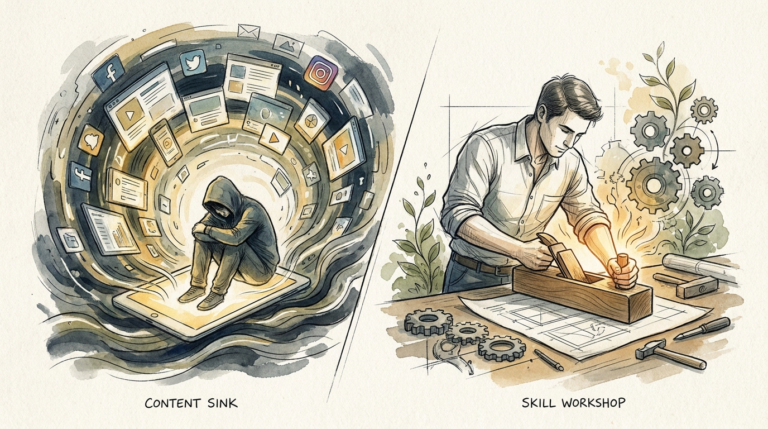
| Skill Level | Low; dependent on digital instructions. | High; hands-on problem solving. |
Transitioning toward resilience means teaching your children how to occupy themselves with nothing but their own minds and the physical objects around them. This is a foundational life skill that will serve them long after the challenge ends.
Best Practices for a Successful Reset
To make your family screen free challenge stick, you need to implement a few best practices. These tips are designed to turn the challenge into a lifestyle shift rather than a temporary phase.
Designate Tech-Free Zones: Establish certain areas of the house, like the dining room and all bedrooms, as “no-phone zones.” This creates a physical boundary that helps the brain switch out of “digital mode.” Keeping screens out of the bedroom is especially important for sleep hygiene and mental health.
The “One Screen” Rule: If you are going to use technology, ensure it is one screen at a time. Multi-tasking—like scrolling on a phone while the TV is on—is devastating for focus and attention spans. By focusing on one thing, you reduce the overstimulation that leads to digital burnout.
Use a “Boredom Jar”: Write down dozens of quick, non-screen activities on slips of paper. When someone says “I’m bored,” they have to pull a slip and do that activity for 15 minutes. This takes the mental load off parents and teaches kids how to find their own fun.
Advanced Considerations: The Eye Level Rule
For those who want to go beyond the basics, consider the “Eye Level Rule.” This is a strategy used by child development experts to combat technoference. It dictates that during any face-to-face interaction or playtime, all devices must be placed away from eye level. Even a phone sitting face-down on a table can signal to a child that they are not the top priority.
By removing the visual cue of the device, you create a sacred space for connection. This is particularly important for toddlers and young children, whose behavior often worsens as a “frantic bid for connection” when they feel a parent is distracted by a screen. Mastering this level of presence is the hallmark of a truly resilient family.
You might also look into “digital minimalism” tools. These are apps and settings that strip your phone of its addictive qualities—turning the screen to grayscale, removing notification badges, and setting hard limits on social media. These tools are the scaffolding that supports your new, resilient habits.
Example Scenarios
How does this look in practice? Let’s look at two different families.
Scenario A: The Weekend Reset. The Smith family decides to go screen-free from Friday at 6:00 PM until Sunday dinner. On Saturday morning, instead of everyone being on their own tablets, they go to the local park for a scavenger hunt. By Saturday night, the kids are playing a board game they haven’t touched in years. They find that they actually enjoy each other’s company when the “noise” is gone.
Scenario B: The Gradual Shift. The Martinez family feels a full weekend is too much. They start with “Screen-Free Mornings.” No one touches a device until everyone has had breakfast and dressed for the day. This simple shift reduces the morning “rush stress” and allows the parents to connect with their children before the school day begins. Over time, they add “Screen-Free Tuesdays,” building their resilience slowly but surely.
Final Thoughts
The family screen free challenge is not about being anti-technology. It is about being pro-connection. It is a tool to help you navigate a world that is designed to capture and sell your attention. By intentionally stepping back, you give your family the chance to breathe, to think, and to bond in ways that a high-speed connection can never facilitate.
Remember that perfection is not the goal. There will be days when the weather is bad, the kids are tired, and a movie is the best way to get through the evening. That’s okay. Resilience is built in the consistent, small choices we make every day to put the people in front of us above the pixels on our screens.
Encourage your family to see this as an adventure. Experiment with different activities, find what makes you laugh, and rediscover the joy of a quiet afternoon. You may find that the best parts of your life don’t require a login or a battery. Start your challenge today and see how much your family can grow when they finally unplug.
Sources
1 connecticutchildrens.org | 2 exonpublications.com | 3 muddypuddles.com | 4 luriechildrens.org | 5 healingharmony.in | 6 ssww.com | 7 unicef.org | 8 heartandmindcounseling.com | 9 recordablebookbuddy.com | 10 ffpeds.com | 11 healthychildren.org | 12 facebook.com