outdoor learning activities
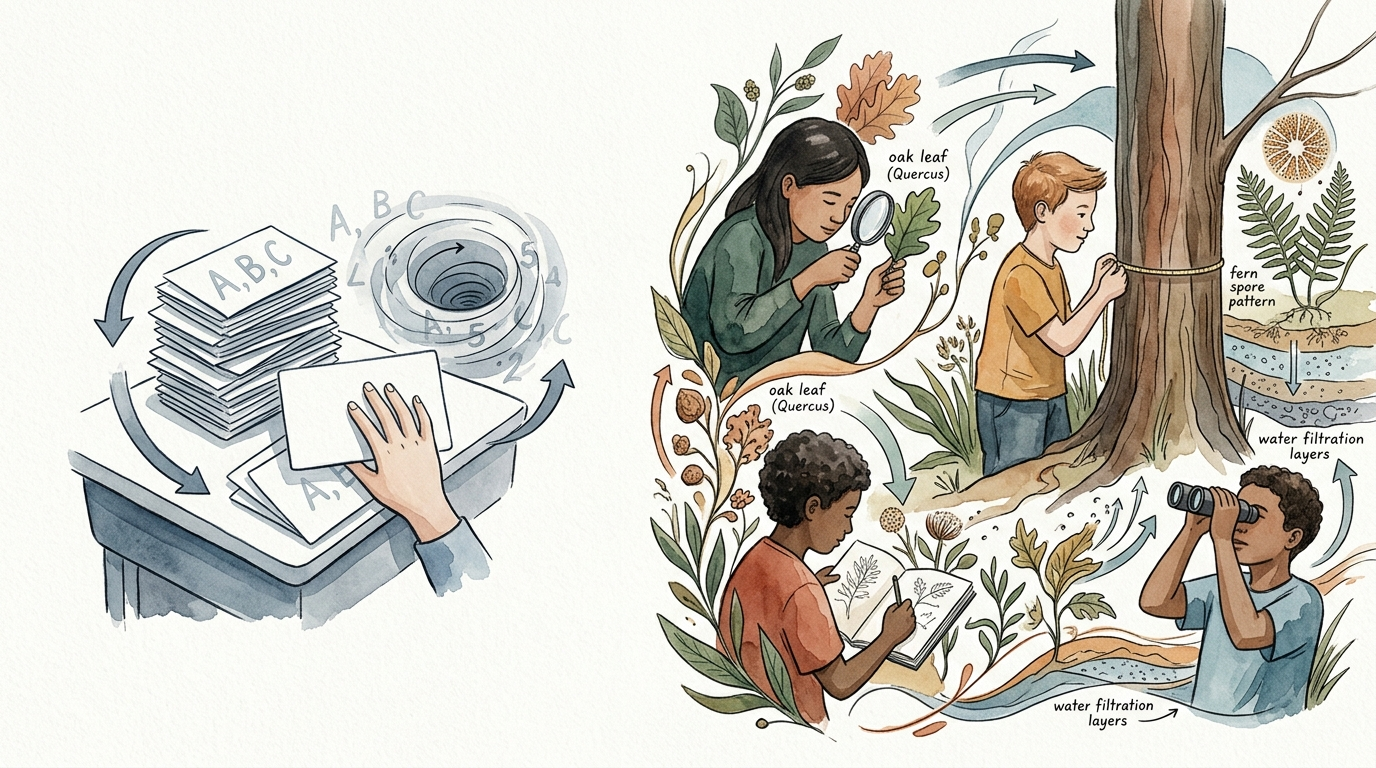
Stop forcing memorization when you can inspire exploration. Flashcards have their place, but nature is the ultimate classroom. Switch from manual rote memorization to strategic, hands-on learning with these outdoor activities.

Traditional education often relies on repetitive drills that treat the brain like a hard drive needing data entry. This “rote” method can feel like a chore for both the student and the teacher. When you take the lesson outside, the environment becomes the teacher. The wind, the soil, and the changing seasons provide a sensory-rich backdrop that anchors information in the long-term memory far more effectively than a white card with black ink ever could.

Nature literacy isn’t just about knowing the names of trees. It is about understanding the systems that sustain life. It involves observing patterns, asking “why,” and seeing the direct impact of cause and effect in real-time. By moving away from static drills and toward dynamic engagement, you help learners develop a deep-seated curiosity that lasts a lifetime.
outdoor learning activities
Outdoor learning activities are educational experiences that use the natural world as a primary source of information and context. Instead of reading about photosynthesis in a textbook, a student might observe the way leaves turn toward the sun or measure the growth of a sapling over several months. This approach is rooted in experiential learning, where the “doing” is just as important as the “knowing.”
These activities exist to bridge the gap between abstract theory and tangible reality. In a classroom, a “habitat” is a definition to be memorized. In the woods, a habitat is the damp underside of a rotting log where isopods and salamanders thrive. This real-world context makes the information relevant. When information is relevant, the brain naturally works harder to retain it.
Outdoor learning is used in forest schools, traditional K-12 curriculum, and even professional team-building retreats. It leverages the “Attention Restoration Theory,” which suggests that natural environments help the brain recover from the fatigue caused by high-intensity focused tasks like staring at a screen or a whiteboard. By stepping outside, you aren’t just changing the scenery; you are optimizing the brain for better processing.
Think of it like the difference between looking at a map and actually walking the trail. The map gives you the layout, but the trail gives you the elevation, the smell of the pine needles, and the physical memory of the climb. Outdoor learning activities provide the “climb” that makes the “map” make sense.
How to Transition to Nature-Based Learning
The shift from flashcards to the field requires a change in mindset. You must move from being a “deliverer of facts” to a “facilitator of discovery.” This doesn’t mean you abandon the curriculum. Instead, you look for ways to “outsource” the teaching to the environment around you.
Start by identifying a core concept you want to teach. If the goal is literacy, don’t just drill sight words. Take a stick and have the learner “write” those words in a patch of soft mud or sand. The physical resistance of the earth and the sensory feedback of the texture create a stronger neural pathway than a pencil on paper. This is a simple but effective example of integrating outdoor learning activities into daily routines.
Observation is your most powerful tool. Set up a “sit spot” where the learner spends ten minutes in silence every day. Their only job is to notice three things that have changed since yesterday. This builds the “habit of attention,” a foundational skill for all academic success. Over time, those three observations will turn into questions about weather patterns, animal behavior, or plant life cycles.
Use “Nature Scavenger Hunts” to teach classification and categorization. Instead of asking a student to circle the “coniferous tree” on a worksheet, ask them to find three different types of needles on the ground. Have them group these items by length, texture, or scent. This teaches the scientific method—observation, data collection, and analysis—without the learner even realizing they are “studying.”
Another technique is the “Phenology Wheel.” This is a circular journal that tracks the seasonal changes in a specific area. Each month, the learner sketches the dominant colors, the temperature, and the most common birds or plants they see. This long-term project teaches patience and provides a visual record of ecological cycles that no textbook can replicate.
Advantages of Experiential Outdoor Education
The benefits of taking learning outdoors are measurable and go far beyond just “getting some fresh air.” Research consistently shows that students who engage in nature-based learning exhibit higher levels of long-term knowledge retention. This is often because the information is tied to a specific sensory experience—the smell of the rain or the rough texture of bark—which acts as a “memory anchor.”
One of the most significant advantages is the reduction of stress and anxiety. Natural light and green spaces help regulate cortisol levels and circadian rhythms. For students who struggle with traditional classroom environments, the outdoors offers a “low-stakes” space where the pressure to perform is replaced by the freedom to explore. A calm brain is a brain that is ready to learn.
Physical health is an obvious but vital benefit. Outdoor learning activities naturally involve movement. Climbing a small hill to check a weather station or squatting to examine a bug hunt improves gross and fine motor skills. This physical engagement prevents the “nature-deficit disorder” often seen in children who spend the majority of their time in front of screens.
Collaboration and social skills also flourish in the wild. Many outdoor tasks, like building a simple shelter or clearing a garden bed, require teamwork and communication. Without the rigid structure of desks and rows, students are forced to interact more naturally, solving problems and sharing discoveries in real-time. This builds “soft skills” like leadership and empathy that are difficult to teach through rote methods.
Common Mistakes and How to Avoid Them
A frequent error is treating the outdoors as “extra recess.” If there is no clear learning objective or structure, students may view the time as purely social, leading to a loss of focus. You can avoid this by setting clear expectations before stepping outside. Explain the specific goal of the session—whether it is to find three types of igneous rocks or to sketch a bird’s nest—so the brain stays in “learning mode.”
Another mistake is over-scripting the experience. If you provide a five-page worksheet to be filled out while standing in a meadow, you have essentially just moved the classroom outside without changing the pedagogy. The magic of nature literacy lies in the unexpected discovery. If a student finds a hawk feather while you are supposed to be studying flowers, let them explore the feather. Flexible lesson plans allow for “teachable moments” that are far more impactful than a rigid script.
Teachers often worry about their own lack of expertise. You might feel you can’t teach nature literacy because you don’t know the name of every tree. This is a misunderstanding of the role. You are a co-researcher. If you don’t know the name of a plant, use a field guide or an app like iNaturalist to find out together. This models the process of lifelong learning for the student.
Safety concerns can also paralyze outdoor initiatives. While risks like insect bites or falls are real, they are often manageable with proper preparation. Conduct a quick site assessment before the session. Ensure everyone has appropriate clothing—”there is no such thing as bad weather, only bad clothing.” Establishing a “base camp” or a whistle signal for gathering helps maintain control without stifling the sense of adventure.
Limitations and Trade-offs
While outdoor learning activities are powerful, they are not a universal replacement for every type of instruction. Some concepts, like advanced calculus or high-level computer programming, may still require the specialized tools and controlled environment of an indoor space. The outdoors should be viewed as a powerful complement to traditional methods, not a complete replacement.
Environmental constraints are a reality. Urban settings with limited green space require more creativity. You may need to rely on container gardens, “crack-of-the-sidewalk” botany, or frequent trips to local parks. While nature is everywhere, the depth of the experience can be limited by the immediate surroundings.
Time is another practical boundary. Outdoor activities often take longer than indoor ones. Getting dressed for the weather, walking to the site, and the inherent “slowness” of nature study can make it difficult to fit into a 45-minute period. To mitigate this, many practitioners move toward “integrated blocks” where several subjects—science, art, and literacy—are taught simultaneously during one long outdoor session.
Nature Literacy vs. Rote Flashcard Drills
Choosing between these two methods depends on your goals, but a strategic blend is often most effective. The table below compares the two approaches across key educational metrics.
| Feature | Rote Flashcard Drills | Strategic Nature Literacy |
|---|---|---|
| Memory Type | Short-term / Working Memory | Long-term / Episodic Memory |
| Engagement | Low / Repetitive | High / Multi-sensory |
| Context | Abstract / Isolated | Real-world / Integrated |
| Skill Level | Beginner / Fact Retrieval | Advanced / Systems Thinking |
| Stress Level | Potential for High Stress | Generally Low / Restorative |
Flashcards are excellent for quick retrieval of static data, like multiplication tables or chemical symbols. Nature literacy is superior for building deep conceptual understanding and critical thinking. If you want a student to remember the parts of a flower for a test tomorrow, a flashcard works. If you want them to understand the role of pollinators in a global ecosystem ten years from now, you need to go outside.
Practical Tips for Immediate Application
You can start implementing outdoor learning activities today with very few resources. Create a “Mobile Discovery Kit” that includes a magnifying glass, a simple sketchbook, a few colored pencils, and a pair of tweezers. Having these tools ready to go makes the transition from indoors to outdoors seamless and exciting for the learner.
Incorporate “Micro-Adventures” into your weekly schedule. These are 15-minute sessions dedicated to a single, high-focus task. For example, “The Square Foot Study” involves placing a hoop or a string on the ground and spending 15 minutes documenting everything inside that one square foot. You will be amazed at how much biodiversity exists in a tiny patch of grass.
Use technology as a bridge, not a barrier. Use a phone to record bird calls or take high-resolution photos of insects for later identification. This allows you to bring a piece of the outdoors back inside for further study, creating a continuous loop between the two environments. Digital microscopes that clip onto smartphones are an affordable way to bring “big science” into the field.
Focus on “Seasonal Storytelling.” Ask the student to write a story from the perspective of a squirrel in the fall versus a squirrel in the spring. This requires them to use their observations of food availability, weather, and tree cover to inform their creative writing. It turns a literacy exercise into an ecological simulation.
Advanced Considerations and Optimization
For serious practitioners, the goal is to move from simple observation to “Phenology and Citizen Science.” This involves contributing real data to global databases. Programs like Project BudBurst or the Cornell Lab of Ornithology’s eBird allow students to submit their observations to help scientists track climate change and bird migration patterns. This gives the learning a sense of “real-world purpose.”
Optimization of your outdoor space can also make a huge difference. If you have access to a yard or school ground, consider planting “native species” specifically designed to attract local wildlife. A small pollinator garden or a bird-feeding station can dramatically increase the number of “teaching moments” available to you. Strategic landscaping creates a higher density of information for the learner to process.
Consider the “Theory of Affordances.” This suggests that the environment “affords” different actions to different people. A fallen log affords balancing for a young child, but for an older student, it affords a study of decomposition and fungal networks. As a facilitator, your job is to identify the affordances of your specific environment and match them to the developmental level of your learner.
Scaling these activities for larger groups requires “Rotational Stations.” Divide the group and have them move between a “Sketching Station,” a “Data Collection Station,” and a “Sensory Exploration Station.” This keeps everyone engaged and prevents the overcrowding of a single natural feature, which could damage the environment you are trying to study.
Example Scenario: The Leaf Rubbing Experiment
Let’s look at how a simple leaf rubbing can be transformed from a craft project into a high-level biology lesson. In a rote classroom, you might show a diagram of leaf veins and have students label “xylem” and “phloem.” In an outdoor setting, the process looks like this:
First, the learner must select three different leaves from the ground. They are encouraged to find leaves of different shapes—serrated, lobed, and smooth. This immediately engages their “classification” skills. They are not just looking at leaves; they are analyzing structures.
Next, they place the leaf under a piece of paper and use the side of a crayon to reveal the vein pattern. As the pattern emerges, you pose the question: “Why do some leaves have veins that look like a ladder, while others look like a fan?” This leads to a discussion about how water travels from the stem to the edges of the leaf.
Finally, they measure the length of the veins and the surface area of the leaf. They compare their rubbings to see if larger leaves have more complex vein systems. This integrates math and biology. By the end of the 30-minute session, the student has a physical piece of art and a deep, multi-dimensional understanding of plant physiology that they discovered for themselves.
Final Thoughts
The world is changing fast, and the ability to think critically and adapt to new environments is more important than the ability to memorize a list of facts. Outdoor learning activities provide the perfect training ground for these essential life skills. They turn the “boredom” of rote memorization into the “excitement” of strategic discovery, ensuring that the lessons learned are not just heard, but felt and understood.
Remember that you don’t need a mountain range or an old-growth forest to begin this journey. A single tree in a city park or a small patch of moss on a garden wall contains enough complexity to fuel weeks of exploration. The most important step is simply walking through the door and looking at the world with a “nature-literate” eye.
Start small, stay curious, and let the environment take the lead. Whether you are a parent, a teacher, or a lifelong learner yourself, the rewards of nature-based education are profound. You aren’t just teaching a subject; you are building a relationship with the planet that will sustain and inspire you for years to come.
Sources
1 communityplaythings.com | 2 learnlife.com | 3 inspirechildren.com | 4 ltl.org.uk | 5 wgu.edu | 6 tapaseducation.com | 7 hale.education | 8 laketahoeprep.org | 9 treehouseschoolhouse.com | 10 freshairteacher.com | 11 childrenandnature.org | 12 columbia.edu | 13 pdx.edu | 14 childrenandnature.org | 15 greenschoolyards.org | 16 weareteachers.com | 17 allstudentscanshine.com | 18 ctaedu.org | 19 childrenandnature.org | 20 trevormuir.com