
screen time printable
Turn the screen from a distraction into a reward for a job well done. Screens aren’t the enemy, but the lack of a visual boundary is. Download this printable to turn tech time into an earned asset rather than a constant nuisance.
Parenting in a digital world feels like a never-ending negotiation. One minute you are trying to enjoy a quiet cup of coffee, and the next, you are being bombarded with requests for “just five more minutes” of Minecraft or YouTube. It is exhausting. You want your kids to be tech-literate, but you also want them to know how to ride a bike, read a book, and help around the house.
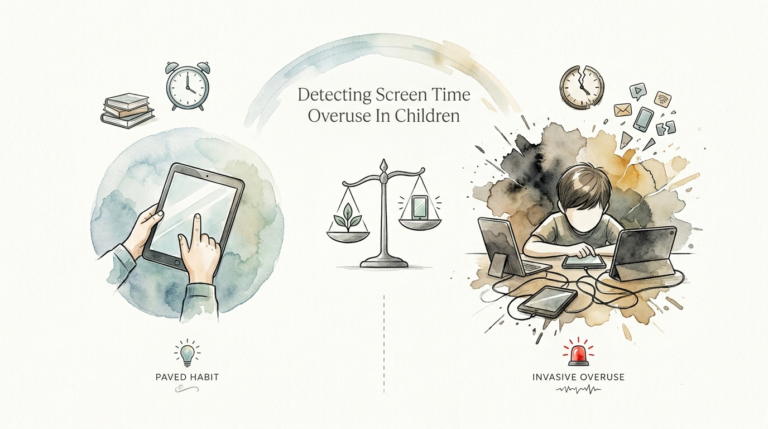
The Digital Distraction vs Focus Framework suggests that the problem isn’t the device itself; it is the friction caused by invisible rules. When expectations are verbal and fluid, they are easy to argue with. When they are printed, laminated, and stuck to the refrigerator, they become the law of the land. This shift moves you from the role of the “screen police” to the role of a mentor helping your child manage their most valuable resource: their attention.
A screen time printable acts as a physical contract. It bridges the gap between your desire for a balanced life and your child’s desire for digital entertainment. By creating a clear, visual path toward earning tech time, you remove the emotional weight of the “No” and replace it with a structured “Yes, once…”
screen time printable
A screen time printable is a visual tool, often a checklist or a token-based chart, designed to help children understand that digital entertainment is a privilege, not a baseline right. It exists to provide a clear structure for the day, ensuring that essential developmental needs—like physical movement, social interaction, and household responsibilities—are met before the tablets come out. In the real world, this is a simplified version of a work-reward system that adults use every day.
Think of it as a “Digital Diet” menu. Just as you wouldn’t let a child eat dessert for breakfast, lunch, and dinner, the printable ensures they get their “vegetables” (reading, chores, outdoor play) before they indulge in the “treat” of screen time. Research from 2026 indicates that the American Academy of Pediatrics (AAP) now emphasizes content quality and context over simple minute-counting. A printable allows you to categorize different types of tech use, distinguishing between educational “fruit and veg” and passive “candy” content.
These printables are used in millions of homes to stop the “nagging loop.” Instead of a child asking you if they can play a game, they simply look at the fridge. If the boxes aren’t checked, the answer is already there. It creates an environment where the child is in control of their own progress, fostering independence and reducing the daily power struggles that drain parental energy.
How to Implement Your Screen Time System
Setting up a screen time printable system requires a quick weekend “reset” to establish new habits. Start by defining what counts as “Must-Do” tasks. These are the non-negotiables that must happen every single day before any device is powered on. Common examples include making the bed, finishing homework, and spending 30 minutes playing outside. You want to keep this list short enough to be achievable but significant enough to feel like real effort was expended.
Next, decide on your “currency.” Some families prefer a simple checklist where completing all tasks unlocks a set block of time (e.g., 60 minutes). Other families use a token system where individual chores earn specific increments of time. For example, clearing the dinner table might earn 15 minutes, while reading a chapter of a book earns 20. This “Earned Asset” model is highly effective for older children who are starting to learn about time management and delayed gratification.
The final step is the “Handover.” When the child finishes their tasks, they bring the printable to you. You verify the work, and then—this is the crucial part—you hand over the device with a clear end time. Using a physical kitchen timer alongside the printable helps children visualize the passing of time, making the eventual transition away from the screen much smoother. Do not rely on the device’s internal clock; a ticking physical timer provides a sensory cue that the “reward phase” is concluding.
Step 1: Categorize the Chores
Divide tasks into daily maintenance and “bonus” opportunities. Daily maintenance keeps the house running and earns the baseline screen time. Bonus chores allow the child to “buy” extra minutes if they have a special event or a new game they are excited about. This teaches them that extra rewards require extra effort.
Step 2: Define Tech Zones
On your printable, clearly mark where screens are allowed. For instance, “Only in the living room” or “No screens in bedrooms.” This physical reminder prevents the device from migrating into private spaces where monitoring becomes difficult. Visual boundaries are often more powerful than verbal ones for younger children.
Step 3: The Lamination Hack
Print your chart and laminate it or put it in a cheap plastic frame. Use dry-erase markers so the child can physically check off the boxes every day. There is a psychological “hit” of satisfaction that comes from checking a box that helps reinforce the positive behavior loop. It makes the system feel permanent and official.
Benefits of a Visual Tracking System
The primary benefit of a screen time printable is the immediate reduction in household tension. When the rules are written down, you stop being the “bad guy.” If a child asks for the iPad and hasn’t brushed their teeth, you can simply point to the chart. The authority shifts from your mood to the established family system. This consistency is the foundation of emotional security for children.
Beyond peace and quiet, these systems build executive function. Children learn to prioritize tasks, manage their time, and understand the relationship between effort and reward. These are life skills that translate directly to academic success and future professional life. You are essentially training their brains to handle the dopamine hits of digital media by balancing them with the serotonin-building satisfaction of completing real-world goals.
Finally, a printable encourages a “content-first” mindset. By including a section on the printable for “What I am going to do on my screen,” you prompt the child to think about their digital time intentionally. Are they going to create a world in Minecraft, or are they just going to scroll aimlessly? Encouraging “Interactive Screen Time”—which involves engagement, creativity, or communication—helps them build digital literacy rather than just being passive consumers.
Challenges and Common Mistakes
One of the most frequent errors parents make is setting the bar too high. If the list of chores is so long that the child can’t possibly finish them before 5:00 PM, they will lose motivation and give up entirely. The goal is to create a “win” for the child. Start with easy wins to build their confidence in the system, then gradually increase the difficulty as the habit of checking the printable becomes second nature.
Inconsistency is another major pitfall. If you enforce the printable on Monday but let them have the tablet for three hours on Tuesday because you’re tired, the system collapses. Children are expert “loophole finders.” If they know the rules are flexible based on your energy levels, they will push those boundaries every single day. You must be prepared to stick to the printable even on the days when it would be easier to just hand over the phone.
Avoid using the printable as a punishment tool after the time has been earned. If a child earns 30 minutes of tech and then misbehaves, try to find a different consequence. If you take away “earned” time, the child learns that the system is unfair and that their hard work can be erased at your whim. This breaks the trust required for the “Earned Asset” model to work. Keep the screen time contract separate from other behavioral issues whenever possible.
Limitations and Environmental Constraints
A screen time printable is not a magic wand for all digital problems. It is significantly less effective for older teenagers who have their own smartphones and a higher need for social connectivity. For teens, a “Media Plan” that focuses on values and sleep hygiene is usually better than a chore-based checklist. The printable is most effective for the 5-to-12 age range, where parental oversight is still the primary driver of daily routines.
External factors can also complicate the system. If your child’s school requires heavy use of a laptop for homework, you cannot count that toward their “reward” time. This can be confusing for kids. You must clearly differentiate between “Tool Time” (schoolwork, coding, creative projects) and “Toy Time” (gaming, social media, entertainment videos). The printable should focus exclusively on “Toy Time” to avoid penalizing academic growth.
Physical space matters too. If your home is small and screens are always visible, the temptation will be constant. A printable works best when devices are stored out of sight in a “Charging Station” until they are earned. If the iPad is sitting on the kitchen counter while the child is trying to read their book for “points,” the distraction will often prove too great for their developing impulse control.
Printable vs. Monitoring Apps
Many parents wonder if they should use a physical printable or a digital monitoring app like Bark or Qustodio. While apps are excellent for safety filtering and hard-stops on usage, they don’t teach the same level of self-regulation as a printable. A table comparing these two approaches shows why a hybrid model is often the best choice for modern families.
| Feature | Screen Time Printable | Monitoring Apps |
|---|---|---|
| Skill Built | Self-regulation & Autonomy | Compliance & Safety |
| Visibility | Highly visible to the whole family | Hidden on the device |
| Negotiation | Reduces it through clear rules | Can lead to “hacking” attempts |
| Cost | Free (Price of paper/ink) | Monthly Subscription |
| Focus | Daily habits and chores | Content filtering and time caps |
Focusing on the printable for younger children helps them internalize the “Work before Play” logic. As they get older, you can phase out the printable and rely more on apps for safety, as the child will have already built the mental muscle needed to manage their own time. Use the printable to build the foundation, and the apps to provide the safety net.
Practical Tips for Success
To make your screen time printable stick, involve your children in the creation process. Ask them, “What chores do you think are fair to do before you get your tablet?” When kids feel like they have helped write the rules, they are much more likely to follow them. This gives them a sense of “buy-in” that is essential for long-term success. You might be surprised to find they are often stricter on themselves than you would be.
Use “Low-Dopamine” activities as the gateway to tech. Encourage them to do their reading or physical play right before their screen time. This makes the transition into the screen easy. However, the transition *out* of the screen is the hard part. Always include a “Transition Task” on your printable for after the screen time ends. This could be something simple like “Set the table for dinner” or “Feed the dog.” Having a specific job to do immediately after the screen turns off helps pull their brain out of the digital fog and back into the real world.
Don’t forget to lead by example. If your printable says “No screens at the table,” but you are checking your email during lunch, the system will lose all credibility. Consider having a “Parent Version” of the printable where you check off your own healthy habits. This shows the child that digital balance is a family value, not just a set of rules meant to control them. It builds a culture of “Digital Wellness” rather than a culture of restriction.
Advanced Considerations: The 2026 Quality Framework
As we move into a more AI-integrated world, the definition of screen time is changing. The latest research suggests that “Passive” vs “Active” use is the most important metric. On your printable, you might want to create different “rates” for different activities. For instance, 30 minutes of learning a language on an app might only “cost” 15 minutes of earned time, whereas 30 minutes of watching unboxing videos “costs” the full 30 minutes.
This nuanced approach helps children understand that not all digital time is created equal. It encourages them to choose “High-Quality” content that actually contributes to their growth. You are teaching them to be “Digital Chefs” who prepare a balanced meal of information, rather than “Digital Garbage Cans” who consume whatever the algorithm throws at them. This distinction is what separates a distracted child from a focused one.
Also, consider the “Dopamine Hangover.” Fast-paced, highly stimulating content—like short-form vertical videos—triggers massive dopamine releases. When the screen turns off, the “drop” can cause irritability and tantrums. Advanced practitioners of the printable system often ban “High-Stim” content on weekdays, allowing it only on weekends when there is more time for the brain to recalibrate. Use the printable to regulate the *intensity* of the digital experience, not just the duration.
Scenario: A Typical Saturday with the Printable
Imagine it is Saturday morning. Usually, the kids would be hovering over your bed at 6:30 AM asking for the remote. With the printable system in place, they know the remote doesn’t “work” until the checklist is done. They head downstairs, get their own cereal, put their bowls in the dishwasher, and get dressed. They might even head outside to jump on the trampoline for 20 minutes to check off their “Physical Activity” box.
By 9:00 AM, they bring you the chart. It is checked off. They have spent two hours being productive, active, and helpful. You hand over the device for their earned hour of play. Because they “paid” for that time with effort, they value it more. They aren’t just zoning out; they are enjoying a hard-earned reward. When the timer dings at 10:00 AM, there is no fight. They know the contract is fulfilled, and they move on to the next part of their day.
This scenario isn’t a fantasy; it is the reality for families who commit to a visual boundary. It shifts the energy of the home from “Can I have…?” to “Look what I did!” The focus is on the child’s achievement, not the parent’s restriction. This small shift in perspective changes the entire atmosphere of the household, replacing stress with a sense of shared accomplishment.
Final Thoughts
A screen time printable is more than just a piece of paper; it is a tool for building a healthier relationship with technology. By turning tech time into a reward for a job well done, you help your child develop the discipline they need to thrive in a world designed to distract them. You are giving them the gift of a “Visual Boundary,” which is the only thing that can truly compete with the siren call of the screen.
The transition might be rocky for the first few days, especially if your kids are used to unlimited access. Stick with it. The long-term benefits—better sleep, fewer tantrums, and a more helpful attitude—are worth the initial effort. Once the habit is established, the printable becomes a silent partner in your parenting, maintaining the peace while you focus on the more important parts of raising your family.
Start small, stay consistent, and watch as your home transforms. You might even find that as your children learn to manage their digital lives, you start to look at your own phone habits a little differently too. This journey toward digital focus is one the whole family can take together, one checked box at a time.
Sources
1 ccrcca.org | 2 choc.org | 3 childrenandscreens.org | 4 theincrementalmama.com | 5 teacherspayteachers.com | 6 thepragmaticparent.com | 7 bark.us | 8 yourmodernfamily.com | 9 timily.app | 10 healthychildren.org | 11 mamaofminis.com | 12 nurture.is | 13 daar.com.au | 14 mayoclinic.org | 15 mayoclinic.org | 16 mayoclinic.org