screen time schedule for kids
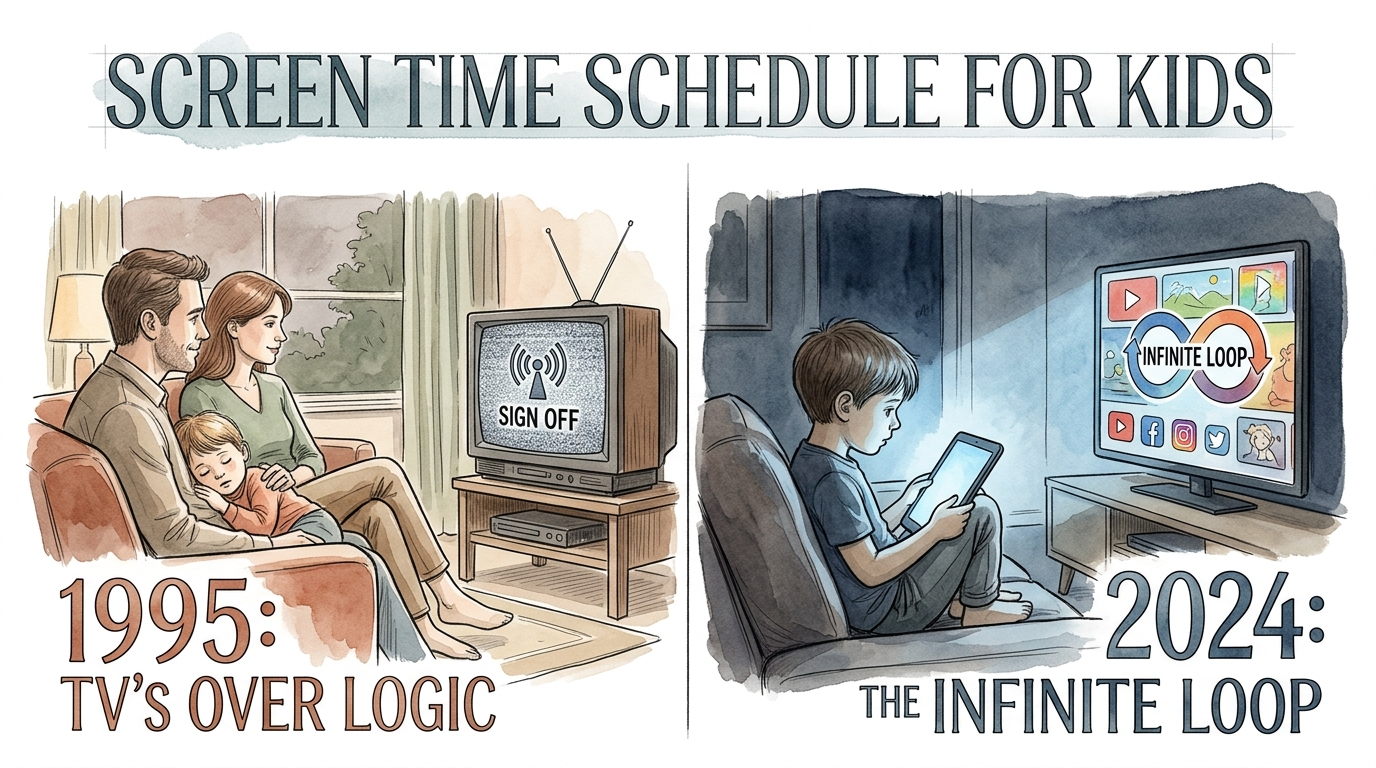
Technology changed the rules of the game. Your 2024 schedule needs to account for the ‘Infinite Scroll.’ In the 90s, the show just ended. Today, the algorithm is designed to never let them leave. You can’t just set a limit; you need a strategic schedule that breaks the dopamine loop.
You might remember the days when Saturday morning cartoons simply stopped. The screen went to static or shifted to the local news. The boundary was built into the technology itself. Modern parents are fighting a different beast. Silicon Valley engineers spend billions of dollars to ensure your child never finds a natural stopping point.
Managing digital consumption in 2024 is no longer about “turning off the TV.” It is about understanding neurobiology. It involves creating a framework that protects a developing brain from a world built for constant engagement. This guide will walk you through building a schedule that actually works in the age of TikTok, YouTube Shorts, and Roblox.
screen time schedule for kids
A screen time schedule for kids is a structured agreement that defines when, how, and why digital devices are used. In the current digital landscape, this is much more than a simple timer. It is a strategic tool designed to prevent “displacement”—the phenomenon where screens replace essential activities like sleep, physical movement, and face-to-face social interaction [1.1.2, 1.4.6].
Experts at the American Academy of Pediatrics (AAP) have shifted their focus in recent years. While they still suggest specific time limits for younger children, the latest guidance emphasizes the quality, context, and conversation surrounding media use [1.1.2, 1.1.3]. A modern schedule acknowledges that not all screen time is equal. A FaceTime call with grandma is fundamentally different from sixty minutes of passive scrolling on a short-form video app.
The primary goal of a modern schedule is to preserve the “digital ecosystem” of the home. This ecosystem ensures that devices serve the child, rather than the child serving the algorithm. Without a plan, children often fall into “dopamine-scrolling,” where they compulsively swipe for the next hit of novelty without ever feeling satisfied [1.2.1, 1.2.5]. A well-designed schedule provides the “stopping cues” that modern apps have intentionally removed.
How to Build a Strategic 2024 Schedule
Creating a schedule that survives the “infinite loop” requires a step-by-step approach. You cannot simply announce a new rule and expect it to stick. You must build a system that accounts for the psychological pull of modern devices.
1. Audit the Content Types
Classify every digital activity in your household. Not all minutes are created equal. Use three categories:
- Passive Consumption: Scrolling TikTok, watching YouTube Shorts, or mindless TV. This has the highest concern level [1.4.6, 1.5.2].
- Interactive/Creative: Building in Minecraft, coding in Scratch, or editing photos. These are moderate concern and can often have longer time blocks.
- Connection: Video calls with family or collaborative school projects. These are generally low concern [1.4.6].
2. The “First-Then” Logic
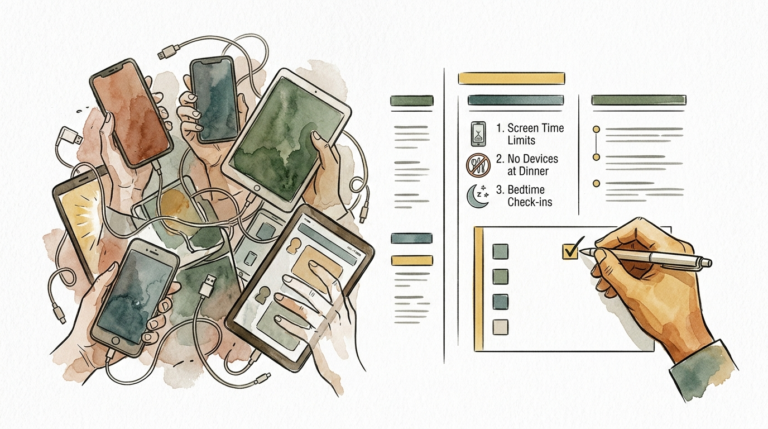
Structural cues are essential for a child’s developing prefrontal cortex, which handles impulse control [1.2.7]. Use a “First-Then” visual board. First, the child completes a non-digital task (chores, reading, or outdoor play). Then, they access their “earned” screen time [1.3.1, 1.3.6]. This teaches them that screens are a secondary activity, not the default state of existence.
3. Implement “Closed-Loop” Transitions
One of the biggest mistakes parents make is cutting off a “high-dopamine” activity (like an infinite scroll) abruptly. This often causes a “dopamine crash” meltdown [1.2.8]. Instead, schedule “closed-loop” activities toward the end of their time. These are games or shows with a definitive ending, like a single episode of a narrative show or a puzzle game with a “level complete” screen. These provide a natural psychological stopping point.
4. Set Hard “Digital Sunsets”
Blue light and high-energy content interfere with melatonin production. Most experts recommend removing all screens from bedrooms 30 to 60 minutes before bedtime [1.1.4, 1.4.4]. Your schedule should include a hard cutoff time where all devices go to a central “charging station” outside the bedroom.
Benefits of a Structured Digital Plan
Implementing a formal screen time schedule for kids provides measurable improvements in household harmony and child development. When the rules are clear and visual, the “parent-as-villain” dynamic begins to fade.
Reduced Power Struggles: Most meltdowns happen because of the “intermittent reinforcement” of the algorithm. When a child doesn’t know when the fun will end, they stay in a state of high arousal. A visual schedule acts as the “boss,” removing the personal conflict between parent and child [1.3.3, 1.3.5].
Protected Development: Excessive screen time is linked to delays in language and social skills, especially in younger children [1.1.5, 1.4.8]. A schedule ensures that “unstructured playtime”—which is significantly more valuable for a developing brain—is not crowded out by digital media [1.4.8].
Improved Sleep Hygiene: By enforcing a digital sunset, children’s brains have the time to settle into a “low-arousal” state. This leads to faster sleep onset and better sleep quality, which directly impacts academic performance and mood regulation [1.1.4, 1.4.4].
Increased Attention Span: Short-form videos (like TikTok or YouTube Shorts) are designed to provide rapid novelty. This “speeds up” the brain’s expectations, making real-world tasks feel boring by comparison [1.2.4, 1.5.2]. A schedule that limits these fast-paced “hits” helps preserve the child’s ability to focus on slower, deep-work tasks like reading or puzzles [1.5.4, 1.5.8].
Challenges and Common Mistakes
Building a perfect schedule is easy on paper but difficult in practice. Many parents fall into traps that inadvertently strengthen the dopamine loop rather than breaking it.
Using Screens as a “Tantrum Stopper”
One of the most frequent errors is using a tablet to calm a child down during a meltdown. While it works in the short term, it teaches the child’s brain that intense emotional outbursts result in a high-dopamine reward [1.1.4]. This prevents them from learning how to self-regulate or sit with “boring” emotions [1.4.7].
Ignoring the “Infinite Scroll” Design
Assuming that “one hour” of YouTube is the same as “one hour” of a movie is a mistake. Algorithms on platforms like YouTube use autoplay and personalized recommendations to keep the child in a “flow state” of consumption [1.2.3, 1.5.2]. A child finishing a 90-minute movie has a clear psychological completion point. A child finishing 90 minutes of Shorts is often in a state of hyper-arousal and will struggle much more to disconnect [1.5.5].
The “Total Ban” Backfire
Strictly banning all devices often leads to “closet scrolling” or social isolation as children get older. Digital media is a primary tool for connection for adolescents [1.1.6]. The goal should be “balanced screen use” rather than total abstinence, focusing on helping the child develop their own “internal timer” [1.1.8, 1.4.2].
Limitations and Realistic Constraints
While a schedule is a powerful tool, it is not a silver bullet. There are environmental and developmental factors that can limit the effectiveness of even the best plan.
Age-Dependent Self-Regulation: The prefrontal cortex—the brain’s “brake” system—does not finish developing until the mid-20s [1.2.7]. You cannot expect a 7-year-old to follow a schedule independently. For younger children, the schedule is a parental management tool. For teens, it is a collaborative framework.
Educational Overlap: In 2024, the line between “schoolwork” and “leisure” is blurred. Many schools require tablets or laptops for homework. Counting these hours toward a “leisure” limit can lead to frustration. Your schedule must differentiate between “required” digital time and “recreational” time [1.4.2].
Parental Modeling: A schedule will rarely work if parents are constantly “dopamine-scrolling” in front of their children. Kids are biologically wired to mimic their caregivers. If the adults in the room cannot put their phones down during mealtimes, the children will view the schedule as an unfair double standard rather than a health-based family value [1.1.2, 1.4.5].
TV logic (1995) vs. The Infinite Loop (2024)
Understanding the technical shift is key to staying motivated. The world has changed, and our parenting strategies must change with it.
| Feature | 1995: “TV’s Over” Logic | 2024: The Infinite Loop |
|---|---|---|
| Stopping Cues | Natural breaks (commercials, end of show). | Autoplay, infinite scroll, no end point [1.2.5, 1.5.2]. |
| Content Selection | Limited by the “TV Guide” and schedule. | Hyper-personalized AI algorithms [1.2.2, 1.2.3]. |
| Reinforcement | Fixed schedule (Wait until next week). | Variable reward schedule (Like a slot machine) [1.2.1, 1.2.3]. |
| Pacing | Standard narrative speeds. | Short-form (15-60s) high-arousal clips [1.5.3, 1.5.5]. |
Practical Tips and Best Practices
Start small and be consistent. The goal is to build long-term digital literacy, not to win a single afternoon’s battle.
- Use Physical Timers: A physical kitchen timer or a “Time Timer” (which shows a red disappearing disk) is much more effective than a phone notification. It provides a visual representation of time passing that children can see from across the room.
- Leverage Built-in Controls: Use Apple’s Screen Time or Google’s Family Link to set “Downtime” where apps become inaccessible after a certain hour [1.4.9]. This automates the enforcement and removes the parent from the immediate conflict.
- Focus on “Displacement”: Don’t just ask “how much time?” Ask “what did this replace?” [1.4.6]. If your child has had 2 hours of screens but also spent 3 hours outside and finished their chores, the situation is different than if they skipped a meal to play a game.
- Curate a “Low-Dopamine” Menu: Not all apps are “brain rot.” Encourage “closed-loop” games like Monument Valley, Townscaper, or creative tools like Toca Life World [1.2.8]. These allow for creativity without the endless “hit” of a social feed.
- Establish Device-Free Zones: Make the dining table and the car “no-phone zones” [1.1.2, 1.1.4]. This encourages conversation and lets the brain “de-stimulate” during transitions.
Advanced Considerations: The Neurobiology of the “Scroll”
For those looking to understand the deeper “why” behind these schedules, we have to look at the brain’s reward system. The neurotransmitter dopamine is often misunderstood as the “pleasure” chemical. In reality, it is the “more” chemical—it is about anticipation and craving [1.2.8, 1.2.9].
When a child uses a platform with “infinite scroll,” the brain is subjected to a “variable ratio reinforcement schedule.” This is the same psychological principle that makes slot machines addictive. Because the user never knows when the “best” video will appear, the brain remains in a state of constant craving. This repeated stimulation can cause the nucleus accumbens—the reward center—to become desensitized [1.2.7].
Over time, this desensitization means that “slower” real-world activities (like reading a book or playing with blocks) no longer provide enough stimulation to satisfy the child. They may become irritable, restless, or “foggy”—a state often referred to by Gen Z as “brain rot” [1.2.4, 1.5.5]. A strategic schedule isn’t just about limiting minutes; it is about protecting the brain’s baseline sensitivity to normal, healthy rewards.
Age-Specific Scenarios
How you implement these rules depends entirely on the developmental stage of the child.
The Toddler Strategy (Ages 2-5)
Focus on co-viewing. The AAP recommends limiting recreational screen time to about one hour per day of high-quality, non-violent content for this age group [1.1.5, 1.4.3]. Break this into two 30-minute sessions. Sit with them and talk about what is happening on the screen. This turns a passive activity into a language-building opportunity [1.1.2, 1.4.8].
The Elementary Framework (Ages 6-12)
Introduce the “Earned Time” system. Link digital access to completed responsibilities. For example, 30 minutes of reading equals 30 minutes of gaming [1.3.3]. Use a “Screen Time Flow Chart” that they can follow independently to see if they are “eligible” for devices [1.3.1]. This is a critical age for building the habit of “work before play.”
The Adolescent Collaboration (Ages 13+)
Transition from “rules” to “values.” At this age, teens use screens for identity formation and social connection [1.1.6, 1.5.3]. Instead of a hard timer, focus on a “Digital Wellness” agreement. Discuss the impact of algorithms and the importance of sleep. Focus on the “5 C’s”: Child, Content, Context, Connection, and Crowding Out [1.4.7].
Final Thoughts
Technology changed the rules of the game, and the old parenting playbooks no longer apply. A screen time schedule for kids in 2024 is not a punishment. It is a necessary piece of mental health infrastructure. By understanding the “infinite scroll” and the dopamine loops engineered into modern apps, you can move from a state of constant conflict to one of strategic management.
Success does not mean a perfect record of zero minutes over the limit. It means creating a home where screens have a place, but they don’t take up the whole room. Focus on quality, protect sleep at all costs, and stay consistent. Your child’s brain—and your own sanity—will thank you for it.
Experiments with different systems, like token charts or visual flowcharts, can help you find what fits your family’s unique rhythm. The goal is to raise a “digital citizen” who knows how to use a tool without being used by it. Deepening your understanding of parental control settings and educational content options will only make your schedule more effective as your children grow.
Sources
1 jfcs.org | 2 thejacobsladdergroup.org | 3 choc.org | 4 screenwiseapp.com | 5 drlookai.ai | 6 youtube.com | 7 commonwealthpeds.com | 8 365daysofnoscreens.com | 9 sevendaysvt.com | 10 childmind.org | 11 aacap.org | 12 forbes.com | 13 raisingdigitalcitizens.com | 14 mayoclinic.org