no phone summer essentials
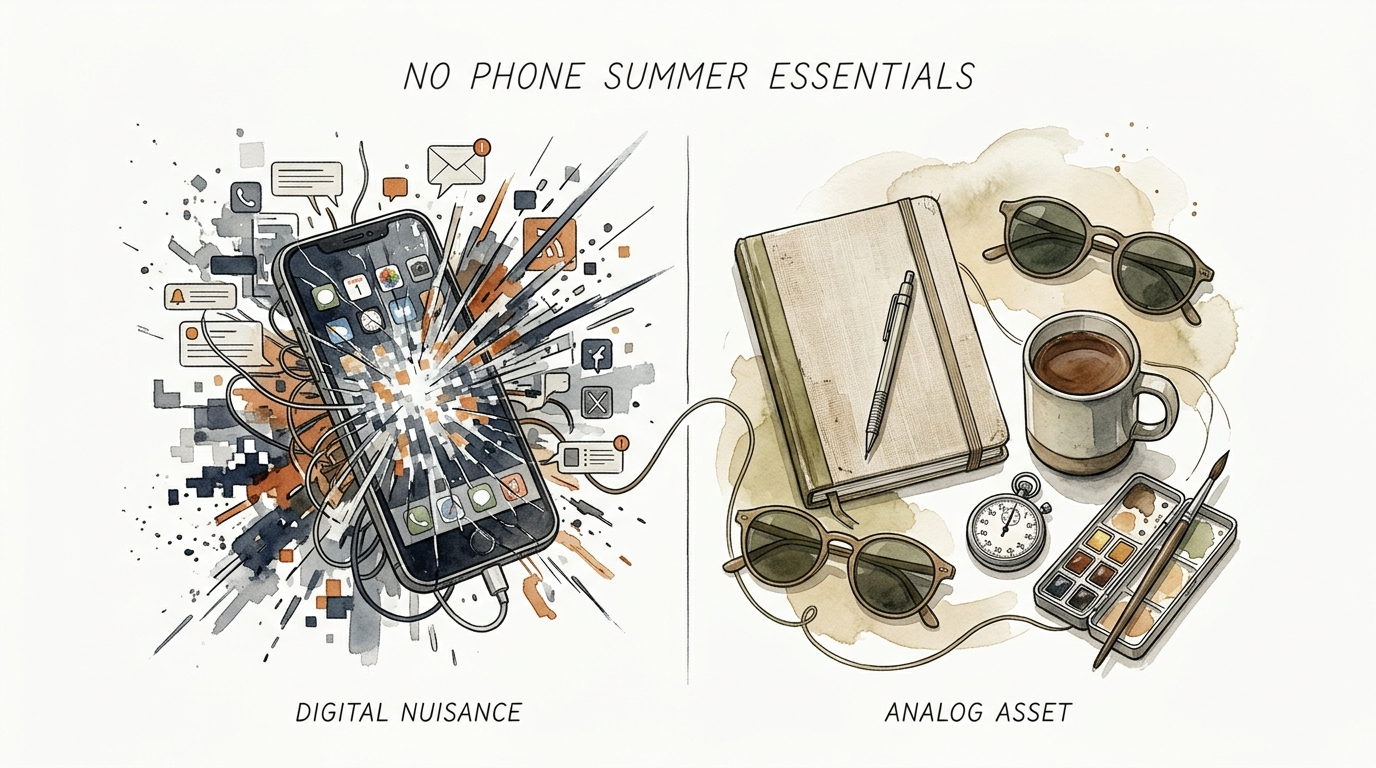
Is your phone a tool or a tether? Swap the noise for these timeless essentials. Constant notifications are a nuisance to your peace of mind. Switch to ‘assets’ that help you navigate the real world, not the digital one. #GearGuide #AnalogLife
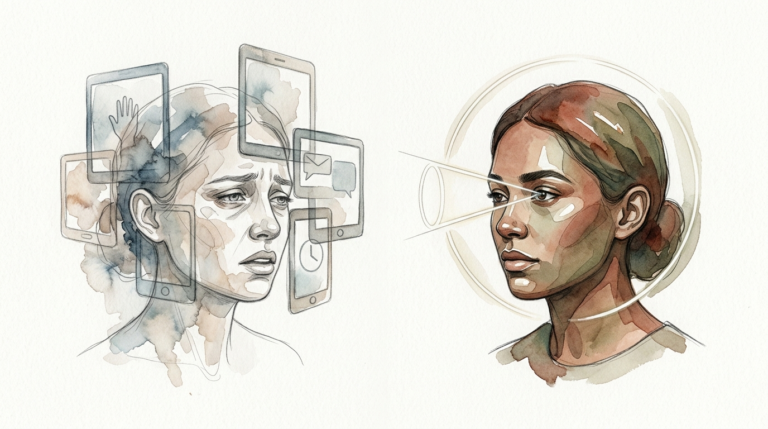
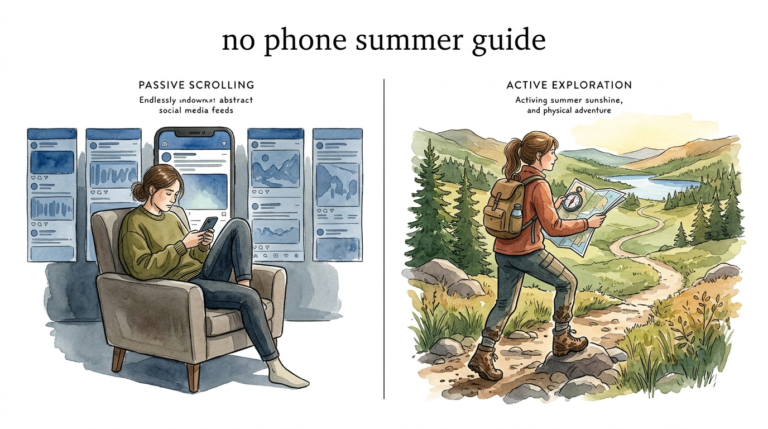
Have you ever looked up from your screen only to realize you’ve lost forty minutes to an algorithm? That feeling of digital exhaustion is exactly why people are turning toward a more tactile way of living. Summer offers the perfect backdrop to reclaim your attention and rediscover the physical world.
This guide explores how to swap high-stress digital pings for high-value analog experiences. We are talking about a shift from being a passive consumer to an active participant in your own life. This isn’t about becoming a hermit; it’s about choosing tools that serve you without demanding your soul in return.
Practicality is the focus here. Moving away from a smartphone doesn’t have to mean being lost or unreachable. It means using specific, intentional gear to fill the gaps that your phone usually occupies.
no phone summer essentials
The concept of “no phone summer essentials” refers to a curated set of analog tools designed to replace the core functions of a smartphone during the warmer months. This movement, often called digital minimalism, encourages people to step away from the infinite scroll and return to single-purpose devices.
Think of it as an “analog stack.” In the past, we carried a camera for photos, a map for directions, and a watch for time. Smartphones consolidated these into one pocket-sized distraction machine. Reversing this process allows you to enjoy the function of the tool without the side effect of digital addiction.
Real-world usage usually starts at the beach, on a hiking trail, or during a weekend getaway. Instead of checking emails while waiting for a sunset, you might use a film camera to capture one frame or a paper map to plot your next stop. These essentials exist to bridge the gap between complete isolation and total connectivity.
Examples of these essentials include minimalist “dumbphones,” mechanical watches, physical journals, and dedicated music players. These items perform their tasks exceptionally well but lack the ability to pull you into a dopamine loop of social media notifications.
Building Your Analog Stack: How to Do It
Transitioning to a screen-free or reduced-screen lifestyle requires a tactical approach. You cannot simply leave your phone at home without preparing for the logistical gaps it leaves behind. Follow these steps to build a system that works for you.
Establish your communication baseline first. If you need to stay reachable for emergencies, consider a minimalist device like the Light Phone III or the Sunbeam F1 Pro. These devices offer calling and texting without the web browser or social media apps that cause “doomscrolling.”
Address your navigation needs next. Buy a high-quality physical atlas or local topographic maps for your area. Learning to orient a map—matching the paper to the world around you—is a foundational skill that increases your environmental awareness. Use “handrailing,” which involves following physical landmarks like rivers or paths, to keep your bearings.
Source a dedicated device for media and memories. A high-resolution digital audio player (DAP) like the Activo P1 allows you to take your music offline without a Spotify subscription. For photos, pick up a point-and-shoot film camera or a basic digital camera. This forces you to be intentional with your shots rather than taking hundreds of photos you will never look at again.
Create a “phone parking” station in your home. This is a physical tray or lockbox, like the Stolp Faraday box, where your phone lives when you aren’t using it for a specific task. Establishing this physical boundary helps break the muscle memory of reaching for your device.
Core Benefits of the Unplugged Life
Choosing analog assets over digital nuisances provides measurable improvements to your mental and physical health. Studies show that even small reductions in screen time can significantly improve attention spans and sleep quality.
One primary advantage is the recovery of “deep focus.” When you aren’t being interrupted by pings, your brain can enter a flow state more easily. This applies to reading a physical book, practicing a craft, or even just having a conversation.
You will also experience a heightened sense of presence. Without a lens between you and the scenery, your brain processes experiences more deeply. This often leads to better long-term memory of events because you were fully engaged with your senses rather than preoccupied with how the moment would look on a social feed.
Reduced anxiety is another observable benefit. The “Fear Of Missing Out” (FOMO) is often fueled by the constant stream of updates from others. Removing the stream removes the pressure to compare your life to a curated digital highlight reel.
Finally, you gain a sense of autonomy. Carrying a paper map or a mechanical watch makes you the master of your tools. You aren’t dependent on a cloud-based service or a battery that might die before the day is over.
Challenges and Common Pitfalls
The road to a phone-free summer is paved with old habits and modern inconveniences. Understanding these pitfalls will help you navigate them without giving up.
The “phantom vibration” syndrome is a real phenomenon where you feel your pocket buzzing even when the phone isn’t there. This is a sign of deep neural wiring that takes time to undo. Don’t be discouraged if you find yourself reaching for a non-existent phone several times a day.
Digital gatekeeping is a significant logistical hurdle. Many modern venues, like concert halls or sports stadiums, require digital tickets. Some parking meters only accept payment through specific apps. Ignoring these realities can lead to frustration.
Social pressure often catches people off guard. Friends and family may get annoyed if you don’t respond to a group chat immediately. It is important to communicate your intentions to your inner circle so they know why you are “going dark” and how to reach you in a true emergency.
Realistic Limitations: When Tech is Necessary
A balanced understanding of digital minimalism acknowledges that sometimes, the analog version just isn’t safe or practical. Pushing for 100% “off-grid” living in a city designed for 100% “on-grid” humans can be dangerous.
Safety is the biggest constraint. If you are solo hiking in remote terrain, a satellite messenger like the Garmin InReach is a vital piece of gear. It provides emergency communication that a paper map cannot. In this case, the tech is an asset, not a nuisance.
Work requirements may also create boundaries. If your job involves “on-call” shifts, you cannot simply disappear. The solution here is to use a secondary, restricted device that only allows work-related communication.
Navigation in entirely unfamiliar, high-traffic urban environments can be another limitation. While paper maps work for general directions, they don’t provide real-time data on road closures or public transit delays. In these specific scenarios, a brief check of a GPS is more efficient than getting lost for hours.
Digital Nuisance vs Analog Asset
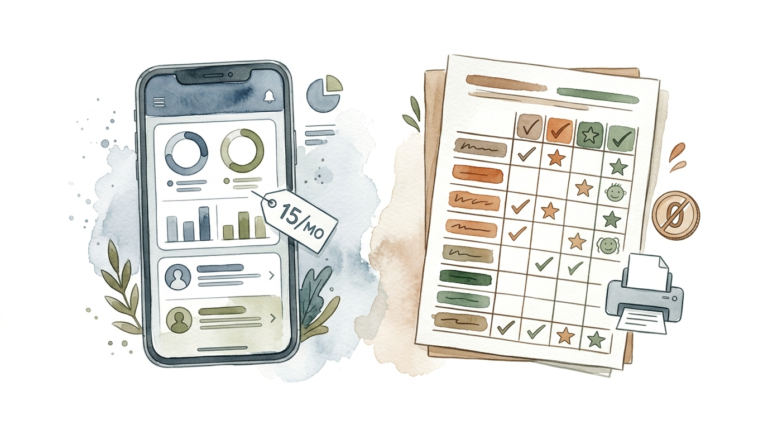
Comparing the two approaches helps clarify why the “no phone” essentials are worth the investment. Focus on how these factors change your daily experience.
| Factor | Digital Nuisance (Smartphone) | Analog Asset (Traditional Gear) |
|---|---|---|
| Cost | High (Monthly data, subscriptions, $1000+ hardware) | One-time purchase (Manual gear lasts decades) |
| Attention | Fragmented (Constant interruptions) | Focused (Single-purpose use) |
| Complexity | Low to start, but high maintenance (Updates, charging) | High to learn (Map reading, film) but low maintenance |
| Privacy | None (Tracking, data mining) | Absolute (No digital footprint) |
| Durability | Fragile (Glass screens, battery degredation) | Robust (Often weather-proof or mechanical) |
Practical Tips for a Screen-Free Season
You don’t have to throw your phone in a lake to see results. Apply these best practices to slowly reclaim your time.
- The Saturday Unplug: Designate one day a week where the phone stays in a drawer. Use this day to test your analog gear and see where your system needs improvement.
- Grayscale Mode: If you must keep your phone with you, turn the screen to grayscale. This removes the “eye candy” effect and makes the device significantly less appealing to look at.
- Notification Audit: Disable every single notification that isn’t from a real human being. You don’t need to know that a random person liked a photo or that an app is having a sale.
- Physical Alarm Clock: Stop using your phone as an alarm. Keeping it out of the bedroom prevents the “wake up and scroll” habit that ruins the first hour of your day.
- Paper Notebook: Carry a small pocket notebook. Use it for to-do lists, grocery lists, and quick thoughts. This replaces the “Notes” app and keeps you away from your screen.
Advanced Considerations for Practitioners
For those who want to go deeper into digital minimalism, the focus shifts from gear to philosophy. This is where you begin to restructure your life around the “Attention Economy” concepts pioneered by authors like Cal Newport.
Consider the “Digital Declutter.” This involves a 30-day period where you remove all non-essential technology from your life. At the end of the month, you only reintroduce tools that provide massive, tangible value. You treat your attention as a finite resource that must be guarded.
Advanced practitioners often invest in high-end analog gear that improves over time. This might include a fountain pen that molds to your writing style or a mechanical watch that can be passed down for generations. The goal is to surround yourself with objects that have “weight” and history, contrasting the disposable nature of modern tech.
Scaling this lifestyle to a family requires even more intention. Creating “No Tech Zones” in the house or using tools like the Aro box—which gamifies time spent away from phones—can help build a collective culture of presence.
Scenario: The Ultimate Phone-Free Beach Day
Imagine a Saturday in July. Instead of checking the weather on your phone, you step outside and look at the sky. You pack a bag with a physical book, a film camera with one roll of 36 exposures, and a printed map of the coastal trail.
You drive to the trailhead. Because you don’t have a GPS constantly re-calculating, you pay closer attention to the road signs. You find the parking lot and realize you’ve noticed three new landmarks you usually miss.
On the beach, you aren’t tempted to take a selfie or check your “likes.” You read twenty pages of your book without stopping to check a text. When a beautiful wave breaks, you take one photo with your film camera. You don’t know if it’s perfect yet, and that’s okay—you’re too busy watching the next wave.
By the time you get home, you feel refreshed rather than drained. You haven’t seen a single ad or news headline. You have lived an entire day in the real world, and your brain is quiet.
Final Thoughts
The “no phone summer essentials” movement is more than just a trend; it is a necessary correction to a world that has become too loud. By choosing to carry analog assets, you are making a radical claim on your own attention. You are deciding that the world in front of you is more interesting than the world inside your pocket.
Start small by replacing one digital habit with an analog tool. Maybe it’s a physical watch today, and a paper map next weekend. The goal isn’t perfection; it’s the pursuit of a life that feels more intentional and less reactive.
Experiment with these tools and see how your perspective shifts. You might find that once you stop looking down, there is a whole lot more to see. Dive into the analog world and discover what it means to be truly connected.
Sources
1 bulletproof.com | 2 freedom.to | 3 reddit.com | 4 substack.com | 5 the-gadgeteer.com | 6 georgetown.edu | 7 androidcentral.com | 8 youtube.com | 9 youtube.com | 10 thesuperiorliving.com | 11 reddit.com | 12 hifiwalker.com | 13 socialmediapsychology.eu | 14 medium.com | 15 womansworld.com