Child Emotional Resilience Screen Time
Does your child need a ‘level up’ sound to feel successful, or can they find joy in the effort itself?
Overuse isn’t just about time; it’s about the source of their self-worth. If they can only handle tasks that provide instant digital feedback, their resilience is tethered to an algorithm. Real-world success is quiet, slow, and un-pingable.
Many parents today feel like they are fighting a losing battle against the “ping.” We see the frustration when the Wi-Fi drops or the iPad time expires. It feels like a personality shift. It feels like the “off” switch on the device is also the “off” switch for their emotional regulation.
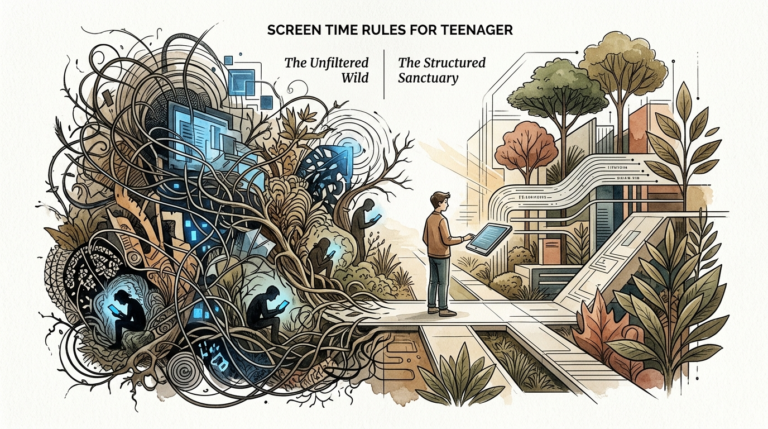
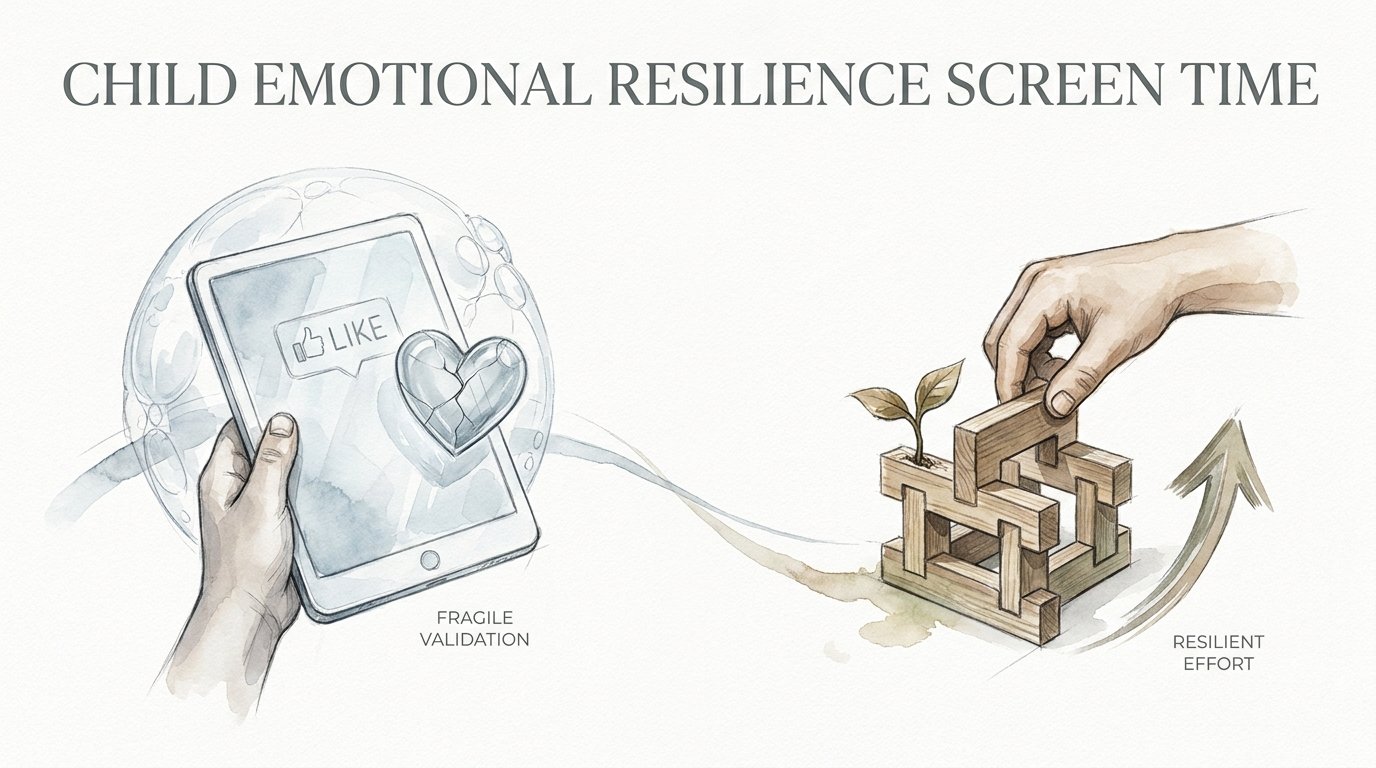
This isn’t your imagination. It is neurobiology in action. We are witnessing a shift from **FRAGILE VALIDATION**—where self-worth comes from external digital metrics—to a world where **RESILIENT EFFORT** is becoming a rare and valuable skill.
Building a child who can thrive without a constant stream of digital rewards is one of the most important tasks of modern parenting. It requires understanding how screens change the way a brain processes “winning.”
Child Emotional Resilience Screen Time
Child emotional resilience screen time refers to the relationship between digital consumption and a child’s ability to “bounce back” from real-world challenges. Resilience is the mental muscle that allows a child to handle a “no,” survive a boring afternoon, or work through a difficult math problem without a meltdown.
In a digital environment, feedback is near-instant. If a child makes a mistake in a game, they respawn in seconds. If they want entertainment, they swipe. This creates a feedback loop of constant, high-speed success. Real life doesn’t work this way. Real life involves “lag.” It involves effort without immediate rewards.
When screen time dominates a child’s day, they may experience a thinning of the brain’s cortex—the area responsible for critical thinking and reasoning. This makes it physically harder for them to stay calm when things get tough. They become “digitally fragile,” meaning their emotional stability is dependent on the next “level up” sound or notification.
This concept is used by pediatricians and child psychologists to explain why some children seem increasingly “brittle.” These children are often highly skilled at complex digital tasks but struggle with the basic emotional labor of waiting their turn or losing a board game.
How the Digital Reward System Works
The brain’s reward system is powered by dopamine. Every time a child hears a “ding,” sees a bright color, or gains a virtual coin, their brain releases a small hit of this chemical. This reinforces the behavior, making them want to stay on the device.
Digital platforms are designed using “variable reward systems,” similar to slot machines. This keeps the brain in a state of high arousal. Over time, this constant stimulation can desensitize the reward system. The child begins to need more and more stimulation just to feel “normal.”
Contrast this with the “grit” required for real-world tasks. Building a Lego set or learning to ride a bike provides dopamine too, but the “hits” are spaced much further apart. The child has to endure frustration and boredom before they reach the reward.
When a child’s brain is conditioned for the 1:1 reward ratio of a tablet, the 1:100 ratio of the real world feels physically painful. This is why transitions away from screens are often so explosive. Their brain is literally crashing from a high-dopamine state.
Benefits of Balancing Digital Input
Reducing reliance on digital validation doesn’t just stop meltdowns; it builds a more capable human. When children have “screen-free” space, they develop what experts call **RESILIENT EFFORT**.
One major advantage is the development of a growth mindset. In a balanced environment, children learn that skill comes from persistence, not just from tapping a button. They become more comfortable with “productive struggle,” which is the sweet spot where learning actually happens.
Another benefit is improved executive function. This includes the ability to plan, focus, and multitask. Because screens often do the “thinking” for the child—directing their eyes and telling them what to do next—off-screen time forces the brain to take the driver’s seat.
Finally, balance preserves the “space for boredom.” Boredom is the birthplace of creativity. When a child is bored, their brain enters the “Default Mode Network,” which is where they process social interactions, imagine the future, and solve problems creatively.
Challenges and Common Mistakes
The most common mistake is the “cold turkey” approach without a replacement plan. If you take away the dopamine source but don’t provide a way for the child to build internal rewards, you are left with a vacuum. This usually leads to power struggles and secret device use.
Another pitfall is using screen time as a “pacifier” for emotional distress. If a child gets a tablet every time they are upset in a restaurant, they never learn the vital skill of self-regulation. They learn that the “cure” for a bad mood is a digital distraction.
Many parents also fall into the trap of “educational” screen time guilt. Just because an app claims to be educational doesn’t mean it isn’t using the same addictive feedback loops. A digital math game can still contribute to “fragile validation” if it relies on constant flashy rewards rather than the joy of solving the problem.
Failing to model the behavior is the final major hurdle. If a parent is constantly checking their phone for notifications, they are signaling that “the ping” is the most important thing in the room. Resilience is caught, not just taught.
Limitations and Constraints
It is important to recognize that screen time is not the only factor in resilience. Genetics, trauma, and neurodiversity (such as ADHD or Autism) play massive roles. For some neurodivergent children, screens can actually be a necessary tool for regulation or communication.
Environmental constraints also matter. A family living in a small apartment during a cold winter with no safe outdoor space will naturally rely more on digital tools. In these cases, the focus shouldn’t be on “zero screens” but on high-quality, interactive content.
We also have to acknowledge that the world is now digital. Schools, social groups, and future jobs all require digital literacy. We cannot raise children in a vacuum. The goal is “digital health,” not “digital abstinence.”
Total bans can sometimes backfire by making the “forbidden fruit” even more attractive. This can lead to a lack of transparency between parent and child, which is more dangerous for emotional health than the screens themselves.
Fragile Validation vs. Resilient Effort
Understanding the difference between these two states is the key to long-term emotional health.
| Feature | Fragile Validation (Digital) | Resilient Effort (Real World) |
|---|---|---|
| Reward Speed | Instantaneous / Milliseconds | Delayed / Minutes to Hours |
| Source of Worth | External (Likes, Levels, Pings) | Internal (Pride, Mastery, Growth) |
| Reaction to Failure | Frustration / Immediate Quit | Curiosity / “Try Again” Mindset |
| Brain Arousal | High / Stressful Excitement | Steady / Calm Focus |
| Sustainability | Low (Requires more for same hit) | High (Builds long-term grit) |
Practical Tips for Parents
Building resilience starts with “scaffolding” the offline experience. You cannot expect a child to go from a high-octane video game to reading a silent book in five minutes. You need a transition phase.
1. Use the “Boredom Gap” Strategy: When the screen goes off, don’t immediately suggest an activity. Let them be bored for 10 minutes. This is the time it takes for their brain to shift gears. This is where the “itch” for a device lives, and sitting through it is a resilience exercise.
2. Prioritize “Un-pingable” Hobbies: Encourage activities that have no digital component. Gardening, painting, woodworking, or even washing the car. These tasks have a clear beginning, middle, and end, but no “level up” sounds.
3. Practice “Scaffolded Failure”: Play games together where losing is possible. Don’t always let them win. Model how to be a “good loser” and explain that the fun was in the playing, not just the score.
4. Set a “Digital Sunset”: Turn off screens at least 60 minutes before bed. The blue light from tablets suppresses melatonin and keeps the brain in a high-arousal state, making emotional regulation the next day much harder.
Advanced Considerations: The Neurobiology of Grit
For those who want to go deeper, we have to look at the **Caudate Nucleus** and the **Anterior Cingulate Gyrus**. These areas of the brain handle reward processing and emotional control.
Research shows that excessive gaming can actually reduce activity in the caudate nucleus. This means the child’s brain literally “dims” its response to normal rewards. To fix this, the brain needs “dopamine fasting”—extended periods of time without high-intensity digital input to let the receptors reset.
Furthermore, resilience is linked to “Anti-fragility.” This concept, popularized by Nassim Taleb, suggests that some systems—like the human spirit—actually *need* stress to grow. Like a muscle that needs resistance to get stronger, a child’s emotional system needs small, manageable “stresses” (like losing a game or waiting for a treat) to become robust.
If we remove all friction from a child’s life via digital shortcuts, we are inadvertently making them more fragile. We aren’t protecting them from stress; we are depriving them of the “resistance training” they need to survive the real world.
Scenario: The Puzzle vs. The App
Imagine two children, Leo and Sam.
Leo is playing a “Sorting App.” He drags a virtual square into a virtual hole. When he succeeds, a star explodes, a chime plays, and he gets 500 “XP.” If he misses, the square just snaps back perfectly. He does this 50 times in two minutes.
Sam is doing a physical 50-piece jigsaw puzzle. He tries a piece. It doesn’t fit. He has to turn it, look at the color, and try again. He might spend three minutes on a single piece. There is no sound. No stars. Just the quiet click of cardboard.
When Sam finishes, his reward is the completed picture. His “dopamine hit” is the result of 20 minutes of sustained effort. If you tell both boys it’s time for dinner, who is more likely to have a meltdown?
Sam is already in a state of “Steady Focus.” Leo is in a state of “High Arousal.” Sam has been practicing resilience for 20 minutes. Leo has been practicing “Fragile Validation.” The way we spend our minutes determines the strength of our minds.
Final Thoughts
The goal isn’t to demonize technology, but to reclaim the source of our children’s success. If a child’s confidence is “algorithm-dependent,” it will always be at risk. True resilience is found in the “quiet, slow, and un-pingable” moments of life.
By intentionally creating space for effort without instant rewards, we give our children a massive competitive advantage. We give them the gift of a brain that can focus, a heart that can handle disappointment, and a spirit that finds joy in the work itself.
Start small. Find one “un-pingable” activity this week. Let them be bored. Let them struggle. And watch as they level up in the only game that truly matters: the real world.
Sources
1 nurture.is | 2 nyp.org | 3 potsdam.edu | 4 psychologytoday.com | 5 ncsu.edu | 6 tanagerplace.org | 7 harvard.edu | 8 psychologytoday.com | 9 medium.com | 10 psych.on.ca | 11 myhspediatrics.com | 12 psychcaretherapy.com | 13 thejacobsladdergroup.org | 14 nih.gov | 15 jjresourcecreations.com | 16 rochester.edu